On this page
Most small teams should start with live chat, add an AI that answers from their help center second, and make sure there is a clear road from one to the other. Skip any of the three and the chatbot vs live chat question gets expensive: either you pay people to answer "what are your hours" forty times a day, or a bot keeps customers away from the one person who could have helped.
That's the short version. The long version depends on what you sell, how many questions repeat, and what time of day your customers write. This guide separates the three things people mean by "chatbot", shows where each approach breaks, prices the options for a small team with the arithmetic, and ends with a decision by business shape.
"Chatbot" means three different things
Half the confusion in this debate comes from one word covering three products.
| What it is | Good at | Breaks when | |
|---|---|---|---|
| Flow bot (rule-based) | Buttons and menus you design in advance: "Pick an option" | Predictable paths such as booking, order lookup, lead capture | A customer asks something your tree doesn't have a branch for |
| AI agent answering from your docs | An AI that reads your published help content and answers in plain language | Repeat questions, around the clock, in the customer's language | Your docs are thin, wrong or out of date |
| Live chat | A person typing in the same widget | Judgment, exceptions, upset customers, sales | Nights and weekends, spikes, and anyone repeating answers all day |
Many tools now blend them: a human team with AI help in the background, or an AI front line with humans behind it. Talvo is the second and third in one inbox. It is not a flow bot. It has no button-and-menu builder for visitors; its workflows automate your inbox, not a decision tree the visitor clicks through. If you want guided flows, that's a gap.
Where a chatbot breaks
A bot's failures are not random. They come in four recognizable kinds.
The confident wrong answer. A bot that guesses is worse than no bot, because the customer believes it. The fix isn't a smarter model, it's a rule: answer only from content you've published, show which article the answer came from, and say "I'm not sure" instead of improvising. That is how Talvo's AI works, and how a knowledge base chatbot stays honest covers the mechanics.
The loop with no exit. A flow bot keeps offering the same three buttons, and the customer can't find a person. This one does the most damage to trust. Five9's 2026 Consumer CX Report, an online survey of 3,000 consumers in the US, UK and Germany run with Hanover Research in April 2026, found that trust in AI to resolve an issue was 55% when a human option was reachable and 26% when it wasn't, and that 92% give AI less than 10 minutes before asking for a person (Five9, 2026 Consumer CX Report). It's a vendor-run, self-reported survey, and the 55 versus 26 is a pattern in answers, not a tested effect. But the direction is hard to argue with: people tolerate a bot they can get out of.
The account-specific question. "Where's my order?" and "Why was I charged twice?" need data about one person. An answer-from-docs AI can explain your refund policy. It can't see that customer's invoice. These belong with a human.
The upset customer. A cheerful bot answering an angry message makes things worse. Some situations need a person, quickly, with no templates.
Where live chat breaks
Humans fail in different places, mostly around time and boredom.
Nobody's there at 9:40 on a Saturday night. A customer writes, finds no one, and opens another tab. If you don't cover nights and weekends, that's a real share of lost questions; the after-hours guide shows how to find out how many with your own data.
Repeat questions eat the team. If the same five questions make up half the volume, you are paying a person to be a slow FAQ page. And queue spikes, after a launch or an outage, turn a two-minute reply into a two-hour one. Speed targets are a people problem as much as a process problem; first response time SLAs has the staffing arithmetic.
What customers say they want
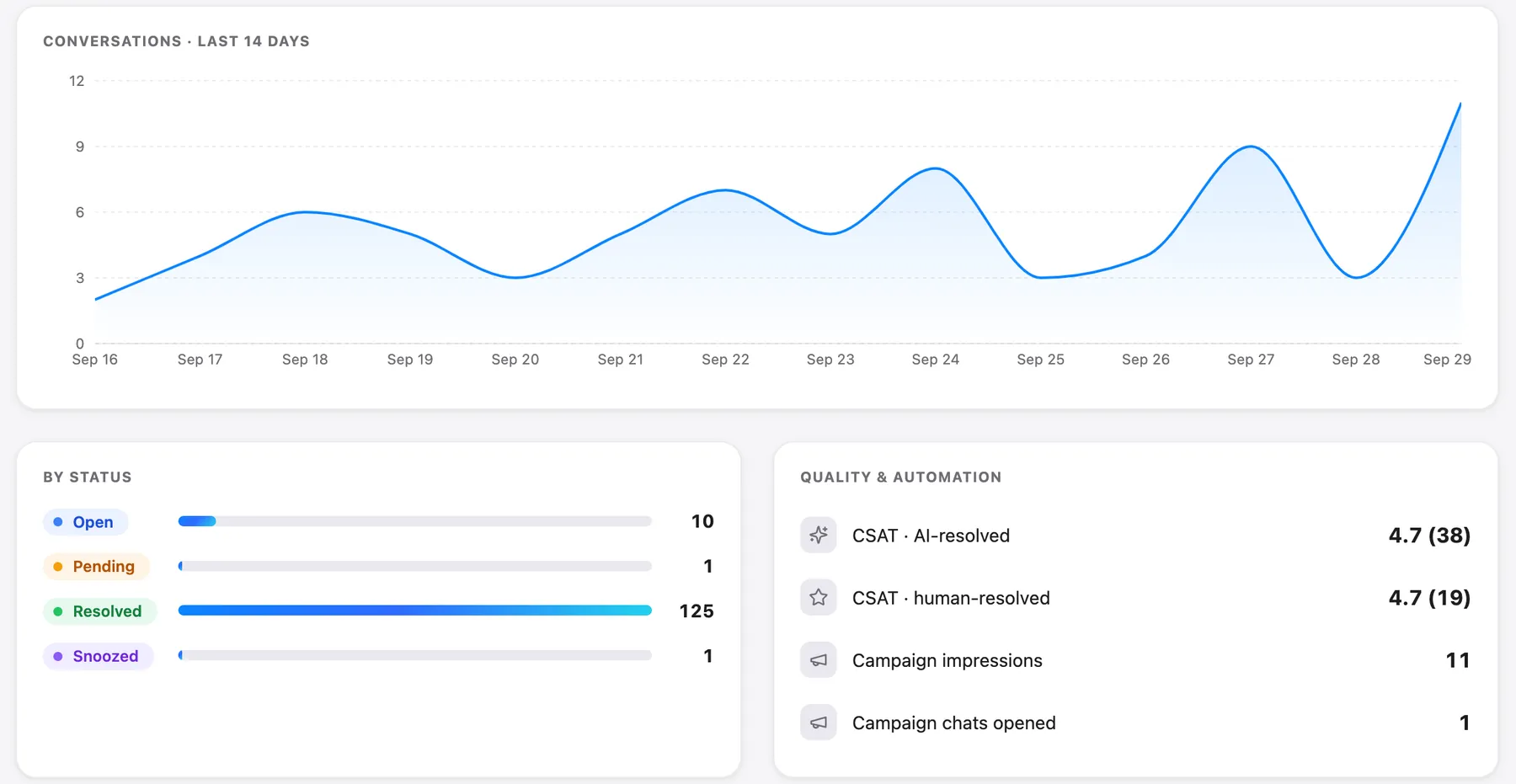
The most consistent finding is not "bots" or "humans". It's "I want to be able to reach a person". The Five9 numbers above point that way, and your own CSAT will tell you the rest. In Talvo's analytics overview, average CSAT is split between AI-resolved and human-resolved conversations, so you can see whether customers who got an AI answer were happier or less happy than those who got a person. Do that for a month before you decide anything.
What each costs a small team per month
Honest numbers need assumptions, and these are ours. Replace them with yours.
Live chat costs people-time. If a typical chat takes five minutes of real work (our assumption; time 20 of your own), then 400 conversations a month is 400 × 5 ÷ 60 = 33.3 hours, and at an assumed $25 an hour fully loaded that is about $833. An AI that fully resolves those conversations doesn't make that money vanish, because you still employ the people. It frees their hours for work that needs judgment, or lets you avoid the next hire.
Talvo prices the AI per resolution: a conversation the AI answered end to end from your published articles, without a teammate stepping in. A hand-off to a human isn't a resolution and isn't billed. The rule we use for the table is the lowest total among plans with enough teammate seats: plan price plus any resolutions above the included amount at $0.49 each. Plans include 100 (Starter, $49), 500 (Growth, $149) or 2,000 (Scale, $299) resolutions a month, with 5, 15 and 25 teammates; annual billing makes them $39, $119 and $249 a month.
| Your team | AI resolutions a month | Cheapest plan, monthly billing | Cheapest plan, annual billing | Human time those replace (5 min each) |
|---|---|---|---|---|
| 2 people | 50 | Starter: $49 (50 is under the 100 included) | Starter: $39 | 4.2 hours |
| 3 people | 400 | Growth: $149 (400 is under the 500 included). Starter would be $49 + 300 × $0.49 = $196 | Growth: $119. Starter would be $39 + $147 = $186 | 33.3 hours |
| 6 people | 1,200 | Scale: $299 (1,200 is under the 2,000 included). Growth would be $149 + 700 × $0.49 = $492 | Scale: $249. Growth would be $119 + $343 = $462 | 100 hours |
Two things to read from it. First, the cost of the AI is small next to the hours it covers ($149 against roughly $833 of time in the 400-conversation row), as long as it actually resolves conversations. Second, it only resolves what your articles can answer; that is why AI resolution rate is a number to measure, not assume. AI resolution pricing compares how other tools bill the same thing.
On Talvo's Free plan, the AI agent gets 25 resolutions a month during the beta, and when that runs out new chats wait for a human. There's no overage billing there. On paid plans there is no spending cap; the control you have is turning the AI off.
Decision by business shape
Your situation matters more than the average.
Low volume, high value, such as a contractor, clinic or consultancy. A handful of chats a day, each worth real money. Live chat first, and treat the AI as an after-hours catcher. Customers here often want a person, and the cost of a wrong bot answer is high. Live chat for service businesses goes deeper.
Repetitive volume, such as ecommerce or SaaS. If most questions are "where's my order", "how do I reset my password" and "do you ship to X", an answer-from-docs AI pays back quickly, provided the docs are good. Write the help articles first. Writing help articles for AI is the unglamorous 80% of the result.
Heavy after-hours demand. Customers in other time zones, or a product used at night. The AI answers around the clock, while your human team keeps business hours and an away message. That is the single strongest case for adding an AI before adding a person.
Regulated or sensitive. Health, finance, legal, safety. Keep a person in front for anything that needs judgment or involves personal data, and use the AI only for general information from approved articles. Be clear with yourself about what a wrong answer costs.
Very low volume. If only a few chats arrive each week, you may need neither a bot nor a fancy tool. A chat widget and an inbox, answered quickly, will do. See best live chat software for small business.
The hand-off, in one paragraph
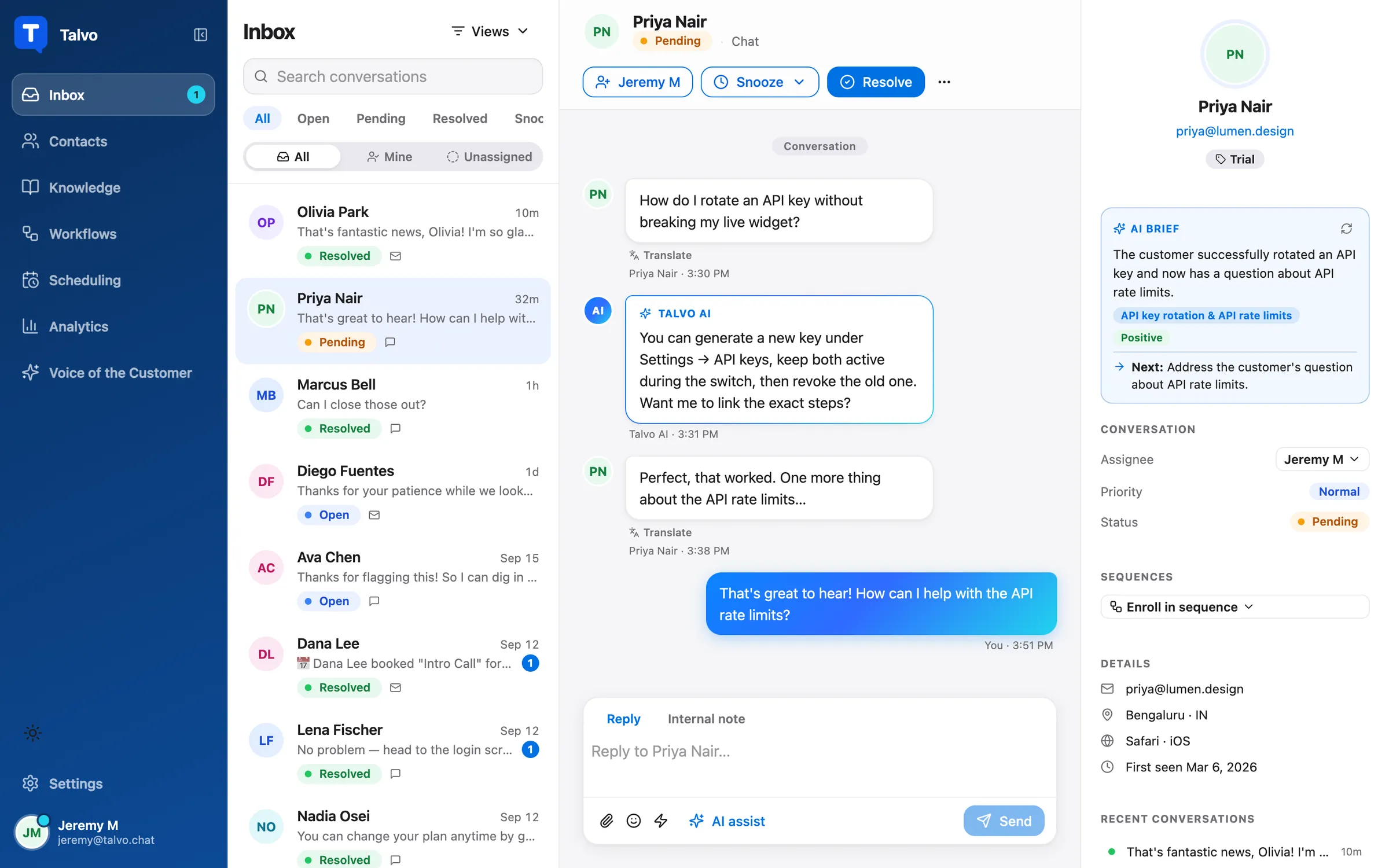
Everything above depends on what happens when the AI gets stuck. In Talvo, the AI hands off when the published articles don't contain enough to answer confidently, when there are no published articles, or when the AI call fails. The customer is told the team will follow up, and the team gets an internal note and an alert. Once a teammate replies, the AI stops answering that conversation. The full mechanics are in AI-to-human hand-off.
One gap you should know about: Talvo's widget has no "talk to a person" button. A customer who types "can I talk to a person?" will in practice end up in a hand-off, because the question isn't answerable from your articles, but that is not a dedicated rule. Given the Five9 numbers, you should compensate. Use the welcome message in the widget settings (up to 240 characters) to say what the customer is talking to and what happens next, and make sure your away message gives a real time for a human reply.
Setting up both in Talvo
The setup for "both" is mostly one afternoon of article writing.
- Install the widgetPaste one script tag before the closing body tag (guide). Live chat, email and the inbox work on every plan, including Free.
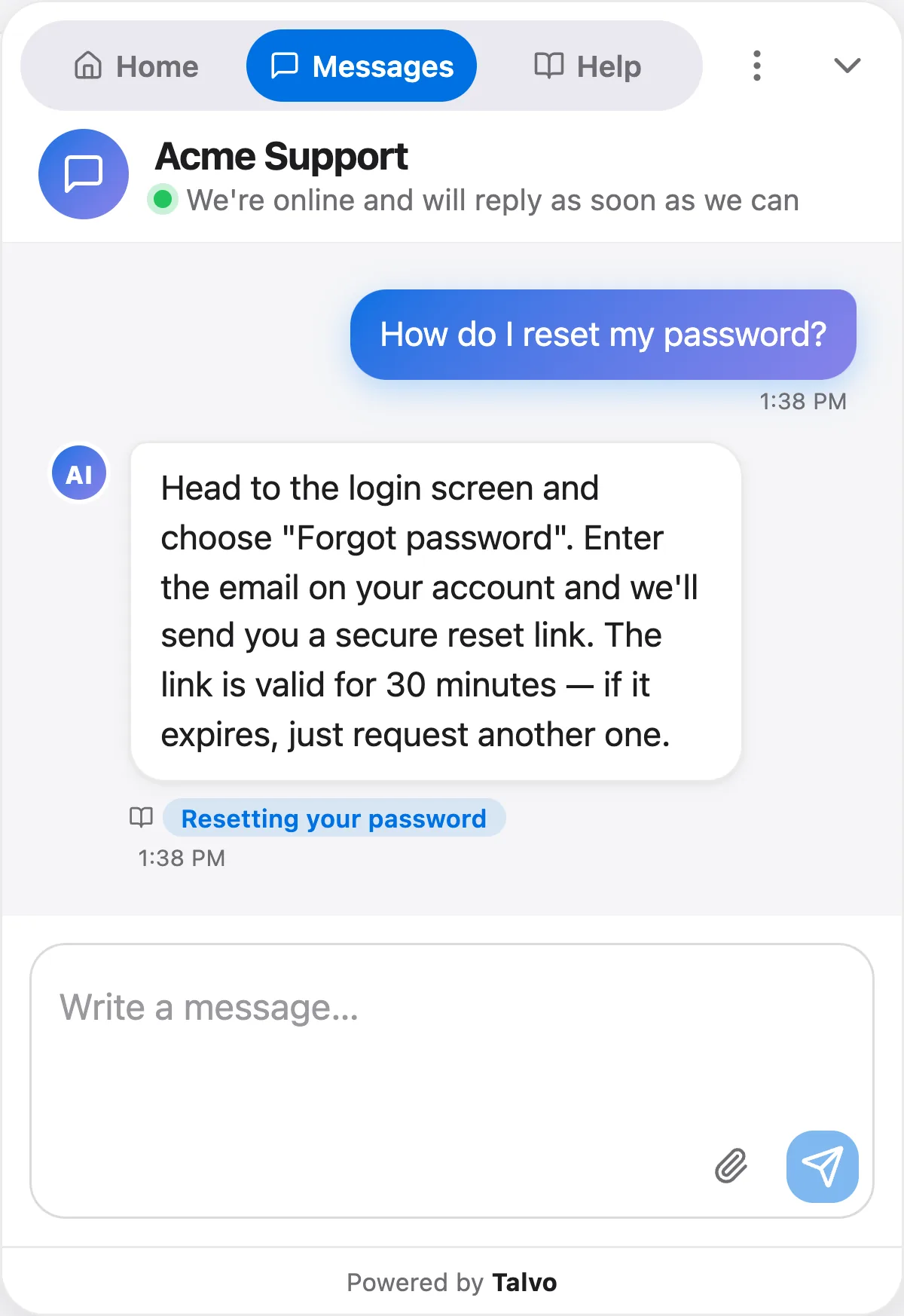
- Publish the answersWrite or import the articles for your top questions. The AI answers only from published articles, and shows which one it used.
- Turn on the AI agentIt's on Starter and up; Free gets 25 resolutions a month during the beta. See how AI auto-resolve works.
- Set hours and the away messageSettings → Inbox → Business hours. The AI still answers outside business hours; the widget shows your away message.
- Say what the customer is talking toWrite a welcome title and message that names the assistant and promises a human follow-up.
- Your top ten questions each have a published article
- You know who covers a hand-off, and by when
- The welcome message tells customers a person will follow up
- You have a way to compare CSAT for AI-resolved and human-resolved chats
- Nobody on the team expects the AI to handle refunds or account-specific questions
Limits, plainly. Talvo has no flow-bot builder, no WhatsApp, SMS or phone, and its AI performance dashboard and hand-off funnel are on the Scale plan only. It's new and in beta, with no customer reviews yet. And an AI answer doesn't stop the response-time clock; if the AI hands off, the customer is still waiting for a human, and the clock keeps running.
Frequently asked questions
What is the difference between a chatbot and live chat?
Live chat means a person types the replies in the chat widget. A chatbot is software answering instead, either from fixed menus and rules or, with an AI agent, in plain language from your help content. Many tools combine them, with the AI first and a human behind it.
Is a chatbot cheaper than live chat?
Per conversation, usually yes, but it only counts when the bot truly resolves the question. At Talvo's list prices a 3-person team with 400 AI resolutions a month pays $149 on monthly billing, and a hand-off to a person isn't billed. The saving is real only to the extent your articles can answer the questions.
Do customers prefer chatbots or humans?
They prefer being able to reach a person. In Five9's 2026 survey of 3,000 consumers, trust in AI to resolve an issue was 55% when a human option was reachable and 26% when it wasn't, and 92% give AI less than 10 minutes before asking for a person. Those are self-reported answers, not a tested effect.
Can a chatbot replace live chat agents?
For repeat questions with clear answers, an AI can take much of the load, particularly outside business hours. It can't replace judgment on exceptions, account-specific problems, upset customers or sales. Most small teams use it to free people's time, not to remove the people.
What questions should never go to a chatbot?
Anything specific to one customer's account or money, such as a double charge, plus refunds outside policy, legal or safety issues, and angry messages. A bot that answers only from published articles should hand these off rather than guess.
Should I start with a chatbot or live chat?
Start with live chat and an inbox so you learn what customers actually ask. Add an AI agent once your top questions have published answers. If much of your demand arrives at night, add the AI sooner.
What is the difference between a rule-based chatbot and an AI chatbot?
A rule-based bot follows paths you design in advance, such as buttons and menus, and fails when a customer goes off the path. An AI chatbot reads the question in plain language and answers from content you give it. Talvo's AI is the second kind, answers only from published articles and has no flow builder.
Can chatbots handle complex questions?
Only to the extent the answer is in your content. A grounded AI can handle a detailed question your articles cover, and it should hand off when they don't. Complex questions that depend on a customer's own data or on judgment belong with a person.
Sources
Other products' prices and features change. We checked these pages; if something is out of date, tell us and we'll fix it.