On this page
- The Salesforce acquisition of Fin: what's confirmed and where each fact comes from
- What this changes today, and what it probably doesn't
- Read your contract for five things
- Questions for your account rep
- Multi-year deals and renewal timing
- Export your data while nothing is on fire
- Signs it's time to look at alternatives
- How to test a switch without disrupting support
- Where Talvo fits, briefly
- A calm plan for the next 90 days
- Frequently asked questions
If you pay for Intercom, three things happened to your vendor this year. It renamed itself Fin in May 2026. On June 15 Salesforce announced a definitive agreement to buy it for about $3.6 billion. And on September 10 Salesforce published a release saying the acquisition is complete. The helpdesk is still called Intercom, the bill still arrives, and as of October 21, 2026 neither Salesforce nor Fin has published anything about pricing or plan changes for customers.
So this isn't a post about panic. Nothing public says your price is going up or your product is going away. It's a post about using the quiet window well: reading your contract, knowing your renewal date, getting your data in a form you could move, and asking the questions that only get easy answers before you sign something long. One disclosure: Talvo makes a competing product and gets a short, labeled mention near the end.
The Salesforce acquisition of Fin: what's confirmed and where each fact comes from
Here is what we could verify, with sources, as of October 21, 2026.
The rename. On May 12, 2026 the company that made Intercom began calling itself Fin, after its AI agent. "Intercom" stays as the name of the helpdesk product. This is reported by trade press (CX Today); we didn't find a primary announcement to cite. Intercom's own pricing page still reads "Intercom helpdesk plans with Fin AI Agent," and the site is still intercom.com.
The agreement. On June 15, 2026 Salesforce announced it had signed a definitive agreement to acquire Fin, "formerly Intercom," for approximately $3.6 billion, subject to customary purchase price adjustments. It said the deal was expected to close in the fourth quarter of Salesforce's fiscal 2027 and cited closing conditions including regulatory clearances. It also said Fin's packaged offerings and models would "complement" Agentforce, Salesforce's agent platform, and that they'd give service teams "fast time-to-value options especially well-suited for SMB and some commercial organizations that need to launch quickly."
Pending, then complete. Salesforce's 10-Q for the quarter ended July 31, 2026 described the deal as pending regulatory approval. Then a Salesforce release dated September 10, 2026 said Salesforce "has completed its acquisition of Fin, formerly Intercom," and that Fin will join Salesforce AI Labs. That puts the close well ahead of the original timeline. Some articles you'll find still call the deal pending; they predate the release.
What the releases say about customers. Very little. The completion release says Fin "will continue to serve its customers" and that Fin's agent works with the help desks and systems companies already use. The release doesn't mention pricing, and it doesn't say whether the Intercom helpdesk name will continue, change or be folded into something else. Neither release gives a product roadmap.
What this changes today, and what it probably doesn't
For a customer on a current subscription, today's practical change is close to zero. Your plan, your seats and your Fin usage work as before, and the price list on the pricing page was the one we describe in our Intercom pricing breakdown when we read it. Your contract is with the same legal entity unless Intercom has told you otherwise, which is the first thing to check in your own paperwork.
What changes is the uncertainty premium. A vendor that was independent is now part of a company with its own priorities, product lines and sales motions. That doesn't mean worse. Some customers will see more investment, tighter integration with Salesforce and a bigger sales organization behind the product. Others will see pricing packaged differently, a reorganized account team or a roadmap that points toward Salesforce customers first. We can't tell you which, and neither can anyone else yet.
The responsible response is to keep your options open for the next few renewals, without doing anything dramatic.
Read your contract for five things
Most self-serve Intercom plans run month to month or annual, and downgrades usually take effect at renewal. If that's you, you have fewer exposures than a company on a multi-year order form, but it's still worth ten minutes. Contracts for Premier Support, onboarding or custom terms are the ones to read slowly.
Look for the renewal mechanics first: the term, whether it auto-renews, and the notice period for cancelling or changing seat counts. Notice windows of 30, 60 or 90 days are common in software generally, and missing one is how a "we'll decide later" turns into another year. Put the date, minus the notice period, on a calendar.
Then pricing protection. Is the rate you pay locked for the term, or does it reset at renewal? If you're on the new-customer promo that has been shown on Essential ($19 per seat annual, $29 monthly at the time of writing), find out in writing how long it lasts, because the pricing page doesn't say. A Capterra review we found cited an outdated rate showing up at renewal; that's one anecdote, but it's the kind of surprise a written price term prevents.
Third, the Fin terms. Fin bills $0.99 per outcome, and any minimum monthly commitment and the definition of an outcome should be in your order form, not just on a web page that can change. See our breakdown of what counts as an outcome if your invoices don't match your sense of "resolved."
Fourth, assignment and change-of-control language. A contract that was signed with one company can have clauses about what happens when that company is acquired. After a close, those clauses are mostly academic, but a new order form is the moment to ask for the terms you want.
Fifth, data. Look at the data processing addendum and the list of subprocessors, and whether you've agreed to notices when they change.
Questions for your account rep
You can send these in an email, which leaves a record. They're framed as questions because they don't have public answers.
Will my current pricing and plan structure stay in place through my renewal, and for how long? Can you put that in the order form? Is the Intercom helpdesk being renamed, merged or retired, and is there a published support timeline for it? Will my customer data be shared with or accessible to Salesforce, and are there any changes to the data processing terms or subprocessors? Does the acquisition change who I contact for support, and are any support terms changing? If I sign for more than one year, what price protections apply, and what are my options if the product changes materially? Is there a customer notice process for changes to the plans or the definition of a Fin outcome?
A good answer is specific and written. "Nothing's changing" is a reasonable thing for a rep to say, and a better thing for them to say in a contract.
Multi-year deals and renewal timing
The single decision where this matters most is length of commitment. There's a real case for signing longer: it can lock your current price and Fin rate while the future is unclear. There's also a real case against: if the product, packaging or pricing shifts after you sign, you're committed to the old terms for a new reality.
If you're being offered a discount for going multi-year, ask what protections come with it. A price lock for a term is worth something. A discount with no right to adjust seats or exit if the product changes materially is a bet. When in doubt, annual is a reasonable middle: it keeps most of the discount, and it keeps you within a year of a clean decision. On Essential that annual discount is $10 a seat per month ($29 vs $39).
If your renewal is within about 90 days, start now. If it's farther off, you still have time, but the data-export work below is worth doing regardless.
Export your data while nothing is on fire
Do this whether or not you ever leave. A backup you didn't need beats one you did.
Plan to capture three things: your help center articles, your contacts, and your conversation history. Articles matter most, because they're what any AI agent answers from, and they move easily. Contacts and attributes matter next. Conversation history is the hardest to carry between tools, and many teams decide only to keep an archive.
We haven't verified which export formats Intercom offers for each, so look in your workspace settings or ask Intercom's support what's available, and confirm what's included before you rely on it. Do a test export now and open the files, rather than discovering gaps in the month you need them.
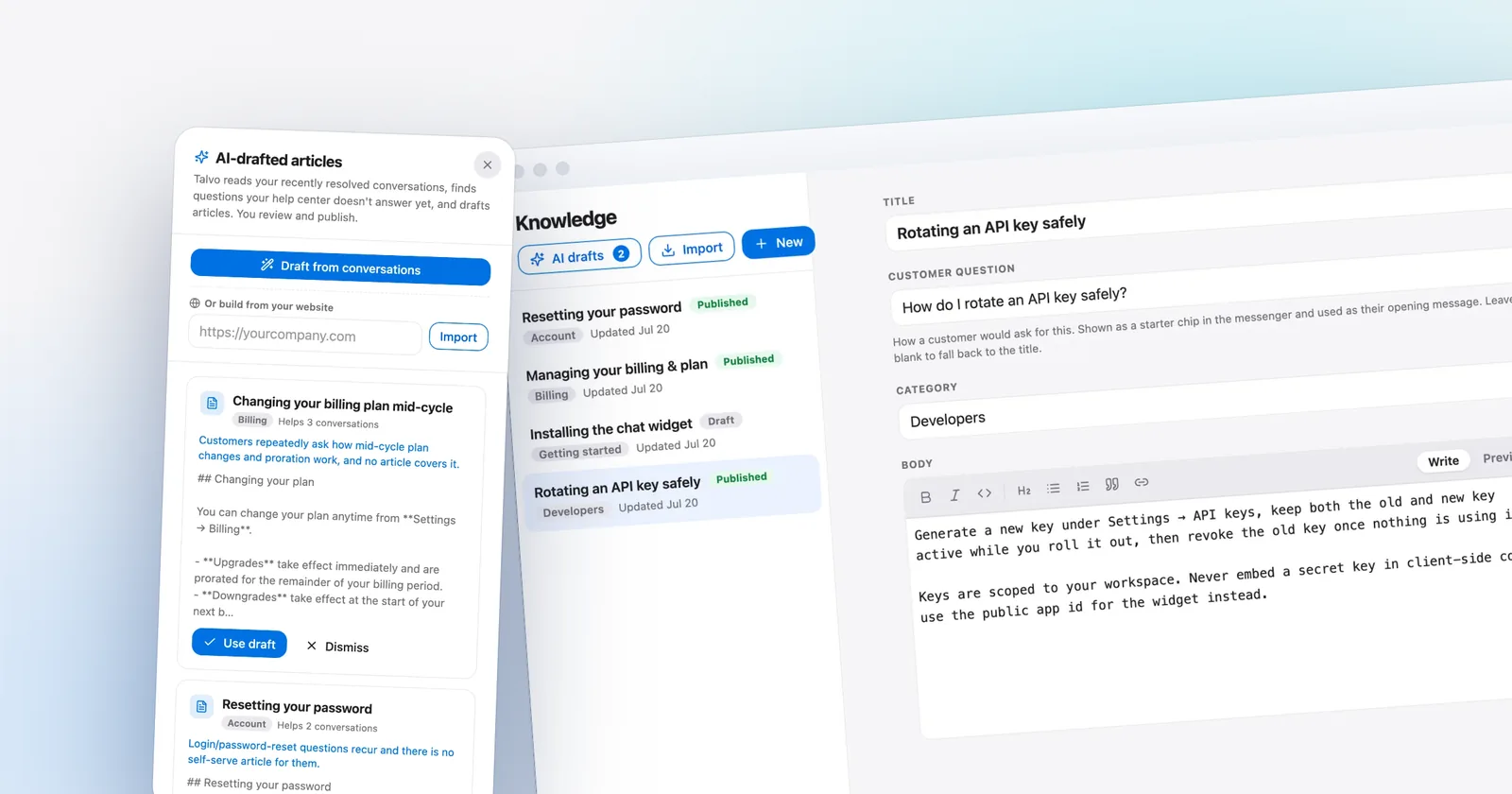
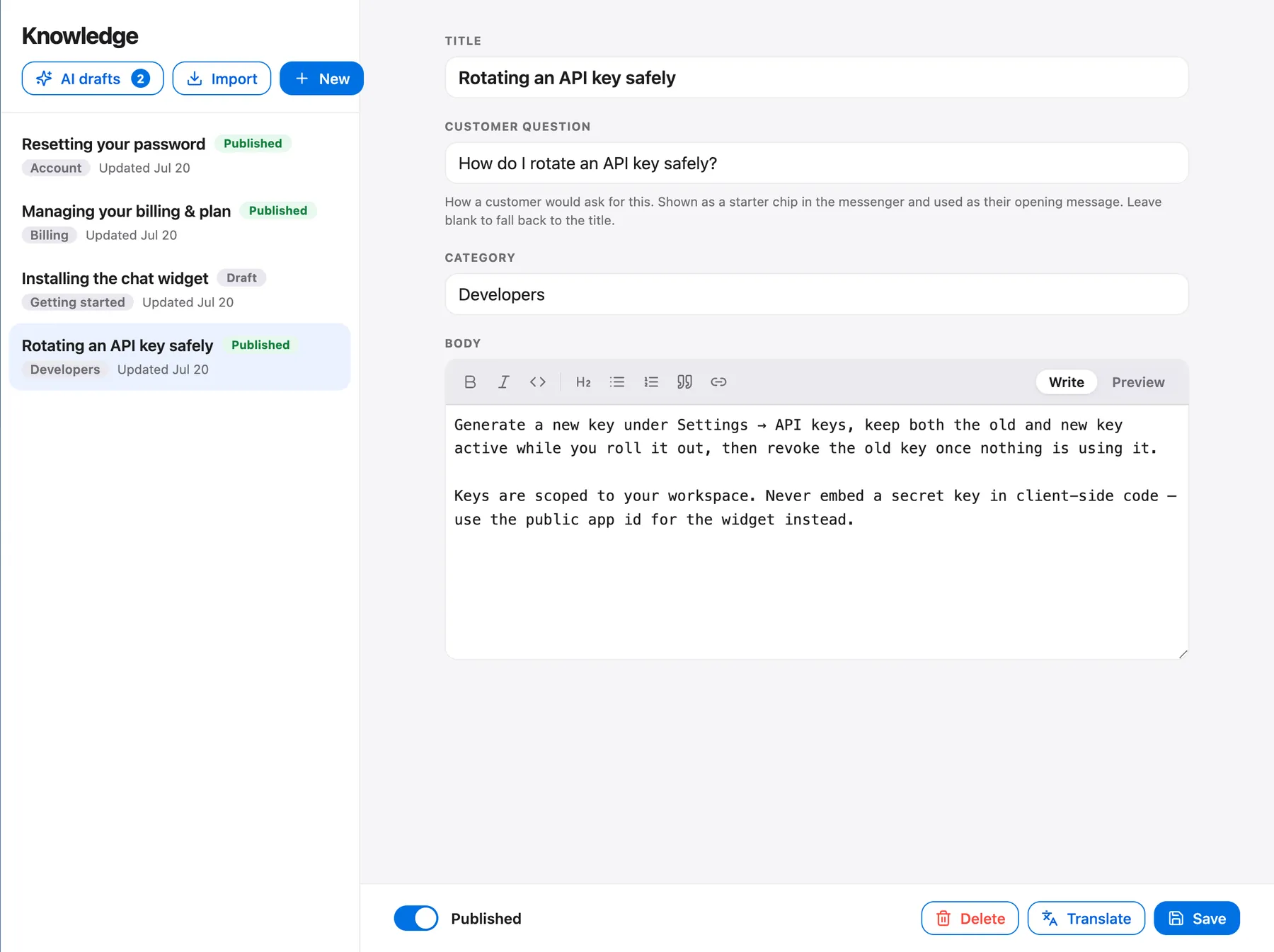
For articles specifically, other tools can read your help center directly. Talvo, for one, can import from Intercom and several other help centers or crawl your public site, and it imports contacts from CSV. That is a convenience for moving out, not a reason to move.
Signs it's time to look at alternatives
None of the following is a verdict on Intercom. Each is a reason to compare, at least.
You get a renewal quote that's well above the last one and the rep can't explain it in writing. Your Fin invoice keeps growing and you can't reconcile it with conversations you'd count as resolved. You're paying for seats mainly so people can read the inbox. You need a channel, a compliance document or an integration that Intercom's new ownership makes less (or more) likely to be on your side of the roadmap. Or you're on a multi-year deal and your plans have shifted.
If instead the product works, the price is acceptable and the answers from your rep are clear, staying is a perfectly good outcome. Intercom has strengths that many small tools don't match, including SOC 2 Type II, data hosting in the US, EU or Australia, a wide set of channels and a large app ecosystem. Read is Intercom worth it for the honest case on both sides.
How to test a switch without disrupting support
The mistake is treating evaluation as a cutover. Treat it as a side-by-side.
Pick one low-risk slice: a single product line, a secondary email address, or a second website. Install the other tool there, import your articles, and point a small share of traffic or a team member's time at it for a couple of weeks. Most chat tools install with a script tag, so this is usually an afternoon, not a project. Compare what matters to you: how often the AI answers correctly, whether it hands off cleanly, how your team likes the inbox, and what the bill looks like at your actual volume.
Keep the live Intercom account untouched through the trial. Bring your renewal date into the plan so you aren't forced to decide on the last day. And write down in advance what would make you switch, so the decision is about evidence rather than mood.
Where Talvo fits, briefly
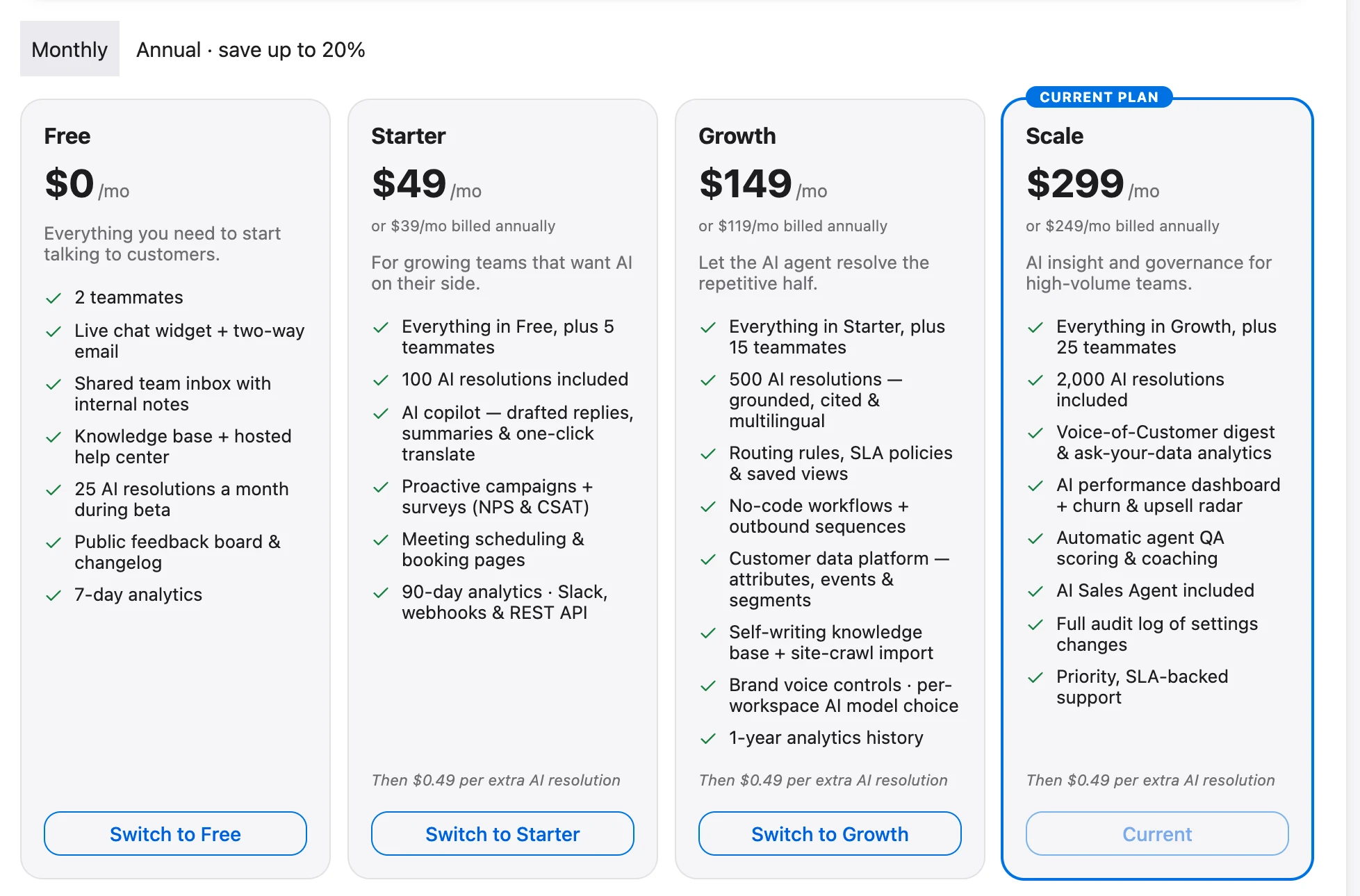
If cost predictability is your main worry, flat pricing is one answer. Talvo charges per workspace instead of per seat: Starter is $49 a month for 5 teammates and 100 AI resolutions, Growth is $149 for 15 teammates and 500, and extra resolutions are $0.49 each. In our pricing comparison, a 5-agent team with 1,000 AI answers comes to $299 a month on Talvo's Scale plan against about $1,185 on Intercom Essential with monthly seats.
The trade-offs are real. Talvo launched in 2026 and is in beta, with no review-site ratings or customer case studies yet. It has no WhatsApp, SMS, Instagram, Messenger or phone support live, no SOC 2 report, no SAML single sign-on, no data-region choice and no HIPAA support. Its integrations today are a REST API, webhooks and Slack. If you need any of those, Intercom or another established vendor is the better fit. Other options worth pricing include flat-priced tools and lower-cost AI rates; our cheaper Intercom alternatives and AI resolution pricing comparison lay them out, and Talvo vs Intercom goes line by line.
A calm plan for the next 90 days
Find your renewal date and notice period this week. Read the contract for the five items above. Send your account rep the questions and file the answers. Run a test export. If a renewal falls inside 90 days, ask for the price and Fin terms in writing before you decide on length. And if you're curious, run one small trial of an alternative on the side. Most of this is housekeeping, and it's the same housekeeping you'd want done on any vendor.
We'll update this post as Salesforce or Fin publish anything about pricing, packaging or the helpdesk.
Frequently asked questions
Did Salesforce buy Intercom?
Yes. Salesforce announced a definitive agreement to acquire Fin, formerly Intercom, for about $3.6 billion on June 15, 2026. A Salesforce release dated September 10, 2026 says it has completed the acquisition. Some older articles still describe the deal as pending.
Is Intercom changing its name to Fin?
The company renamed itself Fin in May 2026, named after its AI agent. The helpdesk product keeps the Intercom name, and Intercom's pricing page still says Intercom helpdesk plans with Fin AI Agent.
Will Intercom prices go up after the Salesforce deal?
Nobody has published a price change. Neither Salesforce release mentions pricing, and Intercom's pricing page showed its usual plans when we read it on October 21, 2026. Whether prices change later is unknown, so ask for your current rate and Fin terms in writing.
Will Intercom be merged into Agentforce?
Salesforce said Fin's packaged offerings and models would complement Agentforce, and that Fin will join Salesforce AI Labs. It has not said whether the Intercom helpdesk will be merged, renamed or retired, so that question is worth putting to your account rep.
Should I sign a long Intercom contract now?
It depends on what protections come with it. A multi-year price lock has value, but a long commitment with no way to adjust seats or exit if the product changes materially is a bet. Many teams choose annual terms as a middle path, keeping most of the discount while staying close to a clean decision point.
How do I export my data from Intercom?
Plan to capture your help center articles, your contacts and your conversation history. We haven't verified every export format Intercom offers, so check your workspace settings or ask support, and run a test export to confirm what is included. Some other tools can import Intercom help articles directly.
How can I test an Intercom alternative without disrupting support?
Run it side by side on one low-risk slice, such as a single product line or a secondary site, for a couple of weeks while Intercom stays live. Compare AI accuracy, hand-offs, inbox fit and the bill at your actual volume, and decide your switching criteria in advance.
Sources
Other products' prices and features change. We checked these pages; if something is out of date, tell us and we'll fix it.
- Salesforce: definitive agreement to acquire Fin, June 15, 2026
- Salesforce: completes acquisition of Fin, September 10, 2026
- Salesforce 10-Q for quarter ended July 31, 2026
- CX Today: Intercom rebrands to Fin
- Intercom pricing page (checked Oct 21, 2026)
- Talvo help: switching to Talvo from another help desk