On this page
- The rate card: what each vendor charges per AI answer
- One word, three families of billable events
- AI resolution pricing at 100, 500, 1,000 and 5,000 conversations
- When per-resolution pricing beats a human
- When it doesn't
- Per resolution, per conversation, or a bundle
- How to avoid paying for bad answers
- Five questions to ask before you sign
- Where Talvo fits, and where it doesn't
- Frequently asked questions
Fin (formerly Intercom, acquired by Salesforce in September 2026) charges $0.99 when its AI resolves a conversation. Help Scout charges $0.75. Zendesk charges $1.50 or $2.00. Talvo charges $0.49. Those numbers are most of what any article on AI resolution pricing will tell you, and they are the least useful part, because each vendor decides for itself what a "resolution" is.
This guide puts ten vendors' rates and definitions side by side, then prices the same four volumes (100, 500, 1,000 and 5,000 AI-handled conversations a month) on every one of them. After that comes the harder question: when does paying per resolution actually beat a human, and how do you avoid paying for answers that were wrong?
We make Talvo, which is one of the ten. We kept it fair by taking every other vendor's number from its own pricing or help page, checked on October 21, 2026, and by labeling anything that came from somewhere else. Pricing pages change often, so recheck the figures that matter before you sign.
The rate card: what each vendor charges per AI answer
Two vendors bill per resolution in the strict sense (Help Scout, Zendesk). Several bill per "outcome", "interaction" or "session". A few bill on usage and don't care whether the customer got helped. The table sorts out the units, the allowances and the minimums.
| Vendor | AI product | What you pay | Included allowance | Minimum, cap or catch |
|---|---|---|---|---|
| Intercom (now Fin) | Fin AI Agent | $0.99 per outcome | None listed on the pricing page | Standalone Fin has a monthly minimum commitment (their example: 50 outcomes). On the Intercom helpdesk you also pay per seat |
| Zendesk | AI agents | $1.50 per extra resolution (committed, 100+) or $2.00 pay-as-you-go | 5 per agent a month on Support Team and Suite Team, 10 on Suite Professional, 15 on Enterprise | Allowance expires annually. You can pause the AI at the limit instead of paying overage |
| Help Scout | Envoy (AI Answers) | $0.75 per resolution | 3 months of unlimited resolutions after you open an account | You can set a monthly spending cap; the AI switches off when it is reached |
| Gorgias | AI Agent | $0.85 to $1.00 per automated interaction, depending on plan | 30, 30, 190 and 530 interactions on Starter, Basic, Pro and Advanced | Each AI interaction also counts as a helpdesk ticket |
| Tidio | Lyro | Add-on tiers: $39 for 50 conversations up to $700 for 1,000 | 50 conversations once, on the Free plan | Past 1,000 you talk to sales. Separate from the base plan and from Flows |
| Crisp | Hugo | Token-based credits; Crisp estimates $0.05 to $0.10 per conversation | $5, $25 and $75 of credits on Mini, Essentials and Plus | When credits run out Hugo stops unless pay-as-you-go is on; those rates aren't published |
| LiveChat | AI Agent | $49.50 per 50 extra resolutions, about $0.99 each | 10 a month on Essential, 200 on Growth | Plans are per user |
| Freshworks | Freddy AI Agent | $49 per 100 sessions, about $0.49 each | 500 sessions, once per account | A session is everything within 24 hours of its start |
| HubSpot | Breeze Customer Agent | Credits at $0.01 each beyond the monthly allowance | 500, 3,000 and 5,000 credits on Starter, Professional and Enterprise | Credits don't roll over. The per-resolution rate isn't on the pricing page |
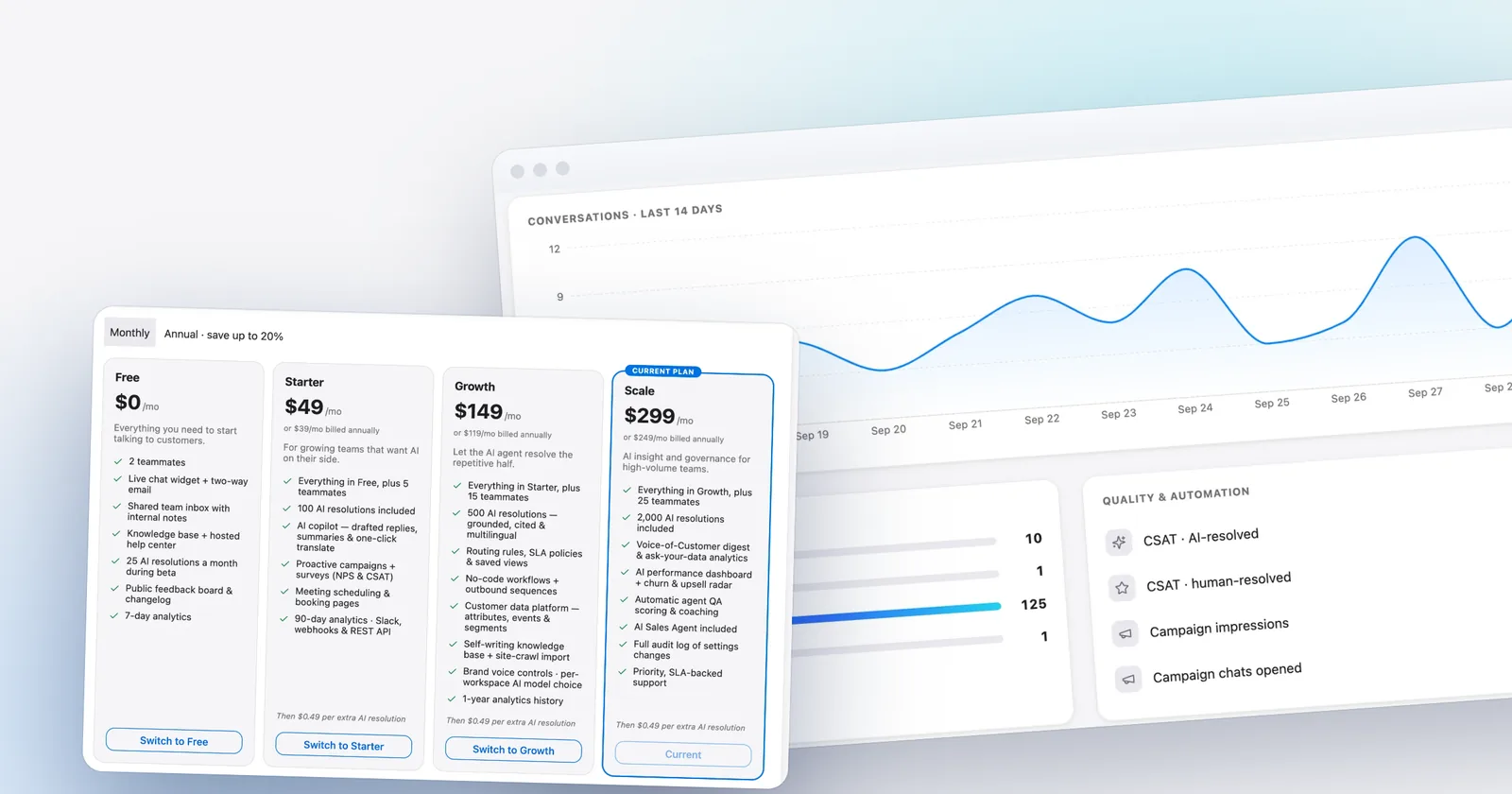
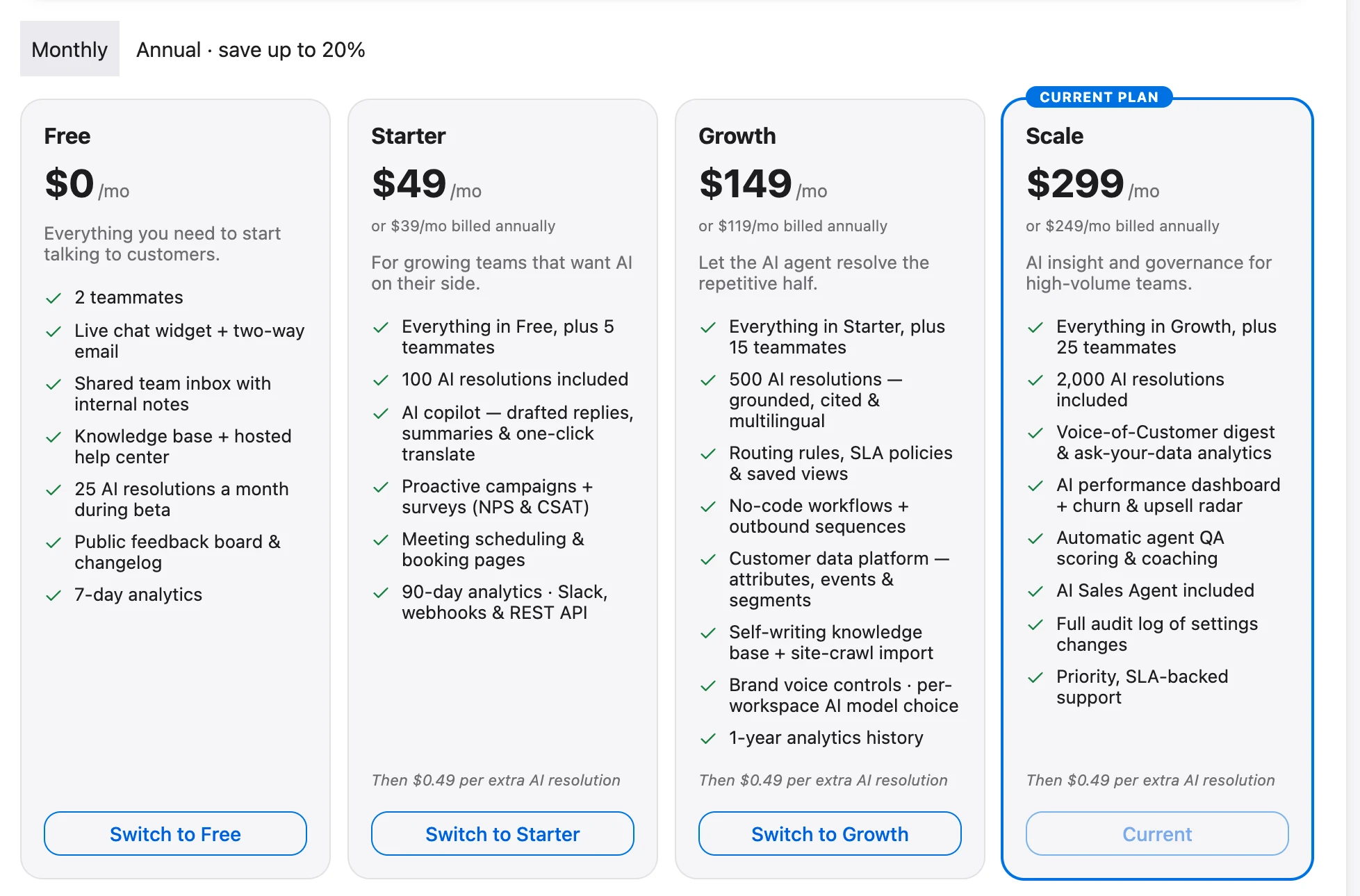
| Talvo | AI agent | $0.49 per resolution beyond the plan's allowance | 25 on Free during the beta, then 100, 500 and 2,000 on Starter, Growth and Scale | No contract on self-serve plans |
Sources: the vendors' own pages, such as Zendesk's pricing, Help Scout's pricing, Gorgias, Tidio and Crisp's Hugo billing article, with the rest linked at the bottom. Where a figure is less solid, it is flagged below rather than buried in a table cell.
A few of those rows need a caveat. Gorgias's pricing page carries two sets of prices in its underlying data, and the Advanced rate reads as $0.85 in one place and $0.90 in another. The rest of this guide uses $0.90, which is also the rate on the Basic and Pro cards. HubSpot's own page stops at "credits"; third-party write-ups put a resolved Customer Agent conversation at 50 credits, about $0.50, but HubSpot's rate sheet wasn't available to confirm it, so treat that one as reported rather than verified. Tidio and Crisp bill on usage, not on whether the conversation was resolved, which is why their rows look so different.
If you're pricing Fin specifically, including seats and add-ons, our Intercom pricing breakdown has the full bill.
One word, three families of billable events
A "resolution" is not a fact about the conversation. It's a rule in the vendor's billing system, and the rules differ in exactly the way that moves your invoice.
| Vendor | Unit | When it becomes billable | When it doesn't |
|---|---|---|---|
| Intercom (Fin) | Outcome | The customer confirms it's resolved, or doesn't ask for more help after Fin responds, or Fin completes a workflow (Procedure), including handoffs. Once per conversation | Customer asks for more help |
| Zendesk | Automated resolution | An LLM reads the transcript and verifies the AI agent resolved it. Only this tier draws on your allowance | Contained but failed verification; AI contributed and a human finished |
| Help Scout | Resolution | A conversation resolved by AI Answers without human help, where the customer doesn't escalate, keep searching the knowledge base, ask more questions or request more help | Any of those follow-ups. One charge per conversation |
| Gorgias | Automated interaction | Page says you pay when the AI resolves a conversation; priced per interaction. Also consumes a ticket | Not spelled out in detail on the pricing page |
| Tidio | Lyro conversation | At least one reply from Lyro on any channel, counted once even if the customer returns | Conversations Lyro never replied to |
| Crisp | AI usage per conversation | From the first AI-handled message until it is resolved, routed or escalated. Escalated conversations still use credits | Nothing after credits run out, unless pay-as-you-go is on |
| LiveChat | Resolution | "The AI directly solved a customer question" | Not further defined on the pricing page |
| Freshworks | Session | All interactions within 24 hours of the session start | Not further defined |
| HubSpot | Credits | Reportedly a resolved conversation: no human handoff or negative feedback within 72 hours (third-party sources) | Same |
| Talvo | Resolution | A conversation the AI answered end to end from the published knowledge base with no teammate stepping in. Once per conversation | Any conversation handed off to a human |
Read down the "billable" column and three families appear.
The first family is pay when the AI spoke. Tidio, Crisp and Freshworks charge for activity. If Lyro replies, that's a conversation. If Hugo starts a chat, it burns credits even when the customer ends up with a person. These models are honest about what they measure, and they tend to be cheap per unit, but a bad answer costs the same as a good one.
The second is pay when nobody objected. Fin and the other "no further help needed" definitions bill when the conversation ends without the customer pushing back. Fin's page spells out the consequence: a customer who simply stops replying after Fin responds is billable, and so is a completed Procedure that ends in a handoff. That isn't a trick. It's the simplest way to bill without asking customers to rate every chat, and the trade-off is that some billed "resolutions" are customers who gave up.
The third is pay when it's verified. Zendesk's tiers, introduced in May 2026, are among the strictest in the table: a second model checks the transcript, and resolutions that fail the check aren't counted. Help Scout gets to a similar place the other way round, by voiding the charge when the customer signals they need more help. You pay a higher rate at Zendesk, but for a narrower set of events.
Talvo's definition sits in the same family as Fin's. It counts an answered conversation that no teammate touched, and a hand-off never counts. We are not claiming that makes it tighter than Fin's; the two are comparable. The honest difference between them is the price, $0.49 against $0.99.
The Talvo help article on what counts as an AI resolution has the full wording.
AI resolution pricing at 100, 500, 1,000 and 5,000 conversations
Here is the same exercise for every vendor. The assumptions matter more than any single cell, so they come first.
- Every figure is the monthly cost of the AI line only: the per-resolution, per-session or credit charges. Seats, helpdesk plan fees and add-ons come on top, and they differ wildly. The one exception is Talvo, where the number is the whole bill (plan and overage together), because Talvo has no per-seat charge to separate out. That choice works against Talvo in the comparison, not for it.
- We assume every AI-handled conversation is billed. That is a ceiling. Vendors with stricter definitions (Zendesk, Help Scout) will bill fewer of them, and anything the AI hands off is free on resolution-priced plans.
- Zendesk assumes a five-agent team on Suite Team, so 25 resolutions a month are included. Committed pricing needs a commitment of 100 or more.
- LiveChat assumes the Essential plan (10 included) and whole packs of 50 at $49.50.
- Freshworks shows the steady-state month, after the one-time 500 free sessions are used up.
- Crisp shows Crisp's own estimate of $0.05 to $0.10 per conversation, as gross usage. Plans include $5, $25 or $75 of credits, which you'd subtract.
- Gorgias uses $0.90 per interaction with no allowance deducted, and ignores the ticket each interaction also consumes.
- HubSpot uses the reported 50 credits per resolution at $0.01 a credit, with no included credits applied.
- Talvo uses monthly billing and the cheapest plan that fits the volume, assuming the team is within that plan's teammate cap (5, 15 or 25).
| Vendor (AI line, per month) | 100 | 500 | 1,000 | 5,000 |
|---|---|---|---|---|
| Fin, $0.99 | $99 | $495 | $990 | $4,950 |
| Zendesk, $1.50 committed | $112.50 | $712.50 | $1,462.50 | $7,462.50 |
| Zendesk, $2.00 pay-as-you-go | $150 | $950 | $1,950 | $9,950 |
| Help Scout, $0.75 | $75 | $375 | $750 | $3,750 |
| Gorgias, $0.90 | $90 | $450 | $900 | $4,500 |
| Tidio Lyro add-on | $75 | $350 | $700 | Not published; Plus plan, ask sales |
| Crisp Hugo (estimate) | $5 to $10 | $25 to $50 | $50 to $100 | $250 to $500 |
| LiveChat, extra packs | $99 | $495 | $990 | $4,950 |
| Freshworks Freddy, $0.49 | $49 | $245 | $490 | $2,450 |
| HubSpot (reported $0.50) | $50 | $250 | $500 | $2,500 |
| Talvo, whole bill | $49 (Starter) | $149 (Growth) | $299 (Scale) | $1,769 (Scale plus 3,000 extra) |
The Talvo row is built like this. At 100, Starter at $49 includes 100. At 500, Growth at $149 includes 500. At 1,000, Growth plus 500 extra resolutions would be $149 + 500 × $0.49 = $394, but Scale at $299 includes 2,000, so Scale is cheaper. At 5,000, Scale at $299 plus 3,000 extra at $0.49 ($1,470) comes to $1,769.
A few things the table says plainly. Zendesk is the most expensive per unit at every volume, and the gap widens as volume grows, though it is also the only one that verifies the transcript before charging. Crisp's usage model is the cheapest by an order of magnitude, and the cost of that is that you pay whether the AI helped or not. Fin and LiveChat land on essentially the same number, because their rates are the same $0.99. Freshworks's $0.49 per session matches Talvo's overage rate, but a Freshworks session is a 24-hour window, not a conversation, and the bill is the AI line only, with seats on top. And at 5,000 conversations the per-resolution vendors cost between about $1,800 and $10,000 a month, which is where the human-labor comparison below starts to matter.
Two more notes on the totals. Gorgias's real number is higher than its table cell, because every AI interaction also consumes a ticket, and past a plan's ticket volume tickets cost $0.36 to $0.40 each. And Help Scout's three-month free trial of AI Answers is the longest free ride in the table: you can run real traffic through it before paying.
Try your own numbers. The calculator uses list prices for five of the vendors above, with seats included, so it shows whole monthly bills rather than the AI line alone. That is why its numbers differ from the table above, which is AI line only. The calculator also prices Zendesk at the $2.00 pay-as-you-go rate, not the $1.50 committed one, and Talvo on monthly billing.
- Crisp Mini~$100–$150/mo$45 per workspace + 1 agents × $10 + AI at Crisp's estimate of $0.05–$0.10 per conversation, less $5 of included credits · Estimate: top-up rate and annual prices aren't published
- Talvo Scale$299/mo$299 per workspace, 2,000 AI resolutions included
- Help Scout Standard$900/mo5 users × $30 + 1,000 AI resolutions × $0.75
- Intercom (Fin) Essential$1,185/mo5 seats × $39 + 1,000 Fin outcomes × $0.99 · Workflow automation needs Advanced ($85–$99 per seat)
- Zendesk Suite Team$2,295/mo5 agents × $69 + 975 AI resolutions × $2.00 (25 included) · $1.50 each with a committed 100+ purchase
Estimates from each vendor's published list prices, checked October 21, 2026. Assumes the cheapest plan that includes live chat and an AI agent, and that every AI-resolved conversation is billable. Excludes taxes, promotions, add-ons (such as agent copilots) and per-use channels like SMS or WhatsApp. Talvo's annual price includes extra resolutions at the same $0.49, billed once a year.
When per-resolution pricing beats a human
Run it with numbers you can change. The ones below are an illustration, not data: a teammate costs $30 an hour fully loaded, and a routine question takes six minutes to read, look up, write and send. That is $3.00 per conversation.
At 1,000 conversations a month, that is 100 hours and $3,000 of human time. Fin's $990, Help Scout's $750 and Talvo's $299 all come in well under it, assuming the answers are right. Even Zendesk's $1,462.50 committed rate comes in under half.
Per-resolution pricing has a real structural advantage here. You aren't charged for conversations the AI couldn't finish, so a hard question that gets handed to a person costs you the person and nothing else. On resolution-priced plans the vendor is paid for finished conversations rather than activity, which lines up better than a flat AI subscription, subject to how loosely a vendor defines "resolved".
It also turns a fixed cost into a variable one. A person on payroll costs the same in a quiet month and a busy one. Per-resolution charges shrink in a quiet month, which suits a business with seasonal swings.
When it doesn't
Where the answer quality slips, the math flips faster than most buyers expect. Say 20 percent of billed resolutions were wrong and the customer came back to a human. You paid $990 for 1,000 billed conversations and spent $3.00 on each of the 200 redos: $990 + $600 = $1,590. Still below $3,000. Now say half were wrong: $990 + $1,500 = $2,490. The saving is almost gone, and you have 500 customers who got a bad answer first. The break-even is where the wrong share reaches about 67 percent ($3.00 minus $0.99, divided by $3.00), and long before that, you have a churn problem the invoice doesn't show.
A few other cases where the bill doesn't pay off.
If you answer very little, the AI saves time rather than money. A founder who handles 40 chats a month in spare minutes, and nobody is on payroll for it. The AI is still worth a look, but there's no labor bill to shrink.
Some questions aren't answer-shaped. Refunds, account-specific lookups and anything that needs an integration the AI doesn't have will be handed off. You don't pay for those, which is the good news, and you don't save anything either.
Then there's volume. At 5,000 conversations, per-resolution pricing at $0.99 is $4,950 a month. A usage model like Crisp's, or a bundle with a large included allowance, can run a fraction of that. Whether you're willing to pay for failures to get that discount is the trade.
And watch for a generous definition. Under any "nobody objected" rule, a customer who got a wrong answer and gave up is a billed resolution. You find these only by looking.
Per resolution, per conversation, or a bundle
The three shapes are worth separating, because the right one depends on how much you trust the AI on your content.
Per resolution (Fin, Zendesk, Help Scout, Talvo's overage) puts the risk of failure on the vendor, except for the gap between "resolved" as defined and resolved as experienced. Per conversation or usage (Tidio, Crisp, Freshworks's sessions) puts the failure risk on you but charges so little per unit that it often doesn't matter. Bundles (the allowances on Talvo's plans, Zendesk's per-agent allowance, LiveChat's 200 on Growth) let you prepay at a lower effective rate and only pay list price for the overflow.
Bundles reward predictability, which is why the 1,000-conversation row above is cheaper on Talvo's Scale plan than on its Growth plan plus overage. The reverse also holds: if you buy a 2,000-resolution allowance and use 300, the unit cost is high. Pick the bundle you will actually fill.
How to avoid paying for bad answers
The cheapest resolution is the one the AI gets right, and the most expensive is the one it gets wrong and bills anyway. Most of the defense is upstream of the invoice.
Make the AI answer from your content, and show its work
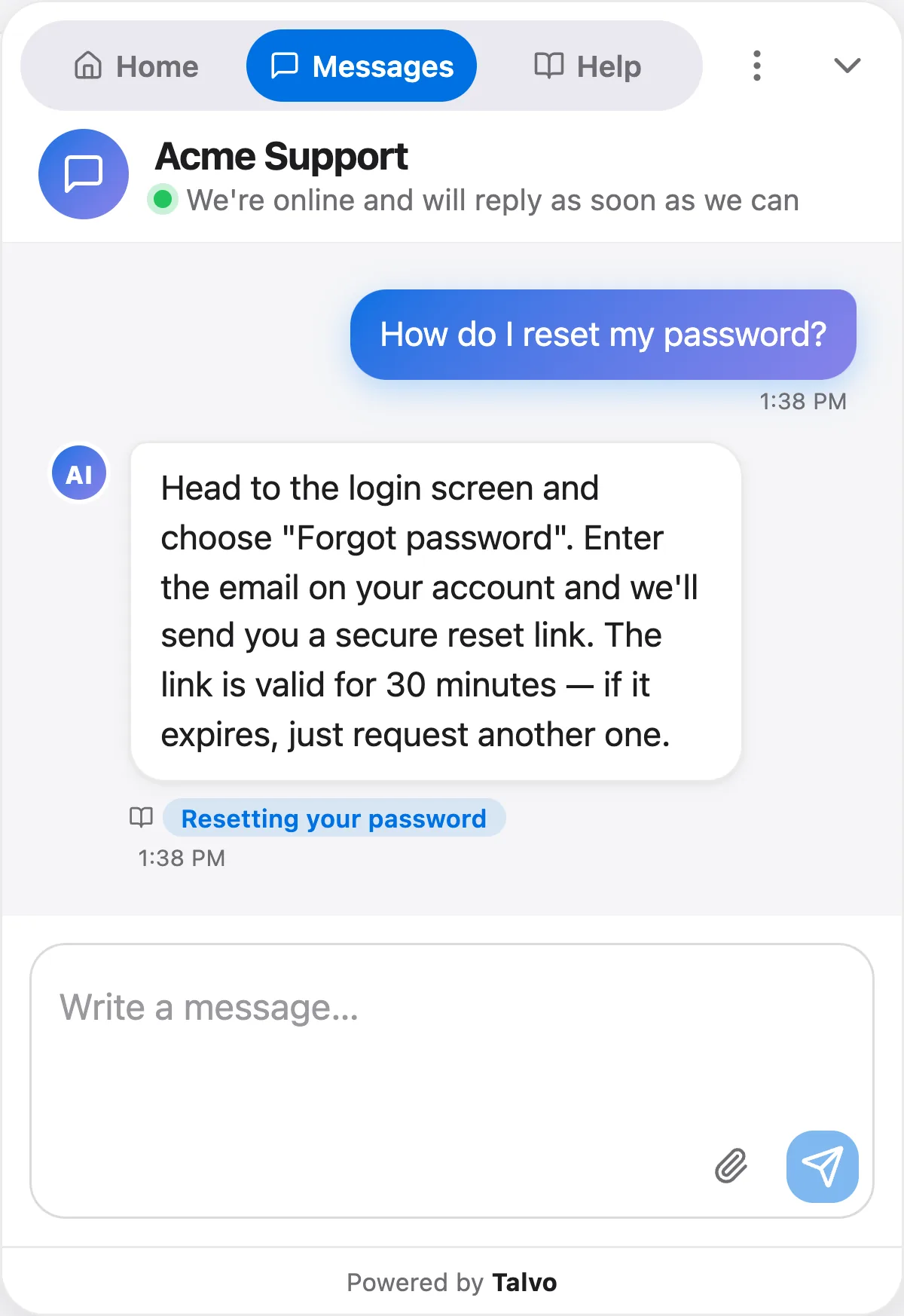
Talvo's AI answers only from published knowledge base articles and shows which article it used. That does two things for billing: it narrows the room for invented answers, and it leaves a receipt. When you audit a charge, you can see the article behind it.
Make hand-off easy
When the AI isn't confident, Talvo hands the conversation to a human with the thread intact, and a hand-off isn't billed. A handoff rate of nearly zero is a warning sign, not a success; it often means the AI is answering things it shouldn't. Our guide to a knowledge base chatbot that cites sources and hands off covers the setup.
Sample what you were charged for. Once a week, read 20 billed conversations. Look for the same customer writing back within a few days, for answers that are technically on-topic but miss the question, and for conversations that ended because the customer stopped replying. That last group is the one "nobody objected" definitions bill and verified definitions don't.
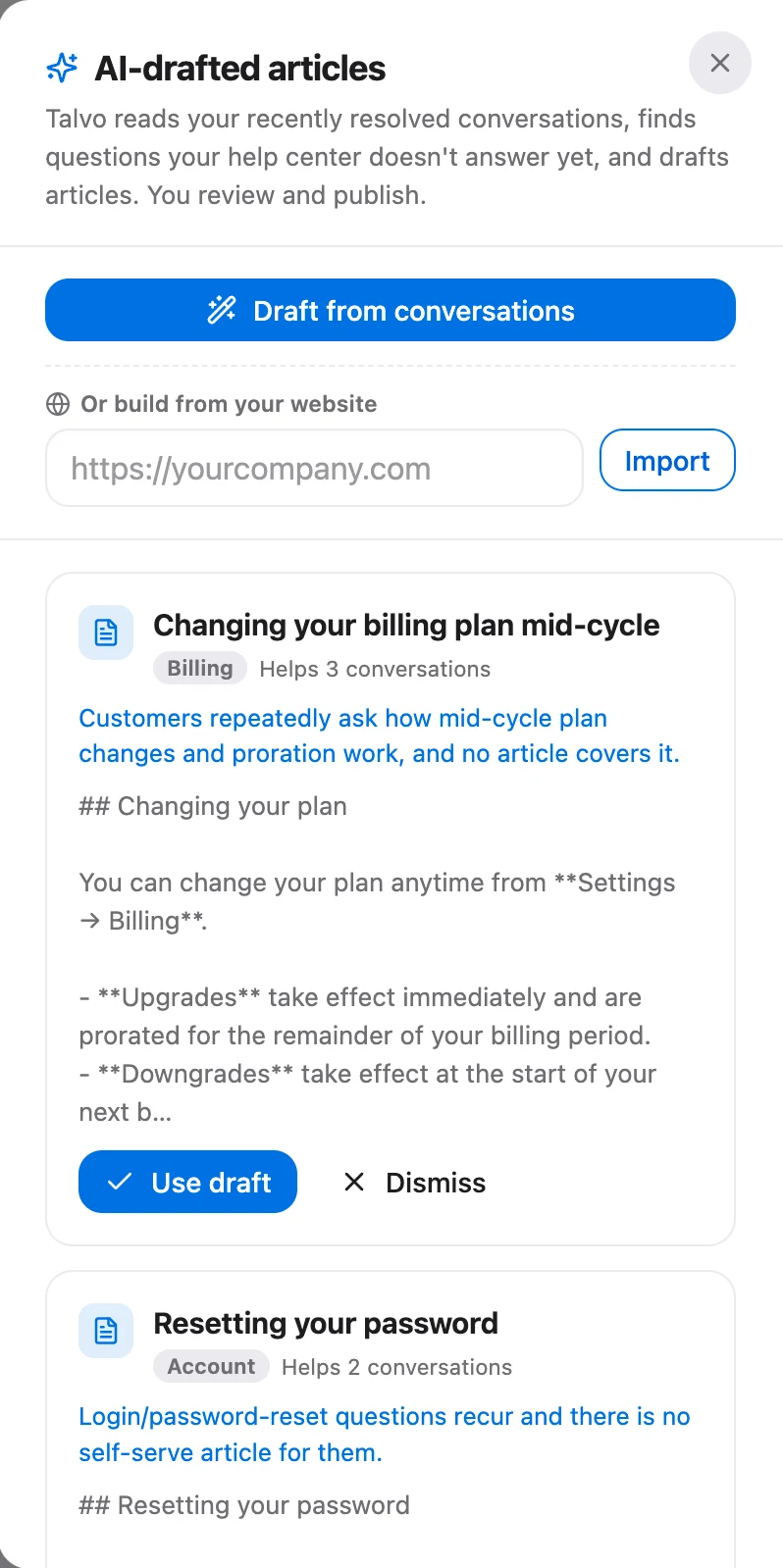
Fix the source, not the symptom. Wrong answers usually trace to a missing or stale article. Talvo's self-writing knowledge base, on the Growth plan, drafts articles from questions the AI couldn't answer, which shortens the loop. See how AI auto-resolve works for the mechanics.
Set a ceiling where the vendor lets you. Help Scout lets you set a monthly cap and switches off AI Answers when you hit it. Zendesk lets you pause the AI agent at the limit rather than pay overage. Crisp's Hugo stops answering when credits run out if pay-as-you-go is off. Whichever vendor you use, know which of those three behaviors you have before the first surprise.
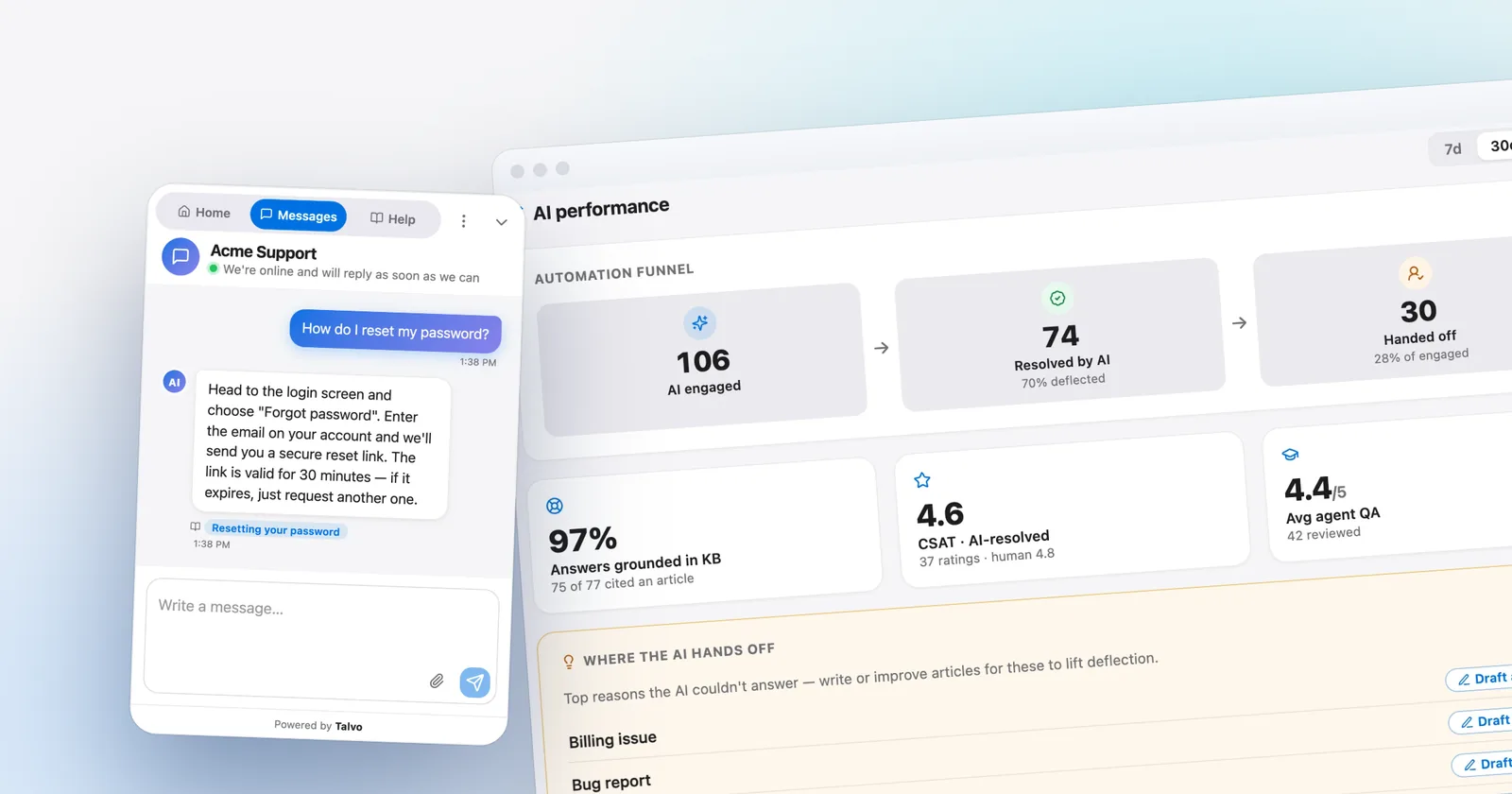
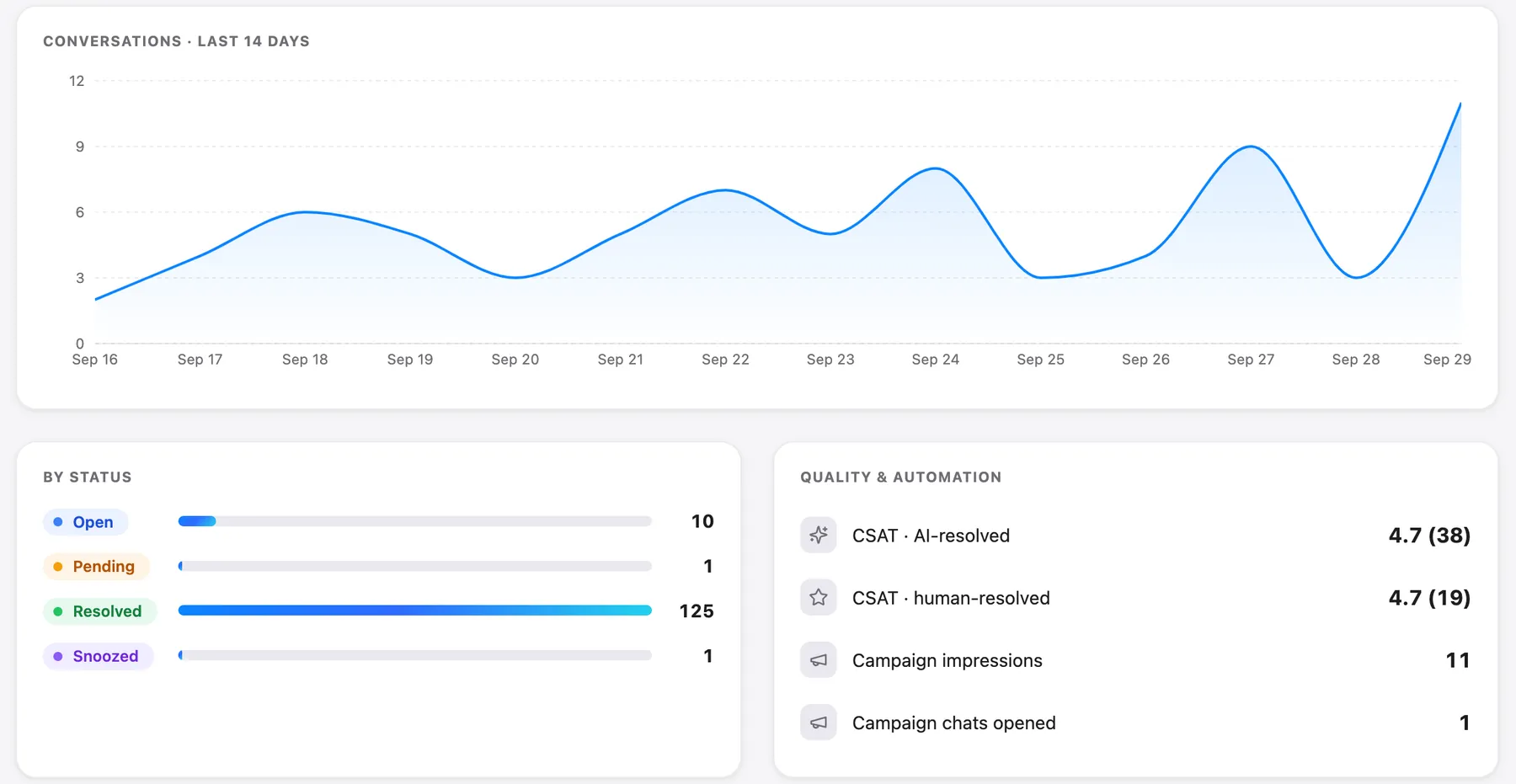
Measure the funnel, not the count. The number to watch is not "resolutions" but the path to it: how many conversations the AI engaged, how many it resolved, how many it handed off. Talvo's AI performance dashboard on the Scale plan shows that funnel and a grounding rate. On other plans, the standard analytics are a starting point.
Five questions to ask before you sign
These cost nothing to ask and they separate vendors quickly.
- Is a customer who stops replying after an AI answer billable?
- If the AI starts a workflow and then hands off, do I pay?
- Is the included allowance per account or per seat, and does it expire?
- Does each AI conversation also count against a ticket, seat or conversation quota?
- What happens when I hit the cap: does the AI stop, or does the meter keep running?
Where Talvo fits, and where it doesn't
Talvo's pricing is a flat plan per workspace with AI resolutions included, then $0.49 for each one beyond the allowance. That is cheaper per resolution than Fin, Help Scout, Zendesk and LiveChat in the table. It is not the cheapest line in it: Crisp's usage-based Hugo is lower per conversation, and HubSpot's reported rate is close.
The caveats are the usual ones for a product in beta. Talvo is new, with no review-site history. It has no WhatsApp, SMS, Instagram or Messenger channel yet, no phone, and no native Shopify or HubSpot integration. It has no SOC 2 report or SAML single sign-on. If any of those are requirements, Fin, Zendesk, Help Scout or Crisp may be the better fit regardless of the per-resolution price. If they aren't, the full plan details are on the pricing page, and the cheaper Intercom alternatives roundup prices the whole stack, not just the AI. For how seats and flat plans interact with AI costs, see per-seat vs flat pricing.
Frequently asked questions
What is resolution-based pricing?
Resolution-based pricing charges you each time an AI agent resolves a customer conversation, instead of charging a flat AI subscription. Conversations the AI hands to a human are normally free. Each vendor defines what counts as a resolution, so the same traffic can produce very different bills.
How much does an AI resolution cost?
Published rates run from about $0.49 (Talvo beyond its included allowance, and Freshworks per session) to $0.75 at Help Scout, $0.99 at Fin and LiveChat, and $1.50 to $2.00 at Zendesk. Crisp estimates $0.05 to $0.10 per conversation, but it bills usage rather than resolutions. Seats and plan fees come on top for most vendors.
What counts as a resolution?
It depends on the vendor. Fin counts a conversation where the customer confirms, or doesn't ask for more help after Fin responds. Zendesk counts only resolutions an LLM verifies from the transcript. Help Scout voids the charge if the customer asks for more help. Talvo counts a conversation the AI answered from the published knowledge base with no teammate stepping in.
Is per-resolution pricing cheaper than hiring or per-seat pricing?
Under an illustrative cost of $3.00 of human time per routine conversation, a $0.49 to $0.99 resolution is cheaper than a person as long as most billed answers are correct. At $0.99 the saving disappears if roughly two thirds of billed answers need human rework, and at Zendesk's $2.00 pay-as-you-go rate it disappears at about one third. Per-seat pricing is a separate cost for the humans who still handle hand-offs.
Do I pay when the AI hands off to a human?
On resolution-priced plans a hand-off generally isn't billed, with one catch at Fin: a completed Procedure that ends in a handoff is billable. On usage-priced plans such as Crisp and Tidio, the AI's activity is billed even when a person finishes the conversation. Talvo never counts a hand-off as a resolution.
Can I cap my AI spend?
Some vendors let you. Help Scout lets you set a monthly cap and switches AI Answers off when it's reached. Zendesk lets you pause the AI agent at your limit rather than pay overage. Crisp's Hugo stops answering when credits run out unless pay-as-you-go is turned on.
How do I avoid paying for bad AI answers?
Use an AI that answers only from your published content and shows the source, make hand-off easy, and read a sample of billed conversations each week for customers who come back. Fix missing or stale articles at the source. Watch the funnel from engaged to resolved to handed off, not just the resolution count.
Sources
Other products' prices and features change. We checked these pages; if something is out of date, tell us and we'll fix it.
- Intercom pricing page (checked Oct 21, 2026)
- Salesforce completes acquisition of Fin (Sept 10, 2026)
- Zendesk pricing (checked Oct 21, 2026)
- Zendesk: About automated resolutions for AI agents
- Zendesk: About automated resolution tiers
- Help Scout pricing (checked Oct 21, 2026)
- Gorgias pricing (checked Oct 21, 2026)
- Tidio pricing (checked Oct 21, 2026)
- Crisp: Hugo pricing and billing explained
- Crisp pricing (checked Oct 21, 2026)
- LiveChat pricing (checked Oct 21, 2026)
- Freshchat pricing and Freddy AI Agent FAQ (checked Oct 21, 2026)
- HubSpot Service Hub pricing (checked Oct 21, 2026)
- Third-party: HubSpot AI agent pricing (reported rate, not confirmed by HubSpot)
- Talvo pricing
- Talvo help: What counts as an AI resolution