On this page
- Four ways support software charges you
- Per seat vs flat pricing at 3, 8, 15 and 25 agents
- Where flat pricing starts to win
- The staircase has steps, too
- Volume pricing: when headcount doesn't matter
- The side effects nobody puts on the pricing page
- How to choose
- What Talvo's model gives up
- Frequently asked questions
Add a fourth person to a support team and one of two things happens to your software bill. Either it goes up by the price of a seat, whatever that person actually does all day, or it doesn't move at all. Which one you get depends on a pricing model most buyers never look at until the renewal quote arrives.
This guide compares per seat vs flat pricing for help desk and live chat software, using the list prices of real vendors at 3, 8, 15 and 25 agents. It also covers the two other models you'll run into (volume-based and usage-based), the side effects nobody puts on the pricing page, and how to choose.
We make Talvo, which is priced per workspace with caps on teammates, so we have an interest in this question. The numbers for every other vendor come from its own pricing pages, checked October 21, 2026, and we say where flat pricing loses.
Four ways support software charges you
Start with per seat. You pay a monthly fee for every person who can reply to customers. Intercom, Zendesk, Help Scout, LiveChat, Freshdesk, Front, HubSpot and Chatwoot all work this way, at prices from $19 to $150 per seat per month depending on vendor and tier (see Intercom and Zendesk for two of them). Cost grows in a straight line with headcount.
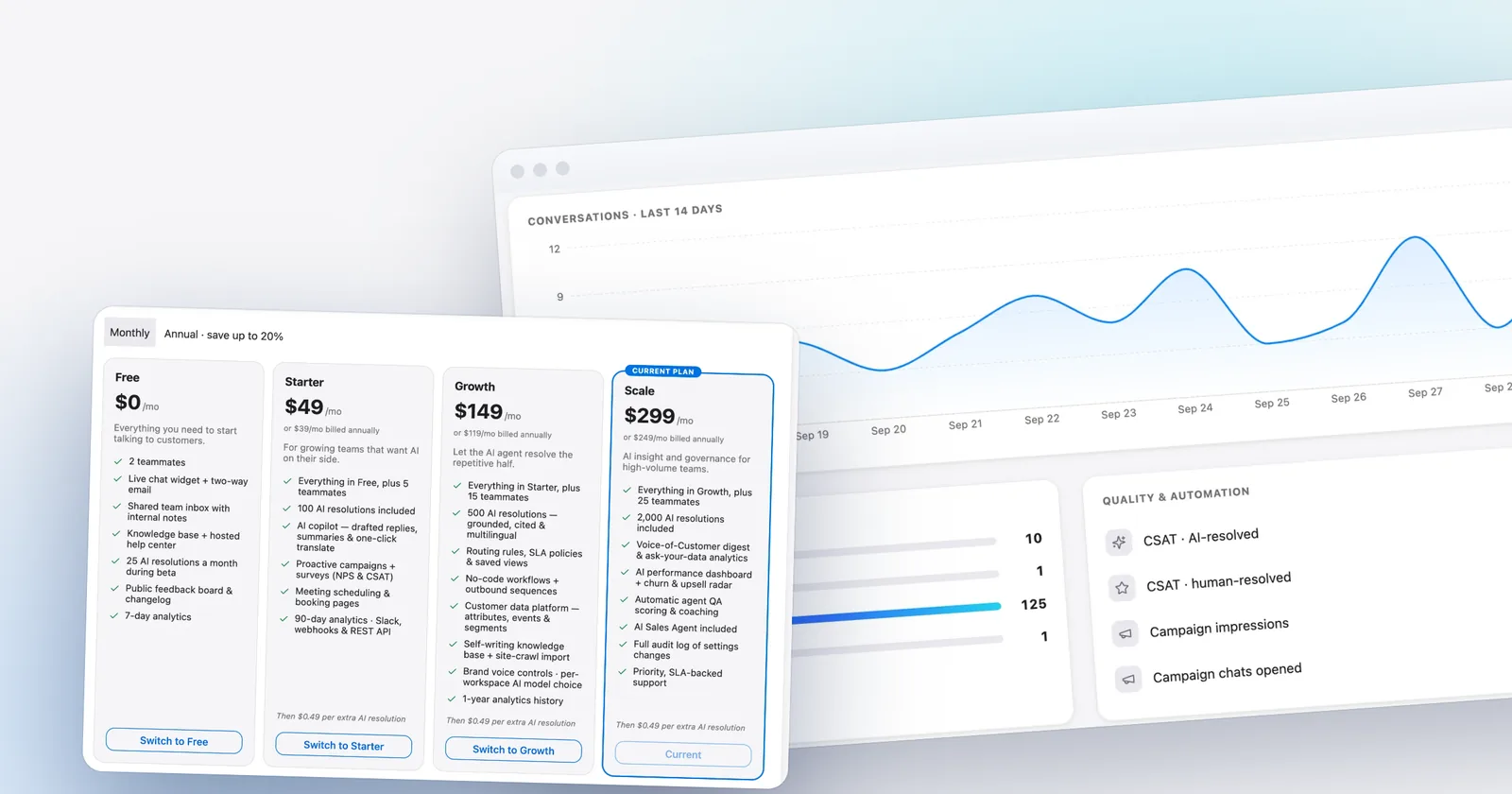
Per workspace, or flat, is the opposite. One price covers the account, with a cap on how many teammates fit. Crisp and Talvo work this way. Crisp's Mini plan is $45 a month for 4 seats, Essentials is $95 for 10, and extra agents are $10 each. Talvo's plans are priced per workspace with teammate caps of 2, 5, 15 and 25. The cost is a staircase, not a line: flat across a band of headcount, then a step up.
Then there is volume. Gorgias is the clearest case. Its pricing page says the helpdesk is never priced per agent; you buy a monthly allotment of tickets, and extras cost $0.36 to $0.40 each. Tidio prices by "billable conversations", meaning chats or tickets in which a human agent replied. Headcount barely matters; volume does.
The fourth model is usage or credits for AI. Fin's $0.99 per outcome, Help Scout's $0.75 per resolution, Crisp's AI credits and the rest. This sits on top of whichever base model you chose, and it is the part that actually scales with success. We covered it separately in AI resolution pricing compared, so this guide sets AI aside and prices the platform alone.
Real products mix these. Intercom is per seat plus per outcome. Gorgias is per ticket plus per AI interaction. Crisp is flat per workspace plus credits plus a limit on customer profiles. "Flat" rarely means one number forever; it means one number across the dimension the vendor chose not to meter.
Per seat vs flat pricing at 3, 8, 15 and 25 agents
The rules for this table: list prices, annual billing, per month, platform only (no AI usage, no add-ons, no tax). Where a vendor offers a plan with live chat and a shared inbox at the entry level, that's the plan used, with two exceptions noted below the tables. Each plan is noted, because a $19 seat and a $55 seat are not the same product.
| Plan | 3 agents | 8 agents | 15 agents | 25 agents |
|---|---|---|---|---|
| Intercom Essential, $29 a seat | $87 | $232 | $435 | $725 |
| Zendesk Suite Team, $55 an agent | $165 | $440 | $825 | $1,375 |
| Help Scout Standard, $25 a user | $75 | $200 | $375 | $625 |
| LiveChat Essential, $19 a user | $57 | $152 | $285 | $475 |
| Freshdesk Growth, $19 an agent | $57 | $152 | $285 | $475 |
| Front, $25 Starter (10-seat cap) then $65 Professional | $75 | $200 | $975 | $1,625 |
| HubSpot Service Hub Professional, $90 a seat | $270 | $720 | $1,350 | $2,250 |
| Talvo, annual billing | $39 (Starter) | $119 (Growth) | $119 (Growth) | $249 (Scale) |
Two vendors don't publish annual prices in a form comparable to the rest, so they get their own table on monthly billing:
| Plan (monthly billing) | 3 agents | 8 agents | 15 agents | 25 agents |
|---|---|---|---|---|
| Crisp (cheapest of Mini or Essentials, plus $10 per extra agent) | $45 | $85 | $145 | $245 |
| Chatwoot Cloud Startups, $19 an agent | $57 | $152 | $285 | $475 |
| Talvo, monthly billing | $49 | $149 | $149 | $299 |
Here is how those cells are built, so you can check them. Intercom at 8 agents is 8 × $29 = $232. Zendesk at 15 is 15 × $55 = $825. Crisp at 8 agents is Mini at $45 for its 4 seats plus 4 × $10, $85, which beats Essentials at $95. Crisp at 15 agents is the Essentials plan at $95 for its 10 seats plus 5 × $10 for the extra agents, $145; at 25 it is $95 + 15 × $10 = $245. Front's Starter plan is capped at 10 seats, so the 15- and 25-agent cells jump to Professional: 15 × $65 = $975 and 25 × $65 = $1,625.
Some notes the table can't carry:
- Intercom's Advanced plan, which adds a workflow builder and multiple inboxes, is $85 a seat, so 8 agents is $680 a month. Essentials is the price of admission, not what most growing teams end up on.
- Zendesk's cheaper Support Team plan is $19 an agent but is email and ticketing only, without live chat or messaging, which is why the table uses Suite Team.
- HubSpot's Professional plan has a required one-time onboarding fee of $1,500 on top of the seats.
- Help Scout's Standard plan covers up to 25 users; the 26th person pushes you to Plus at $45 a user.
- Monthly billing costs more on every per-seat plan: Intercom Essential is $39 a seat, Zendesk Suite Team $69, Help Scout Standard $30, LiveChat Essential $25.
- Freshdesk is shown on its ticketing plan; Freshchat's chat plan is also $19. HubSpot is shown at Professional because the Starter price is unclear on its page ($7 or $20).
- Gorgias isn't in the table because headcount doesn't set its price. See below.
The honest read: Talvo isn't the cheapest at every size. Crisp's flat model undercuts Talvo's monthly pricing at 3, 8 and 25 agents ($45 against $49, $85 against $149, $245 against $299) and roughly ties it at 15. Chatwoot's per-agent pricing is the cheapest of the per-seat vendors at small sizes, and Freshchat has a free plan for up to 10 agents. What you get for the difference is different on each side: Crisp has more channels (WhatsApp, Instagram, SMS) than Talvo does today, and Talvo's AI answers only from your published knowledge base and cites the article. Neither is a reason to pay more by itself, but price is rarely the only line.
Where the staircase model clearly wins is against the mid-priced seat vendors, and the gap grows with every hire. At 8 agents, Talvo's Growth plan at $119 a month on annual billing compares with $200 at Help Scout, $232 at Intercom Essential and $440 at Zendesk Suite Team. At 25 agents, $249 compares with $475 to $2,250.
Try your own headcount below. The calculator shows monthly billing including AI usage at list price (Zendesk at its $2.00 pay-as-you-go rate), so its numbers will be higher than the annual, platform-only tables above.
- Crisp Essentials~$95–$120/mo$95 per workspace + AI at Crisp's estimate of $0.05–$0.10 per conversation, less $25 of included credits · Estimate: top-up rate and annual prices aren't published
- Talvo Growth$149/mo$149 per workspace, 500 AI resolutions included
- Help Scout Standard$615/mo8 users × $30 + 500 AI resolutions × $0.75
- Intercom (Fin) Essential$807/mo8 seats × $39 + 500 Fin outcomes × $0.99 · Workflow automation needs Advanced ($85–$99 per seat)
- Zendesk Suite Team$1,472/mo8 agents × $69 + 460 AI resolutions × $2.00 (40 included) · $1.50 each with a committed 100+ purchase
Estimates from each vendor's published list prices, checked October 21, 2026. Assumes the cheapest plan that includes live chat and an AI agent, and that every AI-resolved conversation is billable. Excludes taxes, promotions, add-ons (such as agent copilots) and per-use channels like SMS or WhatsApp. Talvo's annual price includes extra resolutions at the same $0.49, billed once a year.
Where flat pricing starts to win
Dividing a flat plan's price by a vendor's seat price gives the headcount at which the flat plan becomes cheaper. Using Talvo's annual-billing prices:
| Talvo plan (annual) | vs $19 a seat | vs $25 a seat | vs $29 a seat | vs $55 a seat |
|---|---|---|---|---|
| Starter, $39 for 5 teammates | 3 agents | 2 agents | 2 agents | 1 agent |
| Growth, $119 for 15 teammates | 7 agents | 5 agents | 5 agents | 3 agents |
| Scale, $249 for 25 teammates | 14 agents | 10 agents | 9 agents | 5 agents |
Read it by row. Against Intercom Essential's $29 seat, Talvo's Starter plan is already cheaper at 2 agents, its Growth plan from the fifth, and its Scale plan from the ninth. Each column only matters once your team outgrows the plan before it. Against a $19 seat, Starter wins from 3 agents. So on annual list prices, a team of 3 to 5 pays less on Talvo than on any per-seat plan in the first table. At 6 agents the $19 plans (LiveChat, Freshdesk) edge ahead, $114 against Growth's $119, and Talvo is cheaper again from 7. The cheaper rivals for small teams are Crisp's monthly plans and free tiers. For a team of two, the free tiers from Talvo (2 teammates), Crisp (2 seats), Chatwoot (2 agents) and Freshchat (up to 10 agents) all beat any paid seat, and per-seat pricing is genuinely fine.
The break-even matters less than the shape of the curve. A per-seat bill rises with every hire. A flat bill is flat until the cap, then jumps.
The staircase has steps, too
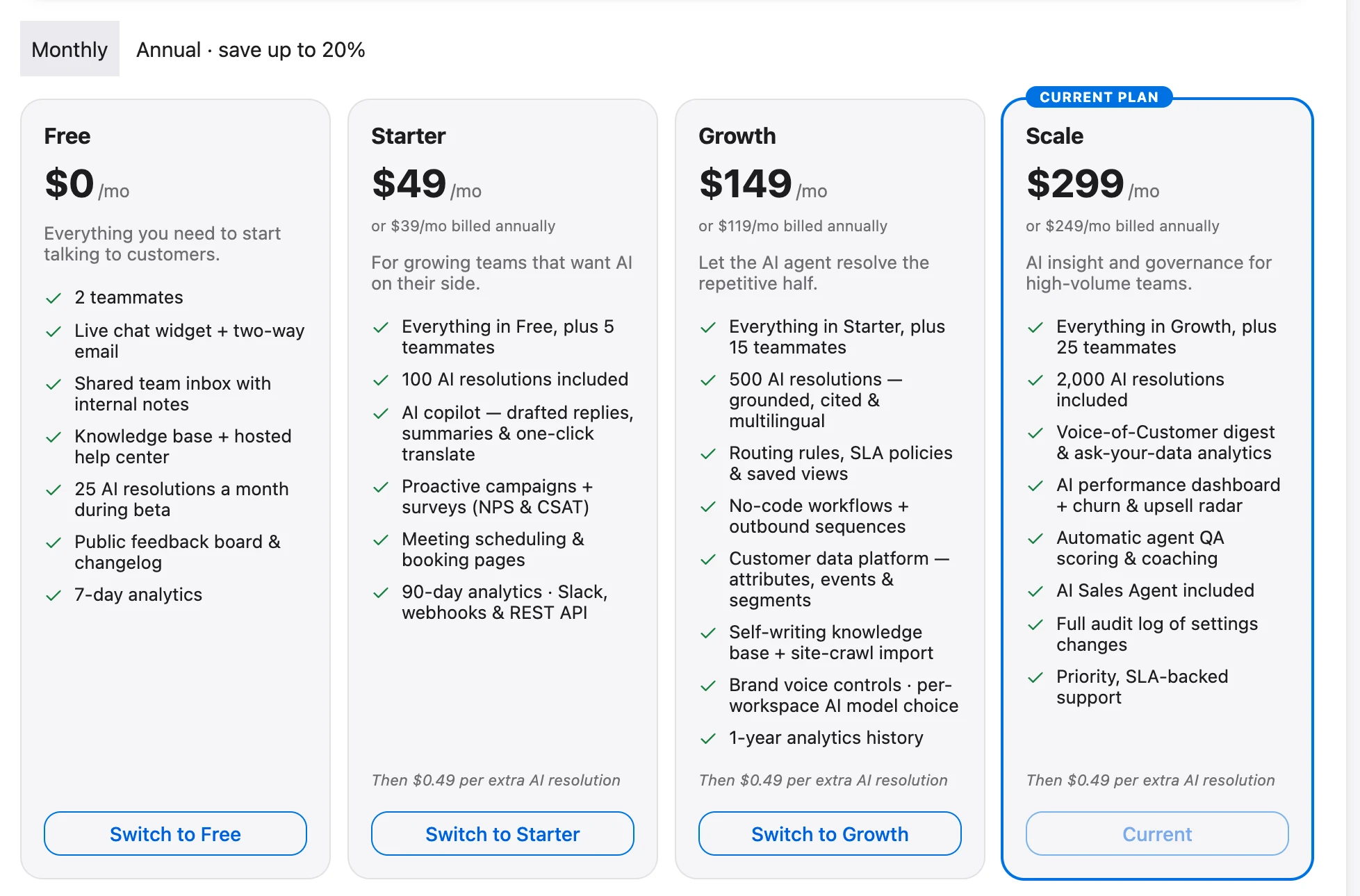
A flat plan with seat caps is not "unlimited". The caps on Talvo's plans are 2 (Free), 5 (Starter), 15 (Growth) and 25 (Scale); Enterprise is custom and unlimited. Adding a teammate up to the plan's limit never changes the bill, but the sixth person costs the jump from Starter to Growth: $80 a month more on annual billing ($39 to $119), $100 on monthly ($49 to $149). The sixteenth costs $130 more on annual ($119 to $249), $150 on monthly ($149 to $299).
So the flat model hasn't removed seat creep. It has concentrated it into three or four moments you can see coming. Whether that is better depends on where your headcount sits. A team of six pays for fifteen seats of room it won't use. A team of fifteen is getting the best deal the model offers. And the plan you land on is also a bundle: the Growth plan adds routing rules, SLA policies, no-code workflows, and 500 AI resolutions a month, so some of that $80 jump is features, not just room.
Crisp's version is gentler. Its extra agents are $10 each, so the staircase has a ramp. Its steepest step is a different meter: Mini caps customer profiles at 5,000 and Essentials at 50,000, and one reviewer on Capterra calls the profile limit the expensive part.
Flat doesn't mean unmetered either. Talvo's AI resolutions beyond the plan's allowance cost $0.49 each, so the monthly total moves with AI volume even when headcount doesn't.
Volume pricing: when headcount doesn't matter
Gorgias is the cleanest per-ticket model, and it behaves differently from either seat or flat plans. Prices below are annual-billing, monthly figures:
| Tickets a month | Plan | Price | Seats included |
|---|---|---|---|
| 300 | Basic | $50 | 500 |
| 2,000 | Pro | $300 | 500 |
| 5,000 | Advanced | $750 | 500 |
Go past a plan's volume and extras cost $36 per 100 tickets on Pro, so 3,000 tickets on Pro is $300 + 10 × $36 = $660, still under Advanced's $750. For an ecommerce brand with 25 agents and 300 tickets a month, Gorgias costs $50. For one with 3 agents and 5,000 tickets, it costs $750. Headcount has nothing to do with it.
That makes ticket pricing excellent for lean teams with many conversations per head, and a risk for any business with spikes. Reviewers' recurring complaint is the overage during Black Friday and Cyber Monday. Gorgias's AI also draws on the same meter: each AI interaction counts as a ticket. Tidio works similarly with its "billable conversation" rule, where only conversations that include a human agent's message count, from $29 for 100 to $349 for 2,000 at monthly pricing.
Help Scout is a useful footnote. It previously priced by "contacts helped" and reverted to per-user pricing, according to a secondary source. Vendors do change models, which is a reason to ask what the renewal terms are.
The side effects nobody puts on the pricing page
Pricing models change behavior. These are the ones to watch for.
Seat rationing
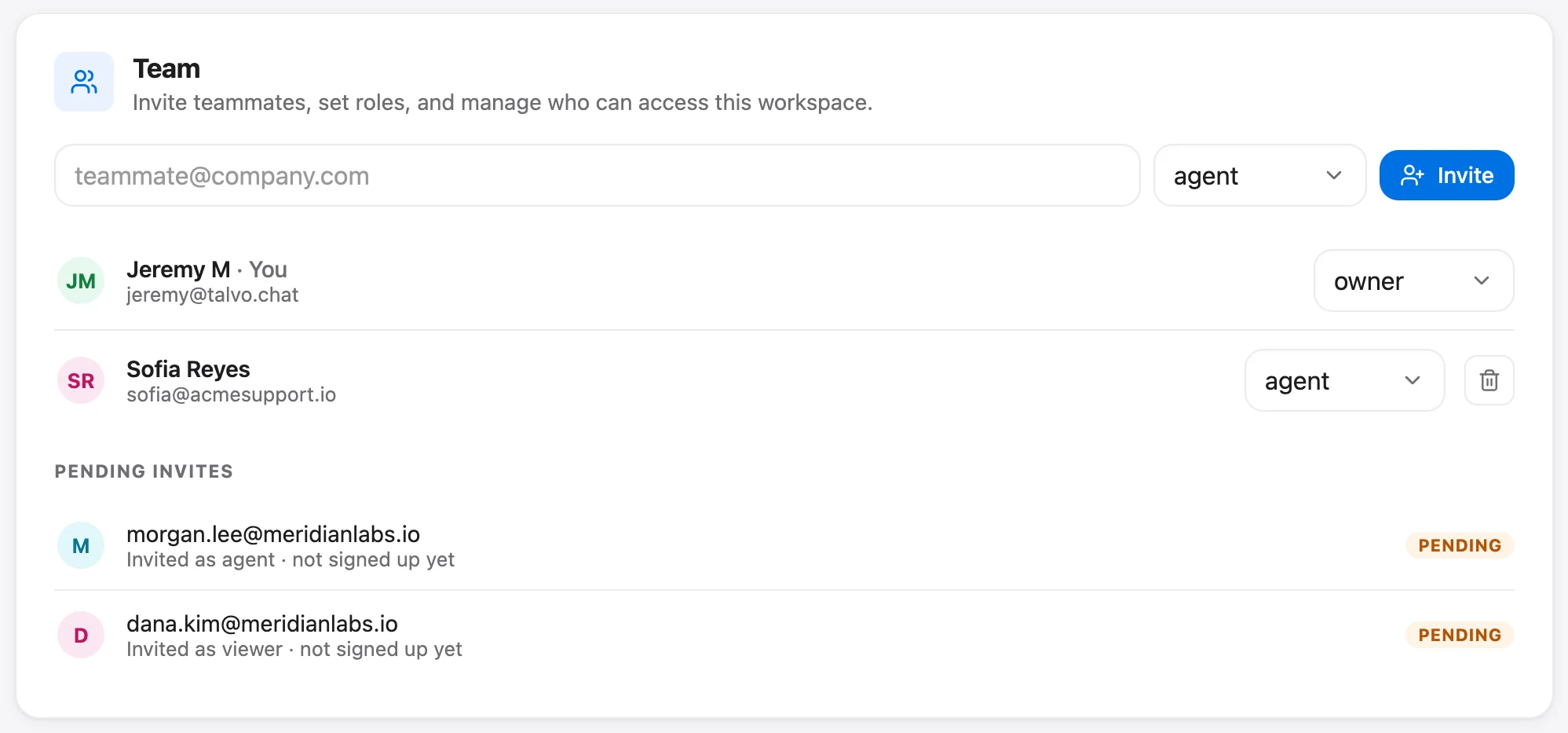
When each seat is $55 a month, someone decides who gets one. The founder who answers three escalations a week doesn't. The engineer who knows the answer to the bug question doesn't. The consequence is a support team that is smaller than the set of people who could help, and answers that stay in someone's head or a side-channel Slack thread instead of the inbox.
Shared logins
The workaround is predictable: two people use one login. Check your vendor's terms, because many restrict sharing a login. You also lose the things you bought the tool for. Replies aren't attributed to a person, internal notes lose their author, response-time reports blur, and you cannot revoke one person's access without cutting off the other. If you're doing this, the real problem is the pricing model, and the fix is a plan that doesn't charge for the extra person.
Part-time and seasonal agents
A seat costs the same whether the person works 40 hours or 4. A seasonal ecommerce team that adds three people for two months pays for them under a monthly seat plan, but downgrades typically take effect at renewal, according to Intercom's FAQ. Flat plans smooth this out if the extra bodies fit under the cap, and break it if they push you over.
Viewer and light seats
Some per-seat vendors discount the people who only read. Intercom's Advanced plan includes 20 free Lite seats and Expert includes 50, but only Full seats can send messages. Zendesk has light agents, who also don't count toward its AI resolution allowance. These are real concessions, and they are worth using before you conclude per-seat is hopeless for a team with many observers.
The upgrade you didn't plan
Plan caps cause step-ups too. Help Scout's 26th user forces Plus. Front's Starter plan stops at 10 seats and the next tier is $65 a seat. Crisp's Mini plan stops at four. Read the cap line before the price line.
How to choose
Start with your growth path, not your current headcount. A team of one or two should start with the free tiers. At three, flat pricing already competes: Crisp's Mini at $45 and Talvo's Starter at $39 on annual billing ($49 monthly) both undercut every per-seat plan in the table, so the choice becomes channels and AI rather than price. A team of five to twenty-five, hiring, with collaborators who dip in and out, is where flat per-workspace pricing pays back.
Then look at conversation volume per head. If each agent handles a few dozen conversations a day, per-seat and flat both work, and the question is which tier you must buy for features. If one agent handles a thousand a month, ticket-based pricing may be cheaper than either.
Third, check seasonality. Spiky volume punishes ticket and conversation meters. Spiky headcount punishes annual seat contracts.
Finally, price the add-ons, because they decide most real bills. Zendesk's Copilot is $50 an agent a month (annual) and needs Suite Professional at $115, so that seat is really $165. Intercom's Copilot is $29 on annual billing or $35 monthly, which doubles the cost of an Essential seat. Zendesk's Contact Center add-on is another $83 an agent. Flat plans have add-ons too. Talvo's AI Sales Agent is $79 a month ($69 annually) on Starter and Growth and included on Scale.
To pressure-test any quote, ask these:
- What is the cap, per plan, on seats, contacts and tickets?
- What does the next person cost when I'm at the cap?
- Do viewers, light agents or collaborators count as seats?
- Can I remove a seat mid-term, and when does the saving start?
- What does AI cost on top, and does it have a meter of its own?
- What changes at renewal?
What Talvo's model gives up
Flat pricing with caps is a trade. You don't pay per head, and the price is predictable up to the cap, but you pay for room you may not use and you take a step at 6, 16 and 26. Talvo is also a beta product with real gaps: no WhatsApp, SMS, Instagram or Messenger channel yet, no phone, no Zapier, native Shopify or HubSpot integration, and no SOC 2 report or SAML single sign-on. If those matter, a seat-priced vendor that has them may be the right buy, even at three times the price.
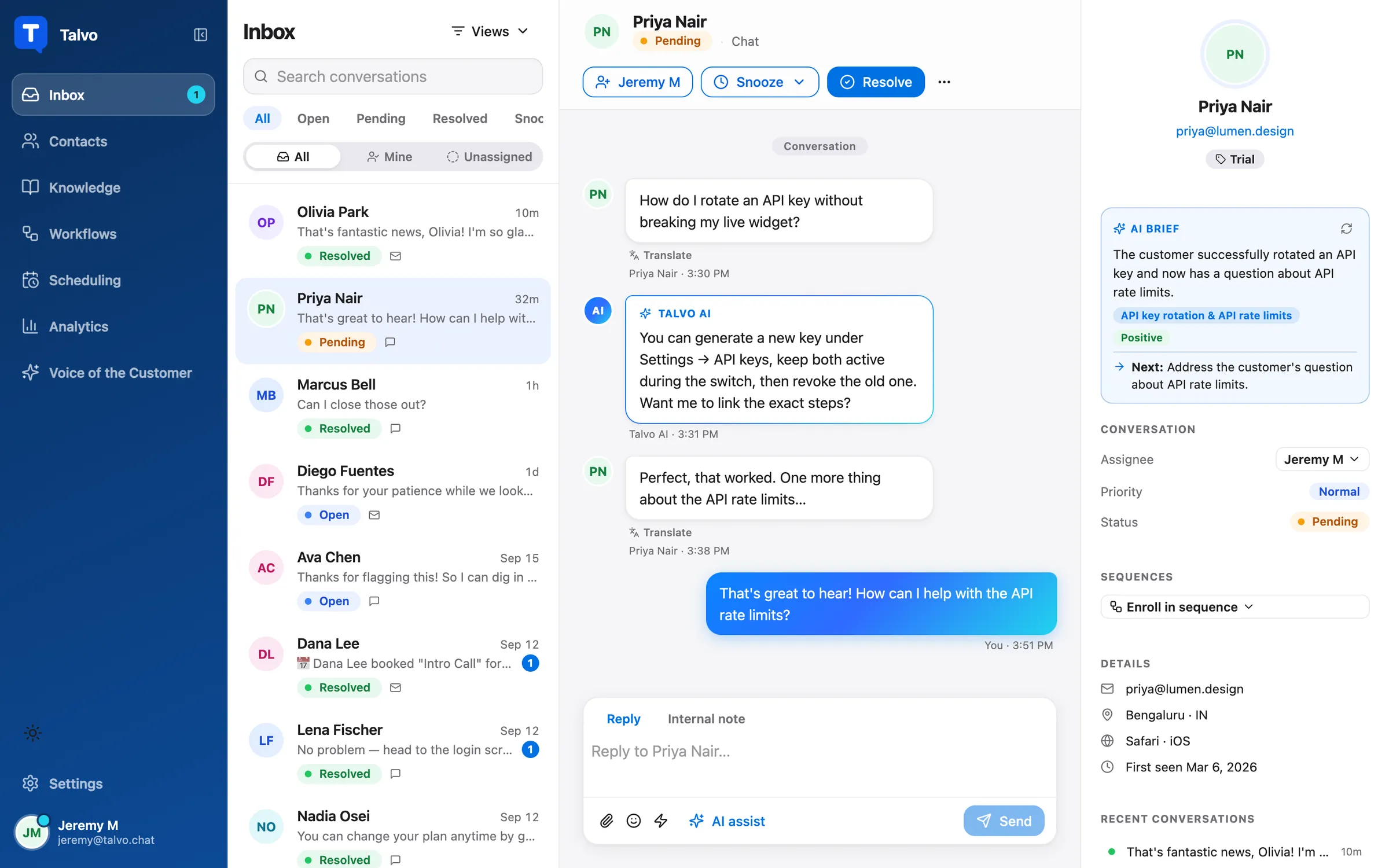
If they don't, the pricing page has the plan grid and the billing help article explains how teammates and AI resolutions are counted. For a wider set of priced options, see the cheaper Intercom alternatives and Intercom's pricing in full. The shared inbox is the feature that every teammate on a flat plan gets to use.
Frequently asked questions
Is per-seat pricing bad?
No. For a team of one or two people, per-seat pricing and free tiers are often the cheapest option, and many vendors have free tiers. It gets expensive as headcount grows or when you want occasional collaborators in the tool, because every person costs the same whatever they do.
What does flat-rate live chat or help desk pricing mean?
It means one monthly price for the workspace, covering up to a set number of teammates, instead of a charge for each person. Crisp and Talvo both price this way. The price is flat across a band of headcount and then steps up to the next plan.
Are unlimited-agent plans really unlimited?
Usually not in every dimension. Flat plans cap seats (Talvo: 2, 5, 15 and 25 teammates by plan; Crisp: 2, 4 and 10 included), or they meter something else, such as Crisp's customer profiles or AI usage. Ask what the cap is on seats, contacts, tickets and AI before you rely on a plan being unlimited.
Which is cheaper for a growing team?
On annual list prices, Talvo's Starter plan ($39 for up to 5 teammates) is cheaper than any per-seat plan in our table for teams of 3 to 5, and its Growth plan ($119 for up to 15) is cheaper than a $29 seat from the fifth agent. Crisp's monthly pricing and free tiers can still be cheaper for very small teams.
Is sharing one login to save on seats allowed?
Check your vendor's terms before doing it; many restrict shared logins. It also removes attribution: replies, internal notes and response-time reports can't be tied to a person, and you can't revoke one user's access without affecting the other.
How is Gorgias priced compared with per-seat tools?
Gorgias charges by monthly ticket volume, not by agent. On annual billing, Basic is $50 for 300 tickets, Pro is $300 for 2,000 and Advanced is $750 for 5,000, with 500 user seats on those plans. That favors lean teams with many tickets per agent and penalizes spiky volume.
How do teammate caps work on Talvo?
Talvo is priced per workspace. Free allows 2 teammates, Starter 5, Growth 15 and Scale 25, and Enterprise is negotiated. Adding a teammate up to the plan's limit never changes the bill; going past it means the next plan.
Sources
Other products' prices and features change. We checked these pages; if something is out of date, tell us and we'll fix it.
- Intercom pricing (checked Oct 21, 2026)
- Zendesk pricing (checked Oct 21, 2026)
- Help Scout pricing (checked Oct 21, 2026)
- LiveChat pricing (checked Oct 21, 2026)
- Freshdesk pricing (checked Oct 21, 2026)
- Freshchat pricing (checked Oct 21, 2026)
- Front pricing (checked Oct 21, 2026)
- HubSpot Service Hub pricing (checked Oct 21, 2026)
- Chatwoot pricing (checked Oct 21, 2026)
- Crisp pricing (checked Oct 21, 2026)
- Gorgias pricing (checked Oct 21, 2026)
- Tidio pricing (checked Oct 21, 2026)
- Talvo pricing