On this page
Intercom (now Fin) is worth it for a company with real support volume, a product people use while logged in, and a budget that can absorb a bill that moves. It is usually not worth it for a team of two to ten answering mostly chat and email, where the AI line quickly outgrows the seat line. The honest answer depends on three things: what channels your customers use, how many conversations the AI will handle, and whether anyone will ask you for a security report.
That's the short version. The rest of this page is the reasoning, the arithmetic at three team sizes, and what to do if the answer is no. We make Talvo, one of the alternatives, so we've kept Intercom's numbers to its own pricing and security pages (checked October 21, 2026) and put the trade-offs where Intercom wins in plain view.
When Intercom is worth it
Start with the cases where you should simply buy it, because there are several.
If your product is software that customers log into, Intercom's messenger and in-app messaging are built for exactly that. Its Proactive Support Plus add-on covers product tours, checklists, surveys and in-app posts, which is a different kind of product from a plain chat widget. If a big part of your support is guiding people through the product, that matters more than the monthly figure.
If customers reach you on WhatsApp, SMS, Instagram, Messenger or the phone, Intercom supports all of them. Several cheaper tools don't, and the ones that do each have their own limits.
If a procurement team will ask for a SOC 2 Type II report, SSO, HIPAA support or a choice of US, EU or Australian hosting, Intercom has them (SSO and HIPAA on its Expert plan). That alone ends many evaluations before price comes up.
And if Fin's quality is the thing you're paying for, that's a legitimate reason. Reviewers often praise Fin's resolution quality, alongside the polished Messenger. When each resolved conversation replaces real agent time, $0.99 is not a high price. Which brings us to the math.
Is Fin worth $0.99 per outcome?
Compare it with the alternative: a person. Suppose a conversation the AI resolves would otherwise take an agent five minutes, and an agent costs you $25 an hour fully loaded. Those are our assumptions, not Intercom's figures, and you should replace them with your own. Five minutes at $25 an hour is about $2.08. Against that, $0.99 is a bargain.
Now the catch. Intercom bills an outcome when the customer confirms the fix, when the customer doesn't ask for more help after Fin responds, or when Fin completes a workflow it calls a Procedure, including handoffs. The middle case means a customer who gives up and closes the tab can be billed. A handoff that ends a completed Procedure can be billed too. So your real cost per saved agent-minute is higher than $0.99 divided by five minutes, and it's hard to forecast, because you can't know in advance how many of your customers go quiet.
A reasonable test: pull a month of your conversations, count the ones a good AI could plausibly answer, and multiply by $0.99. That's your ceiling. If it's a fraction of what the same hours cost in labor, Fin pays for itself. If it's most of an agent's salary, you're renting a very expensive FAQ page, and our guide to AI resolution pricing shows how other vendors compare.
What Intercom costs at your size
Intercom has no free plan, only a 14-day trial with no credit card. Seats start at $29 on Essential billed annually ($39 monthly), $85 on Advanced ($99 monthly) and $132 on Expert ($139 monthly), per seat, per month. Fin is a separate $0.99 per outcome on top. Here is what that means for three teams, next to two alternatives on their published list prices. The assumptions: monthly billing, every person on a paid seat, and the stated number of AI-resolved conversations.
| Team | Intercom Essential | Help Scout Standard | Talvo |
|---|---|---|---|
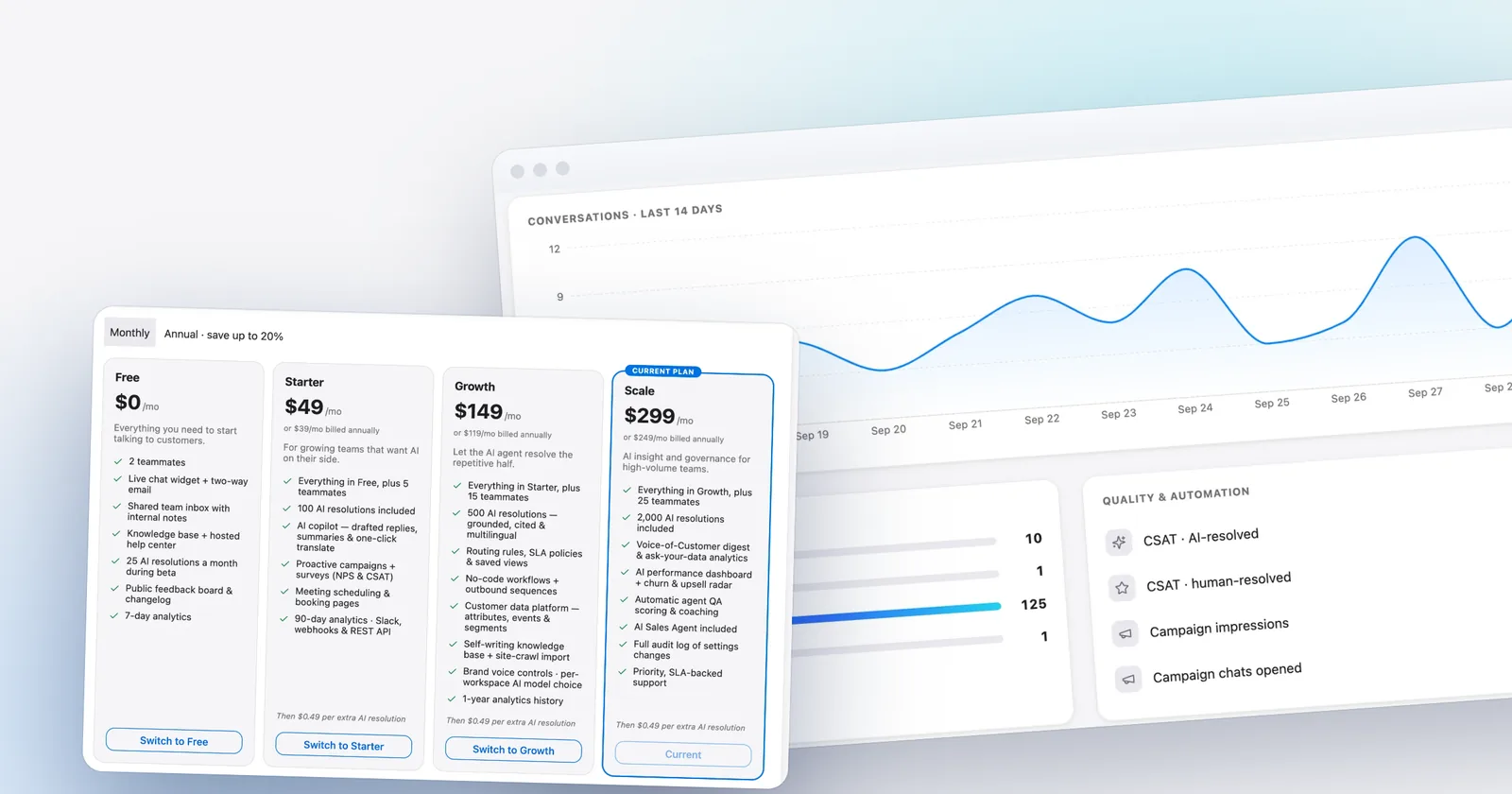
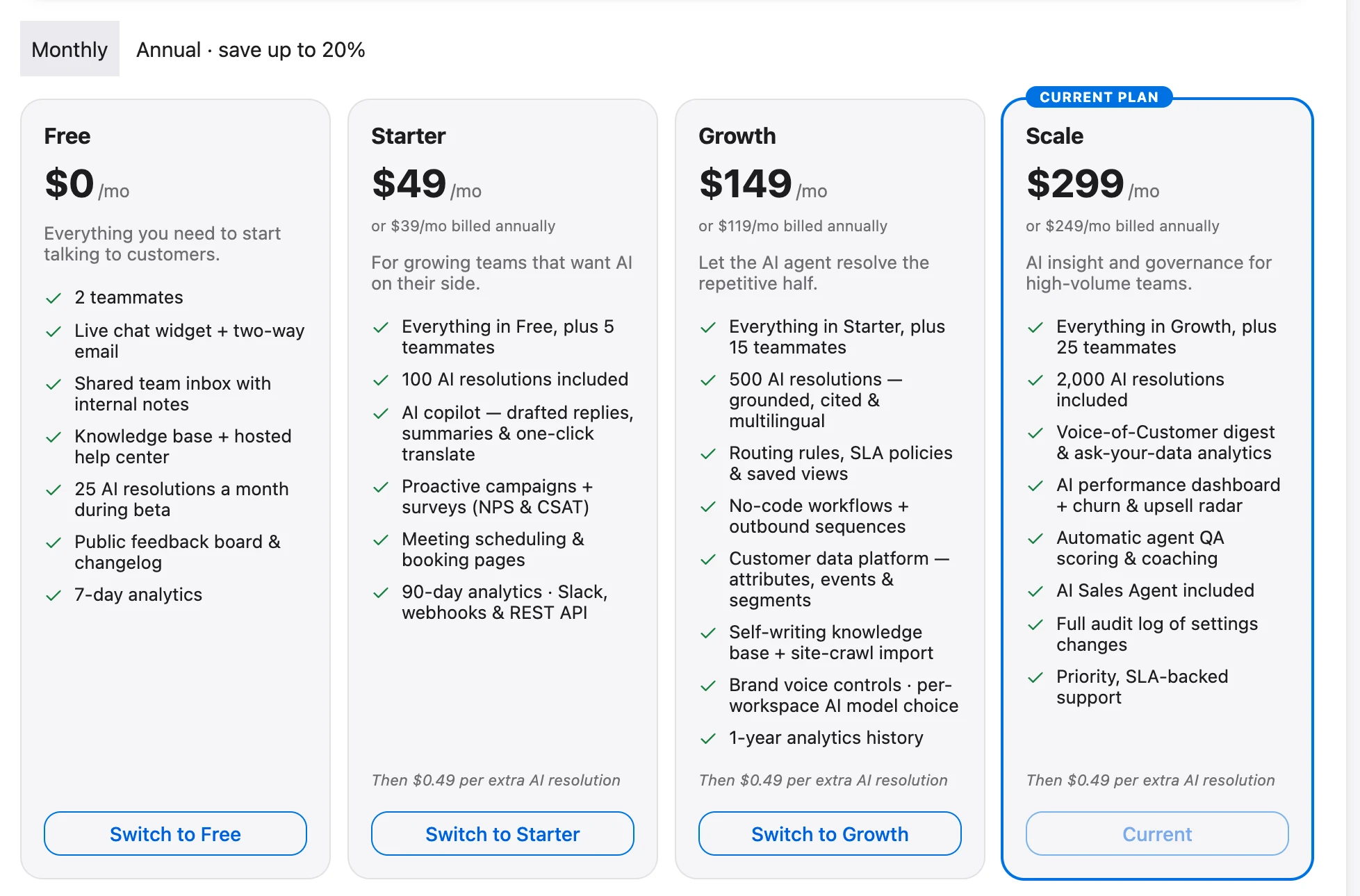
| 2 people, 200 AI resolutions | 2 × $39 = $78, plus 200 × $0.99 = $198, equals $276 | 2 × $30 = $60, plus 200 × $0.75 = $150, equals $210 | Starter $49, plus 100 beyond the 100 included × $0.49 = $49, equals $98 |
| 5 people, 1,000 AI resolutions | 5 × $39 = $195, plus 1,000 × $0.99 = $990, equals $1,185 | 5 × $30 = $150, plus 1,000 × $0.75 = $750, equals $900 | Scale $299 (1,000 is within the 2,000 included), equals $299 |
| 10 people, 3,000 AI resolutions | 10 × $39 = $390, plus 3,000 × $0.99 = $2,970, equals $3,360 | 10 × $30 = $300, plus 3,000 × $0.75 = $2,250, equals $2,550 | Scale $299, plus 1,000 beyond the 2,000 included × $0.49 = $490, equals $789 |
Annual billing trims each column a little and doesn't change the shape. Two things stand out. The AI line is most of the Intercom bill at every size, so negotiating seats saves little. And the gap widens as AI volume grows, because per-resolution rates are multiplied by volume while Talvo's included allowances absorb a large share of it.
This table prices Essential. If you need Intercom's workflow builder or multiple inboxes, you're on Advanced, which adds $60 per seat per month at monthly rates. If you want tours or surveys, add $99 for Proactive Support Plus. Want a deeper breakdown? See Intercom pricing in 2026, and the vendors' own pages are linked at Intercom, Help Scout and Crisp.
When Intercom isn't worth it
Three profiles keep coming up in the complaints and in the math.
The first is the small team with growing AI volume. Seats are cheap; Fin isn't. A five-person team handling 1,000 AI conversations pays about five times as much for Fin as for its seats. The more the AI works, the more the bill grows, which is a strange incentive for the vendor and a hard one for the buyer to budget around.
The second is the email-heavy support team. Most of what Intercom is best at, the messenger, in-app messages and proactive tours, is about live interaction. If most of your volume is email, you're paying for a product tuned for something else. Help Scout, whose pricing is per user and whose core is an email-style inbox, fits that shape better, and it's the cheaper of the two in the table above.
The third is the team that needs a predictable bill. The most-cited complaint in third-party reviews is cost predictability: seats, plus per-outcome Fin, plus per-channel usage for WhatsApp, SMS and phone, plus add-ons for anything proactive. Some reviewers also describe renewal and pricing disputes, and a few note weaker responsiveness from support. Those come from review roundups, several written by competitors, so read them as directional. Trustpilot is reported to be much lower than G2.
If you want the long version with more tools priced, see cheaper Intercom alternatives.
Intercom pros and cons, plainly
What its happy customers say: the messenger looks and feels better than most competitors, the inbox is capable, and Fin resolves a real share of questions. The product is broad, so you can grow into features rather than change tools. Third-party roundups put it at about 4.5 on both G2 and Capterra, from thousands of reviews. We couldn't open those sites directly, so treat the numbers as approximate.
What its unhappy customers say: it costs more than expected and the bill is hard to forecast, product tours and outbound messages are separate purchases, and the value-for-money score is the weakest on Capterra. Whatever any vendor claims, your own help content and your customers' questions will decide your resolution rate.
Is Intercom good for small businesses? It can be, if the small business is a software company with in-app support needs, or one that qualifies for the startup discount. For a local service business, a store or an agency answering questions by chat and email, it is more product than you'll use at a price that scales with both people and conversations.
Before you renew or sign: a short checklist
Pull twelve months of conversation counts so you know your real volume, not a guess. Multiply the AI-answerable share by $0.99 and compare it with the labor it replaces. Ask what happens to a conversation when a customer goes quiet after Fin replies, and whether you can cap monthly Fin spend. Ask which of your current features sit in add-ons. Find your contract's notice period, because downgrades typically take effect at renewal. And since Salesforce now owns Fin, ask what protects your pricing for the term.
If a vendor can't answer those cleanly, that tells you something too.
The acquisition question
In May 2026 the company renamed itself Fin. In June Salesforce announced it had agreed to acquire it for about $3.6 billion in cash, and on September 10, 2026 Salesforce announced the acquisition was complete.
What it means for you is uncertain, and anyone who tells you otherwise is guessing. Pricing and packaging often change after an acquisition, though we can't tell you which way. If you're about to sign a multi-year contract, ask about price protection and whether the terms change now that Salesforce owns Fin. If you're on a monthly plan, you have the flexibility to wait. Our explainer on Intercom, Fin and Salesforce has the questions to put to your account manager.
What to do instead
You have four sensible moves, and not all of them involve leaving.
Stay and trim. If you're an early-stage startup, check Intercom's Early Stage program, which lists 93% off and a year of Fin free for eligible companies. Confirm the eligibility rules with Intercom. Otherwise, look at your plan: many teams on Advanced only need Essential plus a handful of features.
Crisp prices per workspace. The Mini plan is $45 a month for 4 seats, Essentials is $95 for 10 seats, and Plus is $295. It supports many more channels than most flat-priced tools, including WhatsApp, Instagram, SMS and phone (the omnichannel inbox starts on Crisp's Essentials plan, and each workspace connects only one account per social channel). Its AI, Hugo, runs on monthly credits that Crisp estimates at about $0.05 to $0.10 per conversation, billed on usage rather than on resolutions. It usually has the lowest sticker price on this page, but Crisp says it has not been through a SOC 2 audit. Cheaper per-conversation AI is also not the same product as Fin. See Crisp vs Intercom.
Help Scout suits teams where email is the main channel. Standard is $25 per user a month billed annually ($30 monthly), with AI Answers at $0.75 per resolution and a spending cap you can set. It holds a SOC 2 Type 2 report and supports HIPAA, and its SSO is on the Pro plan. It also has live chat and several messaging channels, but it's an email-first desk and per-user pricing still applies.
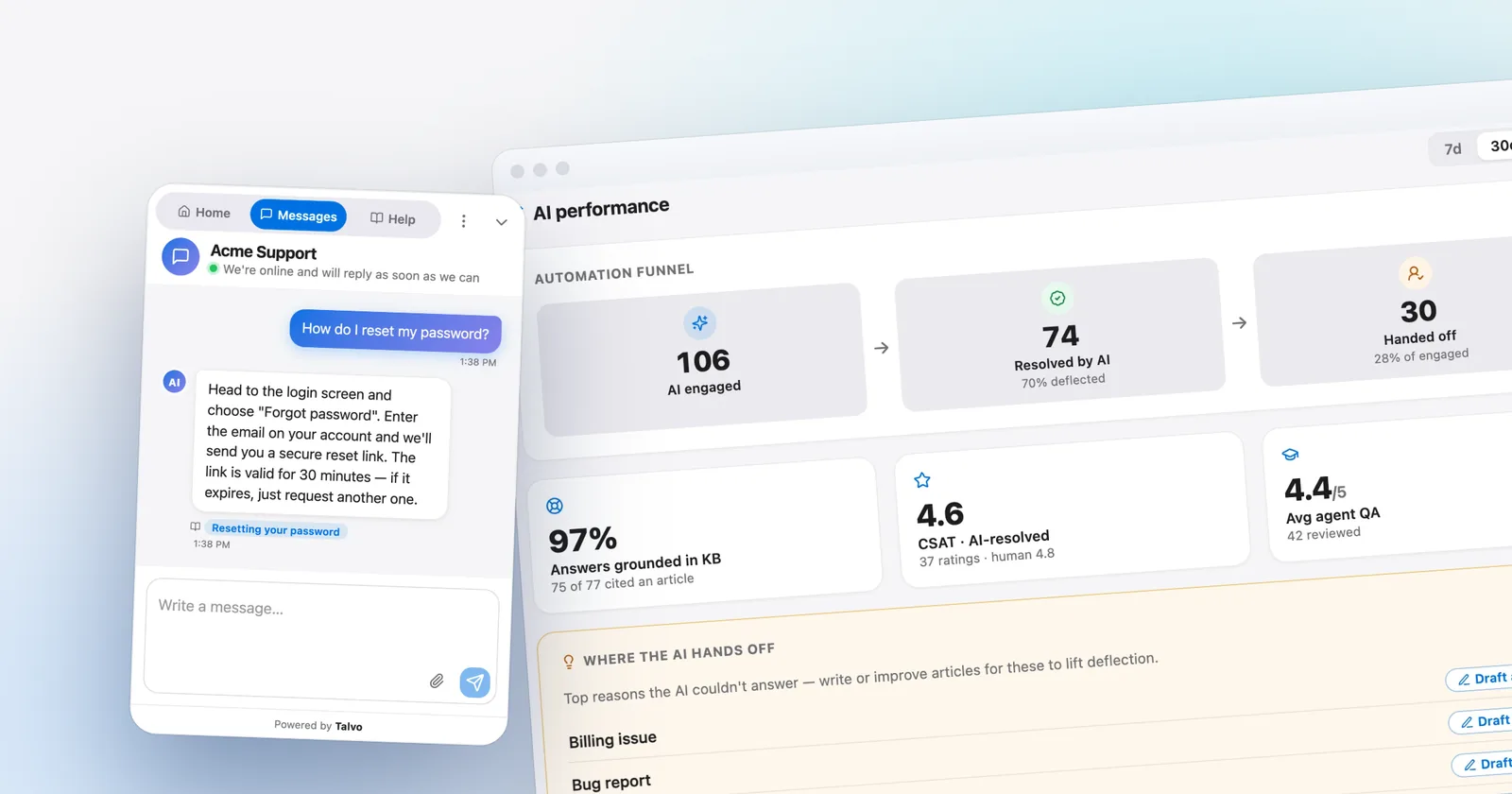
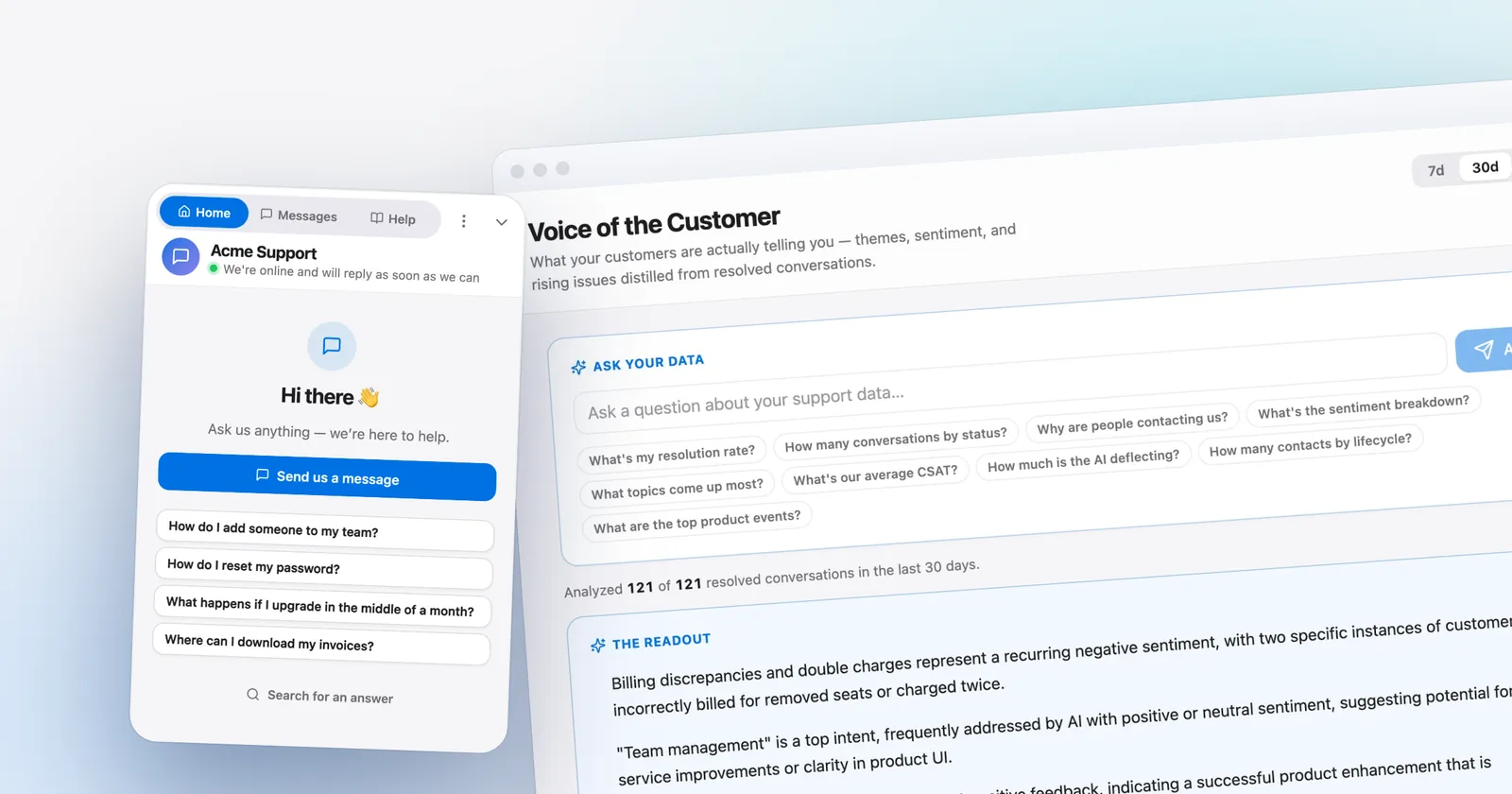
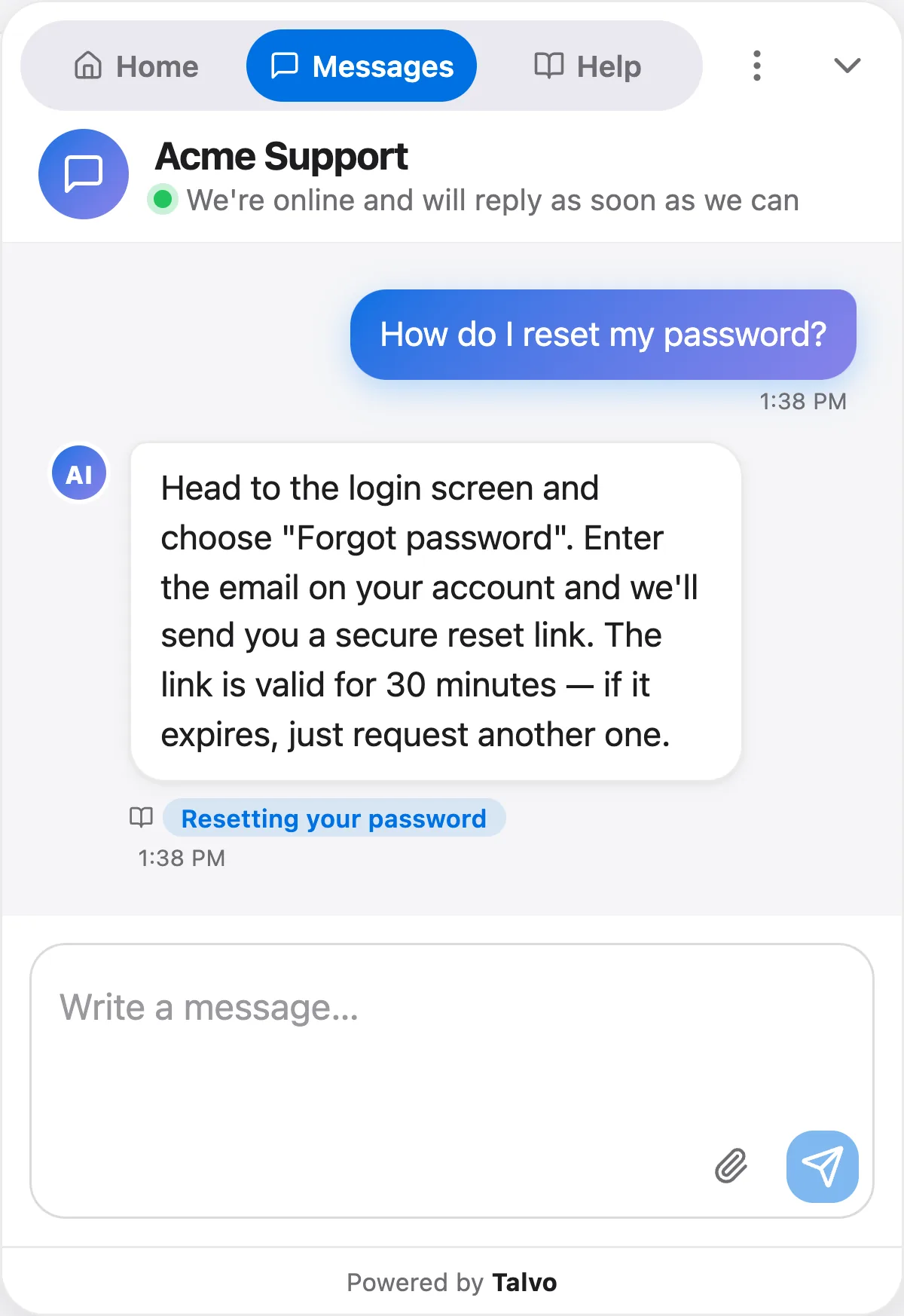
Talvo is the one we make, so weigh this accordingly. Pricing is per workspace with teammates included up to the plan limit, AI resolutions cost $0.49 beyond the allowance, and the agent answers only from your published help articles and shows which one it used. If it isn't confident it hands off with the conversation intact.
The costs of choosing Talvo are real. It launched in 2026 and is in beta with no reviews yet. It supports chat and email only, with no WhatsApp, SMS or phone. It has no SOC 2, SAML SSO, HIPAA or data-region choice. Integrations are a REST API, webhooks and Slack. If any of those is a requirement, Talvo is the wrong answer today, and we'd rather you know before reading our pricing page. Our full Talvo vs Intercom comparison goes through each gap.
A quick answer by team size
Solo to three people, mostly chat and email: Intercom is hard to justify unless you qualify for the startup program or need its channels. A flat-priced tool or Help Scout will cost a fraction.
Four to fifteen people, growing AI volume: this is where the Fin line decides it. Price your real conversation numbers on two or three tools before renewing, and use the pricing page for ours.
Twenty-plus people, multiple channels, compliance questions, a product customers live inside: Intercom earns its price. Get quotes, negotiate the contract, and ask how Salesforce ownership affects the terms. At this size the paperwork usually matters more than the sticker.
Which should you choose?
- you are a small team on chat and email and want a bill that does not rise with each hire
- you expect the AI to handle many conversations and want $0.49 rather than $0.99 per resolution
- you can accept a new beta product without reviews, SOC 2 or WhatsApp
- you run a product customers log into and want tours, checklists and in-app messaging
- customers contact you on WhatsApp, SMS or phone
- buyers will ask for SOC 2, SSO, HIPAA or a choice of data region
- the volume and budget are large enough that Fin's quality justifies $0.99 an outcome
Frequently asked questions
Is Intercom worth the money?
It is for teams with product-led support, multi-channel needs or compliance requirements, and enough volume to justify Fin. For a small team on chat and email it often is not, because Fin's $0.99 per outcome outgrows the seat cost: 5 people with 1,000 AI resolutions is about $1,185 a month at list prices on monthly billing.
What are the downsides of Intercom?
The most-cited downside in reviews is cost predictability, since seats, Fin outcomes and channel usage all add up. Fin can bill when a customer stops replying after an answer, product tours and surveys need a separate $99 add-on, and there is no free plan. Reviews are mostly from secondary sources, so treat them as directional.
Who is Intercom best for?
Software companies whose customers use the product while logged in, teams that need WhatsApp, SMS or phone support, and organizations that require SOC 2, SSO, HIPAA or data-region choice. It also suits teams with the budget to pay for Fin's quality.
Is Intercom good for small businesses?
Sometimes. A small software company that qualifies for the Early Stage program, listed at 93% off, can find it good value. A small store, agency or service business using chat and email will usually pay more than it needs to, because both seats and AI conversations add to the bill.
Does Intercom have a free plan?
No. Intercom offers a 14-day trial with no credit card needed and an Early Stage program for eligible startups, but no free plan. Essential starts at $29 per seat per month billed annually or $39 billed monthly, plus $0.99 per Fin outcome.
What is a cheaper alternative to Intercom?
Crisp, Help Scout and Talvo are three, each with trade-offs. Crisp charges per workspace and covers many channels, Help Scout suits email-first teams at $0.75 per AI resolution, and Talvo charges per workspace with $0.49 per extra resolution but is a new beta product with only chat and email.
Did Salesforce buy Intercom?
Yes. Salesforce agreed in June 2026 to acquire Intercom, which renamed itself Fin in May 2026, for about $3.6 billion, and announced on September 10, 2026 that the acquisition was complete.
Sources
Other products' prices and features change. We checked these pages; if something is out of date, tell us and we'll fix it.
- Intercom pricing page (checked Oct 21, 2026)
- Intercom security page (checked Oct 21, 2026)
- Salesforce press release: Salesforce completes acquisition of Fin (Sept 10, 2026)
- Help Scout pricing page (checked Oct 21, 2026)
- Crisp pricing page (checked Oct 21, 2026)
- Crisp Hugo pricing and billing (checked Oct 21, 2026)
- Talvo pricing (checked Oct 21, 2026)
- Unthread, Intercom review (secondary, competitor-authored)