On this page
- What each product is
- Two pricing models, side by side
- What counts as a resolution
- An Intercom alternative for small business budgets: the same team priced both ways
- The AI agent: where Fin is ahead and where Talvo is different
- Inbox, email and help center
- Automation and proactive messaging
- Channels: Intercom is well ahead
- Integrations and the API
- Security and compliance: not close
- Maturity and reviews
- Switching from Intercom: what moves and what doesn't
- Talvo vs Intercom: a fair verdict
- Frequently asked questions
Put five support people and 1,000 AI-answered conversations a month on Intercom (now Fin), and the list-price bill is about $1,185. The same team on Talvo comes to $299. That gap is why most people end up reading a "Talvo vs Intercom" page, and it's real. It is also not the whole story, because Intercom is ahead of us in several places that may matter more to you than money.
Talvo makes a competing product, so here is how we kept this fair. Every Intercom number below comes from Intercom's own pricing and security pages, checked on October 21, 2026, and the arithmetic is shown so you can redo it. Every Talvo claim comes from our own product and pricing. Where Intercom wins, we say so plainly, and there's a section near the end for who should stay.
What each product is
Intercom is a long-running customer messaging product. In May 2026 the company renamed itself Fin, and "Intercom" now refers to the helpdesk product, though the pricing page and the domain still say Intercom. Salesforce announced a deal to buy it for about $3.6 billion in June 2026 and completed the acquisition on September 10; Fin now sits inside Salesforce's AI Labs group and, in Salesforce's words, will continue to serve its customers. Our Intercom, Fin and Salesforce explainer covers what that means for existing customers.
The product itself is a polished messenger, a shared inbox with ticketing, a help center, and Fin, the AI agent that answers customers. It has a deep feature set and an enterprise sales motion to match.
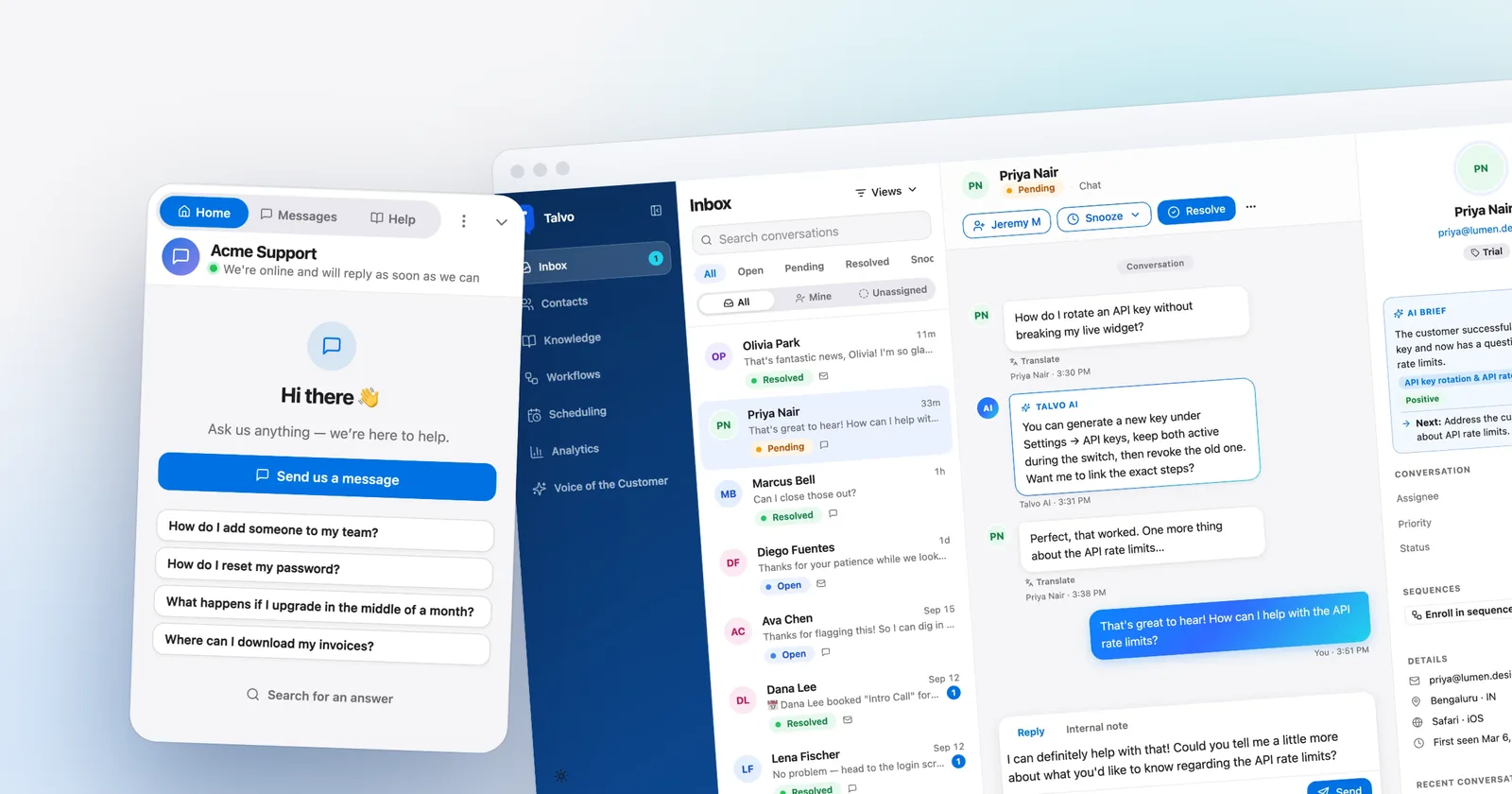
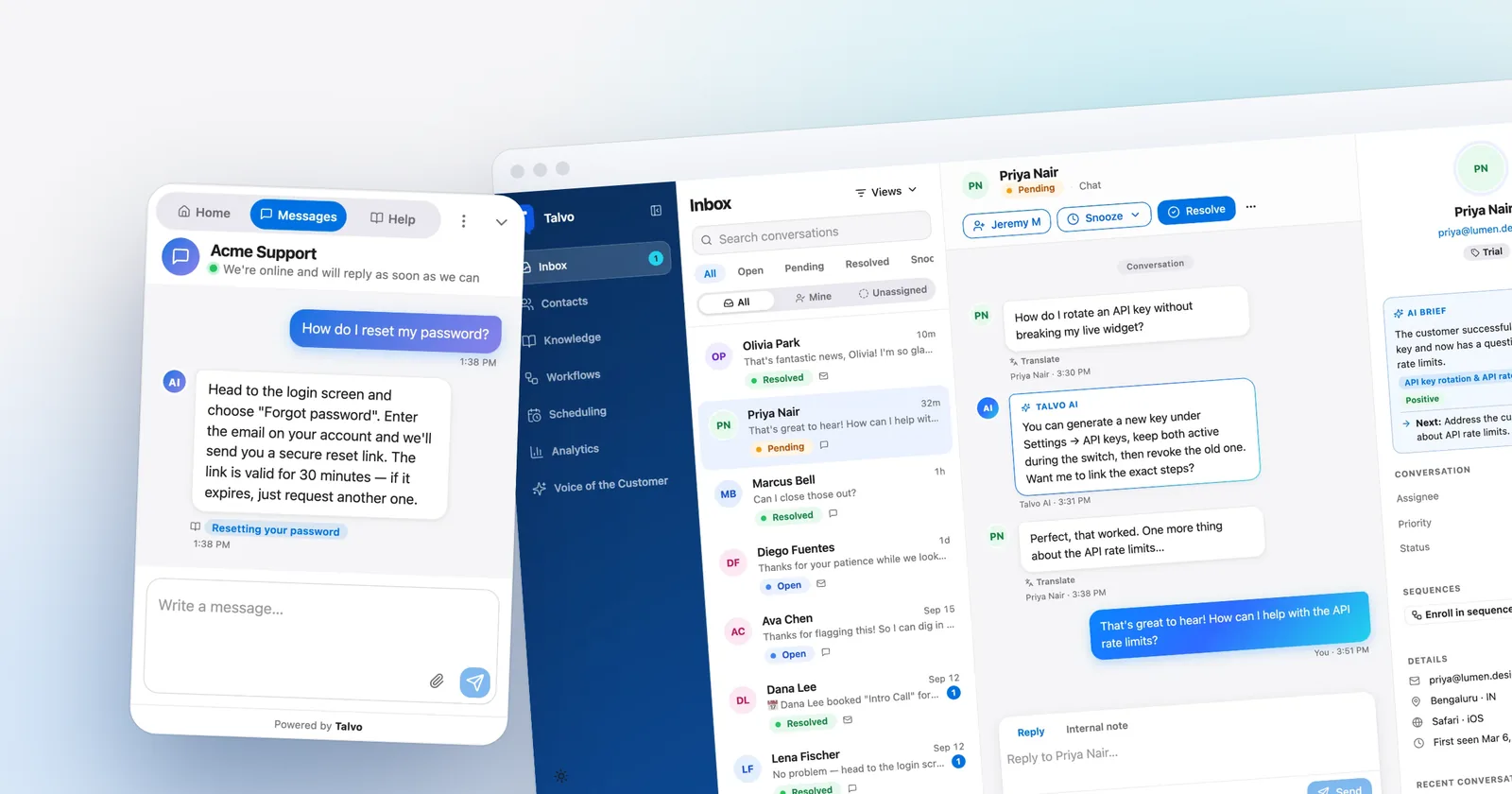
Talvo is a newer, smaller product with the same basic shape: a live chat widget, an AI agent that answers from your help articles, a shared inbox with two-way email, a knowledge base and hosted help center, and no-code workflows. It launched in 2026 and is in beta. It has no customer case studies to show you, no review-site ratings yet, and a list of gaps we'll get to. What it has instead is a different pricing model, and that's the real argument.
Two pricing models, side by side
Intercom charges per seat, then adds usage on top. Talvo charges per workspace and adds usage only for AI beyond what's included.
On Intercom, the helpdesk plans are priced per seat per month. As listed on Intercom's pricing page in October 2026:
| Intercom plan | Annual billing | Monthly billing | What it adds |
|---|---|---|---|
| Essential | $29 per seat | $39 per seat | Fin, Messenger, shared inbox and ticketing, public help center |
| Advanced | $85 per seat | $99 per seat | Multiple inboxes, workflow builder, private and multilingual help center |
| Expert | $132 per seat | $139 per seat | SSO, HIPAA support, SLAs, multibrand |
New customers are currently shown lower promotional prices on Essential. They don't say how long those last, so we use list prices throughout. On top of seats, Fin costs $0.99 per outcome on every plan. Copilot, Intercom's assistant for your own agents, is $29 per agent per month billed annually ($35 monthly). Product tours, surveys and outbound campaigns aren't in any base plan; they sit in the Proactive Support Plus add-on at $99 a month including 500 messages. WhatsApp, SMS, phone and email campaigns are billed as usage.
On Talvo, pricing is per workspace:
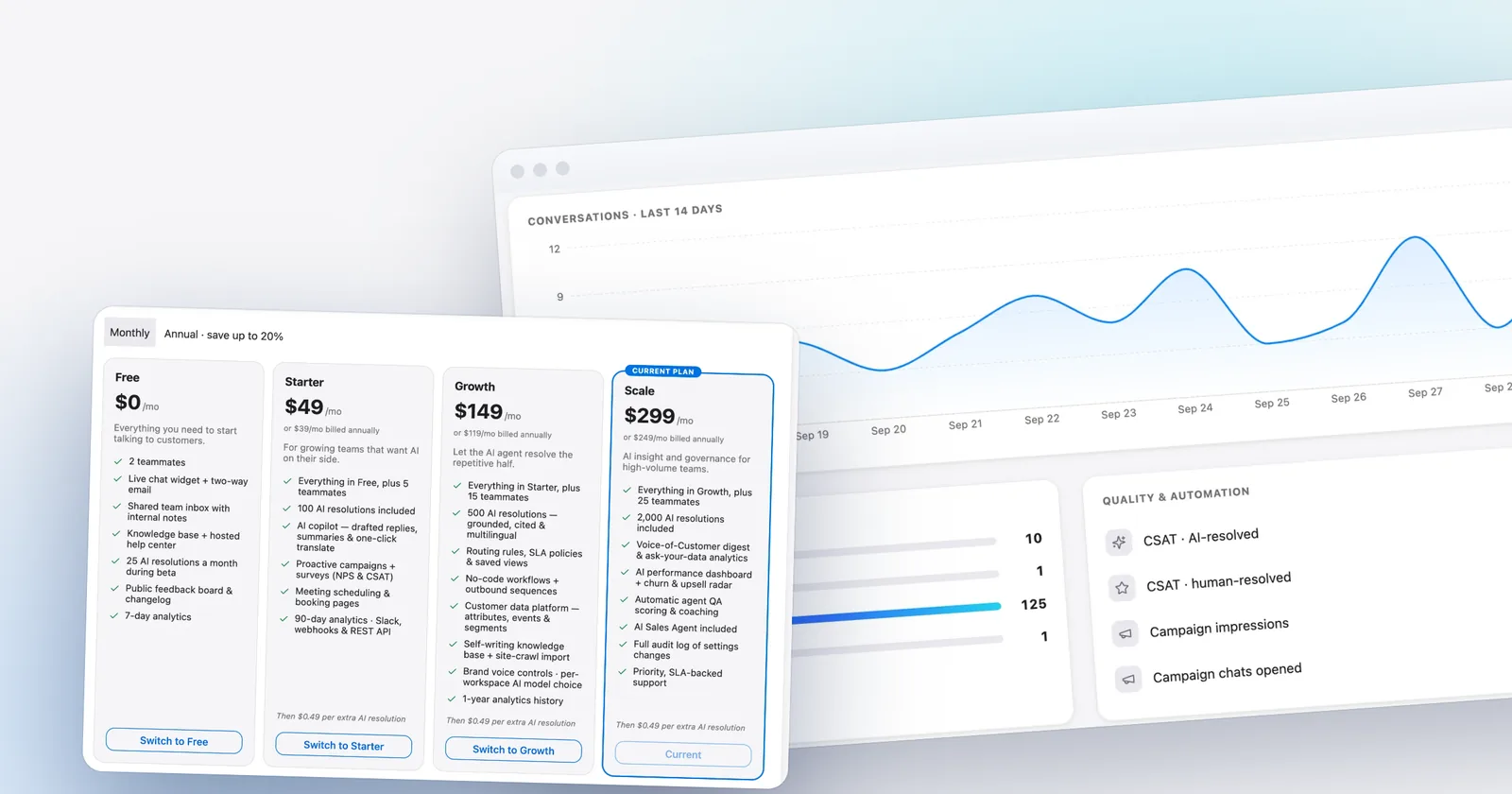
| Talvo plan | Monthly billing | Annual billing (per month) | Teammates | AI resolutions included |
|---|---|---|---|---|
| Free | $0 | $0 | 2 | 25 a month during the beta |
| Starter | $49 | $39 | 5 | 100 |
| Growth | $149 | $119 | 15 | 500 |
| Scale | $299 | $249 | 25 | 2,000 |
Past the included amount, each extra AI resolution is $0.49 on every paid plan. Adding a teammate up to the plan's limit never changes the bill. Plans are month to month with no contract on self-serve.
So one model scales with headcount and one scales with how much the AI does. That's the first thing to decide about your own team. If you're hiring support people, per-seat pricing grows with every hire. If your AI is going to handle most conversations, the per-resolution rate matters more than the seat price. We go deeper on the first question in per-seat vs flat pricing.
What counts as a resolution
Both vendors bill the AI by the result, not by the message, and the definitions are closer than the price suggests.
Intercom's help documentation says Fin charges an outcome when the customer confirms the issue is resolved, or when the customer doesn't ask for more help after Fin responds, or when Fin completes a workflow it calls a Procedure, including handoffs. It's charged once per conversation. That second condition is the one to understand: a customer who simply stops replying can be billable.
Talvo counts a conversation the AI answered from your published knowledge base without a teammate stepping in, once per conversation. If the AI hands off to a human, it isn't a resolution. Read the details in what counts as an AI resolution.
We aren't claiming our definition is stricter. A quiet customer after an AI answer counts on both. The difference worth noticing is that a hand-off never bills on Talvo, while a completed Procedure that ends in a hand-off can bill on Intercom. The bigger difference is simply the rate: $0.99 against $0.49.
An Intercom alternative for small business budgets: the same team priced both ways
Here is the same team on both products at three sizes. The assumptions: list prices, monthly billing, every agent on a paid seat, and the AI resolving the number of conversations shown. Intercom is priced on Essential at $39 per seat monthly, with Fin at $0.99 per outcome. Talvo is priced on the cheapest plan that fits the team and the AI volume.
| Team | Intercom (Essential) | Talvo | Difference |
|---|---|---|---|
| 3 agents, 300 AI resolutions | 3 × $39 = $117, plus 300 × $0.99 = $297, equals $414 | Starter $49, plus 200 beyond the 100 included × $0.49 = $98, equals $147 | $267 a month |
| 5 agents, 1,000 AI resolutions | 5 × $39 = $195, plus 1,000 × $0.99 = $990, equals $1,185 | Scale $299, with all 1,000 inside its 2,000 included, equals $299 | $886 a month |
| 10 agents, 3,000 AI resolutions | 10 × $39 = $390, plus 3,000 × $0.99 = $2,970, equals $3,360 | Scale $299, plus 1,000 beyond the 2,000 included × $0.49 = $490, equals $789 | $2,571 a month |
With annual billing both sides drop a little. Intercom seats fall to $29, which makes the three bills $384, $1,135 and $3,260. Talvo's cheapest fitting plan changes too: Growth at $119 for the 3-agent team (500 resolutions included beats Starter's $39 plus $98 of overage), then Scale at $249 for both larger teams, which makes the bills $119, $249 and $739. The ratio barely moves: Intercom runs roughly three to four and a half times the price at every size.
One quirk before the footnotes: at 5 agents and 1,000 resolutions, Talvo's Scale plan is cheaper than Growth ($149 plus 500 extra × $0.49 = $394), because Scale includes 2,000 resolutions. The cheapest plan also shifts with billing: for the 3-agent team it's Starter on monthly billing ($147) but Growth on annual ($119). Pick the plan by AI volume, not only by headcount.
Three honest footnotes. First, the Fin line dominates. At 5 agents, $990 of Intercom's $1,185 is AI, so the seat price is almost beside the point. Second, this table prices Essential. If you need the workflow builder or multiple inboxes on Intercom you're on Advanced at $99 per seat monthly, which puts the 10-agent team at $3,960. On Talvo, workflows start on the Growth plan ($149 a month). Third, at 3 agents on Talvo's Starter plan you don't get workflows or routing rules, so the comparison is not perfectly like for like at the low end.
If you're asking whether a startup can pay less on Intercom, there is a way. Intercom's Early Stage program lists "93% off" and a year of Fin free for eligible startups. If you qualify, run that number before you compare anything else. Check eligibility on Intercom's side, because we can't confirm the terms for you.
Want your own numbers? Set your team size and AI volume below.
- Crisp Mini~$100–$150/mo$45 per workspace + 1 agents × $10 + AI at Crisp's estimate of $0.05–$0.10 per conversation, less $5 of included credits · Estimate: top-up rate and annual prices aren't published
- Talvo Scale$299/mo$299 per workspace, 2,000 AI resolutions included
- Help Scout Standard$900/mo5 users × $30 + 1,000 AI resolutions × $0.75
- Intercom (Fin) Essential$1,185/mo5 seats × $39 + 1,000 Fin outcomes × $0.99 · Workflow automation needs Advanced ($85–$99 per seat)
- Zendesk Suite Team$2,295/mo5 agents × $69 + 975 AI resolutions × $2.00 (25 included) · $1.50 each with a committed 100+ purchase
Estimates from each vendor's published list prices, checked October 21, 2026. Assumes the cheapest plan that includes live chat and an AI agent, and that every AI-resolved conversation is billable. Excludes taxes, promotions, add-ons (such as agent copilots) and per-use channels like SMS or WhatsApp. Talvo's annual price includes extra resolutions at the same $0.49, billed once a year.
The AI agent: where Fin is ahead and where Talvo is different
Fin has the stronger reputation of the two, and reviewers often praise its resolution quality. It also runs outside Intercom: Fin sold standalone works on top of other helpdesks at the same $0.99, with a monthly minimum.
We can't honestly rank the two on accuracy. We haven't run a head-to-head test. What we can describe is how Talvo's agent behaves, so you can judge whether that's the behavior you want.
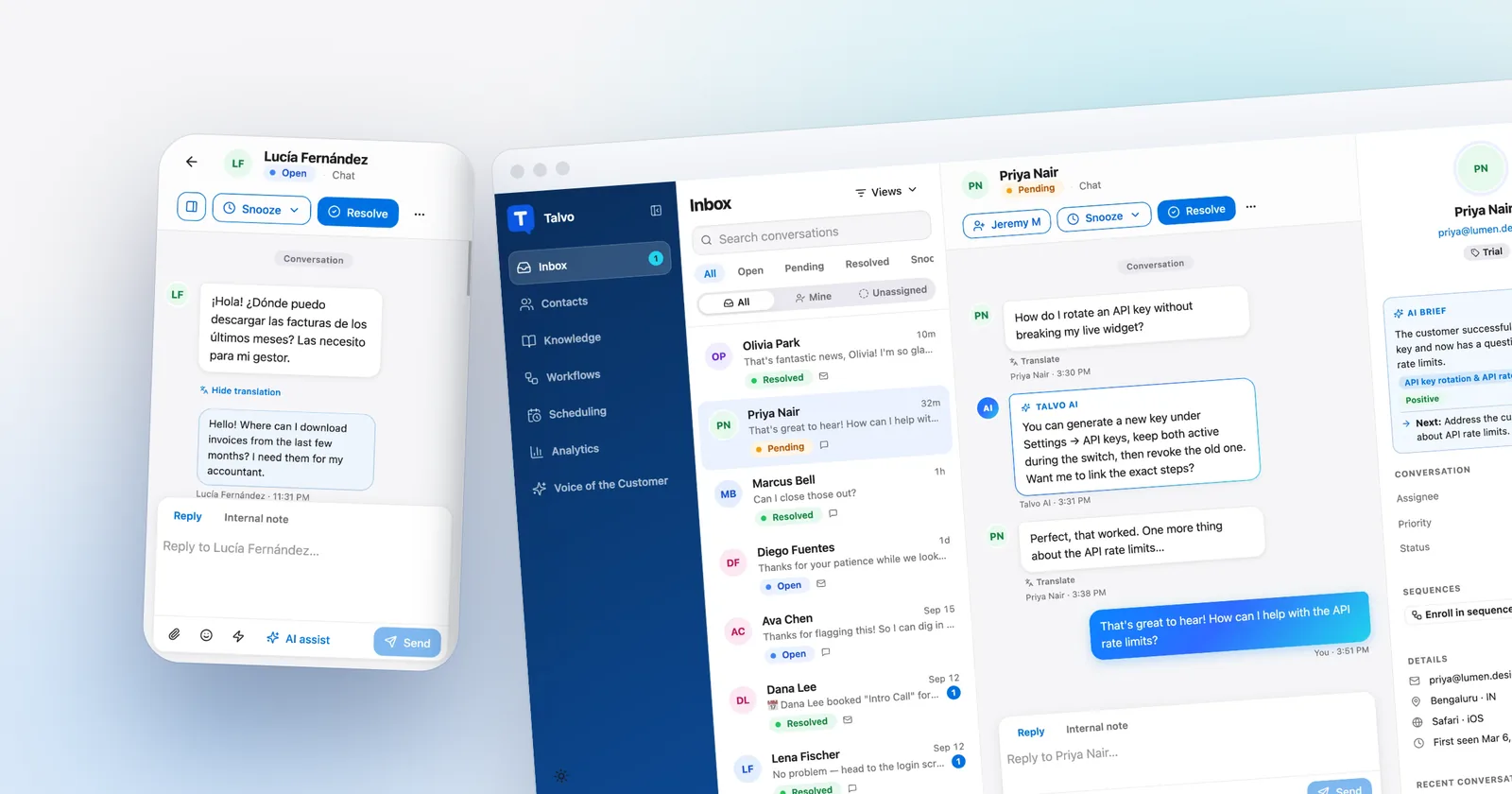
Talvo's AI answers only from your published knowledge base articles, and it shows which article it used. When it isn't confident, it hands the conversation to a human with the whole thread intact, and your team is notified. It replies in the customer's language, and agents can translate any message in one click. You can pick the model per workspace from OpenAI, Anthropic, Google or DeepSeek, and your content isn't used to train models. If you'd rather not run AI at all, you can turn it off.
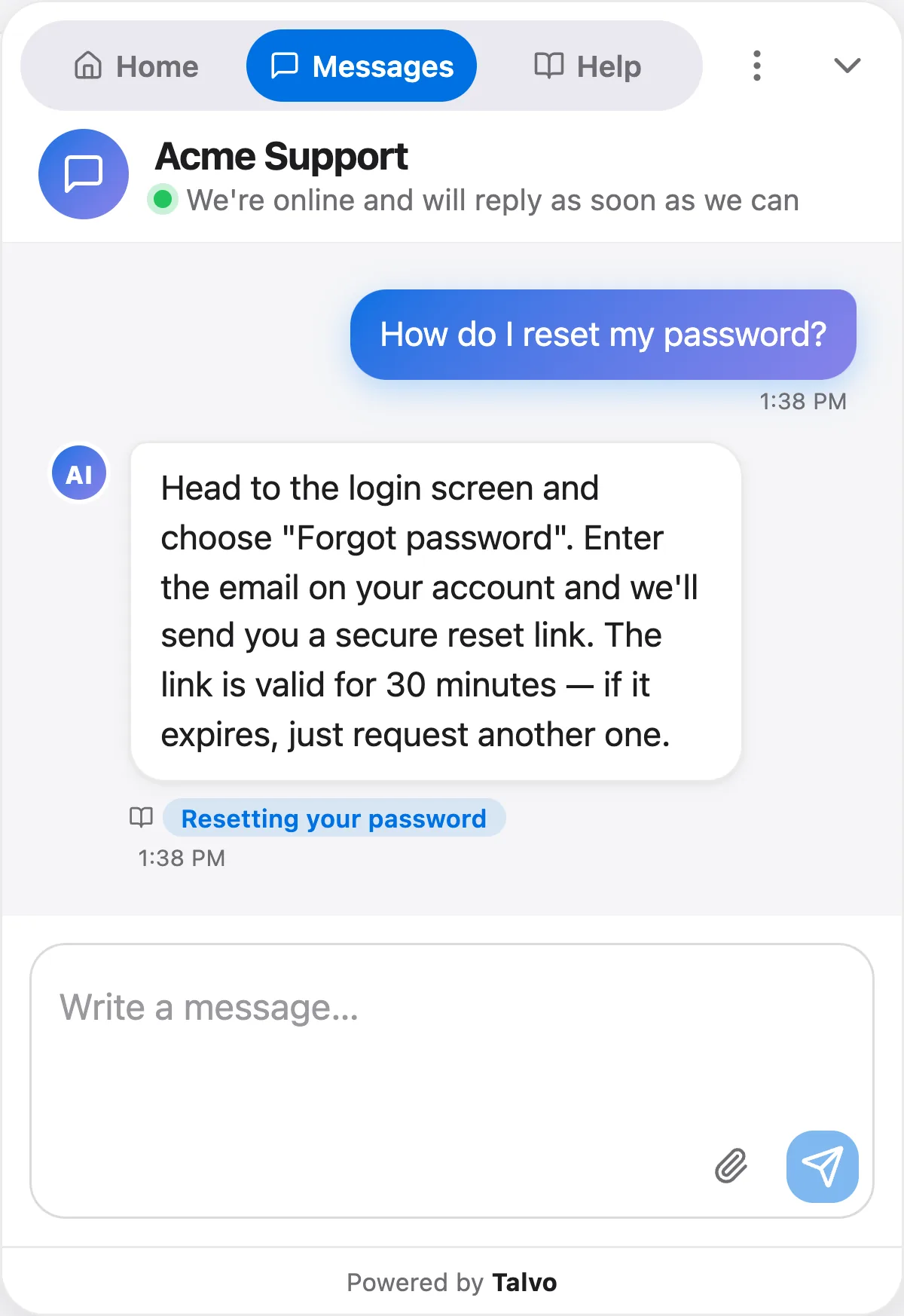
The practical trade is this. An agent that only answers from published articles will say "I'm passing you to the team" more often than one that improvises. That's the right trade for most support teams, but it means the quality of your help center matters. Our write-up on knowledge base chatbots explains how to test that before you commit.
Inbox, email and help center
Both products have a shared inbox, two-way email and a hosted help center. The shapes differ.
Intercom's inbox is a full helpdesk with ticketing, and it gets deeper as you climb plans: multiple team inboxes and round-robin assignment on Advanced, SLAs on Expert. The help center is public on Essential, and private and multilingual from Advanced.
Talvo's inbox covers the daily work, with internal notes on every plan and, on Talvo's Growth plan ($149 a month), saved views, routing rules and SLA policies with first-response targets. You forward your support address into Talvo and replies thread back in the same conversation (see two-way email). The hosted help center is available on the Free plan.
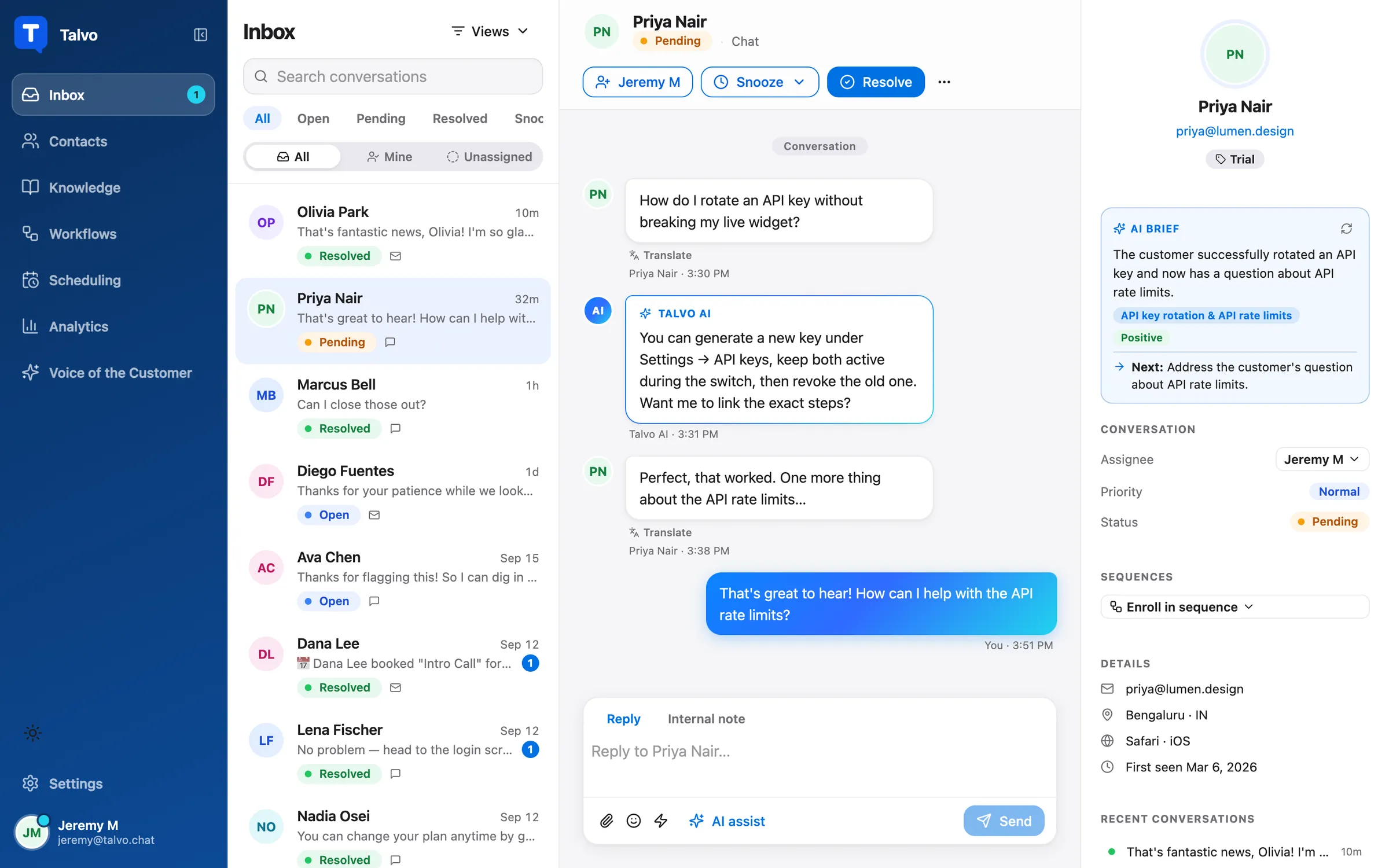
What Talvo doesn't have: a customer-facing ticketing portal. If your customers expect to log in and see their ticket history, Intercom is the more complete answer.
Automation and proactive messaging
Intercom's workflow builder arrives on Advanced. Talvo's no-code workflows arrive on Growth: a visual canvas of trigger, condition branches and actions. Both do the job of routing, tagging and following up without code.
The proactive side is a more interesting difference. On Intercom, tours, checklists, surveys and outbound campaigns live in the Proactive Support Plus add-on at $99 a month. Talvo's Starter plan includes proactive campaigns in the messenger, NPS and CSAT surveys and meeting scheduling, and the Growth plan adds outbound message sequences.
Where Intercom is ahead is the in-app experience. Talvo has no product tours, in-app checklists or native mobile SDK. If guiding users through your product with tours and checklists is a core use, that's Intercom's territory and you should not switch for price alone.
Channels: Intercom is well ahead
This is the clearest gap, so we'll be direct. Intercom supports chat, email, phone, WhatsApp, SMS, Instagram and Facebook Messenger. WhatsApp, SMS and phone are billed as usage on top of your plan.
Talvo supports the live chat widget and email. That's it. WhatsApp, SMS, Instagram and Messenger are on our public roadmap as planned, not shipped, and there's no phone or voice calling. If a meaningful share of your customers reach you on WhatsApp or by text, Talvo isn't ready for you yet, and we'd rather tell you now than after you've migrated.
Integrations and the API
Intercom lists more than 450 apps in its marketplace, per its platform page. That's a real asset: whatever CRM, billing or analytics tool you run, someone has probably built the connector.
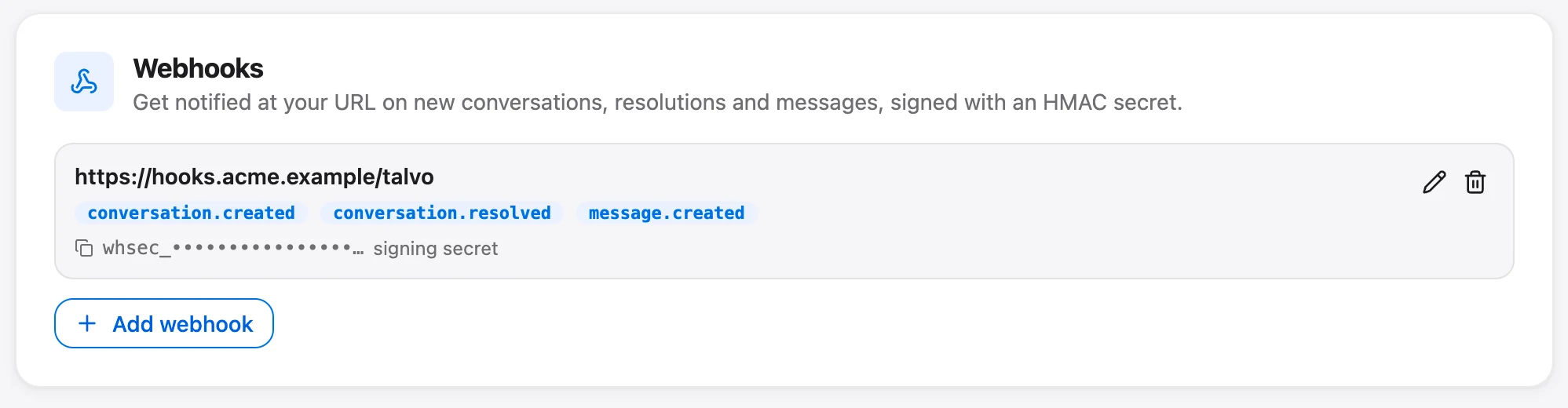
Talvo's integrations today are a REST API with webhooks and Slack notifications. There is no Zapier connection yet (planned), and no native Shopify, HubSpot or Salesforce integration. Signed webhooks and the API are enough for a developer to connect almost anything, but if you want click-to-install integrations without engineering time, Intercom wins comfortably.
Security and compliance: not close
If a security questionnaire sits between you and the purchase, read this section first.
Intercom holds a SOC 2 Type II report and ISO 27001 certification, supports HIPAA on its Expert plan, offers SSO through Okta, Azure AD and OneLogin, and lets you host data in the US, the EU or Australia.
Talvo has none of those. There is no SOC 2 report, no SAML single sign-on, no choice of data region and no HIPAA support. Data is processed in the United States. What we do have is plain basics done properly: HTTPS everywhere, tenant isolation on every query, hashed API keys, signed webhooks, sign-in lockout, no tracking cookies, self-serve deletion, and a public subprocessor list on our security page. That's a fair baseline for many small teams. It is not a substitute for an audit, and for regulated industries or enterprise buyers it won't clear the bar.
Maturity and reviews
Intercom has a long review record. Third-party roundups, several written by competitors, put it at roughly 4.5 on both G2 and Capterra, from thousands of reviews. We couldn't pull those sites directly, so treat the figures as approximate. The same roundups report the recurring complaint: costs are hard to predict once seats, Fin outcomes and channel usage stack up, and some reviewers describe renewal and pricing disputes. Praise centers on the polished messenger and Fin's quality.
Talvo has no reviews on G2 or Capterra, because it's new. We won't invent a rating, testimonials or a customer count, and we'd be wary of any vendor in this position that does. The cost of choosing us is that you're an early adopter. The mitigation is that nothing locks you in: plans are month to month and the Free plan needs no card.
Switching from Intercom: what moves and what doesn't
The question to ask isn't "can I switch" but "what do I lose on the way". This is the honest inventory.
What moves: your help center. Talvo imports articles from Intercom directly, along with Zendesk, Help Scout, Crisp and others, or crawls your public help site. Contacts come across by CSV. The widget is one script tag before the closing body tag, which works on any site where you can add a script (WordPress, Shopify themes, Webflow, Squarespace, Wix and custom builds). Email works by forwarding your support address into Talvo. The switching guide walks through each step.
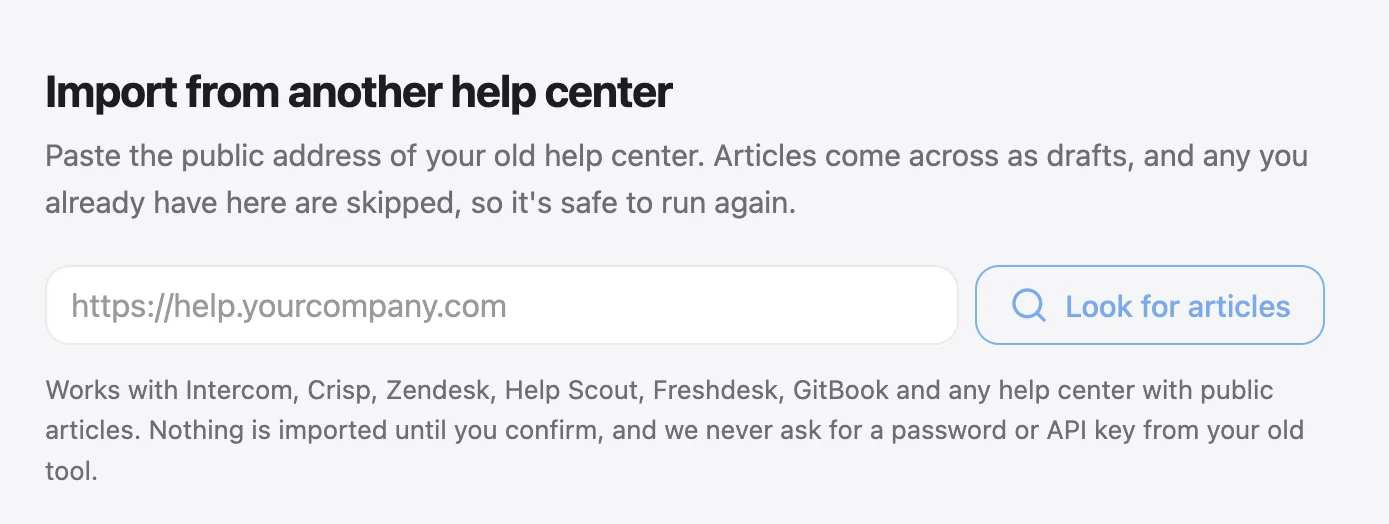
What you rebuild by hand: workflows and routing rules. We don't list an automation converter, so budget time to recreate them. The mechanical parts, such as the widget, help articles and contacts, are quick. The slower part is reviewing the imported articles, because the AI answers only from what's published, and then rebuilding any automations you actually rely on.
What doesn't come along as a promise: your old conversation history. We don't list a conversation-history import, so export what you need from Intercom before you cancel and treat it as an archive.
A sensible path is a parallel run. Install Talvo's widget on a staging page or a slice of your traffic, let the AI answer from your imported articles, and watch which questions it hands off. That tells you whether your help content is ready. Cancel Intercom only after that, and read your contract's notice period first, since downgrades there usually take effect at renewal. If you're weighing your renewal now that Salesforce owns Fin, the Salesforce explainer lists the contract questions to ask.
Talvo vs Intercom: a fair verdict
Choose Intercom when the things it's ahead on are the things you need: WhatsApp and SMS, enterprise security, in-app tours and checklists, hundreds of ready-made integrations, and a vendor with a long public track record. If you have the budget and the volume to justify it, it's a strong product and Fin has the reputation to match.
Choose Talvo when your team is small or growing, your customers reach you by chat and email, your main goal is an AI agent that cites your help articles without a per-seat bill rising under it, and you're comfortable being early. The savings are largest where AI volume is high and headcount is rising, which is exactly the shape of the bills above.
If you're somewhere in between, weigh the cheaper options in cheaper Intercom alternatives, and see the full Intercom pricing breakdown before you decide. The pricing grid at talvo.chat/pricing is the quickest way to price your own team.
Which should you choose?
- your support team is small or growing and you don't want the bill to rise with every hire
- you expect high AI volume and want a $0.49 rate instead of $0.99
- customers reach you by chat and email, and you want AI answers that cite your help articles
- you can accept being early on a beta product with no reviews yet
- customers contact you on WhatsApp, SMS or phone
- you need SOC 2, SSO, HIPAA or a choice of data region
- you rely on product tours, checklists or hundreds of ready-made integrations
- you qualify for the Early Stage startup discount or your AI volume is very low
- you want a long-established vendor with years of reviews
Frequently asked questions
Is Talvo a good Intercom alternative for small business?
For small teams that use chat and email, it can be: pricing is per workspace, so a 5-person team with 1,000 AI resolutions comes to about $299 a month against about $1,185 on Intercom at list prices. It is a new product in beta, though, without WhatsApp, SMS, SOC 2 or SSO. If you need those, stay with Intercom or pick a more established alternative.
How much cheaper is Talvo than Intercom?
At list prices on monthly billing, we calculate $147 against $414 for 3 agents and 300 AI resolutions, $299 against $1,185 for 5 and 1,000, and $789 against $3,360 for 10 and 3,000. The gap comes mostly from Fin's $0.99 per outcome versus Talvo's $0.49 and from Talvo not charging per seat. Your own bill depends on your AI volume.
Can I switch from Intercom to Talvo?
Yes. Talvo imports your help center articles from Intercom or crawls your public help site, takes contacts by CSV, and installs with one script tag. Workflows and routing rules have to be rebuilt by hand, and we don't list a conversation-history import, so export your old conversations before you cancel.
Did Salesforce buy Intercom?
Yes. Salesforce announced a deal in June 2026 to acquire Intercom, which renamed itself Fin in May 2026, for about $3.6 billion, and completed the acquisition on September 10, 2026. Fin now sits inside Salesforce's AI Labs group, and the helpdesk and pricing page still operate under the Intercom name.
Does Talvo have an AI agent like Fin?
Yes. Talvo's AI agent answers only from your published knowledge base, shows which article it used, and hands off to a human with the conversation intact when it isn't confident. We haven't tested it head to head against Fin, and Fin has the longer track record.
What does Talvo not have that Intercom does?
Talvo has no WhatsApp, SMS, Instagram, Messenger or phone channels, no SOC 2 report, SAML SSO, HIPAA support or data-region choice, no product tours or in-app checklists, and no Zapier or native Shopify, HubSpot or Salesforce integrations. WhatsApp, SMS and social channels are on the public roadmap.
Does Intercom have a free plan?
No. Intercom offers a 14-day trial with no credit card and an Early Stage program for startups, but no free plan. Talvo's Free plan includes 2 teammates, the chat widget, shared inbox and help center, with 25 AI resolutions a month during the beta.
Sources
Other products' prices and features change. We checked these pages on October 21, 2026; if something is out of date, tell us and we'll fix it.
- Intercom pricing page (checked Oct 21, 2026)
- Intercom security page (checked Oct 21, 2026)
- Intercom channels explained (checked Oct 21, 2026)
- Talvo pricing (checked Oct 21, 2026)
- Talvo help: What counts as an AI resolution
- Talvo help: Switching from another help desk
- Salesforce: Salesforce Completes Acquisition of Fin (Sept 10, 2026)