On this page
- Crisp is cheaper, and by how much
- The same team on both bills
- Credits consumed versus answers delivered
- What sits behind the chat window
- Channels are Crisp's biggest lead
- Where your data lives, and what neither of us has
- Maturity and reviews
- If you decide to move from Crisp
- The short version
- Frequently asked questions
Put a five-person team and 1,000 AI-answered conversations a month through both price lists and Crisp comes out at roughly $120 to $170. Talvo comes out at $299, on its Scale plan. If you're looking for a Crisp alternative because of the bill, we are probably not it, and this post will say so with the arithmetic attached.
So why read on? Because the two products charge for AI in different ways, they differ in how much inbox and automation sits behind the chat window, and Crisp's channel list is something Talvo can't match today. Whether any of that outweighs the price gap depends on your team.
A disclosure before the details: Talvo makes a competing product. Every Crisp fact below comes from Crisp's own pricing and help pages as listed in October 2026, and every Talvo fact comes from our own plans. Where we couldn't confirm something, we say so instead of guessing.
Crisp is cheaper, and by how much
Crisp prices per workspace, like Talvo does. That already sets both apart from Intercom (now Fin) and Zendesk, which charge for every seat. Crisp's paid plans on its pricing page:
| Crisp plan | Per workspace / month | Seats included | Customer profiles | AI credits included |
|---|---|---|---|---|
| Free | $0 | 2 | 100 | none |
| Mini | $45 | 4 | 5,000 | $5 (about 90 AI conversations) |
| Essentials | $95 | 10 | 50,000 | $25 (about 450) |
| Plus | $295 | 20+ | 200,000 | $75 (about 1,350) |
Extra agents are listed at $10 each per month. Crisp says yearly billing can be switched on inside the app after you subscribe, but it doesn't publish the yearly prices, so everything here uses monthly figures.
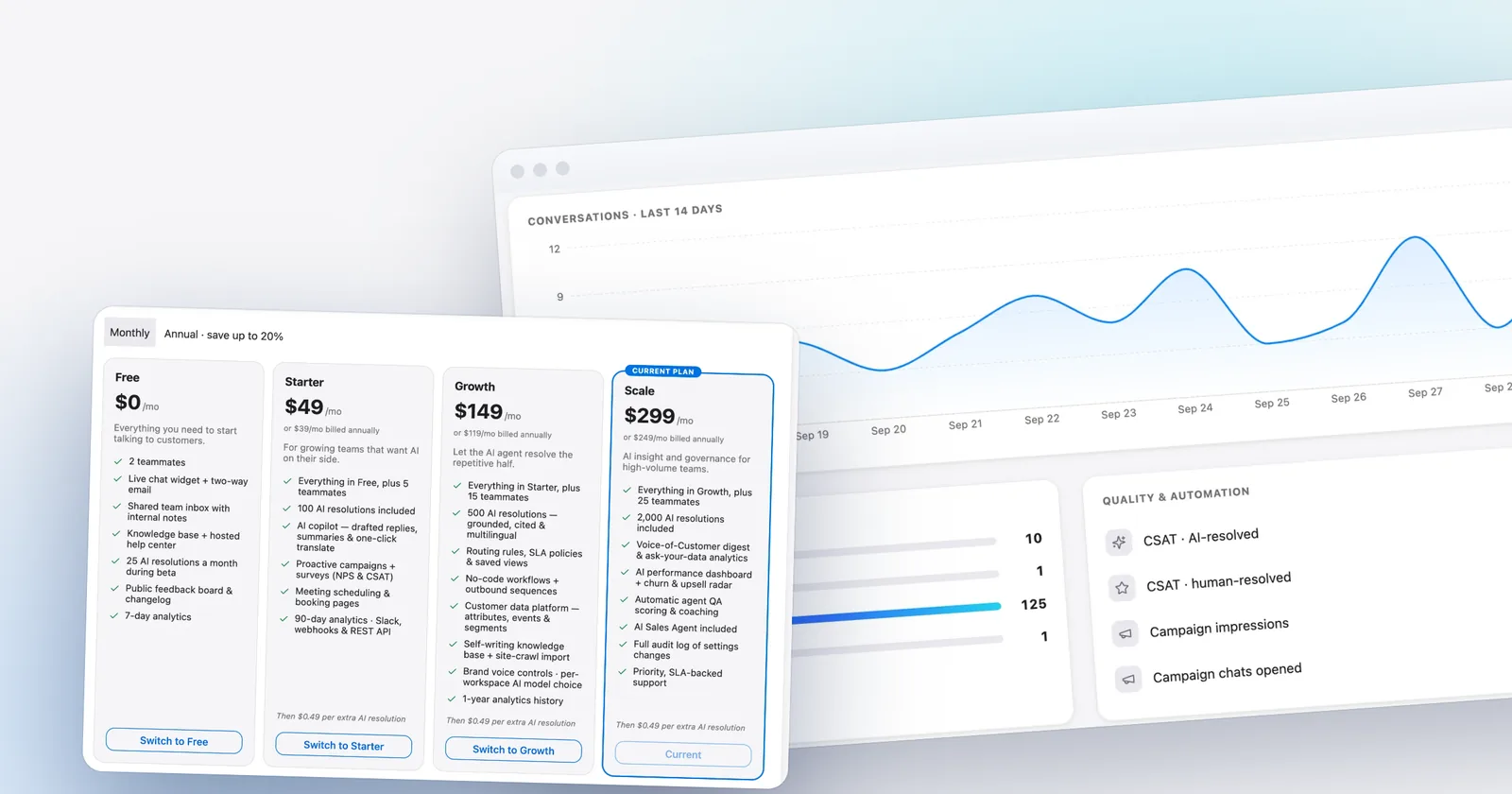
Talvo's plans, from our pricing page, also bill per workspace:
| Talvo plan | Monthly | Annual (per month) | Teammates | AI resolutions included |
|---|---|---|---|---|
| Free | $0 | $0 | 2 | 25 a month during the beta |
| Starter | $49 | $39 | 5 | 100 |
| Growth | $149 | $119 | 15 | 500 |
| Scale | $299 | $249 | 25 | 2,000 |
Past the included amount, each extra AI resolution is $0.49 on every paid plan. Adding a teammate up to your plan's limit never changes the bill.
Line those up and Crisp's entry points are cheaper at every tier, and Crisp has more of them: a $45 plan with four seats has no Talvo equivalent. Crisp also says it doesn't bill on conversation volume for the inbox itself. The meters that matter are customer-profile limits and AI.
The same team on both bills
Three teams, one rule: use list prices on monthly billing, count only what the vendor publishes, and flag the guesses.
The assumptions matter, so here they are. Crisp estimates $0.05 to $0.10 per AI-handled conversation, and says the real number varies with message length, knowledge size, model and how many replies the AI sends. Crisp doesn't publish its pay-as-you-go rate once credits run out, so we assume top-ups cost face value. For Talvo, we count every AI conversation in the scenario as a billable resolution, which is the worst case for us.
| Team | Crisp | Talvo |
|---|---|---|
| 3 agents, 300 AI conversations | Mini $45 + AI of $15 to $30, less $5 included = $55 to $70 | Starter $49 + 200 extra × $0.49 ($98) = $147 |
| 5 agents, 1,000 AI conversations | Essentials $95 + AI of $50 to $100, less $25 included = $120 to $170 | Scale $299 (2,000 included) = $299 |
| 10 agents, 3,000 AI conversations | Essentials $95 + AI of $150 to $300, less $25 included = $220 to $370 | Scale $299 + 1,000 extra × $0.49 ($490) = $789 |
A few notes on how those were built. Talvo's Growth plan at $149 would cost $394 in the middle scenario (500 included plus 500 extra at $0.49, or $245), so Scale at $299 is the cheaper way to buy 1,000 resolutions. In the first scenario Growth is $149 and includes 500 resolutions, only $2 more than Starter plus overage, and it adds routing, SLAs and workflows. Crisp's Essentials price assumes you want its workflow builder, routing and omnichannel inbox; Mini plus one extra agent ($45 + $10) with the same AI would run about $100 to $150 for the 5-agent team, so the true Crisp floor is a bit lower. On annual billing Talvo drops by $28 to $50 a month in these examples (Growth at $119 becomes the cheapest fit for the 3-agent team), but we can't show Crisp's yearly side because it isn't published.
In dollars, Talvo costs roughly 1.8 to 3.6 times as much in these scenarios. That's the honest number.
Credits consumed versus answers delivered
This is where the products differ most, and it has little to do with the sticker.
Crisp's Hugo runs on dollar-denominated credits that reset every billing cycle. Hugo's cost depends on how long the conversations run, how big your knowledge base is and which model answers, which is why Crisp quotes a range instead of a rate. Trial, testing and Playground use also draw from the same credits. If the credits run out and pay-as-you-go is off, Hugo stops answering and conversations go to your humans. That's a reasonable design, and for light AI use it makes the bill very small.
Talvo's AI is billed per resolution. It answers only from your published knowledge base articles, shows which article it used, and when it isn't confident it hands the conversation to a person with the thread intact. A resolution is one conversation the AI answered end to end without a teammate sending a message. Hand-offs never count, and one conversation counts once however many questions it held. The full definition is a public help article, and we compare how other vendors define theirs in AI resolution pricing compared.
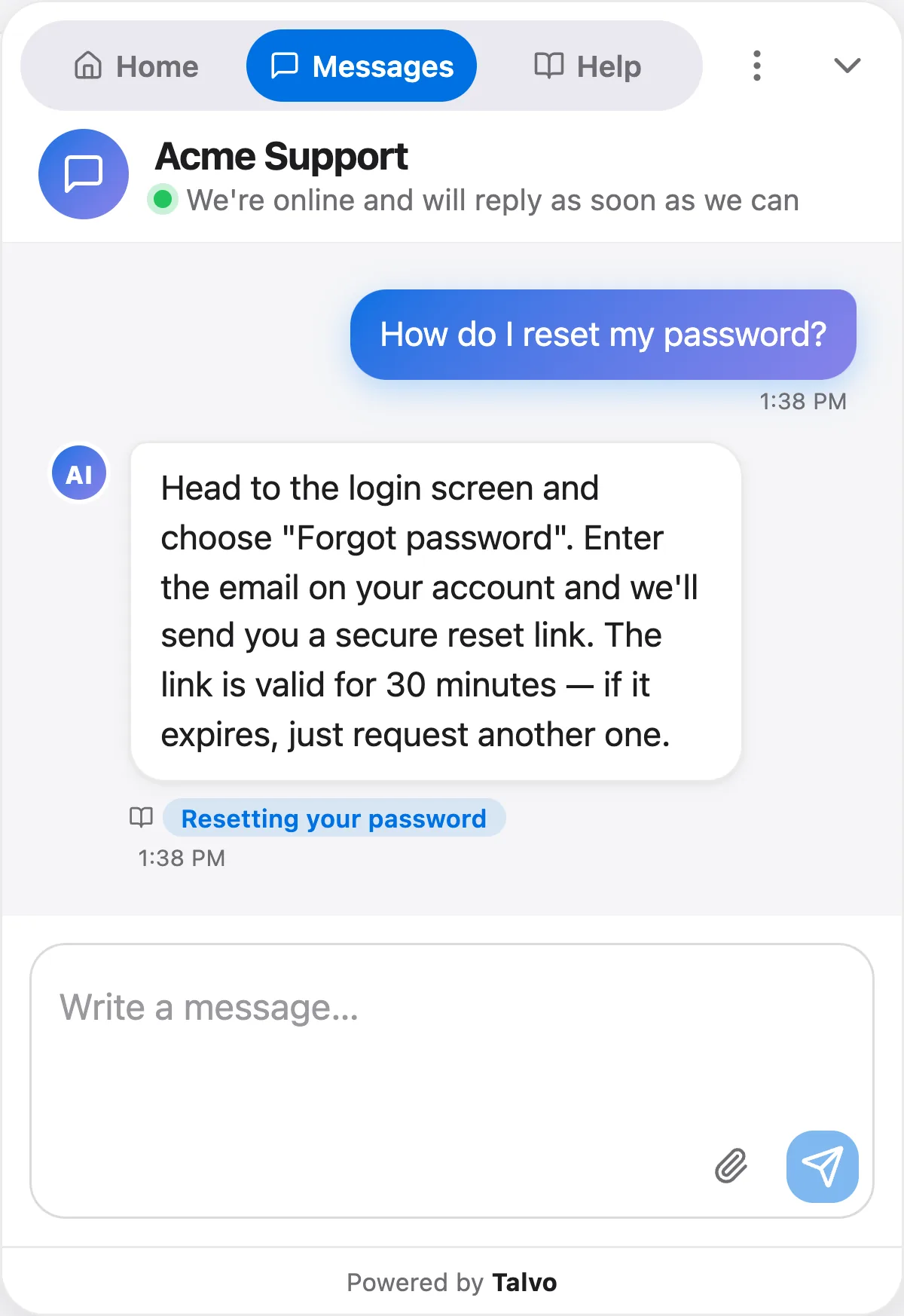
You trade a lower price for a more predictable unit. With credits, a long, tangled conversation costs more than a short one and you only learn by watching usage. With a flat rate per resolution, 1,000 answered conversations cost the same whether they were two messages or twelve, and a conversation that ends in a handoff costs nothing. Whether that predictability is worth the premium depends on how much your AI volume swings.
One thing we couldn't confirm from Crisp's public pages: whether Hugo shows customers which article it drew from. If citations matter for your support, ask during the trial.
What sits behind the chat window
Crisp's Essentials plan already lists a no-code workflow builder, routing, a CRM view, a knowledge base, analytics and the omnichannel inbox. Plus adds ticketing with a customer portal, white-labeling and unlimited task automations. Crisp also has a Status Page product, campaigns, mobile apps and e-commerce integrations for Shopify, WooCommerce, Adobe Commerce and PrestaShop. For a small team that is a lot of product for $95.
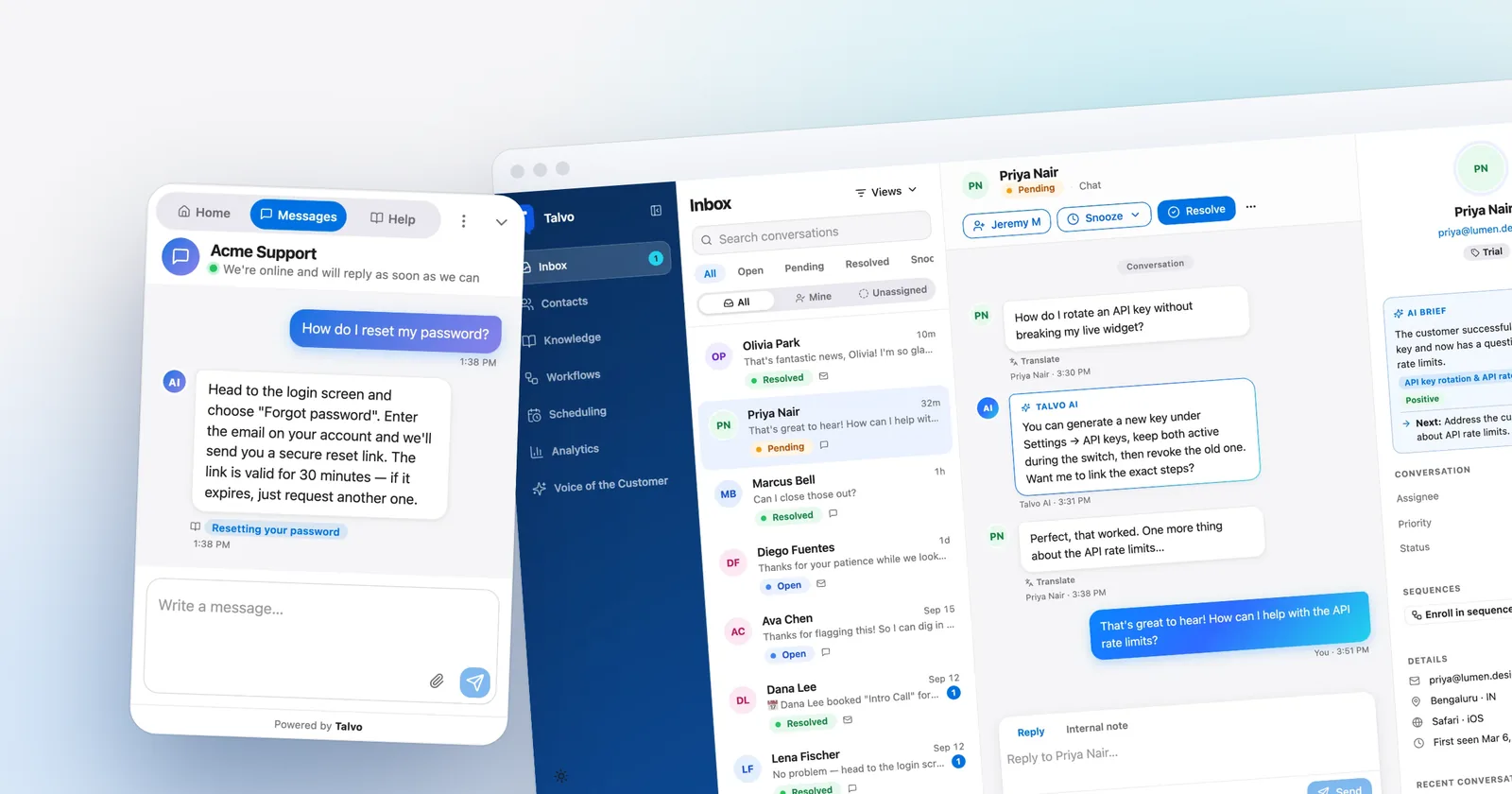
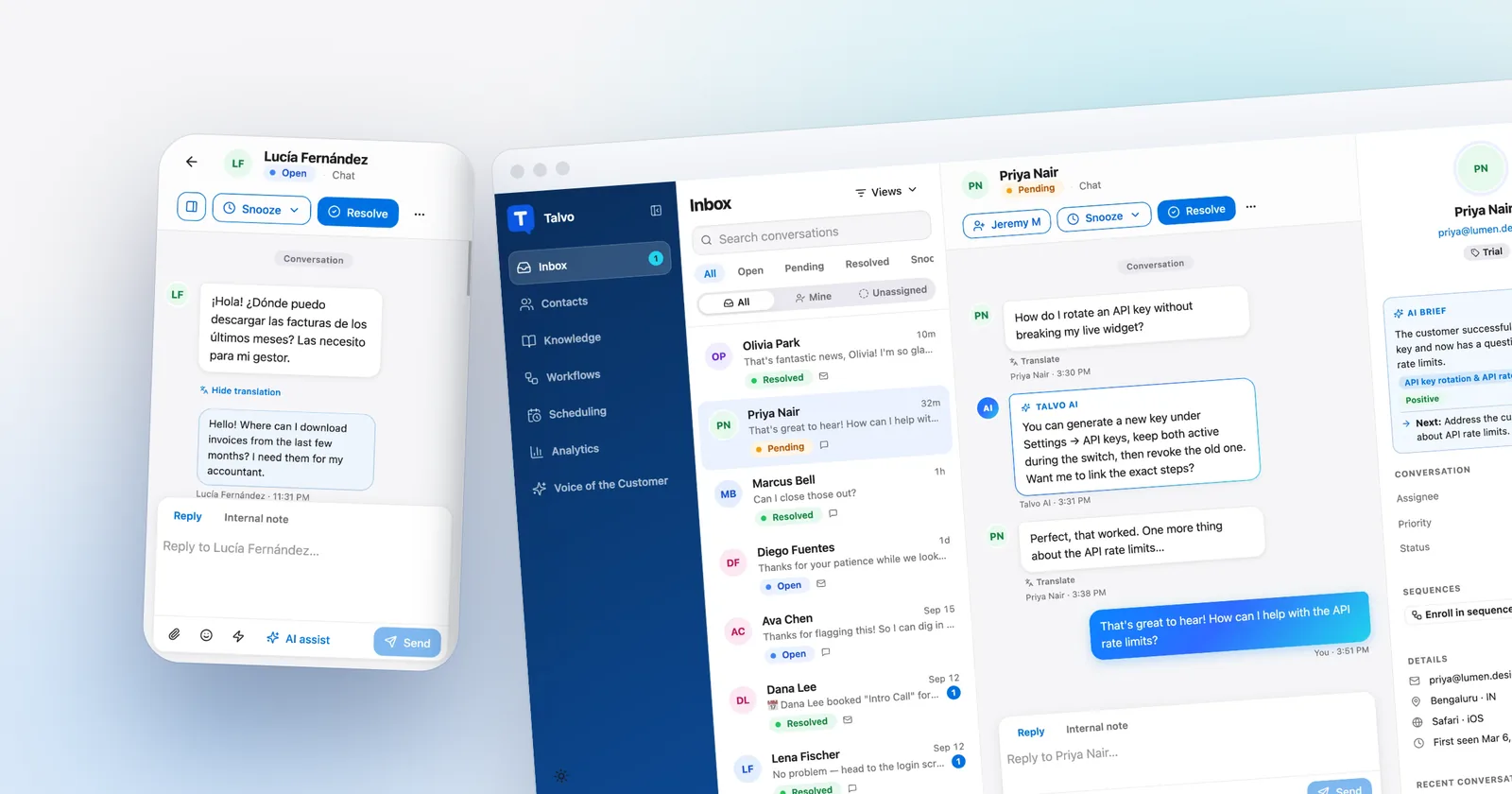
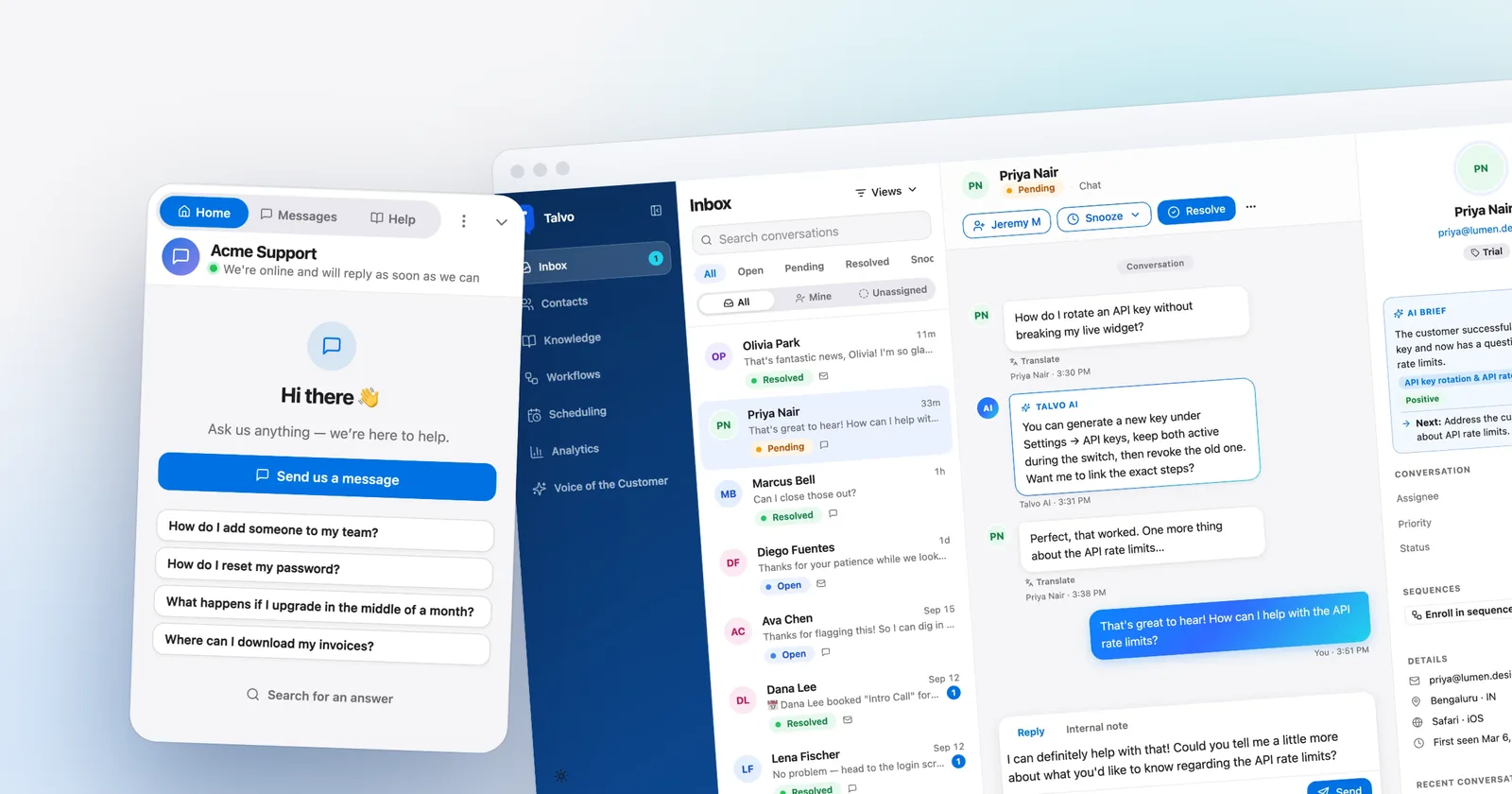
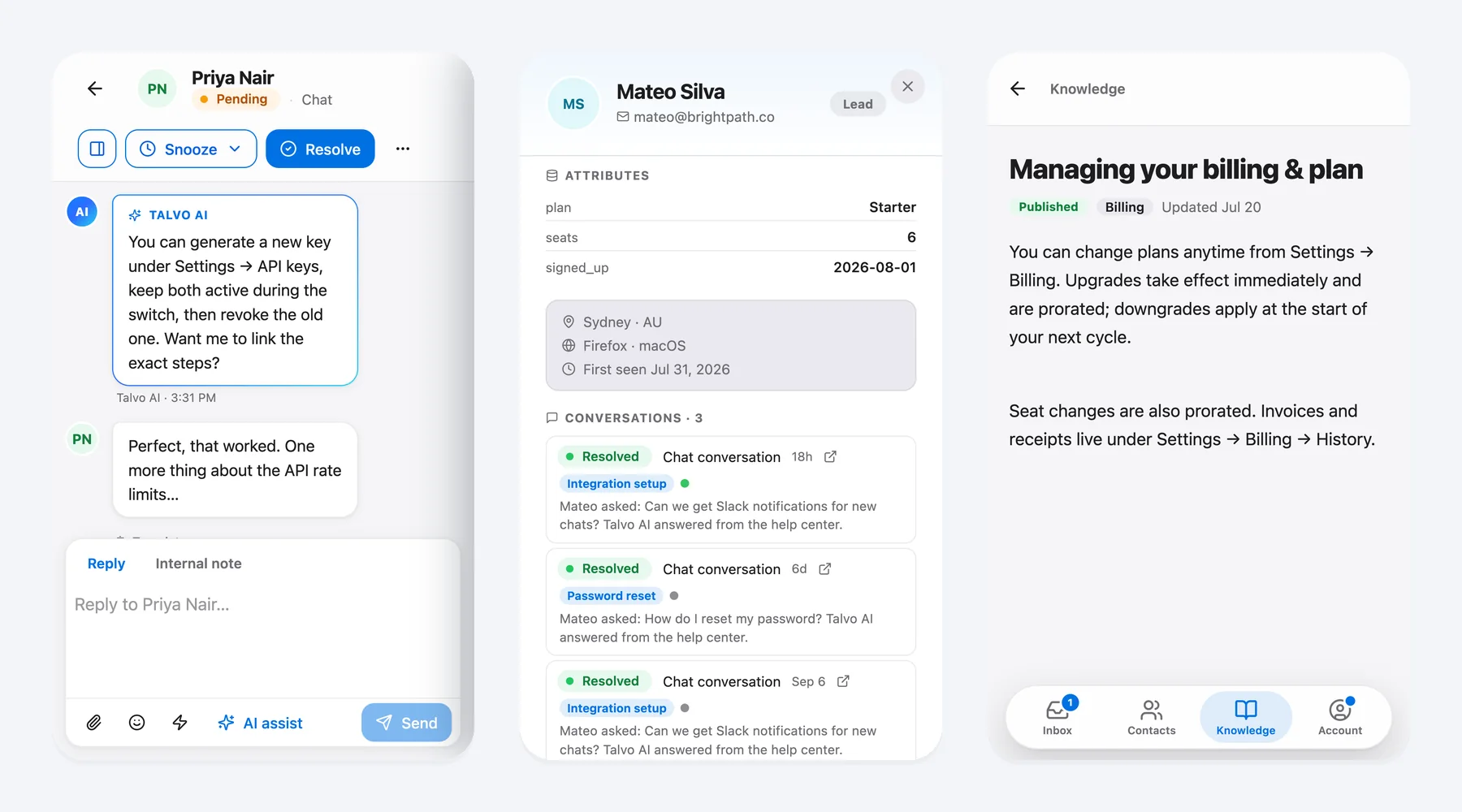
Talvo's shared inbox covers internal notes on every plan and, on the Growth plan, saved views, routing rules and SLA policies with first-response targets. Growth also brings a visual workflow canvas, outbound message sequences, a customer data platform with custom attributes, events and segments, and a self-writing knowledge base that drafts articles from questions the AI couldn't answer. The Scale plan adds a Voice-of-Customer digest that groups themes and sentiment across resolved conversations, an AI performance dashboard, automatic agent QA scoring and an audit log.
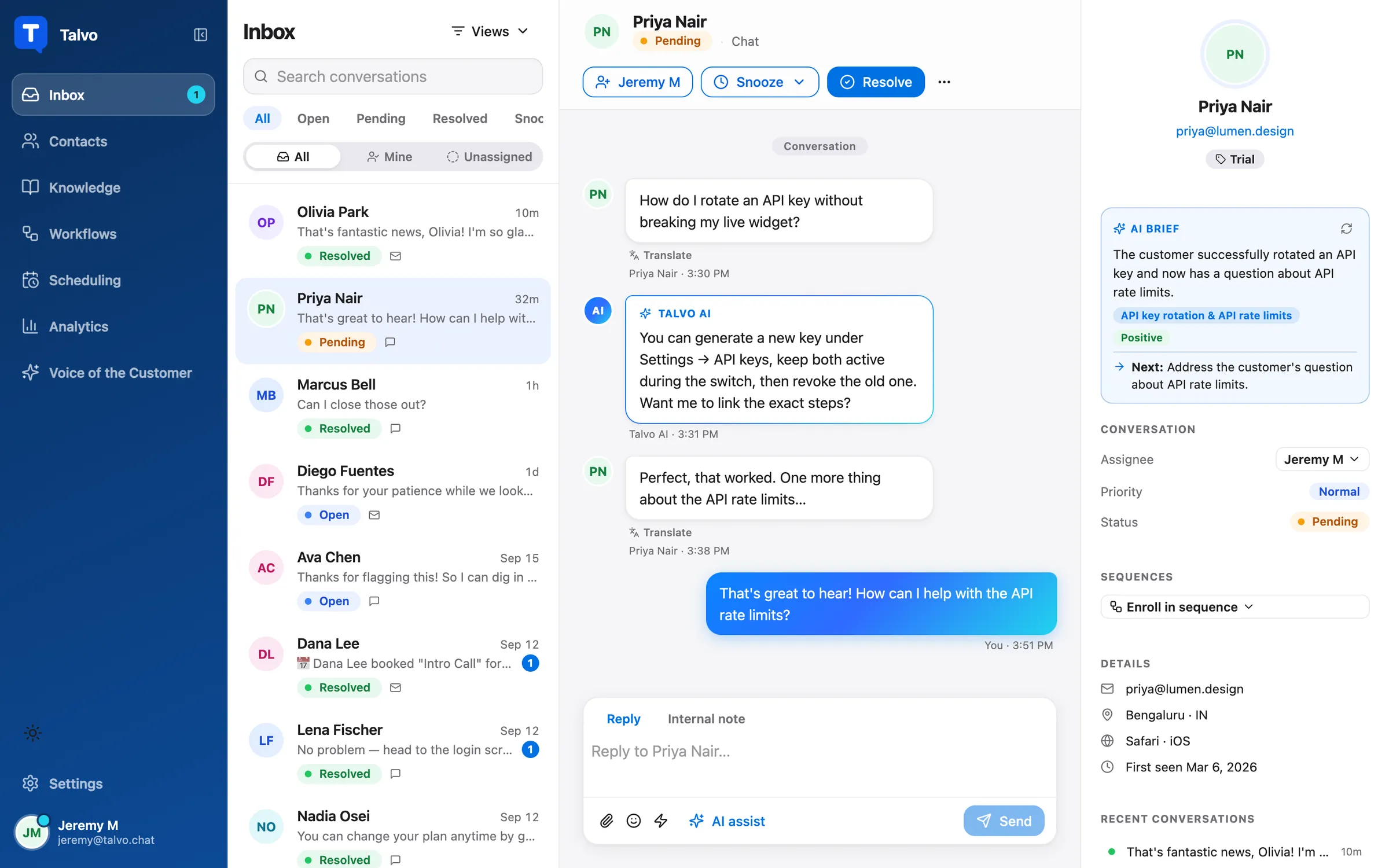
Is that deeper than Crisp? In some places, yes. In others, we don't know. Crisp's pricing page doesn't list SLA policies, outbound sequences or a VoC-style analytics digest, but a page not listing something isn't proof it's absent, so check those against your own list during Crisp's 14-day trial. Where Talvo clearly can't compete is the mobile story. Crisp has mobile apps. Talvo works in the phone's browser with a mobile-adapted inbox and push notifications, and there's no App Store or Google Play app.
Channels are Crisp's biggest lead
If your customers write to you on WhatsApp, Instagram or SMS, stop here and keep Crisp.
Crisp lists the website widget, contact forms, email, Telegram, Facebook Messenger, X direct messages, Instagram, SMS, Viber, Line, WhatsApp Business and phone calling. Its omnichannel inbox is an Essentials feature. One catch from Crisp's FAQ: a workspace connects only one account each of Instagram, Messenger, WhatsApp Business, Viber, Line and Telegram, so agencies running several brands need multiple workspaces.
Talvo has the website chat widget and two-way email. WhatsApp, SMS, Instagram and Messenger are on our roadmap as planned, and there's no phone or voice channel. We won't pretend a roadmap line is a feature.
Integrations follow the same pattern. Crisp lists 100+ integrations on its Plus plan, and its integrations page shows around 84 apps. Talvo has a REST API, signed webhooks and Slack notifications. There's no Zapier connection yet and no native Shopify, HubSpot or Salesforce integration. Teams that live in those tools will do more wiring themselves.
Where your data lives, and what neither of us has
Crisp says your data is hosted on European servers, offers a DPA, and is a French company (Crisp IM SAS). Talvo processes data in the United States and has no region choice. Some buyers want the EU for legal or customer-expectation reasons, and others want the US. Neither is wrong, but if you need one specifically, that decides it. Talvo publishes its subprocessor list on the security page.
On audits the two are closer than people expect. Crisp's own help article says it hasn't been through a SOC 2 audit, and Talvo has no SOC 2 report either. Neither lists SAML single sign-on, and neither lists HIPAA support. If a procurement team will ask for a SOC 2 report, you'll need a different vendor for both.
Maturity and reviews
Crisp has a large body of customer reviews. Secondary sources, several of them published by competitors, that summarize its review pages put it at about 4.6 on Capterra from roughly 147 reviews and about 4.5 on G2 from roughly 200. We couldn't fetch those sites directly, so treat the numbers as directional. The praise is consistent: very fast setup, a generous free plan and good value for small teams. The complaints are also consistent: costs climb with customer-profile limits, some integrations are flaky, reporting is thin and the help docs are sparse.
Talvo launched in 2026 and is in beta. It has no review-site ratings, no case studies and no customer numbers to quote, and we won't invent them. You'd be an early user. For some teams that's fine, and for others it's a reason to wait.
If you decide to move from Crisp
The switching work is smaller than it sounds. Talvo can import a help center from Crisp, or crawl your public site, and contacts come in from a CSV. The chat widget is one script tag before your closing body tag. Forward your support address into Talvo and replies thread back into the same conversation. The switching guide walks through it.
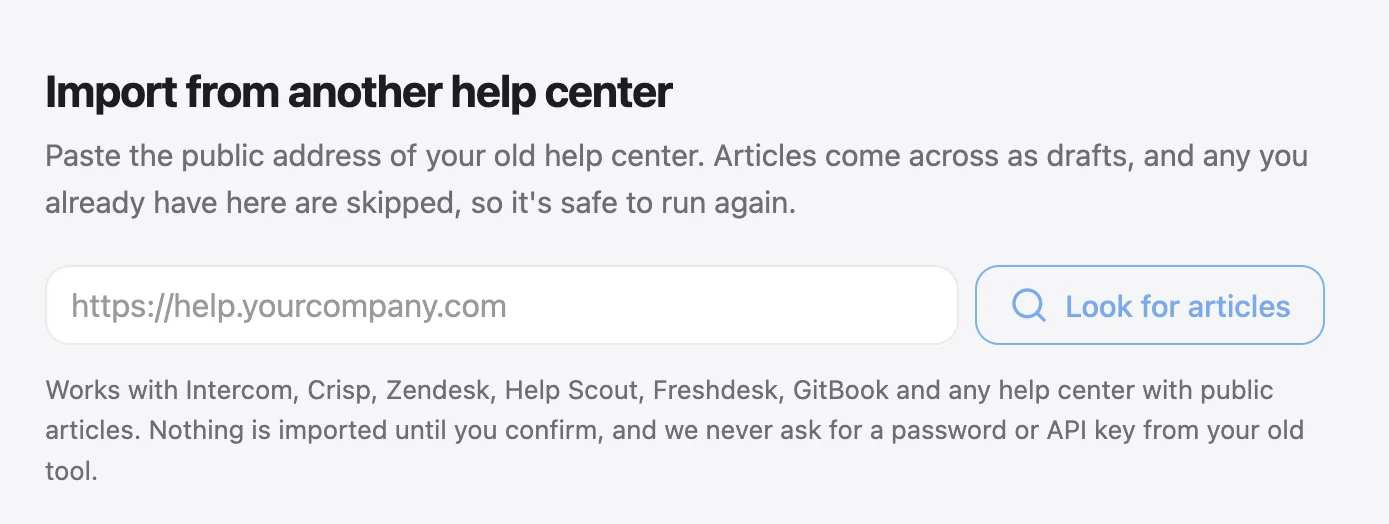
What won't carry over: anything on a channel Talvo doesn't have, your Crisp workflows and triggers (you rebuild them in Talvo's workflow editor), and any integration Talvo doesn't have yet. Run both side by side for a couple of weeks before you remove the Crisp widget.
The short version
Stay with Crisp if price, channels or EU hosting drive the decision. They are real advantages, and Crisp has a track record we don't. Look at Talvo if you want AI billed only on conversations it actually resolved, with cited answers and a handoff, along with SLAs, sequences and a customer data layer (from Talvo's Growth plan at $149 a month) and Voice-of-Customer reporting (from the Scale plan at $299), all in one flat-priced workspace, and you can live without the extra channels. Comparing Crisp to the per-seat tools? See Crisp vs Intercom and per-seat vs flat pricing.
Which should you choose?
- you want AI billed only on conversations it resolved, with the source article shown and a clean handoff
- you need SLA policies, outbound sequences or a customer data layer in the same workspace
- you want Voice-of-Customer themes and sentiment across resolved conversations
- your customers reach you by web chat and email, and you're comfortable adopting a product that is still in beta
- price matters most: Crisp's plans start lower and its AI credits cost cents per conversation
- your customers use WhatsApp, Instagram, Messenger, SMS or the phone
- you need EU data hosting or mobile apps
- you want a mature product with years of reviews behind it
Frequently asked questions
Is Talvo cheaper than Crisp?
No. On list prices Crisp costs less in every scenario we priced: about $120 to $170 a month for 5 agents and 1,000 AI conversations versus $299 on Talvo's Scale plan. Talvo's case is how AI is billed and what sits behind the inbox, not the sticker price.
What is the best Crisp alternative?
It depends on why you're leaving. Teams that need more channels or a bigger integration list should look at tools with WhatsApp and Instagram support, while teams that want cited AI answers, SLAs and automation in a flat-priced workspace can consider Talvo. If cost is the problem, staying on Crisp is usually the cheaper answer.
Is Crisp free?
Crisp has a free plan with 2 seats and 100 customer profiles, and it includes no AI credits. Paid plans start at $45 a month per workspace for Mini, and every paid plan has a 14-day trial. Talvo's Free plan also has 2 teammates, plus 25 AI resolutions a month during the beta.
How does Crisp charge for AI?
Crisp's Hugo AI uses dollar-denominated credits that come with each plan: $5 on Mini, $25 on Essentials and $75 on Plus. Crisp estimates about $0.05 to $0.10 per AI-handled conversation, and a conversation that ends in a handoff still uses credits. Pay-as-you-go rates after the credits run out are not published.
Where does Crisp host its data compared with Talvo?
Crisp says its data is hosted on European servers and offers a DPA. Talvo processes data in the United States and does not offer region choice. Neither has a SOC 2 report, so teams with strict procurement requirements need to check both.
Can I move my help center from Crisp to Talvo?
Yes. Talvo can import help center articles from Crisp, or crawl your public site, and contacts import from a CSV. Workflows and anything on channels Talvo does not support, such as WhatsApp or SMS, have to be rebuilt or left behind.
Does Talvo support WhatsApp, Instagram or SMS like Crisp?
Not yet. Talvo has the web chat widget and two-way email today, and WhatsApp, SMS, Instagram and Messenger are on its public roadmap as planned. If those channels are essential now, Crisp is the better fit.
Is Crisp better than Intercom?
Crisp is much cheaper than Intercom (now Fin) and offers more channels in its base plans, while Intercom has a stronger compliance story and a longer AI track record. We priced the same team on both in our Crisp vs Intercom comparison.
Sources
Other products' prices and features change. We checked these pages on October 21, 2026; if something is out of date, tell us and we'll fix it.