On this page
- Two pricing models that barely resemble each other
- The same team on both bills
- Fin and Hugo are different bets
- Channels: Crisp includes more in the plan, Intercom charges per use
- The inbox, the help center and what's missing
- Security, hosting and who gets to say yes
- What reviewers say
- Who should pick which
- A third option: Talvo, and where it falls short
- Frequently asked questions
Take a five-person support team that lets AI handle 1,000 conversations a month. On Intercom (now Fin), list prices put that bill near $1,185. On Crisp it lands around $120 to $170. Same team, same chat volume, a gap of roughly seven to ten times.
That gap is the main reason "Crisp vs Intercom" gets searched at all. But price isn't the whole story, and Intercom's price buys things Crisp doesn't offer. This post prices three team sizes on both, compares them where it matters (AI, channels, inbox, compliance), says who should pick which, and then introduces a third option briefly, because we make it.
A disclosure up front: Talvo, the third option, is our product. The Crisp and Intercom facts come from their own pricing and help pages as listed in October 2026, and we flag the places where we couldn't confirm something.
Two pricing models that barely resemble each other
Intercom charges for people and for results. You pay a per-seat fee for the helpdesk, then $0.99 each time its Fin AI agent produces an "outcome." WhatsApp, SMS, phone and email campaigns are billed as extra usage on top. On Intercom's pricing page, the three plans are:
| Intercom plan | Per seat / month, annual billing | Per seat / month, monthly billing |
|---|---|---|
| Essential | $29 | $39 |
| Advanced | $85 | $99 |
| Expert | $132 | $139 |
New customers are currently shown lower promotional prices on Essential ($19 annual, $29 monthly). The page doesn't say how long those last, so this post uses the list prices. There's no free plan, only a 14-day trial. Advanced and Expert include 20 and 50 free Lite seats, but only full seats can send messages.
Crisp charges per workspace. You pick a plan, and the plan decides how many people can log in.
| Crisp plan | Per workspace / month | Seats included | Customer profiles |
|---|---|---|---|
| Free | $0 | 2 | 100 |
| Mini | $45 | 4 | 5,000 |
| Essentials | $95 | 10 | 50,000 |
| Plus | $295 | 20+ | 200,000 |
Crisp's pricing page lists extra agents at $10 each per month. That means a fifth agent on Mini should cost $10 more; confirm that at checkout. Reviewers say the cost that actually climbs on Crisp is the customer-profile limit (5,000 on Mini). Crisp says yearly billing can be turned on after you subscribe, but it doesn't publish yearly prices, so everything here is monthly.
The part that surprises people is that Crisp doesn't bill for conversation volume. Its AI is the main variable cost, and it uses prepaid credits.
The same team on both bills
Three teams, list prices, monthly billing. The scenarios assume every AI conversation counts once on each side, with no promotions, no add-ons such as Intercom's Copilot ($35 per agent monthly) or its $99 Proactive Support Plus, and Intercom's cheapest plan.
On the Crisp side, the AI estimate comes from Crisp's own help article, which puts an AI-handled conversation at about $0.05 to $0.10 in credits and calls that an estimate. Crisp doesn't publish its pay-as-you-go rate after the included credits run out, so we assume extra credits cost face value. Included credits are $5 on Mini and $25 on Essentials.
| Team | Intercom Essential | Crisp |
|---|---|---|
| 3 agents, 300 AI conversations | 3 × $39 = $117, plus 300 × $0.99 = $297, total $414 | Mini $45 + AI of $15 to $30, less $5 included = $55 to $70 |
| 5 agents, 1,000 AI conversations | 5 × $39 = $195, plus 1,000 × $0.99 = $990, total $1,185 | Essentials $95 + AI of $50 to $100, less $25 included = $120 to $170 |
| 10 agents, 3,000 AI conversations | 10 × $39 = $390, plus 3,000 × $0.99 = $2,970, total $3,360 | Essentials $95 + AI of $150 to $300, less $25 included = $220 to $370 |
One disclosure on the 5-agent row: Mini plus one extra agent ($45 + $10) with the same AI would run about $100 to $150, a bit under the Essentials figure, but Essentials is where the workflow builder, routing and omnichannel inbox start. On annual billing Intercom's seat cost drops from $39 to $29 a seat, which takes the three totals to $384, $1,135 and $3,260. The AI line doesn't change.
The ten-person row deserves a caveat. Essential has no workflow builder or multiple team inboxes, so many ten-person teams would land on Advanced, where ten seats cost $990 a month ($850 annual). With the same 3,000 outcomes that's $3,960, or $3,820 on annual billing. The Lite seats on Advanced help only if some of your people don't need to reply.
The gap has two causes: Intercom's per-seat fees plus Fin's $0.99 rate, against Crisp's flat workspace price and cents-per-conversation credits. Intercom's bill is also hard to forecast, because you can't know in advance how many conversations Fin will touch. If that sounds familiar, our Intercom pricing breakdown goes through the add-ons in detail.
Fin and Hugo are different bets
Fin is Intercom's AI agent and the main reason many teams pay Intercom prices. Reviewers consistently praise the quality of its answers. Fin can also be bought on its own for $0.99 per outcome on top of another helpdesk, with a minimum monthly commitment (50 outcomes in Intercom's example).
Crisp's Hugo ships inside every paid plan from Mini upward, trained on your knowledge base, and Crisp lists 50-plus-language AI. Cost depends on message length, how large your knowledge is and which model runs, which is why Crisp quotes a range. Credits reset each billing cycle, and trial and Playground use come out of them. When credits run out and pay-as-you-go is off, Hugo stops answering and conversations go to your team.
Is Crisp's AI "like Fin"? For answering from a knowledge base, the idea is the same. What differs is the commercial design: Fin is priced as an outcome you buy, Hugo as a utility you consume. We have no independent head-to-head accuracy data on the two, and we won't make one up. If the AI is why you're buying, run your own twenty hardest questions through both trials. Both vendors offer a 14-day trial.
For a wider look at how other vendors define what counts, see AI resolution pricing compared.
Channels: Crisp includes more in the plan, Intercom charges per use
Both cover the usual set. Intercom's help center lists Messenger, email, phone, WhatsApp, Slack, SMS and social channels, with WhatsApp billed per conversation, SMS per message and phone by usage. Live chat and support email are free and unlimited on every plan.
Crisp's list is wider by default: web chat, contact forms, email, Telegram, Facebook Messenger, X direct messages, Instagram, SMS, Viber, Line, WhatsApp Business and phone. The omnichannel inbox sits on Essentials. The limit to know about is one account each for Instagram, Messenger, WhatsApp Business, Viber, Line and Telegram per workspace, which matters for agencies handling several brands.
The practical difference: if WhatsApp is central to your business, price Intercom's per-conversation fees at your real volume before you compare.
The inbox, the help center and what's missing
Intercom's Essential gives you a shared inbox, ticketing, the Messenger, pre-built reports and a public help center. Advanced adds multiple team inboxes, a workflow builder, round-robin assignment and a private, multilingual help center. SLAs and SSO start on Expert. Product tours, surveys and checklists aren't in any base plan. They come with the Proactive Support Plus add-on at $99 a month including 500 messages.
Crisp's Essentials plan lists a no-code workflow builder, routing, CRM, a knowledge base and analytics. Plus adds ticketing with a customer portal, white-labeling and unlimited task automations. Crisp also sells a Status Page and AI campaigns. We couldn't confirm product tours on Crisp either.
Intercom's polish is real: its Messenger and in-app experience are the thing reviewers praise most. Crisp's reviewers praise setup speed and value, then complain about reporting depth, flaky integrations (Pipedrive comes up) and thin documentation. Both sets of comments come from secondary sources, so weigh them accordingly.
Security, hosting and who gets to say yes
This is where the choice can be made for you.
Intercom lists SOC 2 Type II, several ISO certifications and HIPAA support (on the Expert plan), with hosting in the US, EU or Australia. SSO is on Expert. Crisp hosts in Europe, offers a DPA and supports 2FA, but its own help center says it hasn't been through a SOC 2 audit, and it doesn't mention HIPAA or SAML. If a customer's security review demands a SOC 2 report, Crisp stops there.
What reviewers say
Secondary sources that summarize the review sites report Intercom at about 4.5 on both G2 (roughly 3,900 reviews) and Capterra (roughly 1,100), and Crisp at about 4.5 on G2 (roughly 200) and 4.6 on Capterra (roughly 147). We couldn't open those sites directly, so verify the numbers before quoting them. The pattern is steadier than the numbers. Intercom's recurring complaint is cost predictability (seats plus outcomes plus channel fees), and Crisp's is the climb in cost as customer profiles grow.
Who should pick which
Choose Crisp if you're a small team that wants one flat price, a free tier to start on, a long channel list and a bill that stays small. It's the sensible default for a team of two to ten, particularly when European hosting is a plus.
Choose Intercom if you need a polished in-product Messenger, a compliance story for larger customers (SOC 2, HIPAA, SSO, regional hosting), or you want to buy the AI agent whose answer quality gets the most praise and you can absorb the bill. Early-stage startups should look at Intercom's Early Stage program, which the pricing page describes as 93 percent off plus a year of Fin free. It could change this math entirely, but our research doesn't include the eligibility rules, so check them first.
For anyone weighing cost against fit, is Intercom worth it? takes the Intercom side further, and cheaper Intercom alternatives prices more options.
Moving between them takes planning. We couldn't verify the import tools on either side, so assume you'll rebuild help articles, saved replies and check what each vendor lets you export before you commit.
A third option: Talvo, and where it falls short
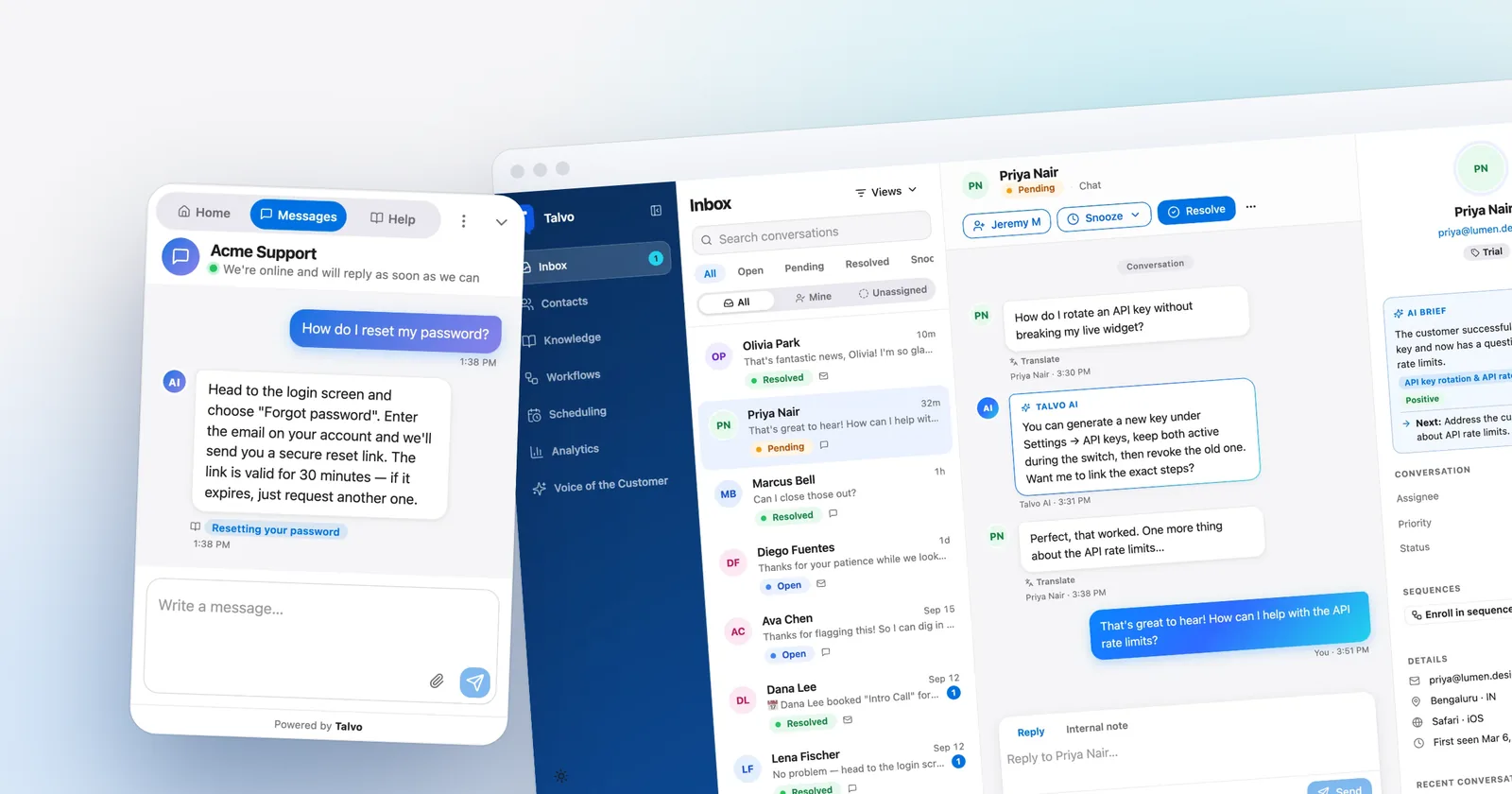
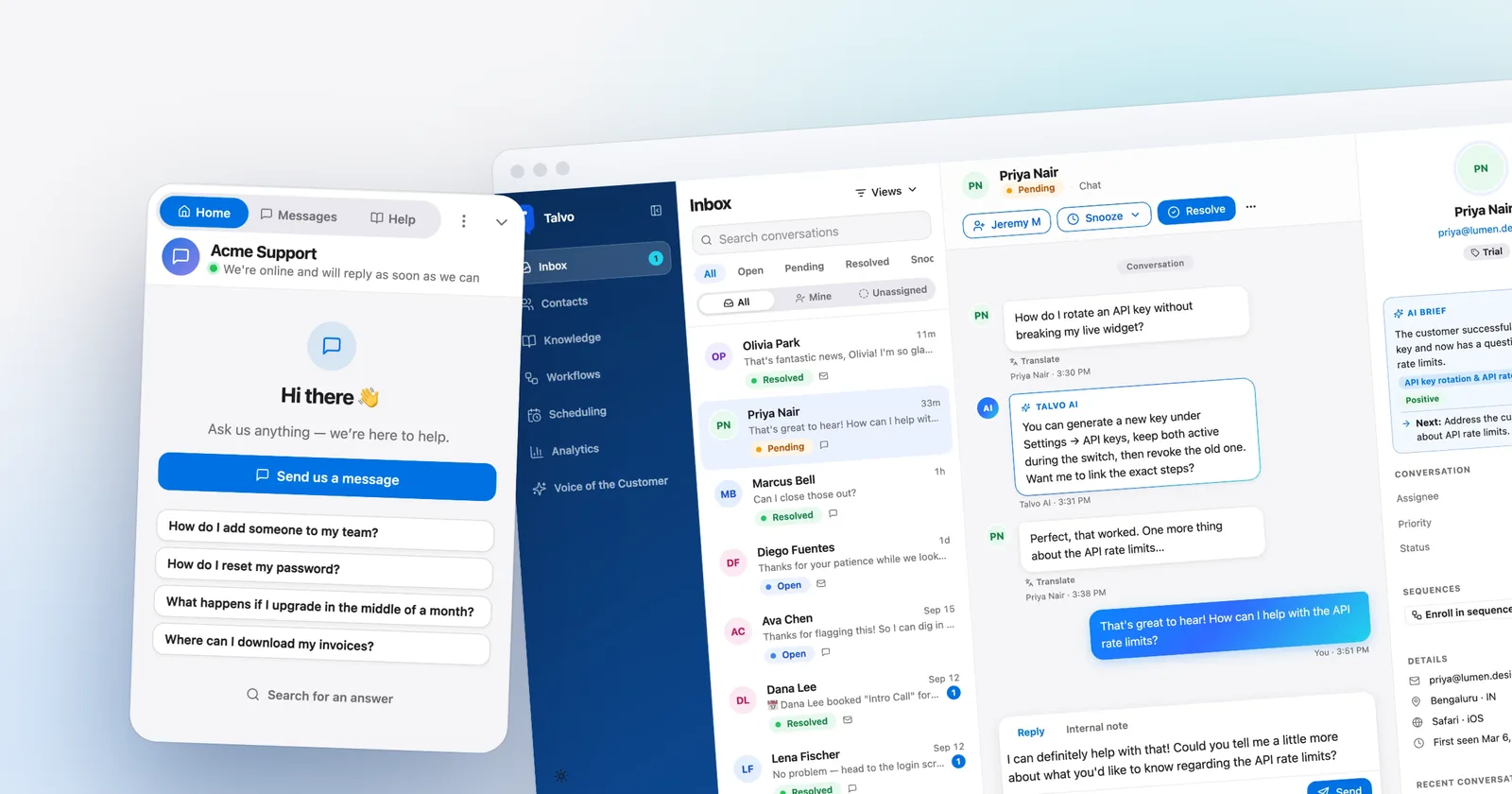
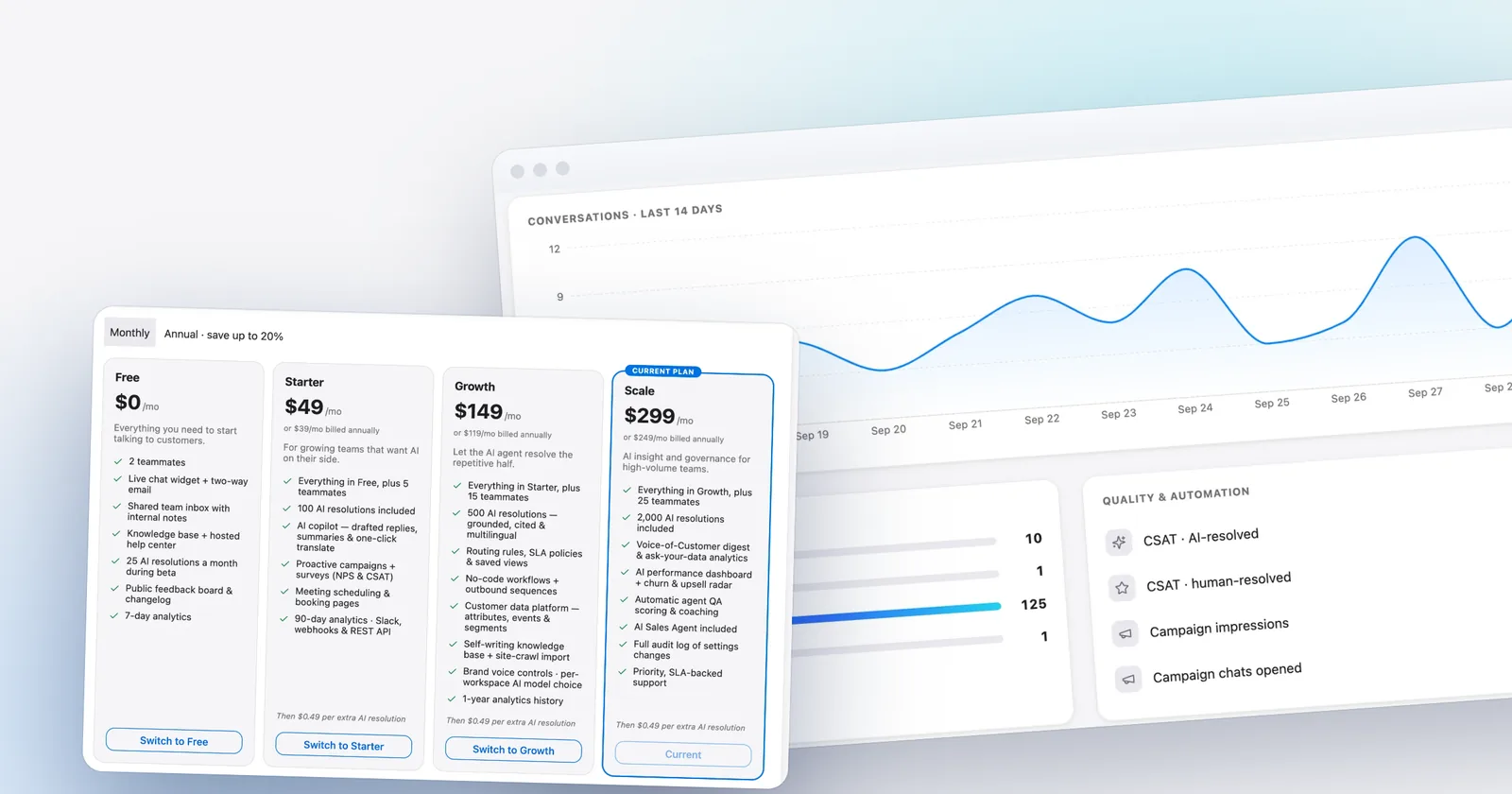
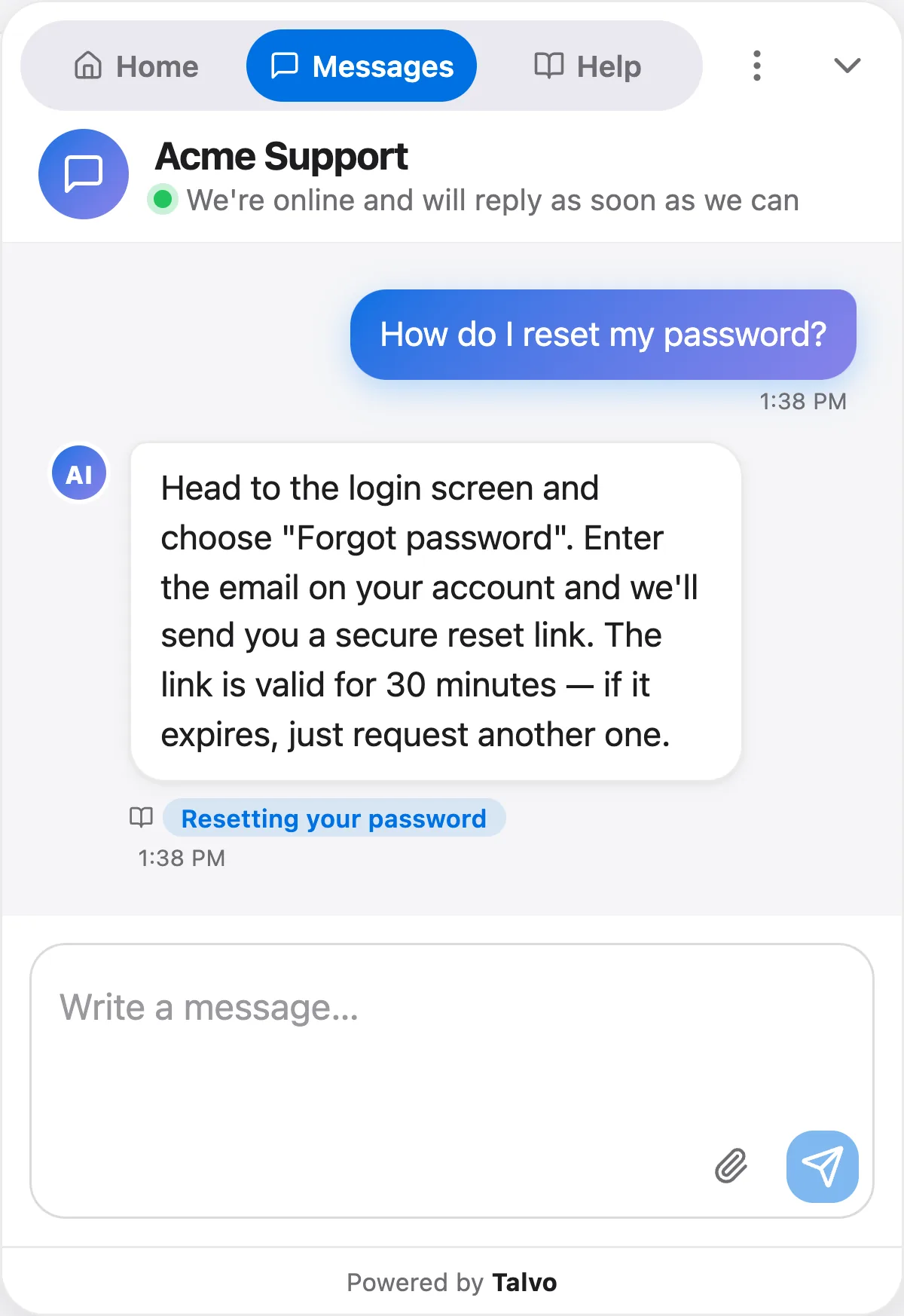
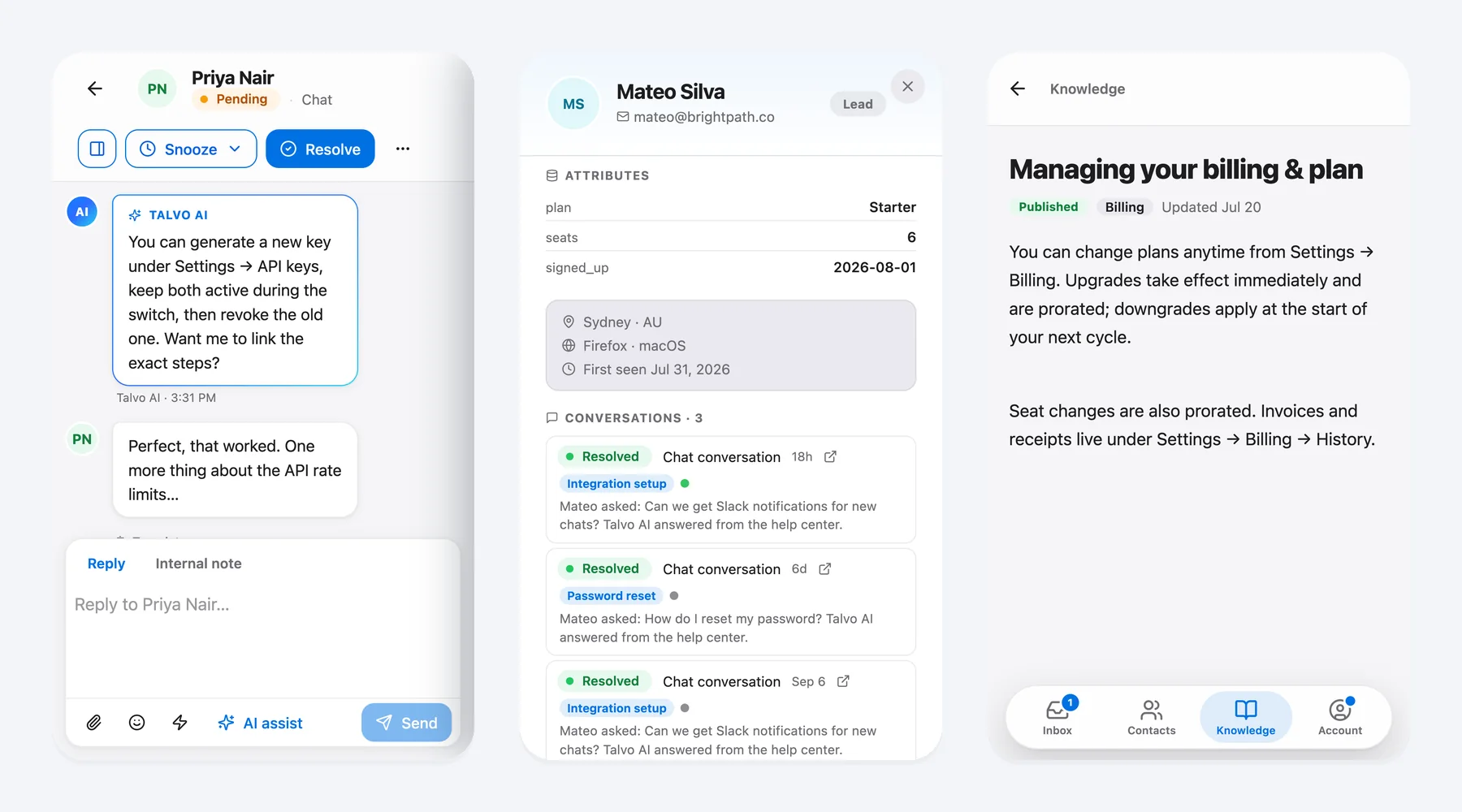
Talvo is the product we make. It shares Crisp's flat per-workspace model and tries to give you Fin-style AI without per-seat pricing. Its Starter plan is $49 a month for five teammates and 100 AI resolutions, Growth is $149 for 15 teammates and 500, and Scale is $299 for 25 and 2,000. Extra resolutions cost $0.49, and a resolution means the AI answered from your published knowledge base without a teammate stepping in, so handoffs are free. On the three teams above, that's about $147, $299 and $789 a month. Cheaper than Intercom, pricier than Crisp.
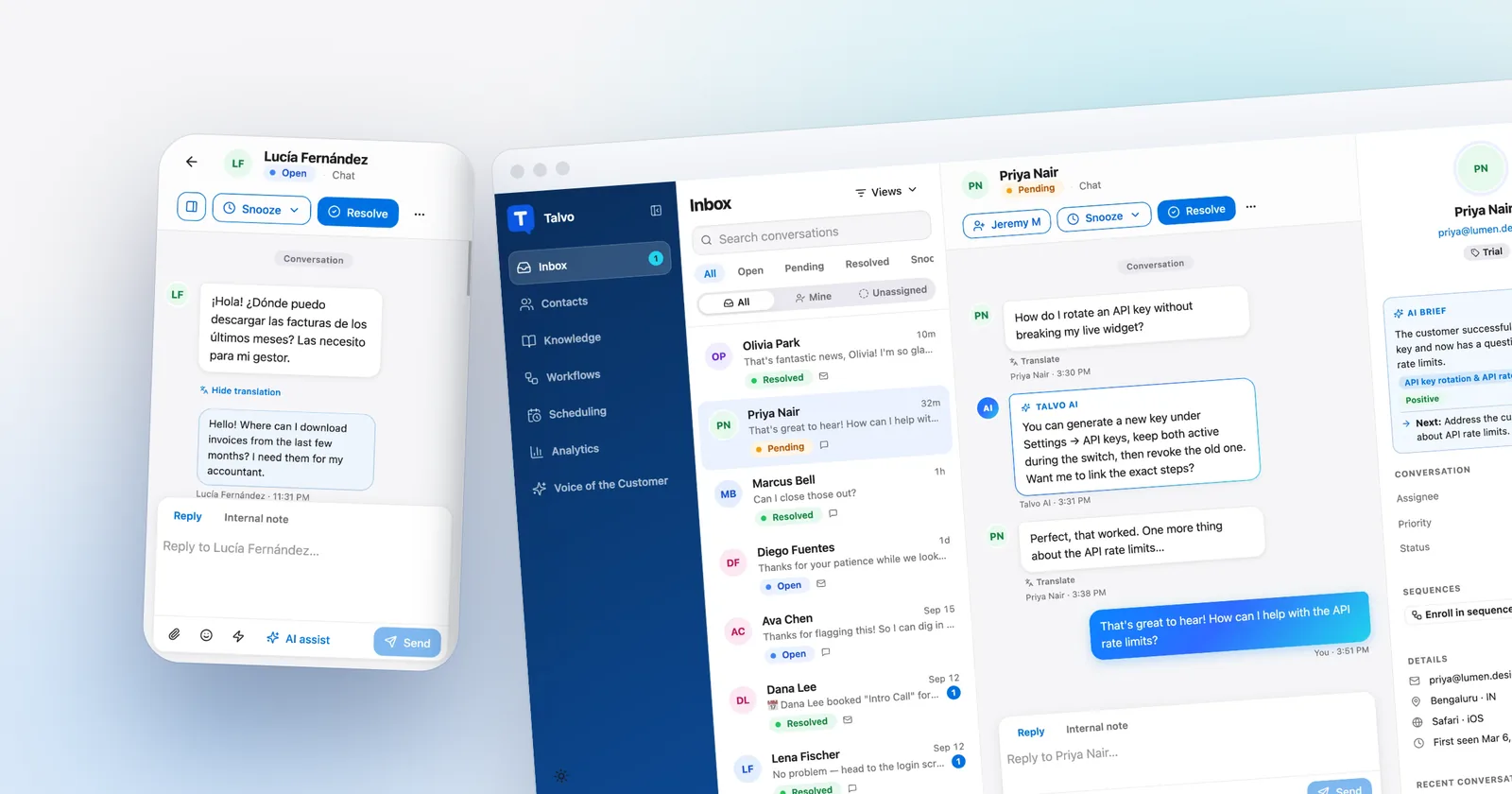
It's also new. Talvo launched in 2026, is in beta and has no review-site ratings, no case studies and no SOC 2 report. There's no WhatsApp, SMS, Instagram, Messenger or phone support (the first three are on the roadmap), no native Shopify or HubSpot integration and no mobile app beyond the phone browser. If you need any of that today, pick Crisp or Intercom. Our Talvo vs Crisp post makes that case in full.
Frequently asked questions
Is Crisp cheaper than Intercom?
Yes, by a wide margin in every scenario we priced. For 5 agents and 1,000 AI conversations, Intercom's Essential plan comes to about $1,185 a month at list prices, while Crisp's Essentials plan with AI credits comes to roughly $120 to $170. The gap comes from Intercom's per-seat fees and $0.99 per Fin outcome.
Does Crisp have AI like Fin?
Crisp has Hugo, an AI agent that answers from your knowledge base and is included from the Mini plan upward. It is billed on AI usage through prepaid credits, estimated at about $0.05 to $0.10 per conversation, instead of $0.99 per outcome like Fin. We have no independent accuracy comparison, so test both on your own hardest questions during their 14-day trials.
Which is better for startups, Crisp or Intercom?
Crisp usually fits an early team better because it has a free plan, flat per-workspace pricing and a small AI bill. Intercom has no free plan, but its Early Stage program is described on its pricing page as 93 percent off plus a year of Fin free, so check whether you qualify before ruling it out.
Can I migrate from Intercom to Crisp?
Probably, but we could not verify either vendor's import and export tools, so we won't promise a clean move. Plan to rebuild help articles and saved replies, and check what Intercom lets you export before you cancel. Run both side by side for a short period if you can.
Does Crisp have SOC 2 or HIPAA support?
Crisp's own help center says it has not been through a SOC 2 audit, and none of the Crisp pages we checked mention HIPAA or SAML single sign-on. Intercom lists SOC 2 Type II and HIPAA support, with HIPAA and SSO on its Expert plan.
Is Intercom the same as Fin now?
Intercom renamed itself Fin in May 2026 and kept Intercom as the name of its helpdesk product. Salesforce agreed to acquire the company in June 2026 for about $3.6 billion and announced on September 10, 2026 that the acquisition was complete.
What is a good alternative to both Crisp and Intercom?
It depends on what you need. Talvo is a newer option with flat per-workspace pricing and $0.49 per AI resolution, but it is in beta and does not support WhatsApp, SMS or Instagram yet. Teams that need those channels today should stay with Crisp or Intercom.
Sources
Other products' prices and features change. We checked these pages; if something is out of date, tell us and we'll fix it.
- Intercom pricing page (checked Oct 21, 2026)
- Intercom security page (checked Oct 21, 2026)
- Intercom channels explained (help article)
- Crisp pricing page (checked Oct 21, 2026)
- Crisp Hugo pricing and billing explained (updated Sep 20, 2026)
- Crisp compliance status with SOC 2 (updated Oct 5, 2026)
- Salesforce press release: Salesforce completes acquisition of Fin (Sept 10, 2026)
- Talvo pricing