On this page
- Intercom pricing in 2026: three plans, two billing modes, one AI rate
- Seats are the small line on the bill
- Fin's $0.99 adds up faster than seats do
- Add-ons, channel fees and the things outside the plans
- Worked monthly bills: three team sizes
- How the bill scales as Fin gets better
- Ways to lower the bill
- Rename and the Salesforce deal: what's confirmed
- What the same teams would pay on Talvo
- What to check before you buy
- Frequently asked questions
Intercom (now Fin) charges for a support team in three separate ways: a monthly fee for every person who answers customers, $0.99 every time its AI agent Fin gets credit for an outcome, and a handful of add-ons that sit outside the plans. A 5-person team with Fin getting credit for 1,000 outcomes a month pays about $1,135 to $1,185 a month at list price, and roughly 85% of that is the AI line, not the seats. That's the number most Intercom pricing pages bury, so this one starts there.
Everything below is from Intercom's own pricing page and Fin's help documentation, read on October 21, 2026, with the arithmetic shown so you can swap in your own numbers. One disclosure: Talvo makes a competing product, and there's a section near the end that prices Talvo for the same teams. Every Intercom number above that section is Intercom's own.
Intercom pricing in 2026: three plans, two billing modes, one AI rate
Intercom has no free plan. It offers a 14-day trial with no credit card, then three seat-based plans. Prices are per seat, per month, and they differ depending on whether you pay annually or monthly.
| Plan | Annual billing | Monthly billing | What you get at that tier |
|---|---|---|---|
| Essential | $29 | $39 | Fin, Messenger, shared inbox and ticketing, pre-built reports, public help center |
| Advanced | $85 | $99 | Adds multiple team inboxes, workflow builder, round-robin assignment, private and multilingual help center, 20 free Lite seats |
| Expert | $132 | $139 | Adds SSO and identity management, HIPAA support, SLAs, multibrand Messenger and help center, 50 free Lite seats |
Fin, the AI agent, costs $0.99 per outcome on every plan. Copilot, the assistant that helps your human agents, is $29 per agent a month billed annually or $35 billed monthly. Those are the list prices. New customers are currently shown lower promotional prices on Essential, covered below, and there's no stated end date on them.
The annual discount isn't uniform, which surprises people. On Essential, paying annually saves $10 a seat, about a quarter. On Advanced it saves $14, about 14%. On Expert it saves $7, about 5%. If you were planning to "just go annual" to fix a high quote, the bigger plans barely move.
Seats are the small line on the bill
Start with who counts as a seat. Intercom sells Full seats and Lite seats. Only Full seats can send messages to customers, and the minimum is one Full seat. Advanced includes 20 free Lite seats and Expert includes 50, which are meant for people who need to look at conversations or collaborate internally but don't answer customers.
That distinction matters for planning. A founder who reads the inbox once a week, an engineer who gets looped in on bugs, a finance person who checks billing threads: on Advanced or Expert they can be Lite seats and cost nothing. On Essential, none are listed as free, so anyone who needs access is a paid seat.
Two other seat details. Essential and Advanced are self-serve, month to month or annual, and downgrades usually take effect at renewal rather than immediately. Contracts are for enterprise needs, Premier Support and custom terms.
The new-customer promo price
As of October 21, the pricing page shows new customers $19 per seat on Essential with annual billing (marked "save 35%") and $29 monthly ("save 25%"). We can't tell you how long that lasts, because the page doesn't say. Treat $29 and $39 as the real prices, and the promo as a good thing to ask your account rep to put in writing for the full contract term.
Fin's $0.99 adds up faster than seats do
Intercom's pricing page says Fin costs $0.99 per outcome, with no seats required if you use Fin on its own. Bills built on outcomes are only as predictable as the definition of an outcome, so it's worth reading closely.
What counts as an outcome
The pricing FAQ says an outcome is counted when any of three things happens: the customer confirms the issue is resolved, the customer doesn't ask for more help after Fin responds, or Fin completes a workflow it calls a Procedure, including handoffs. You're charged once per conversation however many questions Fin answers in it.
The second one is the hinge. A customer who gets an answer and simply closes the tab can be billed as a resolution. Fin's own help article on outcomes words it as a customer who "does not request more help after Fin answers," which is the same idea. The third matters too: a Procedure you've built to end in a handoff to a human counts as an outcome when it runs successfully, even though a person finishes the job.
What doesn't count, per the same help article: a Procedure that fails because the customer asks for a human or it doesn't complete, escalations triggered by Fin's default behavior (frustration detection, for example) or by your own escalation rules, and conversations that auto-close after Fin asked a clarifying question and the customer never replied.
That reading comes from Intercom's own documentation. Independent reviews of Intercom also flag it as the main reason bills are hard to forecast, though those reviews are written by competing vendors, so weigh them accordingly.
Fin standalone
You can run Fin on top of a different helpdesk. Standalone, it's $0.99 per outcome with no seats, setup fees, integration fees or platform fees, but with a minimum monthly commitment. The pricing page gives 50 outcomes as an example. Fin's outcomes help article describes a $49 monthly base that includes 50 resolutions, with extra ones at $0.99, and says unused monthly resolutions are lost rather than rolled over. We couldn't confirm from public pages whether those two descriptions are the same offer, so ask.
What Fin costs by volume
The pricing page lists "from $0.99," and we found no published volume tiers, so the arithmetic is straight multiplication. Large buyers may negotiate; ask.
| Outcomes per month | Fin cost at $0.99 | Per year |
|---|---|---|
| 50 (the pricing page's example minimum) | $49.50 | $594 |
| 100 | $99 | $1,188 |
| 1,000 | $990 | $11,880 |
| 5,000 | $4,950 | $59,400 |
| 10,000 | $9,900 | $118,800 |
At 100 outcomes a month, Fin is the smaller line next to the seats. At 1,000 it's the biggest line on a small team's bill. At 10,000 it's $118,800 a year.
Add-ons, channel fees and the things outside the plans
None of these are on the plan cards, which is how a "$29 a seat" tool turns into a different number on the invoice.
Copilot. $29 per agent a month billed annually, $35 monthly, for unlimited use. Each agent also gets 10 Copilot conversations and 10 AI auto-translation conversations free every month, so a light user may never need to pay.
Proactive Support Plus. $99 a month, including 500 messages. This is where product tours, surveys, checklists, posts, in-app messages, mobile push and carousels live, plus the Series campaign builder. If your plan is to onboard users with a tour, it isn't in any base plan. Extra messages are charged per unit, but the unit price isn't published on the pricing page.
Pro. From $100 a month. It includes Operator, an operations agent, plus analysis of 500 conversations a month and 6,000 credits. Extra credits are $0.01 each.
Channels. Live chat, support email, in-app chats, banners and tooltips are free and unlimited on every plan. Pay as you go: email campaigns (per bulk email), SMS (per message, varies by region), WhatsApp (per conversation, varies by volume and direction) and phone (usage-based). Rates are on Intercom's separate channel pricing page, which we didn't price here, so those aren't in the totals below.
Worked monthly bills: three team sizes
Here's the same arithmetic for three teams. Assumptions: all seats are Full seats, Fin is the only AI cost, and every number is list price with no promo, no tax and no channel fees. The AI line is outcomes times $0.99.
| Team | Plan | Seats | Fin | Monthly billing | Annual billing |
|---|---|---|---|---|---|
| 3 agents, 300 outcomes | Essential | 3 × $39 = $117 | 300 × $0.99 = $297 | $414 | 3 × $29 = $87 + $297 = $384 |
| 3 agents, 300 outcomes | Advanced | 3 × $99 = $297 | $297 | $594 | 3 × $85 = $255 + $297 = $552 |
| 5 agents, 1,000 outcomes | Essential | 5 × $39 = $195 | 1,000 × $0.99 = $990 | $1,185 | 5 × $29 = $145 + $990 = $1,135 |
| 5 agents, 1,000 outcomes | Advanced | 5 × $99 = $495 | $990 | $1,485 | 5 × $85 = $425 + $990 = $1,415 |
| 10 agents, 3,000 outcomes | Essential | 10 × $39 = $390 | 3,000 × $0.99 = $2,970 | $3,360 | 10 × $29 = $290 + $2,970 = $3,260 |
| 10 agents, 3,000 outcomes | Advanced | 10 × $99 = $990 | $2,970 | $3,960 | 10 × $85 = $850 + $2,970 = $3,820 |
With the new-customer promo on Essential, the smallest team's annual-seat bill drops from $384 to 3 × $19 = $57 + $297 = $354. The promo trims seats; it doesn't touch Fin.
Look at the shape. The annual-versus-monthly choice moves each bill by $30 to $140. Moving from Essential to Advanced moves it by $168 to $600. But the AI line is $297, $990 and $2,970, and it scales with how many conversations your customers start, not with how many people you hire.
Now add what teams usually add
Take the 5-agent team on Essential and give it Copilot for everyone and Proactive Support Plus:
| Line | Annual-seat billing | Monthly billing |
|---|---|---|
| 5 Essential seats | $145 | $195 |
| Fin, 1,000 outcomes | $990 | $990 |
| Copilot, 5 agents | 5 × $29 = $145 | 5 × $35 = $175 |
| Proactive Support Plus | $99 | $99 |
| Total | $1,379 | $1,459 |
Add Pro at $100 and the totals are $1,479 and $1,559. None of this is hidden exactly. It's spread across a pricing page, an FAQ and a help article, and no one of them adds it up for you.
Want your own numbers? Set your teammates and monthly AI-answered conversations below. The calculator uses list prices with monthly billing and the same formulas as the tables here (Intercom Essential at $39 a seat plus $0.99 per outcome), and it shows a few other tools for reference.
- Crisp Mini~$100–$150/mo$45 per workspace + 1 agents × $10 + AI at Crisp's estimate of $0.05–$0.10 per conversation, less $5 of included credits · Estimate: top-up rate and annual prices aren't published
- Talvo Scale$299/mo$299 per workspace, 2,000 AI resolutions included
- Help Scout Standard$900/mo5 users × $30 + 1,000 AI resolutions × $0.75
- Intercom (Fin) Essential$1,185/mo5 seats × $39 + 1,000 Fin outcomes × $0.99 · Workflow automation needs Advanced ($85–$99 per seat)
- Zendesk Suite Team$2,295/mo5 agents × $69 + 975 AI resolutions × $2.00 (25 included) · $1.50 each with a committed 100+ purchase
Estimates from each vendor's published list prices, checked October 21, 2026. Assumes the cheapest plan that includes live chat and an AI agent, and that every AI-resolved conversation is billable. Excludes taxes, promotions, add-ons (such as agent copilots) and per-use channels like SMS or WhatsApp. Talvo's annual price includes extra resolutions at the same $0.49, billed once a year.
How the bill scales as Fin gets better
Fin's price per outcome stays the same as it improves. That sounds fine until you follow it through: the better your knowledge base and Fin's setup, the more conversations it ends without a human, and the more you're billed. A good result and a bigger invoice are the same event.
For planning, work backward from your own history. Take last month's conversation count, estimate how many are repetitive questions your help center can answer (be conservative), and multiply by $0.99. If you get 2,000 conversations a month and half are answerable, that's up to about $990 for the AI line before seats. Then compare it to what a part-time hire would cost you in your market. Fin can easily be worth $0.99 where a human answer costs far more and speed matters. It's harder to justify where conversations are short, low-value or already handled by a quick macro.
One more thing to build in: the definition. Because silent customers and Procedure handoffs can count, assume your billable outcomes will run higher than the conversations you'd personally call "resolved." Ask Intercom, or look in your own reporting once you're on a trial, for the ratio.
Ways to lower the bill
Most levers are on the seat side, and most savings there are small. The big lever is the AI line.
Pay annually on Essential, where it saves about a quarter of seat cost. Skip the upgrade to Advanced unless you actually need what it adds; the extra $56 to $60 per seat a month is the largest swing on the table above. If you have a lot of read-only teammates, Advanced's 20 free Lite seats may beat paying for Full seats on Essential, but do that math with your real headcount.
If you qualify, ask about the Early Stage program, which the pricing page describes as 93% off plus a year of Fin free for startups. We haven't been able to read the eligibility rules (Intercom's help page for it blocked our fetch), so check them directly before you plan around it.
On the AI side, review how your Procedures are built, since a Procedure that ends in a handoff can bill as an outcome. Keep your help content tight, so Fin answers correctly in one turn. And before signing anything, get the written definition of an outcome and the minimum monthly commitment into your order form, with the promo price and its term.
Last, ask for a cap or alert. We didn't find a published spending cap for Fin on Intercom's pages, and some other vendors' AI products have one, so it's a fair thing to ask for.
Rename and the Salesforce deal: what's confirmed
Intercom renamed the company Fin in May 2026 and kept "Intercom" as the name of its helpdesk. The pricing page still reads "Intercom helpdesk plans with Fin AI Agent," and the site is still intercom.com.
On June 15, 2026, Salesforce announced a definitive agreement to buy Fin for about $3.6 billion. A later Salesforce release dated September 10, 2026 says it completed the acquisition, and Fin now sits inside Salesforce AI Labs. Neither release says anything about pricing, and the list prices on Intercom's pricing page were the ones above when we read it on October 21. We cover what to ask before your renewal in a separate post, Intercom is now Fin, and Salesforce has bought it.
What the same teams would pay on Talvo
Here's the part where we're a party to the comparison. Talvo is a customer messaging platform with live chat, an AI agent, a shared inbox, email and a knowledge base, and it launched this year, so it's in beta. We have no customer case studies and no review-site ratings to show you.
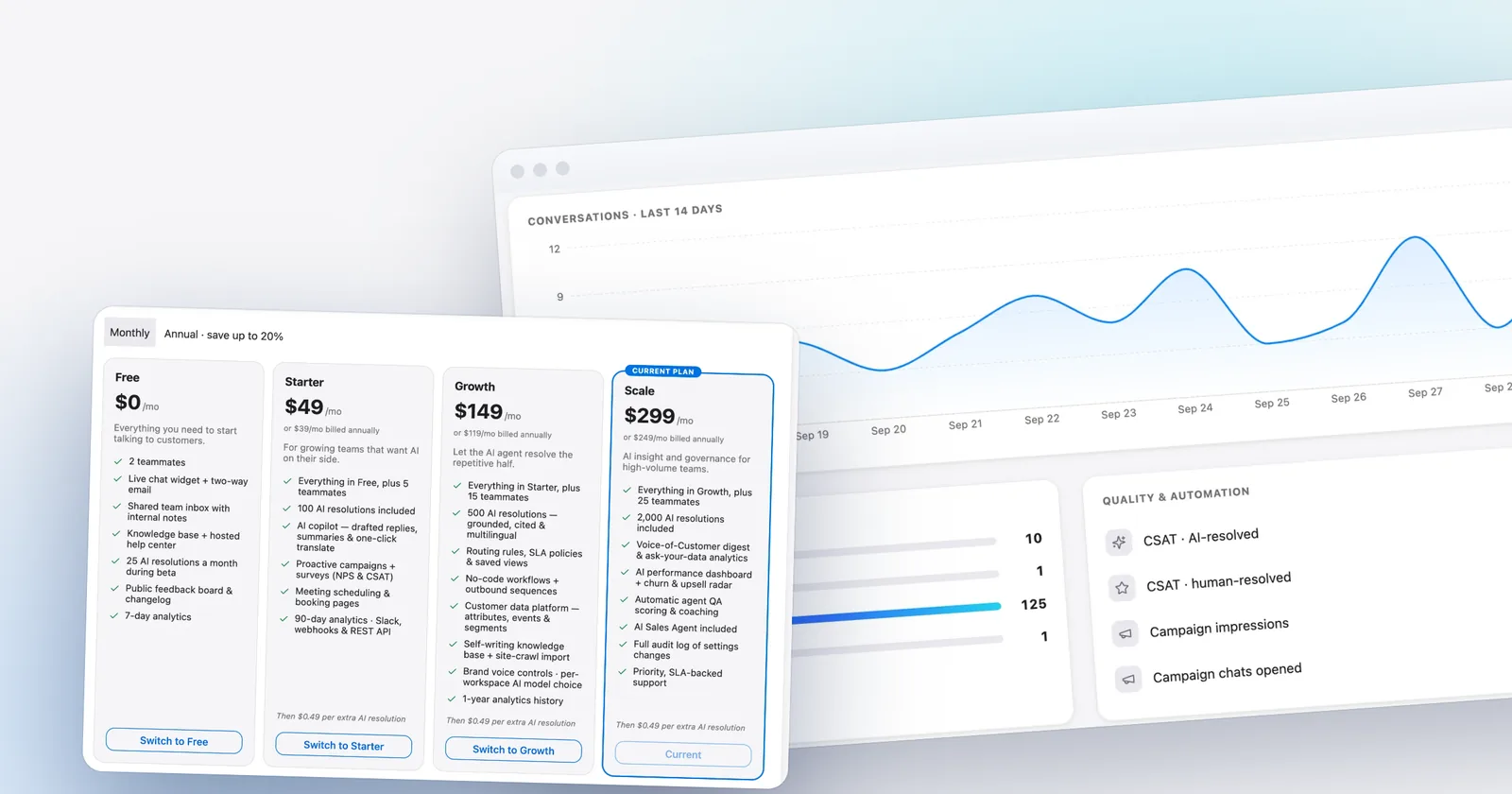
Talvo prices per workspace, not per seat. Starter is $49 a month with 5 teammates and 100 AI resolutions. Growth is $149 with 15 teammates and 500 resolutions. Scale is $299 with 25 teammates and 2,000. Annual billing brings those to $39, $119 and $249 a month. Resolutions past the included amount are $0.49 each on every paid plan.
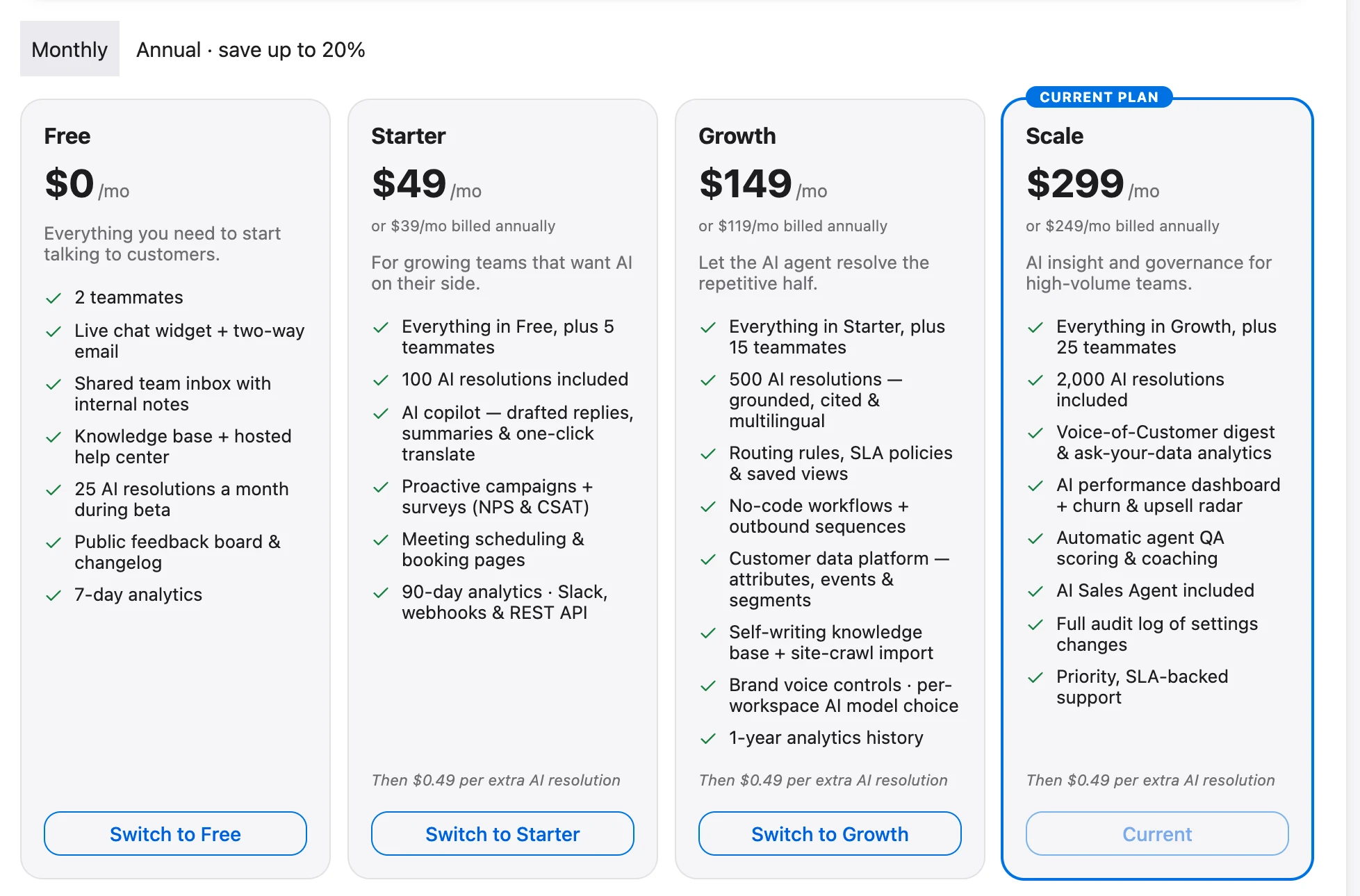
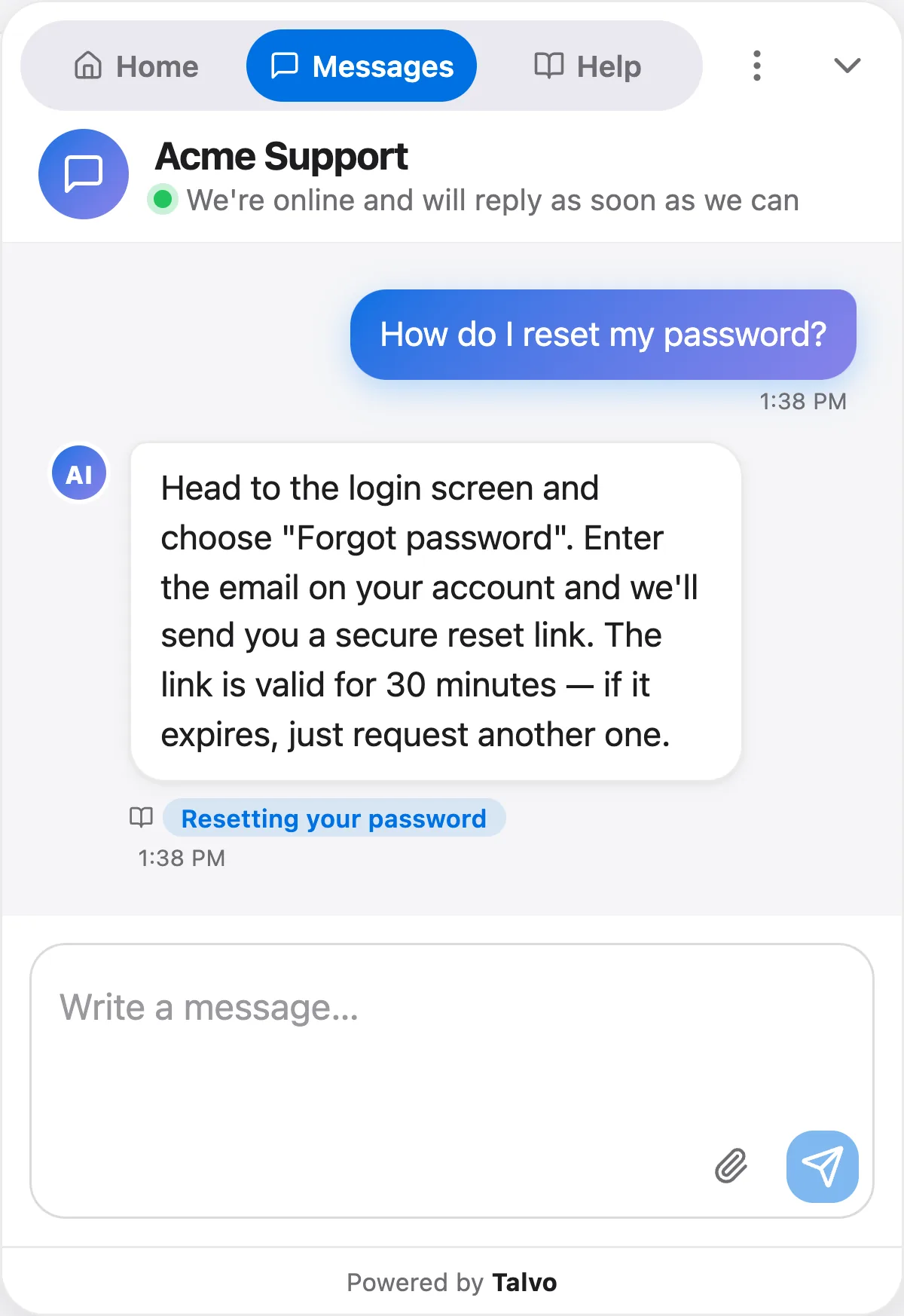
A Talvo resolution is a conversation the AI answered end to end from your published knowledge base with no teammate stepping in, counted once. A handoff to a human isn't one. That's comparable to Fin's definition, so the real difference here is price per resolution, $0.49 against $0.99. It's not a stricter or looser rule. (Details are in what counts as an AI resolution.)
For the same scenarios, here is the cheapest Talvo plan that fits, worked out separately for monthly and annual billing:
| Team | Monthly billing | Annual billing | Intercom Essential (monthly seats) |
|---|---|---|---|
| 3 agents, 300 outcomes | Starter: $49 + 200 × $0.49 ($98) = $147 | Growth: $119, covers 500 | $414 |
| 5 agents, 1,000 outcomes | Scale: $299, covers 2,000 | Scale: $249 | $1,185 |
| 10 agents, 3,000 outcomes | Scale: $299 + 1,000 × $0.49 ($490) = $789 | Scale: $249 + $490 = $739 | $3,360 |
For the first team, Growth at $149 monthly includes 500 resolutions and is only $2 more than Starter plus overage; on annual billing Growth at $119 is the cheaper plan, because Starter's $39 plus the same $98 of overage comes to $137. The 5-agent and 10-agent rows are where flat pricing starts to show, because the plan includes the people and a block of AI answers.
Scaling the AI line on Talvo by itself, assuming a Scale plan: 1,000 resolutions are inside the $299; 5,000 is $299 + 3,000 × $0.49 = $1,769; 10,000 is $299 + 8,000 × $0.49 = $4,219. Fin at the same volumes is $4,950 and $9,900 before any seats. Talvo's pricing page also states a 15-teammate cap on Growth and 25 on Scale; beyond that you'd be talking to us about Enterprise.
That's where we're cheaper. Here's where we aren't the better pick. Intercom has SOC 2 Type II, HIPAA support on Expert, data hosting in the US, EU or Australia, and SSO. Talvo has none of those yet: no SOC 2 report, no SAML, no choice of data region, no HIPAA. Intercom also covers WhatsApp, SMS, phone, Instagram and Messenger; Talvo has none of those channels live, though WhatsApp, SMS and Instagram/Messenger are on our public roadmap. Intercom has product tours, checklists and a large app marketplace. Talvo's integrations today are a REST API, webhooks and Slack. And Intercom has years of production use behind its AI that we simply don't.
If you need those, or your support is product-led with in-app tours and many channels, Intercom's price buys things Talvo doesn't have. If you mostly need a chat widget, an inbox, email and an AI that answers from your docs with citations, compare directly in Talvo vs Intercom, or see cheaper Intercom alternatives and AI resolution pricing compared. For the seat-versus-flat question, per-seat vs flat pricing shows the crossover. And if you're asking whether the whole thing is worth it, start with is Intercom worth it.
What to check before you buy
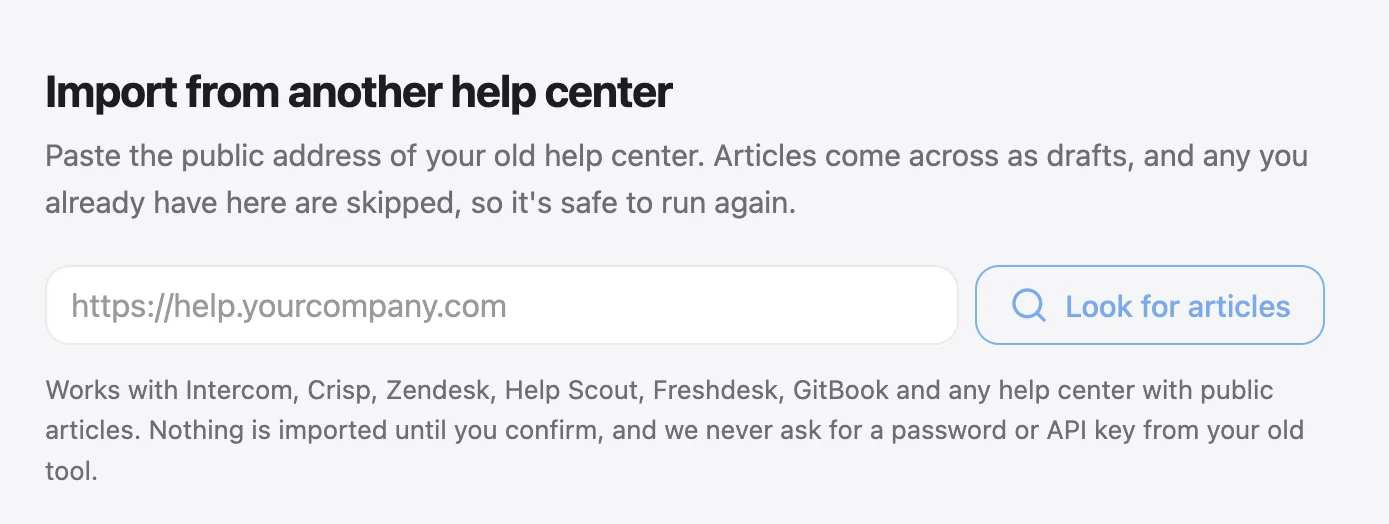
A short list, because the bill is simpler than the page. Know your Full-versus-Lite count. Pick monthly or annual knowing the annual saving shrinks as you go up the plans. Get the outcome definition and any minimum in writing. Price Copilot and Proactive Support Plus only for the people and features that need them. Ask which channel rates apply to you. And do the Fin line with your own conversation history, because that's the number that decides everything else. If you're moving content over, Talvo can import your help center, including Intercom articles.
Frequently asked questions
How much does Intercom cost per month?
Intercom's seat plans are $29 (Essential), $85 (Advanced) and $132 (Expert) per seat a month billed annually, or $39, $99 and $139 billed monthly. On top of that, its Fin AI agent costs $0.99 per outcome. A 5-person team on Essential with 1,000 Fin outcomes a month pays about $1,135 on annual seats or $1,185 on monthly.
Does Intercom have a free plan?
No. Intercom offers a 14-day trial with no credit card, including Fin and add-ons, but no free plan. Startups can apply to its Early Stage program, which the pricing page describes as 93% off plus a year of Fin free.
Is Fin included in Intercom plans?
Fin is available on every Intercom plan, but its usage is billed separately at $0.99 per outcome. You can also buy Fin standalone, without Intercom seats, on top of another helpdesk, subject to a minimum monthly commitment.
What counts as a Fin outcome?
Per Intercom's pricing FAQ, an outcome is counted when the customer confirms the issue is resolved, when the customer doesn't ask for more help after Fin responds, or when Fin completes a Procedure, including ones that end in a handoff. You're charged once per conversation. Failed Procedures, escalations and conversations that auto-close after a clarifying question don't count.
Does Intercom charge per seat?
Yes. Full seats, the ones that can message customers, are billed per seat each month, with a one-seat minimum. Advanced includes 20 free Lite seats and Expert includes 50, but Lite seats cannot send messages.
Why is Intercom so expensive?
The bill has several independent parts: per-seat fees, a per-outcome fee for Fin, add-ons such as Copilot at $29 to $35 per agent and Proactive Support Plus at $99, and pay-as-you-go channels. For teams with a lot of AI-answered conversations, Fin is usually the largest line, because it scales with customer volume rather than headcount.
Did Salesforce buy Intercom?
Yes. Salesforce completed its acquisition of Fin (formerly Intercom) on September 10, 2026, after announcing a roughly $3.6 billion agreement on June 15, 2026. Intercom renamed itself Fin in May 2026; the helpdesk keeps the Intercom name. Neither release discusses pricing, and list prices were unchanged when we checked on October 21, 2026.
Sources
Other products' prices and features change. We checked these pages; if something is out of date, tell us and we'll fix it.
- Intercom pricing page (checked Oct 21, 2026)
- Fin AI Agent outcomes help article (checked Oct 21, 2026)
- Salesforce: definitive agreement to acquire Fin, June 15, 2026
- Salesforce: completes acquisition of Fin, September 10, 2026
- CX Today: Intercom rebrands to Fin
- Talvo pricing
- Talvo help: what counts as an AI resolution