On this page
- The hand-off rules on one page
- A confident wrong answer is worse than a hand-off
- What the human should receive
- The customer's escape hatch
- What happens when nobody is online
- One voice per thread
- A ten-message test before customers find the gaps
- Measure it monthly
- Setting up hand-offs in Talvo
- Frequently asked questions
A customer asks your chatbot something it can't answer, asks again in different words, then types "human" three times. Whether that ends with a person on the thread or a closed tab depends on your chatbot human handoff rules, and most small teams never wrote any. The bot shipped with whatever defaults came in the box.
This guide is about those rules: when the AI should let go, what the person who picks up should already know, what the customer can do when the bot isn't helping, and what happens when nobody is at a desk. It ends with a ten-message test script and the numbers to check each month. Talvo is the worked example, including a gap in how it handles the "I want a person" moment that you should know about before you rely on it.
The hand-off rules on one page
Put these in writing before you turn an AI agent on. The last column is how Talvo behaves today, so you can see where a tool you're evaluating might differ.
| Situation | What good looks like | What the team should receive | Talvo today |
|---|---|---|---|
| No article or document covers the question | Hand off; never guess | The question and a note saying why | Hands off, with an internal note |
| The customer asks for a person | Hand off at once, in any wording | A flag that they asked | No rule and no button; see the escape hatch below |
| Same question asked again, still unanswered | Stop trying, hand off | Both attempts | No loop rule in the docs; the AI stops after 10 AI replies in one chat |
| Needs the account or a judgment call (refund, cancellation, dispute) | Hand off without an attempt | Who they are, what they want, order details | Governed by what your published articles say |
| Angry, legal or safety-related | Hand off immediately and alert someone | The full thread, marked urgent | No sentiment rule documented |
| Nobody is online | Hand off anyway, say when they'll hear back, capture contact details | Everything above, waiting when the team returns | Hands off; asks for an email if it has none |
Nothing in that table is exotic. Each row needs an owner, a wording and a test, and a row your tool can't do should be a known gap, not a surprise.
A confident wrong answer is worse than a hand-off
The first trigger is the one that matters most, and it has nothing to do with how annoyed the customer is. It is the AI noticing that it doesn't have an answer.
Plenty of guides tell you to set a confidence threshold and offer a number. Those numbers are vendor opinions, not a standard, and most small-business tools don't give you a slider anyway. The lever you do have is content. If your help articles don't cover a question, a well-built agent should say so by handing the conversation over, not by stretching a loosely related article into something that sounds right.
That is how Talvo's AI agent is built. It answers only from your published articles and cites the one it used. The documented triggers for a hand-off are:
- the published articles don't contain enough to answer confidently
- there are no published articles at all
- the AI call fails or runs out of credits
There is one more rule that does a lot of quiet work. A reply to a real question that doesn't cite an article is turned into a hand-off. Only greetings and thank-yous can go out without a citation. So the AI can't drift into freelancing when the knowledge base runs dry. Our guide to how a knowledge base chatbot works goes deeper on grounding and citations, so we'll leave it there.
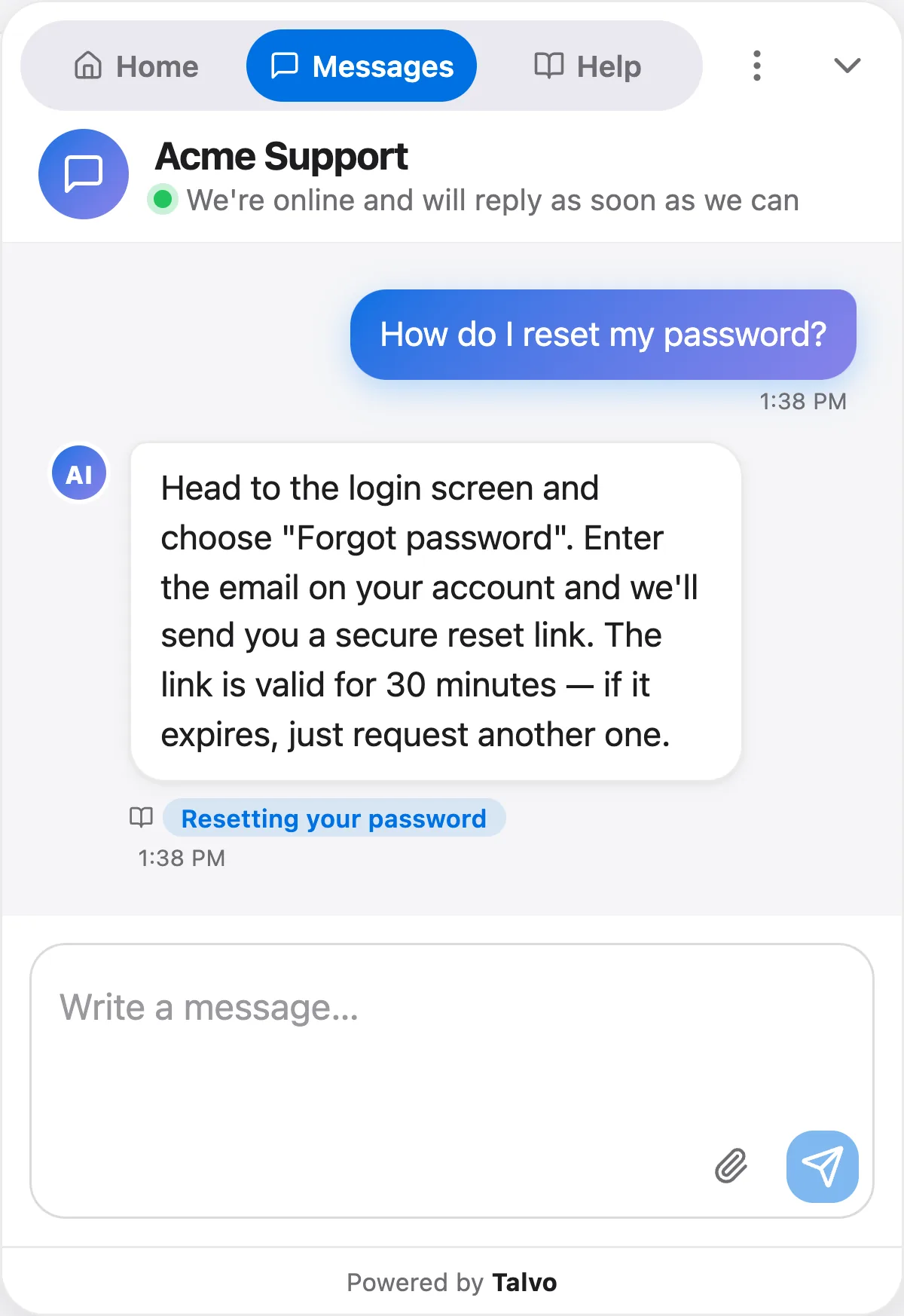
A hand-off is a correct outcome here, not a failure. In Talvo it is also free: hand-offs are never billed as AI resolutions.
What the human should receive
The worst moment in a hand-off is the first message from the human: "Hi, how can I help?" The customer has just explained everything. Now they do it again.
Whatever tool you use, the person who picks up needs five things without asking for them.
- The whole conversation so far, in order, including what the bot already said
- A one-line summary of what the customer is trying to do
- Which article or source the bot tried, if any, and why it stopped
- Who the customer is: name, email, account or order reference if you have it
- How to reach them if they leave the chat before anyone replies
Microsoft's Copilot Studio documentation is a useful reference for how thorough this can get. Its hand-off can share the full conversation history plus context variables such as the last topic, the topics visited, the last phrases the customer used and their language (Microsoft Learn). You won't need all of that, but it shows the principle: package the context so the human doesn't have to reconstruct it.
Zendesk's guidance for its AI agents makes the same point from the other direction. It recommends collecting details such as the order number, name and email, and tagging the ticket, before the hand-off happens (Zendesk).
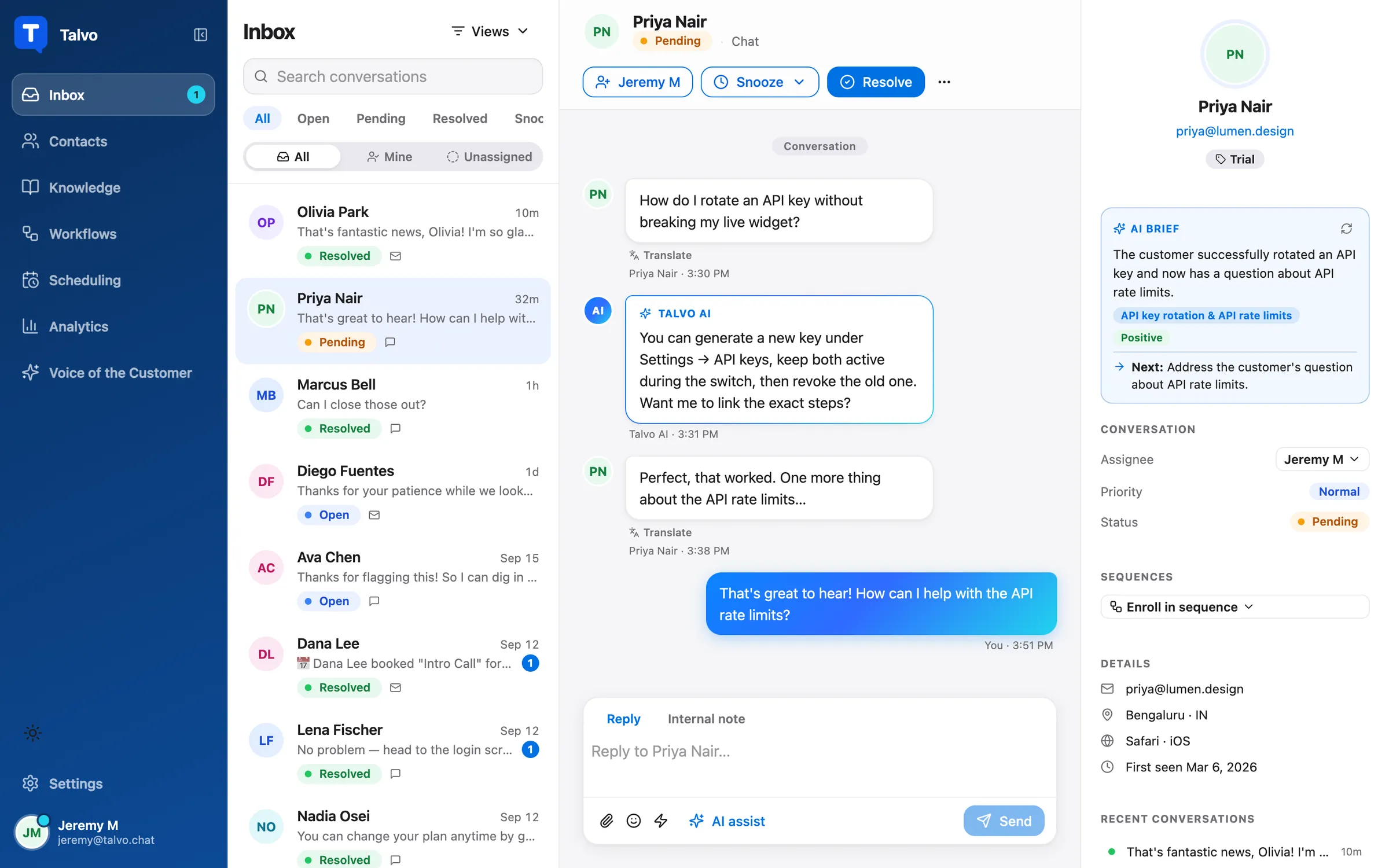
In Talvo, the conversation stays intact in the shared inbox, and the team gets an internal note on it reading "AI auto-resolve couldn't answer confidently from the knowledge base and handed off. This conversation needs a human reply." On Starter and up, the AI brief on the thread summarizes it for whoever opens it. The note tells you why the AI stopped; reading the thread tells you what the customer asked.
The customer's escape hatch
Here's the uncomfortable part of the whole topic. Some customers don't want your bot at all. They want a person, and they will tell you so.
The US Consumer Financial Protection Bureau wrote about what happens when they can't (CFPB, June 2023). Its report on bank chatbots describes "doom loops," where the customer gets the same unhelpful responses over and over with no way out. It was about banks, but the shape is universal. Gartner's survey of 3,566 customers, run in February and March 2026, found that 87% say companies using generative AI for service must provide access to a human agent (Gartner, August 2026).
Vendors take different approaches to the escape hatch:
- Fin (formerly Intercom) escalates by default when a customer clearly asks to speak to a human, when it detects strong frustration, or when the conversation loops. It offers escalation once per conversation and, if no teammate is available, the customer gets a refusal with no fallback (Fin help).
- Microsoft Copilot Studio has an Escalate system topic that fires when the user types something like "talk to agent" or the agent can't determine intent. Without a connected engagement hub, it just shows a message such as a support URL (Microsoft Learn).
Notice what the Fin documentation also tells you: an escape hatch with nobody behind it is a trap with extra steps.
Talvo has no explicit one, and that's a real gap
There is no "talk to a person" button in the Talvo widget, and there is no keyword or phrase rule that triggers a hand-off when a customer asks for one. If someone types "can I talk to a person," that is not a question the knowledge base answers, so in practice it tends to end in a hand-off. But that is a side effect of the AI having nothing to cite, not a rule, and we won't describe it as a guarantee.
If this matters for your business, and for most it should, here is what to look for in any tool you're comparing, ours included.
- A visible way to ask for a person, or phrase detection that treats "human," "agent" and "real person" as a request
- A cap on repeated attempts, so the bot stops after it has failed twice
- A fallback when nobody is online: an email capture, a form or a promised reply time
- The request logged, so you can count how often customers ask
- A bot that apologizes and tries again instead of handing over
- Escalation that is refused with no alternative when the team is offline
- A hand-off that drops the conversation instead of carrying it
What you can do inside Talvo today:
- Use the welcome message under Settings → General → Chat widget (up to 240 characters) to tell visitors how to reach a person directly, with an email address or a link.
- Publish a short "How to reach us" article with your hours and address. It gives the AI something real to cite when someone asks. Test the phrasings your customers use, because the outcome isn't guaranteed for each one.
- Keep someone watching live chats. If a teammate replies, the AI steps aside for the rest of that conversation.
None of those is a button. We'd rather say that plainly than have you find it in week two.
What happens when nobody is online
For a team of two to five people, a lot of hand-offs happen when nobody is looking. The AI answers at 2 a.m. and it hands off at 2 a.m., and then a human is not coming for six hours.
The hand-off message has three jobs in that moment: confirm the question was received, set an honest expectation, and get a way to reach the customer. In Talvo the customer sees:
If Talvo doesn't have an email for them, the message ends instead with "What's the best email to reach you, in case you step away before they reply?" If they type one, it's saved on their contact and acknowledged. That email question is the right instinct, because a chat visitor who closes the tab can't be reached otherwise.
Two things about Talvo's overnight behavior to know:
- The AI has no business-hours check. It answers around the clock and hands off the same way at any hour.
- The hand-off message is the same at any hour and doesn't mention when your team returns. The widget header does, though. Outside your business hours it shows your away message instead of "We're online" and the reply-time promise.
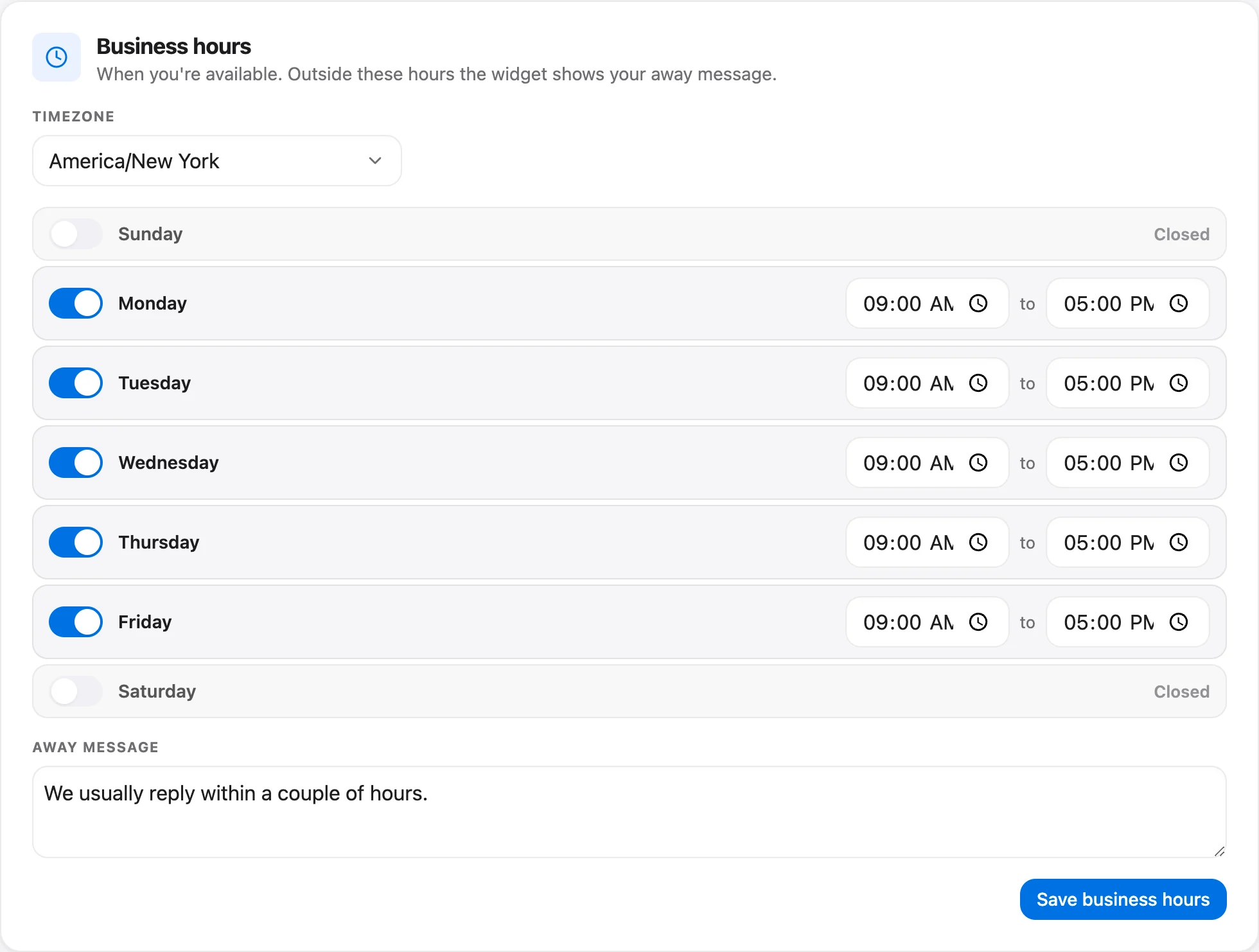
So write the away message to carry the expectation the hand-off message doesn't. Wording that works, with your own hours and address swapped in:
We're away until 9:00 a.m. Eastern. Leave your question and an email
address and we'll reply the next business morning. If it can't wait,
email support@yourcompany.com and put "urgent" in the subject.
Business hours and the away message are on every plan, and so are the no-reply reminders (Settings → Inbox → Reply reminders, 12 hours by default) that alert the team when a customer has been waiting. Our guide to after-hours customer support covers the overnight queue in full, and first response time SLAs cover the clock that starts when a hand-off lands.
When a hand-off does land, Talvo alerts the assignee, or the whole team if the chat is unassigned, by push notification and by email ("needs a reply"). Emails are limited to one per conversation per 30 minutes, and each person can turn them off under Settings → Inbox → Notifications. On the first message of a widget chat the hand-off alert is email only, because a "New chat" push already went out. Hand-offs don't post to Slack. Slack fires on new conversations and status changes, so a team that lives in Slack will see the chat start but not the moment the AI gave up on it.
One voice per thread
The last failure is two voices in one conversation: a person answers, and then the bot jumps back in with a cheerful article link.
The rule should be simple. Once a human replies, the bot stays out for the rest of that conversation. If the same customer comes back tomorrow with a new question, that's a new thread and the bot can take it.
Talvo works this way. The AI will not reply in a conversation a teammate has already joined, and taking over is as simple as typing a reply. It also stops after 10 AI replies in a single chat. There's no control for handing a conversation back to the AI, so don't plan around one.
A ten-message test before customers find the gaps
Open your widget in a private window and send these. Write down what actually happens, not what you hope happens.
| # | Send | Pass looks like |
|---|---|---|
| 1 | A question your articles answer plainly | A cited answer, no hand-off |
| 2 | A question you know isn't covered | A hand-off, with no invented answer |
| 3 | "Can I talk to someone?" | A path to a person, or at least a clear message about what happens next |
| 4 | The same question three times, reworded | The bot stops, or hands off, rather than looping |
| 5 | An angry message in capitals | A human sees it quickly |
| 6 | A refund request outside your policy | No promise from the AI |
| 7 | Anything at 2 a.m. | An away message, a reply-time promise and a way to leave contact details |
| 8 | A question in another language | A reply in that language, or a hand-off the team can read (agent-side translate needs Talvo's Starter plan, $49 a month, or higher) |
| 9 | A question with an order number in it | The number is visible to the person who picks up |
| 10 | Reply as a teammate mid-thread | The AI goes quiet |
Row 3 is where you learn what your tool does. Run it twice, once with an email on file and once without.
Fix what fails, and rerun all ten after any big change to your articles: a new article can make the bot confident about something it shouldn't be.
Measure it monthly
You don't need a benchmark. You need four numbers from your own workspace, tracked the same way every month.
| Measure | Formula | Example |
|---|---|---|
| Hand-off rate | Conversations the AI handed off ÷ conversations the AI engaged | 120 ÷ 400 = 30% |
| Time to human | Median minutes from hand-off to the first human reply | Read it off a month of threads |
| After-hours share | Hand-offs that landed outside business hours ÷ all hand-offs | 42 ÷ 120 = 35% |
| Satisfaction | Average CSAT on handed-off conversations vs AI-resolved ones | Compare the two |
A high hand-off rate isn't automatically a broken bot. It often means customers are asking things your articles don't cover, which is a content fix. Your after-hours share tells you whether a 9-to-5 team can keep up. AI resolution rate covers the resolve side of the same funnel, so we won't repeat it here.
On Talvo's Scale plan ($299 a month, $249 billed annually), the AI performance dashboard shows the engage, resolve and hand-off funnel and ranks the topics the AI hands off most. Draft an article from the top of that list and watch the topic fall.
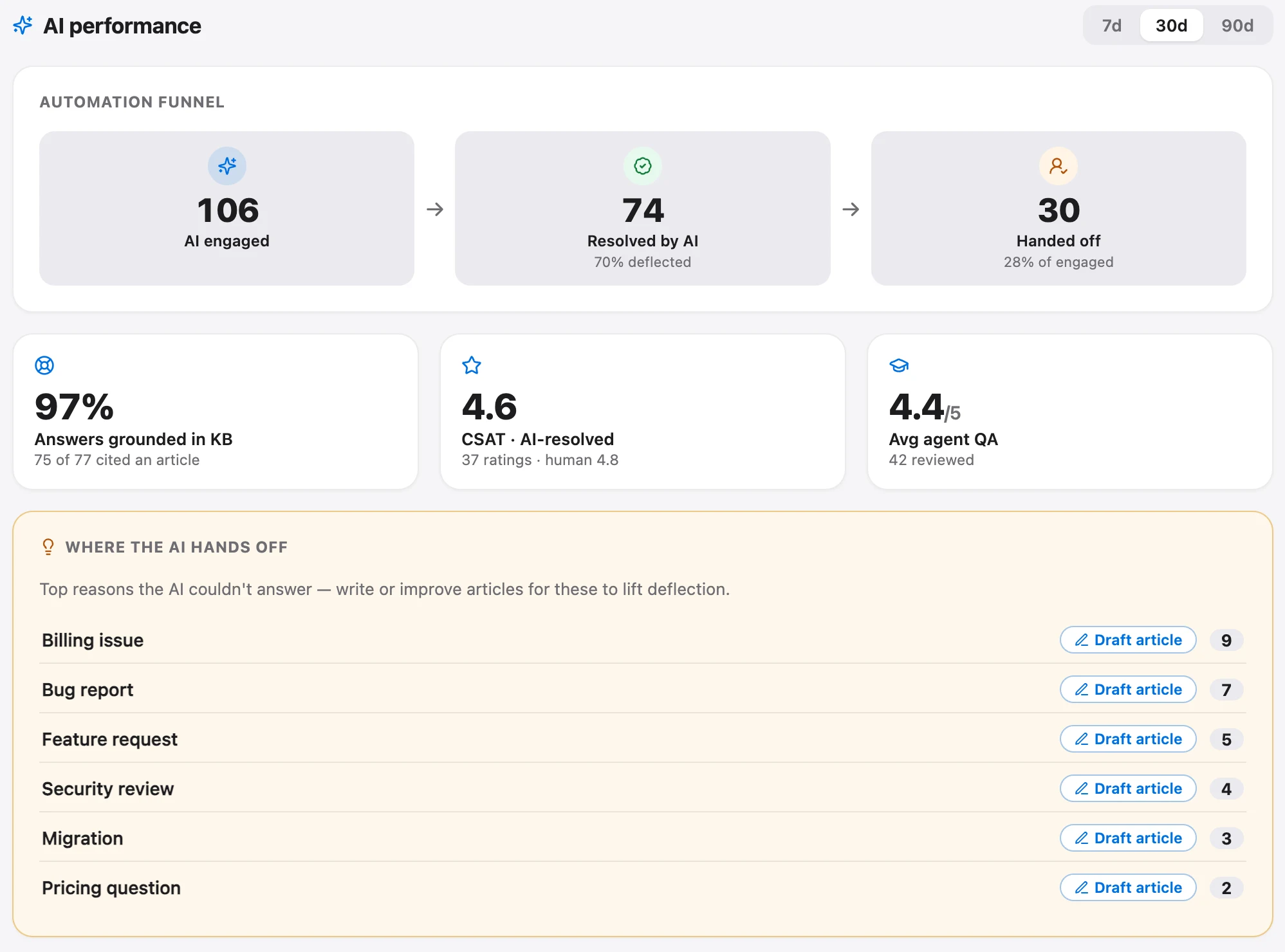
Below Scale, you do the grouping yourself. Each handed-off conversation carries the internal note, so a month of them is quick to read. On the Growth plan and up, the self-writing knowledge base drafts articles from questions the AI couldn't answer. Talvo's analytics split CSAT between AI-resolved and human-resolved conversations on every plan, but the overview doesn't break out CSAT for handed-off conversations, and analytics can't report by tag.
Setting up hand-offs in Talvo
- Publish before you switch onThe AI answers only from published articles, so write the ones that cover your top questions first. See how AI auto-resolve works.
- Set business hours and the away messageSettings → Inbox → Business hours. This is where the overnight expectation lives. The shared inbox guide covers the queue side.
- Choose who gets alertedAssign conversations or leave them for the whole team, and check Settings → Inbox → Notifications so the "needs a reply" email isn't switched off.
- Write the escape routeUse the welcome message and a "How to reach us" article to give a person-shaped way out, since there's no button.
- Run the ten-message testDo it before the widget goes on your live site.
Where Talvo stops, in one place: no "talk to a person" button, no phrase trigger, no documented sentiment or loop detection, and no phone, SMS or WhatsApp channel to escalate into. Routing rules that send billing questions to one person need the Growth plan ($149 a month) or higher, and the AI performance funnel is Scale only. A thin knowledge base means a lot of hand-offs.
What it does do is hand over with the conversation intact, tell the customer what's happening, ask for an email if it has none, alert the team and then get out of the way. Talvo is new and in beta, and we have no customer data on how its hand-offs perform, so we don't claim any. Run the test and decide on what you see.
Frequently asked questions
What is a chatbot human handoff?
It is the moment an AI chatbot stops answering and passes the conversation to a person on your team. A good one carries the full conversation, tells the customer what happens next and alerts the right people. A bad one drops the context or leaves the customer talking to a bot that can't help.
When should a chatbot hand off to a human?
When it has no reliable answer, when the customer asks for a person, when the same question has failed twice, when the issue needs account access or judgment such as a refund, and when the message is angry, legal or about safety. In Talvo, the AI hands off when the published articles don't answer confidently, when none are published, or when the AI call fails.
What information should be passed to the human agent?
The whole conversation, a one-line summary of what the customer wants, the article or source the bot tried, who the customer is, and how to reach them if they leave. Without those, the agent has to ask again. In Talvo the thread stays intact in the shared inbox and carries an internal note explaining why the AI handed off.
Can a customer ask Talvo for a human?
There is no 'talk to a person' button in the Talvo widget and no keyword rule that triggers a hand-off on request. A request for a person is not something the knowledge base answers, so it often ends in a hand-off, but that is a side effect, not a guarantee. Use the welcome message and a 'How to reach us' article to give customers a direct route.
What should happen if no agent is available?
The bot should still hand off, tell the customer when they will hear back and ask for contact details. In Talvo the AI hands off at any hour, the widget shows your away message outside business hours, and if Talvo has no email for the customer the hand-off message asks for one. The team is alerted by push and email.
Does the AI keep replying after a teammate joins?
In Talvo it does not. Once a teammate replies, the AI stops answering that conversation, so the customer never gets two voices. The AI also stops after 10 AI replies in one chat. A new conversation from the same customer starts fresh.
How do I measure whether hand-offs are working?
Track four numbers each month: hand-off rate (handed-off conversations divided by AI-engaged ones), median minutes from hand-off to the first human reply, the share of hand-offs outside business hours, and CSAT on handed-off versus AI-resolved conversations. Talvo's Scale plan shows the hand-off funnel and ranks hand-off topics; on lower plans you read a month of hand-offs yourself.
Sources
Other products' prices and features change. We checked these pages; if something is out of date, tell us and we'll fix it.
- CFPB: Chatbots in consumer finance (June 2023)
- Fin help: how to automatically escalate conversations (checked Oct 21, 2026)
- Zendesk: configuring escalation strategies and flows for AI agents
- Microsoft Learn: Copilot Studio advanced hand-off
- Gartner: 87% of customers say companies using GenAI for service must provide access to a human (Aug 4, 2026)
- Talvo: how AI auto-resolve works