On this page
- The short version, by situation
- Zendesk starts with tickets, Intercom starts with the Messenger
- How each one bills its AI, from their own pages
- The same three teams on both bills
- Channels and voice
- Quality, workforce tools and reporting
- Compliance and where the data lives
- What Salesforce owning Fin changes, and what it doesn't yet
- A third option for small teams: Talvo
- Before you sign either contract
- Frequently asked questions
Put five agents and 1,000 AI-handled conversations on Zendesk and on Intercom (now Fin), and the two bills come out at roughly $1,137.50 and $739 a month. Both numbers assume annual seats, and that 60% of those AI conversations end up billable. Move Intercom up one plan and the gap shrinks to about 10%. Let Intercom bill every AI conversation while Zendesk's checker lets only 60% through, and the two bills match. That is the real answer to "Zendesk vs Intercom" in 2026: the difference isn't the sticker price, it's how each company decides what counts as an AI resolution.
This post prices the same three teams on both, compares the products where it affects a decision (channels, voice, quality tools, compliance), and says what the Salesforce deal does and doesn't change. Near the end there's a short section on a third option, because we make one. We kept Talvo out of the main comparison on purpose. Every Zendesk and Intercom number comes from their own pricing and help pages as listed on October 21, 2026, and every sum is shown.
The short version, by situation
| If this describes you | Lean toward |
|---|---|
| Customers phone you, and you want a real telephony product | Zendesk |
| You need HIPAA on a published plan, data center choice in the US, EEA, UK or APAC, or a large app marketplace | Zendesk |
| Your support is a queue of email tickets with macros, triggers and SLAs | Zendesk |
| Your front door is a chat Messenger inside a web app, and tours, surveys and checklists matter | Intercom (Fin) |
| You want the AI agent to be the center of the product, with the lowest published per-outcome price | Intercom (Fin) |
| You already run Zendesk and only want a better AI agent | Fin on top of Zendesk |
| You have 2 to 10 people, answer by chat and email, and the per-seat math already hurts | Neither; see the third option near the end |
Zendesk starts with tickets, Intercom starts with the Messenger
Zendesk grew out of email ticketing. Its Support Team plan, $19 per agent a month billed annually or $25 monthly, is exactly that: tickets, macros, triggers, dashboards. Live chat and messaging don't start until Suite Team, at $55 annually or $69 monthly. From there the ladder is Suite Professional ($115 or $149), which adds skills-based routing, SLAs, IVR, custom reporting and HIPAA enablement, and Suite Enterprise, which is quoted by sales. There is no free plan, only a 14-day trial of Suite Professional.
Intercom grew out of the chat bubble. Live chat, support email and in-app chats come with every plan, with Essential at $29 per seat billed annually or $39 monthly, Advanced at $85 or $99, and Expert at $132 or $139. Essential covers the Messenger, a shared inbox with ticketing, reports and a public help center. Advanced adds multiple team inboxes, a workflow builder, round-robin assignment and 20 free Lite seats. Expert adds SSO, HIPAA support, SLAs and 50 free Lite seats. No free plan there either, just a 14-day trial. Intercom's new-customer promo prices ($19 annual, $29 monthly on Essential) don't say how long they last, so every sum below uses list prices.
- The deepest ticketing and routing of the two, with a published path from five agents to an enterprise
- Voice, social and business messaging, email and chat in one suite
- SOC 2 Type II, HIPAA enablement, data center location and SAML on published plans
- A very large integration catalog
- The $19 entry price is email only; chat starts at $55 to $69 per agent
- Only 5 included AI resolutions per agent per month on Suite Team (10 on Professional), then $1.50 or $2.00 each
- Copilot ($50 per agent, yearly), QA and workforce tools are paid add-ons
- Polished Messenger and in-app messaging, with chat, email and in-app chats on every plan
- The lowest published per-outcome AI price of the two, at $0.99
- Copilot is cheaper per agent, with 10 free Copilot conversations per agent each month
- No included AI outcomes; every one is metered
- Tours, surveys, checklists and outbound campaigns are not in any base plan
- WhatsApp, SMS and phone are billed as usage on top of seats
Seats are only half of either bill. On both products the second half is AI.
How each one bills its AI, from their own pages
Both companies charge for results rather than messages. They define a result very differently.
Zendesk bills the automated resolution. Since May 18, 2026, an LLM reads the transcript and confirms that the AI agent actually resolved the request. Two other outcomes don't count against your allowance: a "contained" resolution (the AI finished, but verification failed) and an "assisted escalation" (a human finished). Zendesk's resolution tiers article never states in one sentence that only verified resolutions draw from the allowance. It says the other two don't, which comes to the same thing, so treat it as our reading. A conversation ends 72 hours after the first email, two hours after the first message on messaging by default (configurable up to 72), or at hangup on voice.
Fin bills the outcome, at $0.99, once per conversation. An outcome is one of three things, per Intercom's pricing FAQ: the customer confirms the issue is solved, the customer doesn't ask for more help after Fin responds, or Fin completes a workflow (a Procedure), including one that ends in a handoff to a human.
| Zendesk | Intercom (Fin) | |
|---|---|---|
| Billable unit | Verified automated resolution | Outcome |
| Price | 5 included per agent a month (10 on Professional), then $1.50 committed (100 or more bought ahead) or $2.00 pay-as-you-go | $0.99 each, nothing included |
| Counts when the customer goes quiet | Only if the LLM check confirms it was resolved | Yes, silence after an answer is billable |
| Counts when it ends in a handoff | No (assisted escalation) | Yes, if it completes a Procedure that ends in handoff |
| At the limit | You choose: allow overage or pause the AI agent | Metered; the pricing page states no cap |
| Standalone | No | Yes, on another help desk, $0.99 per outcome with a monthly minimum (the page's example is 50 outcomes) and no platform fee |
The allowance caveat matters on Zendesk. The 5 per agent are pooled for the year, with a cap of 10,000 a year per account, and unused ones expire annually. Our monthly math treats them as a monthly pool, which is close enough for steady volume and generous for a seasonal business.
Read that table twice before you compare the per-unit prices. Zendesk's unit costs about 50% to 100% more, but its verification step means fewer conversations hit the meter. Fin's unit is cheaper and its definition is broad. A competitor-written review of Intercom flags the same thing: a customer who simply stops replying is billable, which is why some customers say the bill is hard to forecast. Intercom's own page calls the unit an "outcome" now, although its schema markup still says "resolution".
The same three teams on both bills
The teams are 3 agents with 300 AI-handled conversations a month, 5 agents with 1,000, and 10 agents with 3,000. "AI-handled" means the AI agent replied at least once.
Two assumptions drive everything, and both are ours, not vendor data. First, 60% of AI-handled conversations become billable on both sides. Second, Zendesk's annual column uses annual seats and committed resolutions at $1.50, while its monthly column uses monthly seats and pay-as-you-go at $2.00. We excluded Copilot, voice, SMS, WhatsApp and every other add-on.
Here is the arithmetic for the middle team. Zendesk Suite Team: 600 billable resolutions, less 25 included (5 agents × 5), is 575. At $1.50 that's $862.50, plus 5 seats × $55 = $275, for $1,137.50 on annual billing. On monthly billing, 575 × $2.00 = $1,150, plus 5 × $69 = $345, for $1,495. Intercom Essential: 600 × $0.99 = $594, plus 5 × $29 = $145, for $739 annual; with 5 × $39 = $195, it's $789 monthly.
| Team and billing | Zendesk Suite Team | Intercom Essential | Intercom Advanced | Fin on Zendesk Suite Team |
|---|---|---|---|---|
| 3 agents, 300 AI, annual | $412.50 | $265.20 | $433.20 | $343.20 |
| 3 agents, 300 AI, monthly | $537 | $295.20 | $475.20 | $385.20 |
| 5 agents, 1,000 AI, annual | $1,137.50 | $739 | $1,019 | $869 |
| 5 agents, 1,000 AI, monthly | $1,495 | $789 | $1,089 | $939 |
| 10 agents, 3,000 AI, annual | $3,175 | $2,072 | $2,632 | $2,332 |
| 10 agents, 3,000 AI, monthly | $4,190 | $2,172 | $2,772 | $2,472 |
Why four columns? Because Intercom Essential and Zendesk Suite Team are priced as the entry plan with chat, but they aren't the same product. Essential has no workflow builder, no multiple team inboxes and no round-robin; those start at Advanced. Zendesk Suite Team already has omnichannel routing and a workflow tool (Action Builder). If you need that tier of automation, Advanced is the fairer match, and the gap shrinks to about 10% at five agents on annual billing ($1,019 against $1,137.50).
The last column is the hybrid: Zendesk Suite Team seats, with Fin handling the AI at $0.99 per outcome instead of Zendesk's resolution meter. We priced it on Suite Team because that's where Zendesk's chat starts. It is cheaper than Zendesk's own AI in every row, because the cheaper meter more than makes up for giving up the included resolutions. Whether Fin's resolutions are as good as Zendesk's is a question for your own trial.
Now the sensitivity. Fin's definition is broader, so a 60% rate may flatter it. If Fin bills all 1,000 AI conversations for the middle team, Intercom Essential is 1,000 × $0.99 = $990, plus $145, or $1,135 annual (and $1,185 monthly). That is within $2.50 of Zendesk's $1,137.50, where the verification step keeps the billable count at 600. If both bill every conversation, Zendesk becomes 975 × $1.50 = $1,462.50, plus $275, or $1,737.50, and Fin stays about a third cheaper. So the order depends on which company's checker is stricter on your traffic, and only a trial tells you that.
Copilot, the agent-side assistant, widens the gap further. Zendesk's Copilot add-on is $50 per agent a month, billed yearly, and sits on Suite Professional and above, so one agent costs $115 + $50 = $165 a month on annual billing. Without the add-on, Professional gets pooled Copilot use of 5 per agent a month, capped at 500 per instance. Fin's Copilot is $29 per agent billed annually or $35 monthly, so an Essential agent with Copilot is $58 annual, and every agent gets 10 free Copilot conversations a month. Zendesk doesn't publish a monthly Copilot price.
For the full plan grids, see Zendesk pricing in 2026 and Intercom (Fin) pricing in 2026. For how the AI meters compare across more vendors, there's AI resolution pricing compared.
Channels and voice
If phone is a channel, this section decides the comparison. Zendesk has native voice: embedded voice, recording and voicemail from Suite Team, IVR, callbacks and monitoring on Professional, with numbers and minutes sold as usage add-ons. Its AI agents can handle voice, but that requires Zendesk voice. Intercom lists phone as a pay-as-you-go channel and doesn't publish a rate.
Messaging is closer. Zendesk's Suite plans cover web messaging, live chat, Facebook, Instagram, X, WhatsApp, Slack and WeChat, with SMS as an add-on and extra WhatsApp numbers priced separately. Intercom's chat, support email and in-app chats are included in every plan, while WhatsApp (per conversation), SMS (per message) and phone are metered, with rates that vary by volume, direction or region, and no published rate for phone. Intercom's omnichannel pages also list Instagram and Facebook Messenger.
The practical split: for a phone-heavy support team, Zendesk is the only one of the two with a product you can price. For a chat-first SaaS team, Intercom's Messenger and its in-app tools are the reason people pay for it, though product tours, surveys, checklists and outbound campaigns aren't in a base plan. They sit in the Proactive Support Plus add-on, $99 a month with 500 messages.
Quality, workforce tools and reporting
Zendesk sells a Workforce Engagement bundle (workforce management plus QA) at $50 per agent a month on annual billing. QA alone is shown as "requires QA add-on" with no published price, and the third-party figures that circulate aren't confirmed by Zendesk. Reporting scales with the plan: prebuilt dashboards on the Team plans, custom exploration and hourly refresh on Professional.
Intercom's closest equivalent is the Pro add-on, from $100 a month. It includes the Operator agent and AI analysis and quality monitoring across 500 conversations analyzed and 6,000 credits a month, then $0.01 per extra credit. Intercom doesn't list a workforce-management product. If you schedule shifts for a large team, that is a real gap. If you have eight people, probably not.
Compliance and where the data lives
Both vendors hold SOC 2 Type II. Zendesk's trust center also lists ISO 27001, 27017, 27018 and 27701, FedRAMP authorization and a long tail of regional attestations. Intercom lists ISO 27001, 27018, 27701 and 42001, with Fin separately AIUC-1 certified.
HIPAA is plan-gated at both. On Zendesk, "HIPAA enabled" appears only on Suite Professional, and signing a BAA also requires the Advanced Compliance add-on, which isn't priced publicly. On Intercom it's the Expert plan, $132 or $139 per seat. SSO is different: Zendesk's pricing table lists SAML and JWT single sign-on on every plan shown, while Intercom puts SSO on Expert.
Data location differs in range. Zendesk offers US, EEA, UK and APAC data centers, with the data center location feature included from Suite Professional. Intercom hosts in the US, EU or Australia. Both attach conditions to these regions, so check the details with each vendor before you promise anything to a regulated customer.
On integrations, Zendesk's pricing table says 1,000+ prebuilt apps while its navigation says 1,800+; we use the lower number. Intercom's platform page says 450+, though its app store page doesn't show a count. Zendesk's comparison page claims a much bigger gap, which is vendor marketing, though the direction is plausible.
Ratings, for what they're worth: secondary sources put Zendesk around 4.3 on G2 and 4.4 on Capterra, and Intercom around 4.5 on both. Those numbers come from third-party write-ups, many by competitors, rather than the review sites themselves, so treat them as directional. The recurring complaints are consistent with the pricing: Zendesk for a complex price structure and add-on sprawl, Intercom for cost predictability.
What Salesforce owning Fin changes, and what it doesn't yet
Intercom renamed itself Fin in May 2026, keeping "Intercom" as the helpdesk product's name. On June 15, 2026 Salesforce announced it would buy Fin for about $3.6 billion, and on September 10, 2026 it said the acquisition was complete. Fin now sits inside Salesforce AI Labs, and the release says it "will continue to serve its customers". It says nothing about pricing, plans or what happens to the helpdesk name.
One thing to watch if you're reading vendor pages: Zendesk's own Zendesk vs Fin comparison page, last updated October 14, still describes the Salesforce deal as an announced intent. It was completed more than a month earlier. That page also leans on "roadmap uncertainty" for Fin, which is a fair question to ask but not a finding, since nobody has published a roadmap. As of October 21, 2026, Intercom's pricing and product pages are unchanged.
Our separate post, what Salesforce's purchase of Fin means for Intercom customers, covers the timeline, contract questions and what to do before your renewal. The short version for this comparison: nothing public gives you a reason to rule Intercom out today, and nothing public gives you a guarantee about 2027 either.
A third option for small teams: Talvo
If your team is 2 to 10 people, answers customers over chat and email, and winces at both bills above, there's a different pricing shape. Talvo, which we make, prices the workspace rather than the seat: Starter is $49 a month ($39 billed annually) for 5 teammates and 100 AI resolutions, Growth is $149 ($119) for 15 teammates and 500, and Scale is $299 ($249) for 25 and 2,000. Extra resolutions are $0.49 each. A hand-off to a human is never billed.
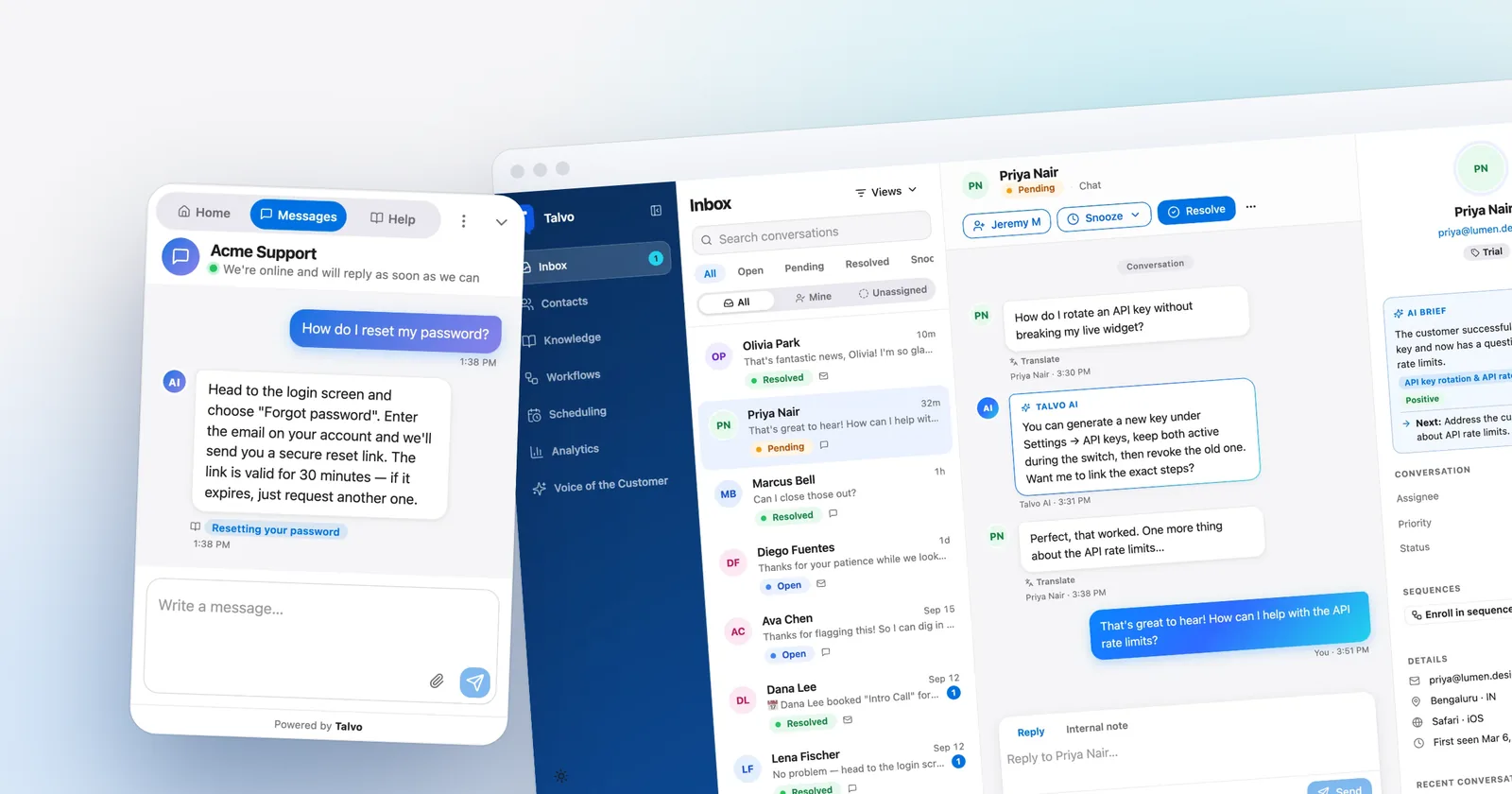
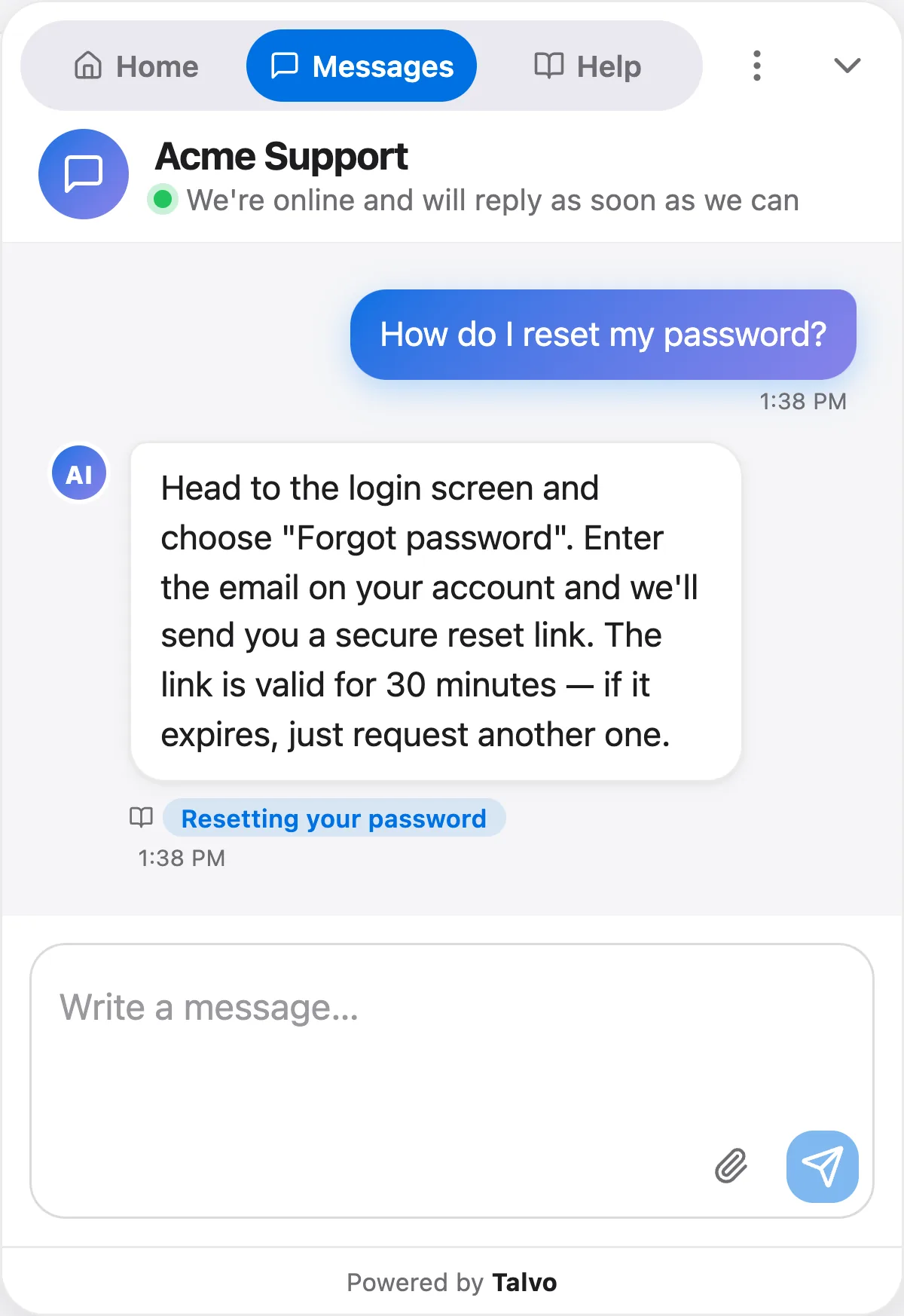
Its AI agent answers only from your published help articles and shows the article it used.
Here are the three teams again, using the same 60% assumption (180, 600 and 1,800 resolutions). For Talvo we take the plan with the lowest total among those with enough teammate seats, overage included, separately for monthly and annual billing.
The 3-person team is cheapest on Starter: $49 + (180 − 100) × $0.49 = $49 + $39.20 = $88.20 monthly, or $39 + $39.20 = $78.20 annual (Growth would be $149 or $119). The 5-person team is cheapest on Growth: $149 + (600 − 500) × $0.49 = $149 + $49 = $198 monthly, or $119 + $49 = $168 annual, against $294 or $284 on Starter and $299 or $249 on Scale. The 10-person team needs Growth or Scale, and Scale wins: $299 monthly or $249 annual with 2,000 resolutions included, against $149 + (1,800 − 500) × $0.49 = $786 monthly or $756 annual on Growth.
| Team | Talvo monthly billing | Talvo annual billing |
|---|---|---|
| 3 teammates, 180 resolutions | $88.20 (Starter) | $78.20 (Starter) |
| 5 teammates, 600 resolutions | $198 (Growth) | $168 (Growth) |
| 10 teammates, 1,800 resolutions | $299 (Scale) | $249 (Scale) |
To try your own numbers, the calculator below takes teammates and billable AI resolutions a month, so for the middle team enter 600, not 1,000. It shows month-to-month list prices and prices Zendesk at the $2.00 pay-as-you-go rate, so its Zendesk, Intercom Essential and Talvo totals match the monthly figures above ($1,495, $789 and $198), not the annual ones. It also lists Help Scout and Crisp. Crisp bills every AI conversation, not only resolutions, so for Crisp the full 1,000 is the fairer input.
- Crisp Essentials~$100–$130/mo$95 per workspace + AI at Crisp's estimate of $0.05–$0.10 per conversation, less $25 of included credits · Estimate: top-up rate and annual prices aren't published
- Talvo Growth$198/mo$149 per workspace, 500 AI resolutions included + 100 × $0.49
- Help Scout Standard$600/mo5 users × $30 + 600 AI resolutions × $0.75
- Intercom (Fin) Essential$789/mo5 seats × $39 + 600 Fin outcomes × $0.99 · Workflow automation needs Advanced ($85–$99 per seat)
- Zendesk Suite Team$1,495/mo5 agents × $69 + 575 AI resolutions × $2.00 (25 included) · $1.50 each with a committed 100+ purchase
Estimates from each vendor's published list prices, checked October 21, 2026. Assumes the cheapest plan that includes live chat and an AI agent, and that every AI-resolved conversation is billable. Excludes taxes, promotions, add-ons (such as agent copilots) and per-use channels like SMS or WhatsApp. Talvo's annual price includes extra resolutions at the same $0.49, billed once a year.
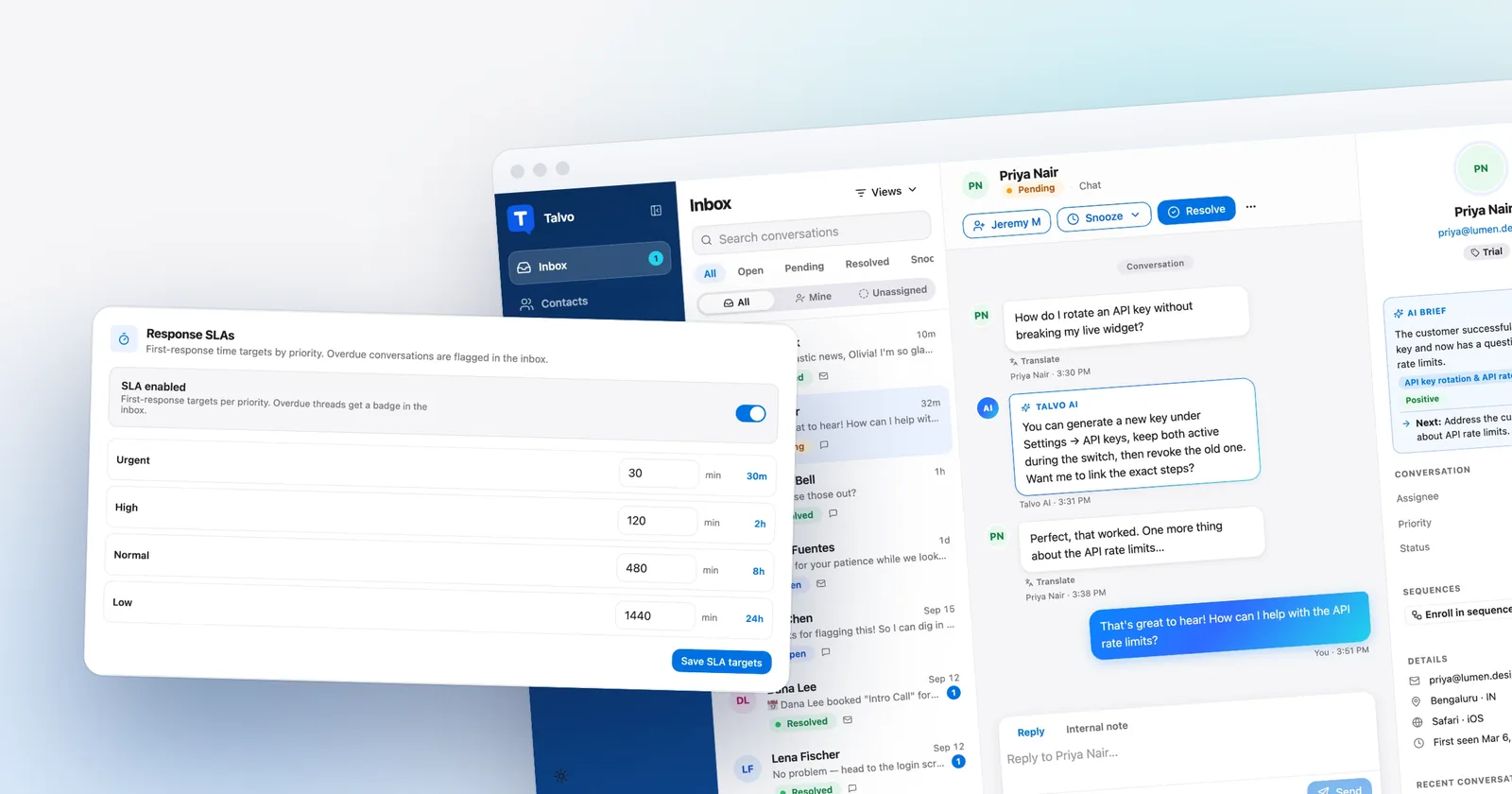
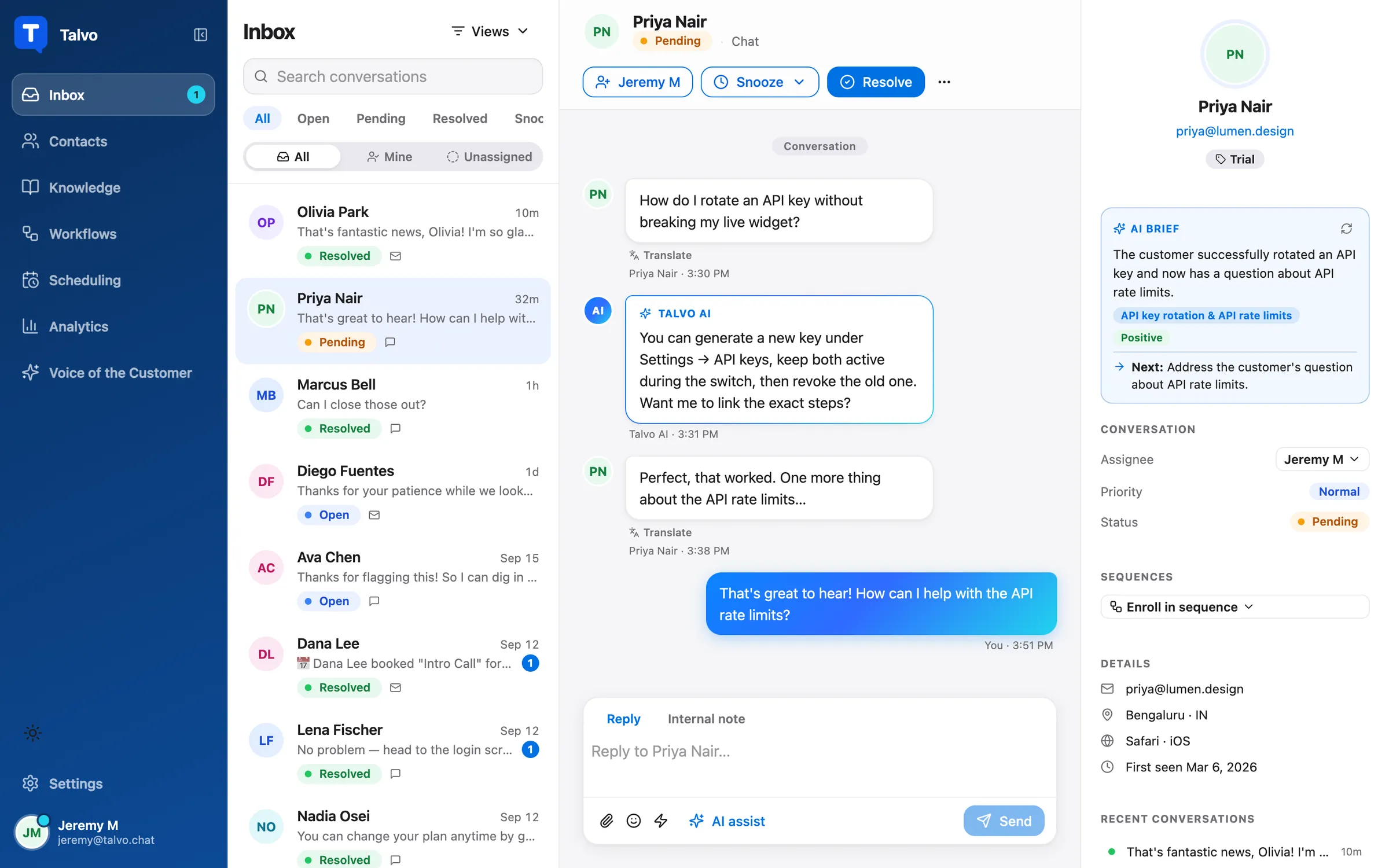
Talvo has a shared inbox with internal notes, @mentions, canned responses with variables, routing rules and first-response SLAs on Growth, and a hosted help center, all in one workspace price.
The gaps are large, and for some readers disqualifying. There's no phone or voice, WhatsApp, SMS, Instagram or Messenger. There is no SOC 2 report, SAML single sign-on, HIPAA support or data-region choice (data is processed in the United States). There's no customer ticket portal, no skills-based routing, and no workforce-management product. Scale includes automatic agent QA scoring, but that's a smaller thing than Zendesk's QA and WFM bundle. Integrations today are a REST API, webhooks and Slack, with no native Shopify, HubSpot or Salesforce connection and no marketplace. Talvo launched in 2026, is in beta, and has no reviews yet.
It imports a Zendesk or Intercom help center from the public address, which is the part of a move that usually takes longest. Past tickets and conversations don't come across. Our head-to-heads cover the details: Talvo vs Zendesk and Talvo vs Intercom. On the pricing logic, per-seat vs flat pricing explains when each model wins.
Before you sign either contract
Decide what to check, because the sticker prices won't settle this. Most of what matters is what each vendor counts, and whether you need a feature that only one of them sells.
- Do customers call you? If yes, price Zendesk's telephony and stop comparing chat
- Count how many of last month's AI-eligible conversations the AI could realistically finish; apply it to both meters
- Ask Zendesk how verification handles your conversation window, and ask Fin how it bills a customer who goes quiet
- Check which plan holds your must-have features: workflows and round-robin (Intercom Advanced), SLAs and skills routing (Zendesk Professional)
- Confirm HIPAA, SSO and data location against the plan, and ask both vendors about the BAA
- If you're an Intercom customer, read your contract for renewal terms and ask your account contact what the Salesforce deal changes
- Run each trial on real conversations for a full week, with the AI turned on
If you want a wider field than two, cheaper Intercom alternatives and Zendesk alternatives for small teams price the same team across more tools, and Fin AI alternatives covers the case where you like the AI idea but not the meter.
Which should you choose?
- your team is 2 to 10 people answering by chat and email, and per-seat pricing is the main complaint
- you want a flat workspace price and AI resolutions at $0.49 beyond an included amount
- you can live without voice, WhatsApp, SMS, social channels and SOC 2, and accept a beta product with no reviews yet
- Choose Zendesk if customers phone you, you need HIPAA or a data center region, or your work is an email ticket queue with SLAs and macros
- Choose Intercom (Fin) if your front door is an in-app Messenger and you want the cheaper published AI unit
- Choose Fin on top of Zendesk if you like Zendesk's ticketing but want a different AI meter
Frequently asked questions
Is Intercom now called Fin, and who owns it?
Intercom renamed the company Fin in May 2026 and kept Intercom as the name of the helpdesk product. Salesforce announced on June 15, 2026 that it would buy Fin for about $3.6 billion and said on September 10, 2026 that the acquisition was complete. Fin now sits inside Salesforce AI Labs, and Salesforce says it will continue to serve its customers.
Is Zendesk or Intercom cheaper for a small team?
In our same-team sums, Intercom Essential was cheaper in every row: about $739 against $1,137.50 a month for 5 agents and 1,000 AI-handled conversations on annual billing, assuming 60% are billable on both. Essential has no workflow builder or multiple inboxes, though. On Intercom Advanced the same team is about $1,019, so the gap narrows to roughly 10%.
How much does Fin cost per resolution, and what counts as one?
Fin costs $0.99 per outcome, charged once per conversation, with no outcomes included in the seat price. An outcome is the customer confirming the issue is solved, the customer not asking for more help after Fin responds, or Fin completing a workflow (a Procedure), including one that ends in a handoff to a human.
What is a Zendesk automated resolution, and how much does it cost?
It is a request the AI agent resolved without escalation, and since May 18, 2026 an LLM checks the transcript to verify it. Suite Team includes 5 per agent a month (10 on Professional), then each extra one is $1.50 if you commit to 100 or more in advance, or $2.00 pay-as-you-go.
Does Zendesk charge when the AI hands off to a human?
No. Zendesk's resolution tiers article says a conversation where the AI assisted and a human finished (an assisted escalation) does not count against your resolution allowance. A contained resolution that fails the LLM check doesn't count either.
Can I use Fin with Zendesk?
Yes. Intercom sells Fin to run on top of another help desk, including Zendesk, at $0.99 per outcome with no seats required and a monthly minimum (the pricing page's example is 50 outcomes). You keep paying for your Zendesk seats.
Which is better for phone support?
Zendesk, because it has native voice: embedded voice, recording and voicemail from Suite Team, and IVR and callbacks on Professional, with numbers and minutes as add-ons. Intercom lists phone as a pay-as-you-go channel and doesn't publish a rate.
Which plan is HIPAA-compliant at each vendor?
On Zendesk, HIPAA enablement appears on Suite Professional, and signing a BAA also requires the Advanced Compliance add-on, which isn't priced publicly. On Intercom, HIPAA support is on the Expert plan. Confirm the current terms with each vendor before sending regulated data.
Sources
Other products' prices and features change. We checked these pages; if something is out of date, tell us and we'll fix it.
- Zendesk pricing (checked Oct 21, 2026)
- Zendesk: About automated resolution tiers
- Zendesk: About automated resolutions for AI agents
- Zendesk trust center (checked Oct 21, 2026)
- Zendesk vs. Fin comparison page (read Oct 21, 2026)
- Intercom pricing (checked Oct 21, 2026)
- Intercom security (checked Oct 21, 2026)
- Salesforce: completes acquisition of Fin (Sept 10, 2026)
- Talvo pricing (checked Oct 21, 2026)