On this page
- The short answer, priced
- What Fin costs now, and what it counts as an outcome
- Resolution, conversation, session, credit: four ways AI gets billed
- Path A: keep your helpdesk, swap only the AI
- Path B: replace the helpdesk and the AI together
- Where Talvo costs more, and what the cheaper tools leave out
- A cheap agent that resolves less isn't cheaper
- How to test Fin AI alternatives on your own content in a day
- When to stay on Fin
- Frequently asked questions
Fin bills $0.99 every time its AI agent finishes a conversation. A five-person team that lets it handle 1,500 conversations a month pays $1,485 for the AI alone, plus about $195 in seats. Fin is the name Intercom took in May 2026, Salesforce closed its purchase of the company on September 10, and a lot of renewal conversations now start with the same question: what else is out there?
This guide to Fin AI alternatives prices every option the way you would actually buy it. Same team (five people), same two volumes (300 and 1,500 AI resolutions a month), seats included, arithmetic shown. We make Talvo, which is one of the options, so we say plainly where it costs more than the others. Competitor numbers come from each vendor's own pricing or help page, checked on October 21, 2026. The few that don't (Freshchat's monthly seat price, Crisp's pay-as-you-go rate, Front's quoted Autopilot rate) are marked as such.
The short answer, priced
If you want one table, here it is. All figures are monthly bills for five teammates on month-to-month billing, with the AI resolutions you'd pay for at each volume.
| Option | 300 AI resolutions | 1,500 AI resolutions |
|---|---|---|
| Crisp Hugo on Essentials (estimate) | about $95 to $130 | about $145 to $370 |
| Chatwoot Captain on Startups (estimate) | $107 to $125 | $179 to $269 |
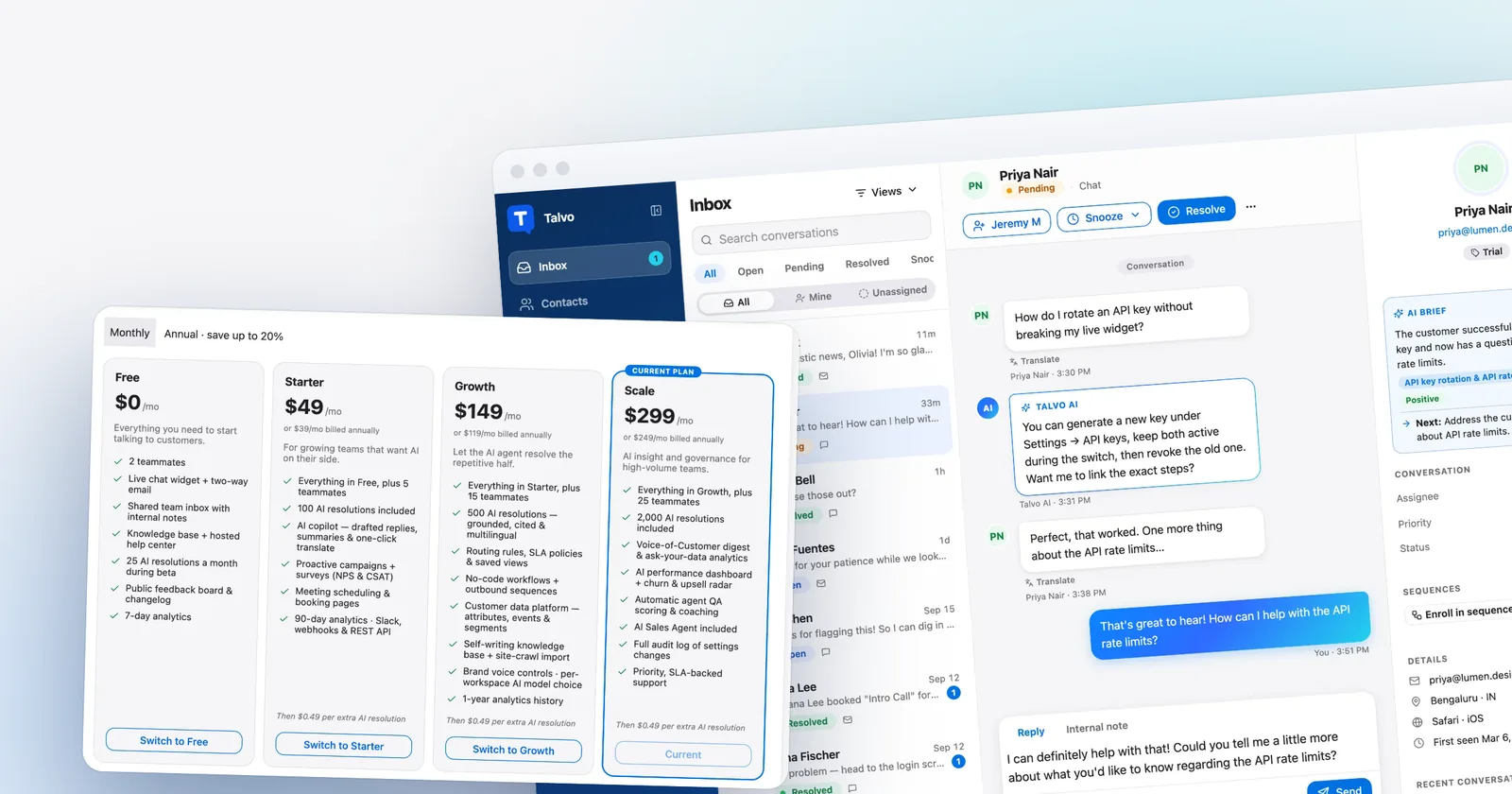
| Talvo (Starter at 300, Scale at 1,500) | $147 | $299 |
| Help Scout plus AI Answers | $375 | $1,275 |
| Fin on Intercom Essential | $492 | $1,680 |
| Zendesk Suite Team, pay as you go | $895 | $3,295 |
Talvo is cheaper than Fin by $345 at 300 resolutions and $1,381 at 1,500, but it is not the cheapest line. Crisp and Chatwoot come in lower on paper, and why (and what they leave out) takes up the second half of this post.
What Fin costs now, and what it counts as an outcome
Fin's pricing page uses the word "outcome" and charges $0.99 for most of them. There are five kinds: a resolution, a Procedure hand-off, a disqualification, self-serve routing and a qualification. The last one, the Qualification outcome, is $9.99, ten times the rest. Nothing is included in the base price, so the meter starts at the first outcome.
What makes an outcome billable is the part people miss. Fin's wording is that the customer confirms the issue is resolved, or "they don't ask for more help after Fin responds", or Fin completes a workflow (a Procedure), "including handoffs". It is charged once per conversation. So a customer who gets an answer and quietly leaves is a billed outcome, and so is a Procedure that ends by passing the chat to your team. A conversation merely passed to your team with no outcome is not charged. Our Intercom pricing breakdown has the rest.
The seats are separate. On the Intercom helpdesk, Essential is $29 per seat per month billed annually or $39 billed monthly, Advanced is $85 or $99, and Expert is $132 or $139. This guide uses list prices. Fin can also be bought alone on another helpdesk, with no seats, at the same $0.99 and a monthly minimum (the page's example is 50 outcomes). Intercom's Early Stage program advertises up to 93% off plus a year of Fin free.
Did the acquisition change any of this? Not that Salesforce has said: its announcement of the completed deal doesn't mention pricing, and the page we read on October 21 still showed $0.99. Our post on Intercom, Fin and Salesforce covers what customers should do about the ownership change.
Resolution, conversation, session, credit: four ways AI gets billed
Before comparing prices, line up what each vendor charges for. Our longer AI resolution pricing comparison goes into each definition.
| Product | Unit | Published rate | What triggers a charge | Hand-offs billed? |
|---|---|---|---|---|
| Fin | Outcome | $0.99 ($9.99 qualification) | Confirmed, assumed or Procedure completed | Procedure hand-offs, yes |
| Talvo | Resolution | $0.49 past the plan's allowance | AI answered from a published article, no human message | No |
| Help Scout | Resolution | $0.75 | Resolved by AI without human help | No, charge is voided if the customer escalates |
| Zendesk | Automated resolution | $1.50 committed, $2.00 pay as you go | Resolution checked by a model against the transcript, per Zendesk's help article | No |
| Gorgias | Automated interaction | $0.90 annual, $1.00 monthly | Request fully resolved without a human | No, but each one also counts as a ticket |
| Drag | Credits, 50 per resolution | $0.50 | Agent finishes with no one on your team involved | No |
| Featurebase | Resolution | $0.49 | Not defined on the pricing page | Unknown |
| LiveChat (now sold as Text) | Resolution, sold in packs of 50 | $49.50 per pack, about $0.99 | "The AI directly solved a customer question" | Not stated |
| HubSpot | Credits, 50 per resolved conversation | $0.50 | Resolved conversation | Not stated |
| Freshworks | Session, $49 per 100 | about $0.49 | Any interaction within 24 hours | Yes |
| Tidio Lyro | Conversation | $0.70 each from 200 a month | At least one AI reply | Yes |
| Crisp Hugo | Usage credits | about $0.05 to $0.10 per conversation (Crisp's estimate) | First AI message until resolved, routed or escalated | Yes |
| Chatwoot Captain | Credits, 1 per AI action | $0.02 per credit past the allowance | Every assistant reply, lookup or summary | Yes |
| Front Autopilot | Conversation | "Starting at" $0.05, quoted by sales | Not defined | Not stated |
The last column shows the split. Fin, Zendesk, Help Scout, Drag, Gorgias and Talvo bill outcomes. Tidio, Crisp, Freshworks and Chatwoot bill activity. If your AI resolves 300 conversations and hands 300 more to a person, an outcome-billed vendor charges for 300 and an activity-billed one for 600, which is why a "$0.05 per conversation" tool is not automatically cheaper than a "$0.49 per resolution" one.
Talvo's resolution counts when the AI answered end to end from a published article and no teammate sent a message, once per conversation. We don't claim that's stricter than Fin's; the two rules are comparable. The difference is the price, $0.49 against $0.99, and no ten-times-priced outcome. The help article has the exact wording.
Path A: keep your helpdesk, swap only the AI
The first decision isn't which vendor, it's how much you're replacing. If you like your inbox and only the AI bill bothers you, you can leave the helpdesk alone and change the agent. Fin itself is sold standalone on other helpdesks, which doesn't help if the AI bill is the problem. The alternatives are AI layers that connect to a helpdesk you already pay for, and none of them includes an inbox, so every hand-off lands in the tool you already have.
| AI layer | How it bills | Published price | Counts as billable |
|---|---|---|---|
| eesel AI | Credits per ticket or chat worked | 500 credits $299, 1,000 $499, 1,500 $699, up to 5,000 $1,749 a month; optional overage $0.80 a credit | A ticket the agent works on, whatever the outcome |
| My AskAI | Per ticket or conversation | Pro $199 (1,000 tickets, about $0.12 each extra), Scale $499 (2,000, about $0.10 extra) | Per ticket or conversation, no formal definition |
| Chatbase | Credits per AI response | Hobby $32 (700 credits), Standard $120 (4,000), Pro $400 (15,000), billed yearly; extra credits $40 per 1,000 | Each AI response, 1 to 5 credits depending on the model |
| Quickchat AI | Credits per AI message | Starter $9 (150 credits) up to Business $999 (30,000); Enterprise from $0.50 per resolution with a 2,000 monthly minimum | 1, 2 or 4 credits per message |
| Botpress | Per conversation | Plus $150 a month annual (250 included, extra $65 per 100) | Any exchange with at least two customer messages |
| Wonderchat | "Resolutions" plus credits | Basic about $124 a month (about 1,000 resolutions), billed yearly | Not defined on the page |
Take the same five people on the Intercom helpdesk (Essential, five seats at $39 monthly, so $195) and swap Fin for an AI layer. At 300 resolutions, My AskAI Pro adds $199, for $394 against $492 on Fin. eesel's smallest block adds $299, for $494, which is the same as Fin, and it bills tickets worked rather than tickets resolved. At 1,500, My AskAI lands between $454 and $634 depending on how many conversations it touches, eesel from $894 to roughly $1,340, and Fin is $1,680. Chatbase is the cheapest entry point at $32 a month, but its credit use varies by model, so the bill is harder to forecast, and like the others it has no inbox. The wide ranges exist because these tools bill the conversations they touch, not only the ones they finish.
A caveat before you plan around any of this. AI vendors say their apps plug into Intercom through its App Store, scoped to Workflows. We couldn't verify that against Intercom's own documentation, so ask the vendor to show you a working setup on your plan before you cancel anything.
Path B: replace the helpdesk and the AI together
If seats are the larger part of your Intercom bill, changing only the AI leaves most of the problem in place. Replacing both is the bigger project and the bigger saving.
The math, per-resolution vendors first
These vendors charge only for resolutions, so no guessing is needed. Seats are included, on monthly billing where it's published.
| Product and plan | 300 resolutions | 1,500 resolutions |
|---|---|---|
| Talvo | Starter $49 + (300 − 100) × $0.49 = $147 | Scale $299, 2,000 included = $299 |
| Drag Pro | 5 × $30 = $150 + (15,000 − 10,000 credits) × $0.01 = $200 | $150 + (75,000 − 10,000) × $0.01 = $800 |
| Featurebase Growth (annual price) | 5 × $29 = $145 + 300 × $0.49 = $292 | $145 + 1,500 × $0.49 = $880 |
| Help Scout Standard | 5 × $30 = $150 + 300 × $0.75 = $375 | $150 + 1,500 × $0.75 = $1,275 |
| LiveChat Essential | 5 × $25 = $125 + 6 packs × $49.50 = $422 | $125 + 30 packs × $49.50 = $1,610 |
| Fin on Intercom Essential | 5 × $39 = $195 + 300 × $0.99 = $492 | $195 + 1,500 × $0.99 = $1,680 |
| Gorgias Pro, no seat fees | $360 + 110 × $1.00 = $470 | $360 + 1,310 × $1.00 = $1,670 |
| HubSpot Professional | 5 × $100 = $500 + 12,000 credits × $0.01 = $620 | $500 + 72,000 credits × $0.01 = $1,220 |
| Zendesk Suite Team, pay as you go | 5 × $69 = $345 + (300 − 25 included) × $2.00 = $895 | $345 + (1,500 − 25) × $2.00 = $3,295 |
Footnotes by row. Drag includes 2,000 pooled credits per seat, enough for 200 resolutions. Featurebase's seat price is the annual rate, since the page shows no monthly one, and it doesn't state an included amount. LiveChat includes 10 resolutions on Essential, so 290 and 1,490 are extra, bought in whole packs of 50. Gorgias also counts every AI interaction against your ticket allowance, and a $1.50 overage figure on some pages would raise those rows to $525 and $2,325. Gorgias Pro includes 190 AI interactions, which is why 110 and 1,310 are billed. HubSpot Professional includes 3,000 credits a month, so 12,000 and 72,000 credits are billed; the total excludes a $1,500 one-time onboarding fee and assumes nothing else spends credits, and HubSpot's page doesn't confirm that Customer Agent is sold on Professional (third parties say it is). Zendesk's included resolutions are 5 per agent per month, pooled annually.
Annual billing changes some of these. Talvo on annual billing is $119 a month at 300 resolutions (on annual billing, Growth beats Starter plus overage once you pass about 260 resolutions) and $249 at 1,500. Fin with annual seats is $442 and $1,630. Help Scout is $350 and $1,250. Zendesk's committed rate of $1.50 with annual seats is $687.50 and $2,487.50. Talvo's gap shrinks a little in percentage terms and stays large in dollars.
The activity vendors, shown as a range
Billing on conversations touched means the bill depends on a number you won't know until you try it, so each cell shows two cases. The floor assumes the AI touches only the conversations it resolves, which never happens in real life. The second assumes it touches twice as many as it resolves (a 50% resolution rate, chosen for easy arithmetic, not a benchmark; plug in your own). For Chatwoot we also assume three AI replies per conversation.
| Product and plan | 300 resolutions: floor / twice touched | 1,500 resolutions: floor / twice touched |
|---|---|---|
| Crisp Essentials ($95, 10 seats, $25 of credits) | $95 / about $100 to $130 | about $145 to $220 / about $220 to $370 |
| Chatwoot Startups (5 × $19 = $95, 300 credits) | $107 / $125 | $179 / $269 |
| Front Starter + Autopilot (5 × $25 annual) | $140 / $155 | $200 / $275 |
| Freshchat Growth + Freddy sessions (5 × $23, third-party seat price) | $262 / $409 | $850 / $1,585 |
| Tidio Starter ($29) + Lyro | $239 / $554 | not published above 1,000 conversations |
| Kommunicate Professional (3 seats plus 2 more) | $260 / $260 | $260 / $270 |
Several of these figures are softer than the first table. Crisp publishes only a range of $0.05 to $0.10 per Hugo conversation and doesn't publish its pay-as-you-go rate, so its numbers are estimates. Front's Autopilot is listed as "starting at $0.05 per conversation" with the real rate coming from sales, and its $25 seat price is the annual rate. Freshchat's monthly seat price comes from third-party write-ups (Freshworks shows annual prices), and its 500 free sessions are a one-time grant we left out. Tidio's monthly Lyro ladder ($39 for 50 conversations up to $700 for 1,000) is read from data embedded in its pricing page, and above 1,000 it says to contact sales; the Starter plan's 100 human conversations are ignored, and many human chats would move the base plan up.
Kommunicate is an AI-first platform that includes a human inbox: its Professional plan is $200 a month for 2,000 conversations and three seats, plus $30 for each extra seat, so $260 for five. It is the one place in the second table where escalations barely move the bill.
Which of these can actually replace Fin?
The harder question is what each tool does when the customer isn't asking a simple question. Three are the ones most readers shortlist, so here are their strengths and drawbacks.
- $0.75 per resolution, and the charge is voided if the customer escalates, keeps searching the help docs or asks for more
- A monthly spending cap switches the AI off when you hit it
- New accounts get three months of unlimited AI Answers resolutions to test on real traffic
- Seats are $25 per user annual, $30 monthly on Standard, and the price grows with headcount
- Built around email and a shared inbox first, with live chat included from Standard
- Existing Help Scout customers don't get the free trial period
- Resolutions are checked by a model against the transcript before they draw down the allowance, per Zendesk's help article
- Deepest ticketing and routing here, with voice, messaging and email in one suite
- SOC 2 Type II and ISO certifications; HIPAA available with an add-on
- $1.50 committed (100 or more) or $2.00 pay as you go per resolution past a small, annually pooled allowance
- Copilot is a $50-per-agent add-on sold only on Suite Professional and above
- Built for larger support organizations, and small teams pay for features they don't use
- Plans are per workspace: $45 for 4 seats, $95 for 10, with Hugo credits included
- Hugo's estimated cost of $0.05 to $0.10 per conversation is among the lowest published AI rates here
- Real omnichannel (WhatsApp, Instagram, SMS, phone) and EU-hosted data
- Bills AI usage, so conversations handed to a human still burn credits
- The pay-as-you-go rate isn't published, and Hugo stops answering when credits run out
- Crisp's own help article says it has not been through a SOC 2 audit
The rest are quicker to place:
| Tool | Best for | Main catch | Compliance and channels |
|---|---|---|---|
| Tidio | Small stores; Shopify actions on the Growth plan | Three separate meters (human conversations, Lyro conversations, Flows visitors); escalated conversations are billed at about $0.70 per Lyro conversation from 200 a month; no help center product | Messenger, Instagram and WhatsApp on every plan |
| Chatwoot | Teams that want open source and $19 per agent on Startups | A three-reply conversation costs about three credits and a hand-off still spends them; self-hosting takes server skills and the Community Edition has no Captain AI | SOC 2 Type II announced for the cloud service |
| Drag | Teams who want $0.50 per resolution (50 credits), hand-offs free, pooled credits per seat | The AI agent is on the Pro plan only ($24 annual, $30 monthly per seat) | Not covered in the pricing research |
| Freshworks (Freshchat and Freshdesk) | Freddy sessions at about $0.49 with 500 free sessions to start | The 500 are a one-time grant, escalated sessions are billed, and a session is every interaction inside 24 hours rather than one conversation | SOC 2 Type 2 and ISO 27001, with SSO on the plans that list it; WhatsApp, SMS, Facebook and Instagram on Growth |
Gorgias, HubSpot, Front, Featurebase and LiveChat also appear in the tables. Gorgias is built for Shopify-first online stores, and the Shopify depth it and Tidio offer is something Talvo doesn't have. HubSpot Customer Agent makes sense if your team already lives in HubSpot's CRM. LiveChat is a polished chat-first console with Shopify features and SOC 2 Type 2, priced per user. Featurebase has the same $0.49 rate as Talvo but doesn't say what's included or what counts as a resolution on the page we read.
- Crisp Essentials~$145–$220/mo$95 per workspace + AI at Crisp's estimate of $0.05–$0.10 per conversation, less $25 of included credits · Estimate: top-up rate and annual prices aren't published
- Talvo Scale$299/mo$299 per workspace, 2,000 AI resolutions included
- Help Scout Standard$1,275/mo5 users × $30 + 1,500 AI resolutions × $0.75
- Intercom (Fin) Essential$1,680/mo5 seats × $39 + 1,500 Fin outcomes × $0.99 · Workflow automation needs Advanced ($85–$99 per seat)
- Zendesk Suite Team$3,295/mo5 agents × $69 + 1,475 AI resolutions × $2.00 (25 included) · $1.50 each with a committed 100+ purchase
Estimates from each vendor's published list prices, checked October 21, 2026. Assumes the cheapest plan that includes live chat and an AI agent, and that every AI-resolved conversation is billable. Excludes taxes, promotions, add-ons (such as agent copilots) and per-use channels like SMS or WhatsApp. Talvo's annual price includes extra resolutions at the same $0.49, billed once a year.
The calculator above uses list prices for five of these products (Talvo's cheapest fitting plan, Intercom Essential, Zendesk Suite Team, Help Scout Standard and Crisp), so some of its numbers may differ slightly from the tables, which add estimate ranges and per-vendor footnotes. Change the team size and volume to match yours. There's also a standalone support cost calculator.
Where Talvo costs more, and what the cheaper tools leave out
Here is the straight version. On paper, Crisp's Hugo is cheaper than Talvo at 300 resolutions and probably at 1,500, depending on how many conversations it touches. Chatwoot is cheaper at both volumes. Front's Autopilot would be, if the "starting at" rate holds. Kommunicate undercuts Talvo at 1,500 ($260 to $270 for five seats). My AskAI and Chatbase show lower AI-only prices, but neither includes an inbox, so the helpdesk bill comes on top. Drag at 300 is close, with $170 to $200 against Talvo's $147 to $149. Anyone telling you one product is cheapest across the board hasn't priced all of them.
What changes the picture is what's inside the price. Several of these tools bill the conversations your AI hands off, several are AI-only and need an inbox you pay for separately, and a few sell a "resolution" without defining it. And per-seat tools get more expensive with each hire while Talvo's plans don't: adding a teammate up to the plan's limit never changes the bill. (Talvo has a cliff of its own. Starter covers 5 teammates, and the sixth person moves you to the Growth plan at $149 a month. Our per-seat versus flat pricing guide has the longer argument.)
The honest cost of choosing Talvo is on the feature side. Talvo is new, launched in 2026 and in beta, with no reviews on G2 or Capterra yet. It has no WhatsApp, SMS, Instagram or Messenger channel (they're on the public roadmap), no phone support, and no native Shopify, HubSpot or Salesforce integration; what you get today is a REST API, webhooks and Slack. There's no SOC 2 report, no SAML single sign-on, no choice of data region and no HIPAA support. Its AI agent answers from your published articles and hands off when it isn't confident. It doesn't run multi-step Procedures the way Fin does. If any of those is a hard requirement, price isn't the deciding factor; read Talvo versus Intercom first.
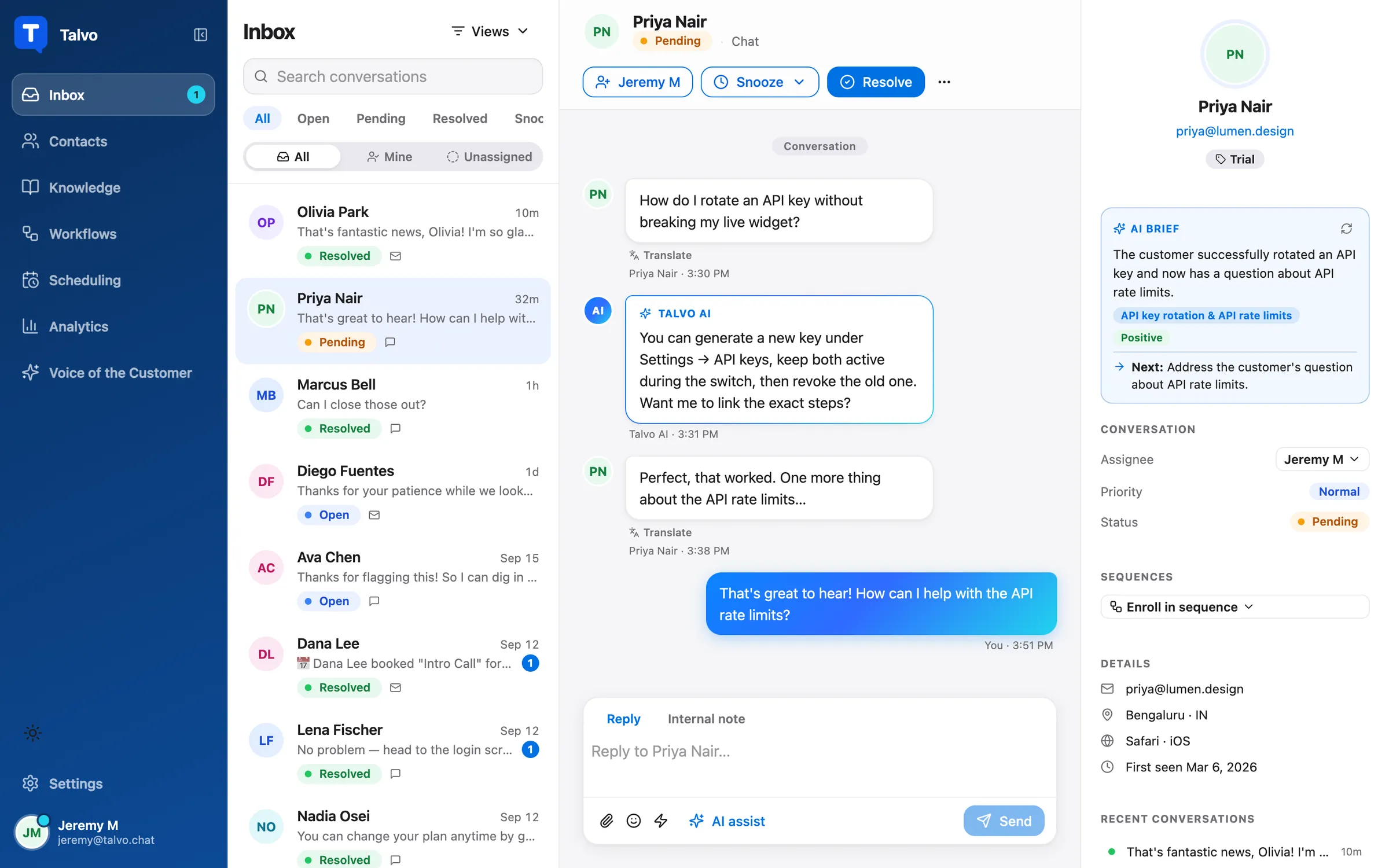
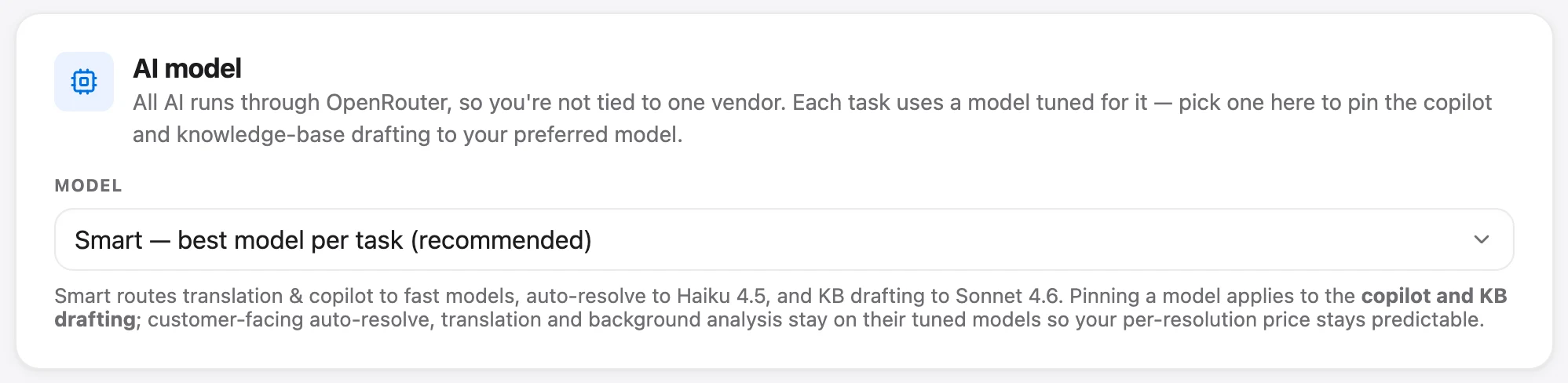
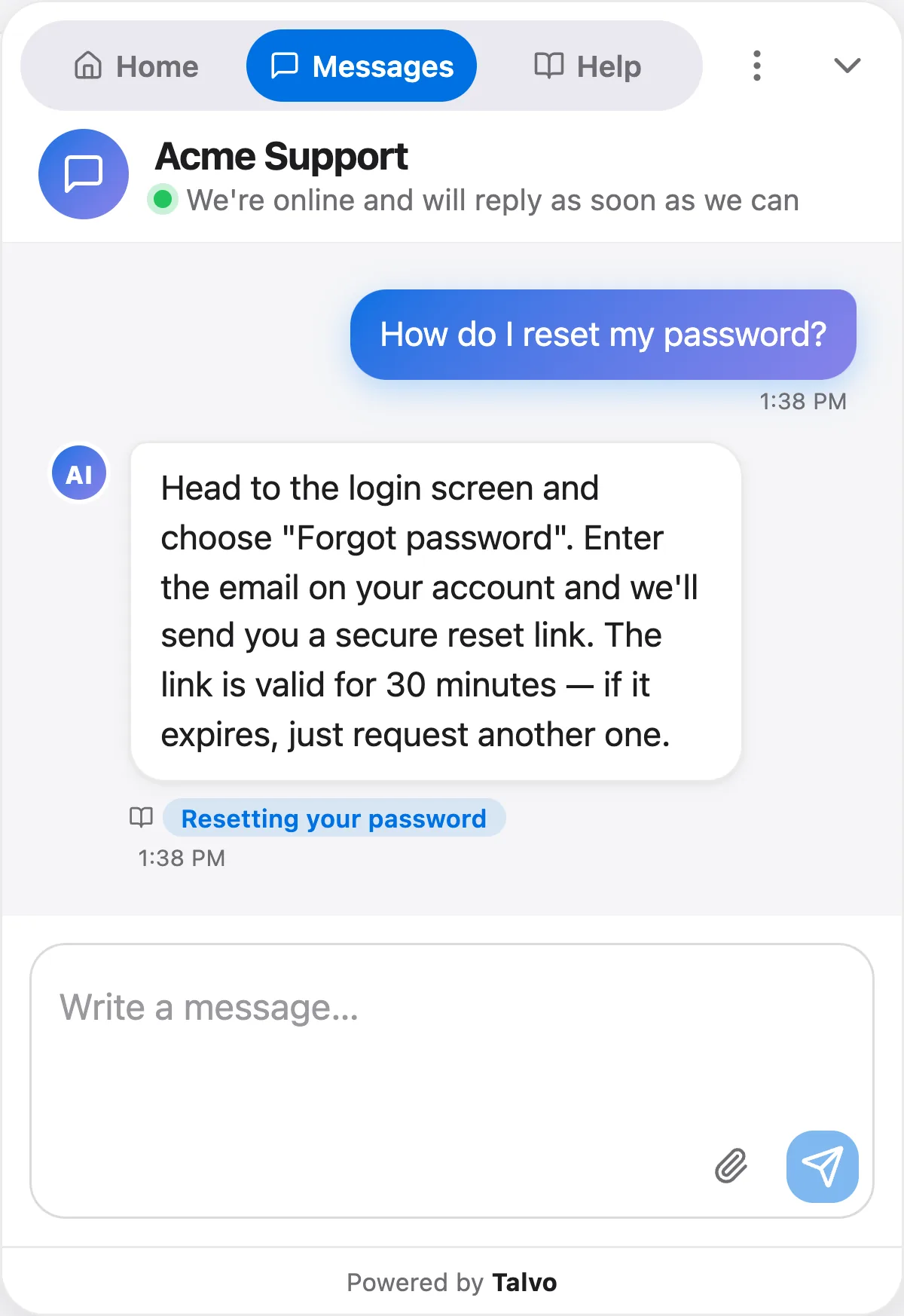
For the money you get the whole stack in one workspace: live chat, a shared inbox, two-way email, a knowledge base with a hosted help center, and an AI agent that cites the article it used. On the Growth plan and above you can pick the model per workspace, and on any plan the AI can be turned off entirely. Talvo can import articles from Intercom, Zendesk, Help Scout, Crisp, Freshdesk and most public help centers.
A cheap agent that resolves less isn't cheaper
Price per customer helped matters more than price per resolution, and the gap between them is the conversations your team still has to handle. Here's an illustration, with assumptions up front and no claim about any product. Say 1,000 conversations a month reach an AI agent. A human conversation costs you $3.00 (a $30-an-hour teammate spending six minutes). Agent X resolves 700 of the 1,000 at $0.99: $693 for the AI plus 300 human conversations at $3.00 is $900, so $1,593 in total. Agent Y resolves 400 at $0.49: $196 for the AI plus 600 human conversations is $1,800, so $1,996 in total. The cheaper tool costs $403 more.
Flip the numbers and the conclusion flips: if both resolve 700, the $0.49 tool wins by about $350. You can't tell which case you're in from a pricing page, and nobody should quote you a resolution rate for your content, including us. So ask three things of any agent you test: does it cite the article behind each answer, does it say it doesn't know when it doesn't, and does the hand-off arrive with the conversation intact? A wrong answer billed as a resolution is the most expensive thing in the table. To count your own rate, see AI resolution rate: how to measure it, and the knowledge base chatbot guide explains citations and hand-offs.
How to test Fin AI alternatives on your own content in a day
Free trials are plentiful. Help Scout gives new accounts three months of unlimited AI Answers, Tidio gives 50 lifetime Lyro conversations, Freshworks gives 500 sessions once per account, and Talvo's Free plan includes 25 AI resolutions a month during the beta. Use them like this:
- Pull your 50 real questionsExport the last month of conversations and pick the 50 your team answers most. Use the customer's own wording, typos included.
- Load the same content into each toolImport or crawl your help center. Don't write special articles for the test, or you'll be testing your writing rather than the product.
- Ask all 50, then score each answerMark every reply as cited and correct, correct but uncited, handed off, or wrong. Handed off is not a failure; a wrong answer is.
- Add 10 questions your docs can't answerThe right behavior is a hand-off. An agent that improvises here will do it to customers.
- Price the resultMultiply the share it would have resolved by your monthly volume, then apply the vendor's billing rule, including whether hand-offs are charged.
Fix the content before you blame the tool: most wrong answers trace to a missing, thin or contradictory article. Our guide on writing help articles an AI can answer from covers the fixes.
When to stay on Fin
Fin is not overpriced for everyone. If your support runs on multi-step Procedures, you need voice, enterprise compliance (SOC 2 Type II, ISO certifications, HIPAA support on the Expert plan, regional hosting) is a procurement requirement, or you're moving into the Salesforce stack, the extra cost buys things the cheaper options don't have. Third-party reviews tend to praise its Messenger and the quality of its resolutions. The recurring complaint is cost predictability, with seats plus per-outcome fees plus per-channel usage on the same invoice.
If your startup qualifies for the Early Stage program, the first year can cost far less than anything here. Take the discount, then revisit when it ends.
- Procedures for multi-step workflows, and reviews that single out its resolution quality
- SOC 2 Type II, ISO certifications, HIPAA support and US, EU or Australian data hosting
- Standalone option with no seats if you're staying on another helpdesk
- $0.99 per outcome, with nothing included, and $9.99 for a qualification
- Chats that simply end, and Procedure hand-offs, can be billed as outcomes
- Seats, outcomes and usage-priced channels make the monthly bill hard to forecast
Before you sign with anyone, including us, put these to the vendor:
- Is a customer who stops replying after an answer billable?
- If the AI starts a workflow and then hands off, do I pay?
- Is the included allowance per account or per seat, and does it expire?
- Does each AI conversation also use a ticket, seat or conversation quota?
- What happens at the cap: does the AI stop, or does the meter keep running?
- Can I see the article or source behind every billed answer?
Which should you choose?
- you want the AI, inbox, live chat and help center in one workspace priced per workspace instead of per seat
- your volume is a few hundred to a couple of thousand resolutions a month and $0.99 per outcome plus seats no longer makes sense
- your customers reach you through your website and email, and you can live without WhatsApp, SMS, Instagram and phone for now
- you want an AI agent that answers only from published articles, cites the one it used and hands off with the conversation intact
- your support depends on multi-step Procedures, voice, or enterprise compliance such as SOC 2 Type II, ISO certifications and HIPAA support
- you are in or moving to the Salesforce stack, or your startup qualifies for Intercom's Early Stage program
- you need WhatsApp, SMS, Instagram and Messenger channels that Talvo does not offer yet
- you value an established product with a long review history over a lower price
Frequently asked questions
What is cheaper than Fin AI?
On published prices, Crisp's Hugo and Chatwoot's Captain are lower per conversation, Talvo ($0.49 per extra resolution), Featurebase ($0.49), Drag ($0.50) and Help Scout ($0.75) are lower per resolution, and Zendesk is higher. For a five-person team at 300 resolutions a month, Talvo comes to about $147 against $492 on Fin with Intercom Essential seats. Cheaper per unit doesn't always mean cheaper overall, since some tools also bill hand-offs or need a separate inbox.
How much does Intercom Fin cost in 2026, including seats?
Fin is $0.99 per outcome, with $9.99 for a qualification outcome and nothing included. On the Intercom helpdesk you also pay for seats: Essential is $29 per seat annual or $39 monthly. Five seats and 300 outcomes is about $442 to $492 a month, and 1,500 outcomes is about $1,630 to $1,680.
Can I keep Intercom and use a different AI agent?
Some AI vendors, My AskAI among them, say their apps connect to Intercom through its App Store, scoped to Workflows. We couldn't verify that against Intercom's own documentation, so ask the vendor to demonstrate a working setup on your plan before you cancel Fin. Savings are modest at low volume: swapping Fin for eesel's smallest block costs about the same at 300 resolutions.
Can I use Fin without Intercom?
Yes. Fin's pricing page sells it on other helpdesks such as Zendesk or Salesforce with no seats required, at the same $0.99 per outcome and a monthly minimum commitment (its example is 50 outcomes). You keep your existing inbox and only change the AI bill.
Is per-resolution pricing better than per-conversation pricing?
Per-resolution pricing puts the cost of failure on the vendor, because you aren't charged when the AI hands a conversation to a person. Per-conversation, session and credit pricing charges for those hand-offs but often has a far lower unit price. Which is cheaper depends on your resolution rate, so model both with your own numbers.
Does the Salesforce acquisition change Fin's pricing?
Salesforce completed its acquisition of Fin on September 10, 2026, and said Fin will continue to serve its customers within Salesforce AI Labs. Its announcement doesn't mention pricing, and Fin's pricing page still showed $0.99 per outcome when we checked on October 21, 2026. Recheck before renewal, as pages change.
Which AI agent cites its sources and hands off when it doesn't know?
Talvo's AI agent answers only from your published knowledge base articles, shows which article it used, and hands off to a person with the conversation intact when it isn't confident. Hand-offs are never billed as resolutions. For any other vendor, test it with questions your docs don't answer and check that it hands off instead of improvising.
Is there a free alternative to Fin AI?
There are free trials rather than free AI at scale. Talvo's Free plan includes 25 AI resolutions a month during the beta, Help Scout gives new accounts three months of unlimited AI Answers, Tidio gives 50 lifetime Lyro conversations, and Freshworks gives 500 sessions once per account. Chatwoot's free Hacker plan has no Captain AI credits.
Sources
Other products' prices and features change. We checked these pages; if something is out of date, tell us and we'll fix it.
- Fin pricing (checked Oct 21, 2026)
- Intercom pricing (checked Oct 21, 2026)
- Salesforce completes acquisition of Fin (Sept 10, 2026)
- Zendesk pricing (checked Oct 21, 2026)
- Help Scout pricing (checked Oct 21, 2026)
- Crisp pricing (checked Oct 21, 2026)
- Crisp Hugo billing explained (updated Sept 20, 2026)
- Tidio pricing (checked Oct 21, 2026)
- Chatwoot pricing (checked Oct 21, 2026)
- Drag pricing (checked Oct 21, 2026)
- LiveChat pricing (checked Oct 21, 2026)
- Freshchat pricing (checked Oct 21, 2026)
- Gorgias pricing (checked Oct 21, 2026)
- HubSpot Service Hub pricing (checked Oct 21, 2026)
- eesel AI pricing (checked Oct 21, 2026)
- My AskAI pricing (checked Oct 21, 2026)
- Talvo pricing
- Talvo: what counts as an AI resolution