On this page
- Two products with the same job and different instincts
- Tidio bills three meters. Talvo bills one.
- Looking for a Tidio alternative? The same team, priced both ways
- What counts as an AI conversation, and what counts as a resolution
- How the two AI agents differ in practice
- Shopify, social channels and ten seats: where Tidio wins
- Inbox, help center and the rest of a working day
- Switching from Tidio to Talvo, step by step
- Which one fits you
- Frequently asked questions
Take a five-person team that answers 400 conversations by hand and lets an AI agent handle another 300. On Tidio's list prices that comes to $299 a month: $89 for the base plan and $210 for Lyro, its AI add-on. On Talvo, the same team pays $147. If you're hunting for a Tidio alternative, that gap is why you ended up on a Talvo vs Tidio page, and it's real. It also only shows up in some shapes of team. In others Tidio is the cheaper tool by a wide margin, so we show both.
Talvo makes a competing product, so here is how we kept this fair. Every Tidio number comes from Tidio's own pricing page and help center, checked on October 21, 2026, and the arithmetic is on the page so you can redo it. Every Talvo claim comes from our own product and pricing. For the full Tidio price ladders read Tidio pricing, decoded. For a wider list of options, see Tidio alternatives.
Two products with the same job and different instincts
Tidio is a live chat and helpdesk tool built around small online stores. It has a chat widget, ticketing, email management, a visual builder called Flows for greeting and qualifying visitors, and Lyro, the AI agent. Its strongest ground is Shopify and WordPress, and Messenger, Instagram and WhatsApp come on every plan, including Free. It has a large review base and a free plan with ten seats.
Talvo has the same basic shape: a live chat widget, an AI agent that answers from your help articles, a shared inbox with two-way email, a knowledge base and hosted help center, and no-code workflows. It launched in 2026 and is in beta. It has no customer case studies, no ratings on G2 or Capterra, and a list of gaps we'll get to. What it has instead is a different way of charging, and that's the whole argument.
Tidio bills three meters. Talvo bills one.
Tidio sells three things separately, and each one counts something different.
| Meter | What it counts | Where it lives |
|---|---|---|
| Base plan | Billable conversations: any chat, ticket, email or social conversation that includes a message from a human agent | Free (50), Starter (100), Growth (250 to 2,000) |
| Lyro | Conversations with at least one reply from the AI agent | Add-on, 50 to 1,000 a month on self-serve |
| Flows | Visitors reached by a Flows automation | Add-on, 100 free a month, then from 2,000 visitors |
| Talvo | AI resolutions beyond the amount your plan includes | Starter 100, Growth 500, Scale 2,000, then $0.49 each |
Talvo meters nothing else. Pricing is per workspace: Starter is $49 a month for 5 teammates, Growth is $149 for 15, and Scale is $299 for 25, with annual billing taking those to $39, $119 and $249 a month. Human conversations aren't counted at all, and adding a teammate up to your plan's limit never changes the bill.
The practical difference is what moves your invoice. On Tidio, it moves with how many conversations your team touches and how many your AI touches. On Talvo it moves with how many conversations the AI fully finishes. We've written about why that second shape is easier to forecast in per-seat vs flat pricing.
Looking for a Tidio alternative? The same team, priced both ways
Three teams, list prices, monthly billing. "Human" means conversations where a teammate sends at least one message, which is what Tidio's base plan counts. "AI" means conversations the AI agent handles. We assume every one of them ends up resolved, which flatters Tidio, and we test that assumption right after the table. Talvo is priced on the cheapest plan that fits the team and the AI volume.
| Team | Tidio | Talvo |
|---|---|---|
| Small: 3 agents, 100 human, 100 AI | Starter $29 + Lyro 100 conversations $75 = $104 | Starter $49, with the 100 resolutions included = $49 |
| Medium: 5 agents, 400 human, 300 AI | Growth 400 tier $89 + Lyro 300 tier $210 = $299 | Starter $49 + 200 beyond the 100 included × $0.49 = $98, so $147 |
| Busy: 10 agents, 1,000 human, 1,000 AI | Growth 1,000 tier $179 + Lyro 1,000 tier $700 = $879 | Scale $299, with all 1,000 inside the 2,000 included = $299 |
On annual billing Tidio takes two months off, which is the monthly price times 10/12. The three teams come to $86.67, $249.17 and $732.50 a month. Talvo's cheapest fitting plan shifts: the medium team lands on Talvo's Growth plan at $119 (its 500 included resolutions beat Starter's $39 plus $98 of overage), and the busy team on Talvo's Scale plan at $249. The small team stays on Starter at $39.
If the team uses Flows, add Tidio's smallest paid tier of $29 for 2,000 visitors, which takes the medium team to $328. Removing Tidio's branding is another add-on, $20 a month ($16.67 on annual billing). Talvo's widget and public pages show "Powered by Talvo" and there is no option to remove it, so that line has no Talvo equivalent.
Now the test of the assumption. Tidio counts every conversation Lyro replies in, including ones it hands to a person. Say the medium team's AI answers 450 conversations and fully resolves 300 of them. Lyro's 300 tier is no longer enough, so the team moves to the 500 tier at $350, and the bill becomes $89 + $350 = $439. Talvo bills the 300 resolutions and ignores the 150 hand-offs, so it stays at $147. The worse your help content is, the wider the gap grows, because a hand-off costs money on one side and nothing on the other.
Where Tidio is the cheaper tool
Tidio's seat count is generous and its base plan is cheap at low volume. Talvo's Starter plan stops at 5 teammates and its Free plan at 2, so a bigger team with light traffic has no cheap rung.
| Team | Tidio | Talvo |
|---|---|---|
| 8 agents, 80 human conversations, no AI | Starter $29 ($24.17 annual) | Growth $149 ($119 annual), the cheapest plan with 8 seats |
| 4 agents, 90 human conversations, no AI | Starter $29 ($24.17 annual) | Starter $49 ($39 annual) |
| 8 agents, 80 human, 100 AI | Starter $29 + Lyro $75 = $104 | Growth $149 |
That third row has a crossover. With 8 agents and about 100 human conversations, Tidio stays cheaper until Lyro reaches somewhere between 150 conversations ($139 total) and 200 ($169 total). Past that, Talvo's Growth plan, with 500 resolutions included, wins.
What counts as an AI conversation, and what counts as a resolution
The two products define their AI unit differently, and the difference is where the money goes.
| Tidio (Lyro) | Talvo | |
|---|---|---|
| Unit billed | A conversation with at least one reply from Lyro | A conversation the AI answered end to end from a published article, with no teammate message |
| Hand-off to a person | Counts if Lyro replied first. An immediate hand-off with no Lyro reply isn't counted | Never billed |
| Customer comes back later | Pricing FAQ: one conversation. Help center: see below | The conversation is the unit, so follow-ups in it are one resolution |
| Free allowance | 50 conversations, once, for the life of the account | 25 resolutions a month on Free during the beta |
| Price per unit (self-serve) | $0.78 at 50, $0.75 at 100, then $0.70 to $0.73 up to 1,000 | $0.49 beyond the included amount |
| When the allowance runs out | On Free, Lyro stops for good. On monthly paid plans, the package auto-upgrades at 95% by default | On Free, new conversations wait for your team until the 1st. On paid plans, $0.49 each |
Here is the caveat the pricing page doesn't print. Tidio's pricing FAQ says that if a customer leaves the chat window and returns later, it still counts as a single conversation. Tidio's help article on the Lyro limit says something else: a thread closes after 15 minutes of inactivity, and any new message from the visitor starts a new thread whose Lyro response counts against your quota again. Neither page says which wording governs your invoice. If your customers often wander off mid-chat and come back, ask Tidio's support which one applies before you budget, because the help-center wording means one shopper can be billed twice if that wording is the one that applies.
Talvo's rule has its own edge, and we're not claiming it's gentler everywhere. A conversation where a teammate replies stops being an AI resolution the moment the person types. And a customer who simply goes quiet after an AI answer still counts, because the AI finished the conversation without a human. The definition is public so you can judge it against your own traffic.
Then there is the effect nobody mentions on the pricing page. Because a Tidio conversation only becomes billable when a human replies, the better Lyro performs, the fewer billable conversations you pay for on the base plan. But every conversation Lyro touches costs on its own meter. When Lyro does more, the base meter shrinks a little and the Lyro meter grows a lot. The numbers for that are in our Tidio pricing breakdown.
How the two AI agents differ in practice
Tidio's Lyro learns from an uploaded FAQ, a website scraper or an imported Zendesk help center. It can run Lyro Actions, with one free on every plan, and the top Premium tier advertises a guaranteed 50% Lyro resolution rate on pay-per-resolution billing, with no published price. Copilot, the assistant for your own agents, is listed on every plan.
Talvo's agent answers only from your published knowledge base articles and shows which article it used. When it isn't confident, it hands the conversation to a person with the whole thread intact and notifies the team. It replies in the customer's language, and a teammate can translate any message in one click. You can pick the AI model per workspace on the Growth plan and up, and your content isn't used to train models.
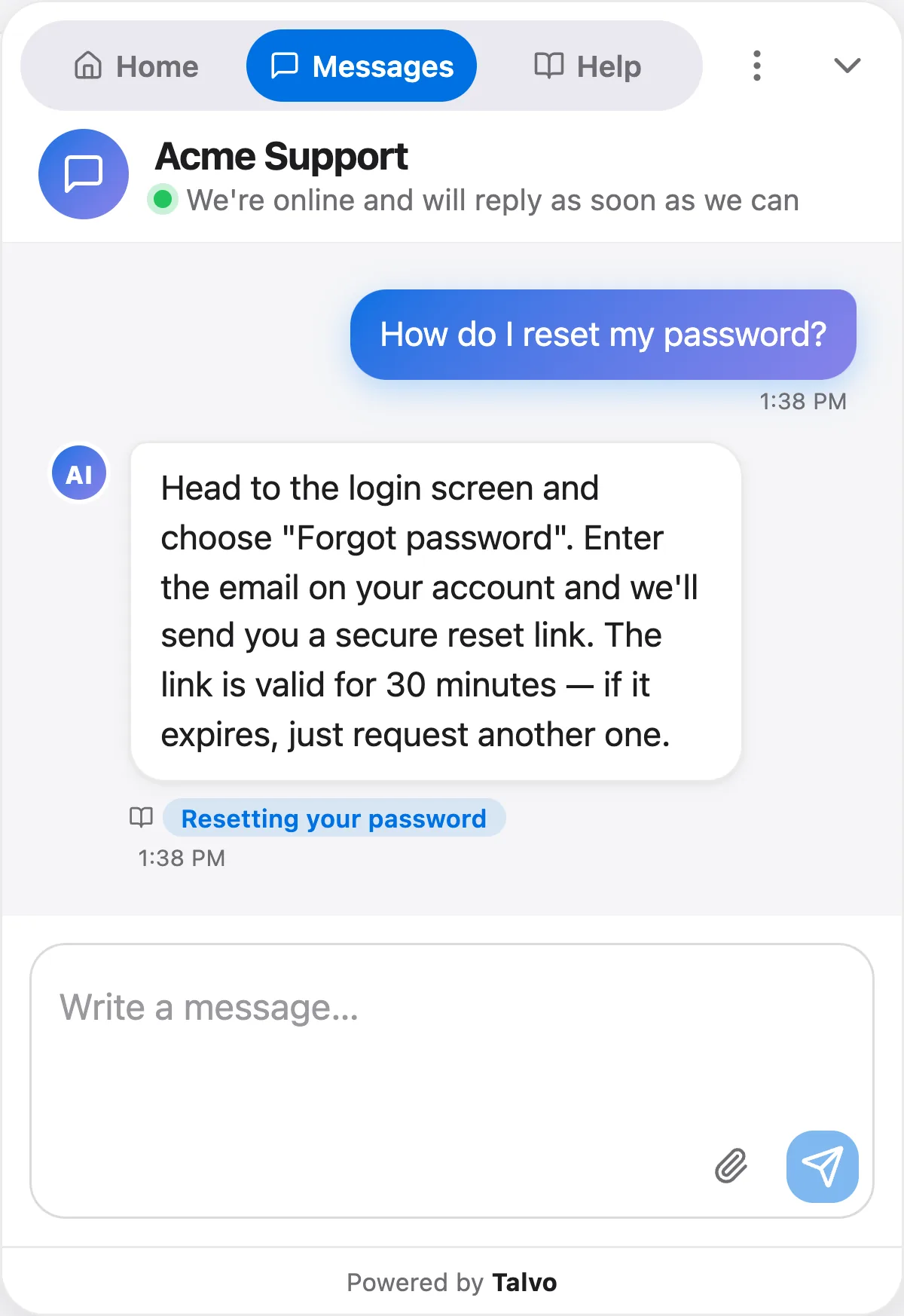
This comparison doesn't rank Lyro and Talvo's agent on accuracy, because that takes running both on the same questions. What we can say is the trade. An agent that answers only from published articles hands off more often than one that improvises, which is right for most teams and means the quality of your help center decides the outcome. Our post on knowledge base chatbots explains how to test that before you commit. And Talvo's agent doesn't look up orders. If "where is my package" is your top question, read the next section before anything else.
Shopify, social channels and ten seats: where Tidio wins
- WhatsApp, Instagram and Messenger on every plan, Free included
- Native Shopify actions on the Growth plan and up
- Ten seats on every self-serve plan, including Free
- A visual Flows builder for greeting and qualifying visitors
- Says it completed a SOC 2 examination (the type isn't stated)
- A large review base: about 4.6 on G2 and 4.7 on Capterra, per secondary roundups
- Three meters make the total hard to predict
- Lyro bills every conversation it replies in, hand-offs included
- No standalone help-center product on its pricing page
- SSO only on Premium, and an 11th seat means Plus, from $300 a month plus usage
- Replies stop when the monthly human-conversation quota runs out
If you run a Shopify store and most questions are about orders, returns and shipping, Tidio is the better fit and we'd tell you to stay. Its native Shopify actions are the kind of thing Talvo has nothing like: no Shopify app, no order lookups, no store actions. You can still paste Talvo's script tag into a Shopify theme and have the AI answer from your policy articles, but it can't see a customer's order.
The rest of the gap list, plainly. Talvo has no WhatsApp, SMS, Instagram or Messenger, and no phone or voice. The first four are on our public roadmap as planned, not shipped. There's no SOC 2 report, no SAML SSO, no choice of data region and no HIPAA support. The Free plan has 2 teammates against Tidio's 10, and Starter stops at 5. There are no product tours or native mobile SDK, and no App Store app, though the inbox runs in a phone browser. And Talvo has no reviews yet, while Tidio has a large base of them. The Tidio ratings above come from competitor-written roundups, so treat them as approximate.
Tidio's complaints are about money more than quality. Reviewers cite unpredictable bills, proactive greetings eating quota, and some say they were moved to a higher tier without clear consent. We think the likely mechanism is the automatic upgrade: Tidio's help center says that on monthly plans, newer projects upgrade to the next tier at 95% of a quota unless you switch it off, and it applies to conversations, Lyro and Flows alike. That link is our inference, not something reviewers or Tidio state, and the setting can be turned off.
Inbox, help center and the rest of a working day
Both tools cover the daily work of a small support team. Tidio gives you live chat, ticketing and email management on every plan, plus auto-assignment, macros and a satisfaction survey from the Growth plan. Talvo's inbox covers the same ground, with internal notes on every plan, two-way email that threads replies back into one conversation, and an AI brief that summarizes each thread so a teammate can pick it up mid-stream.
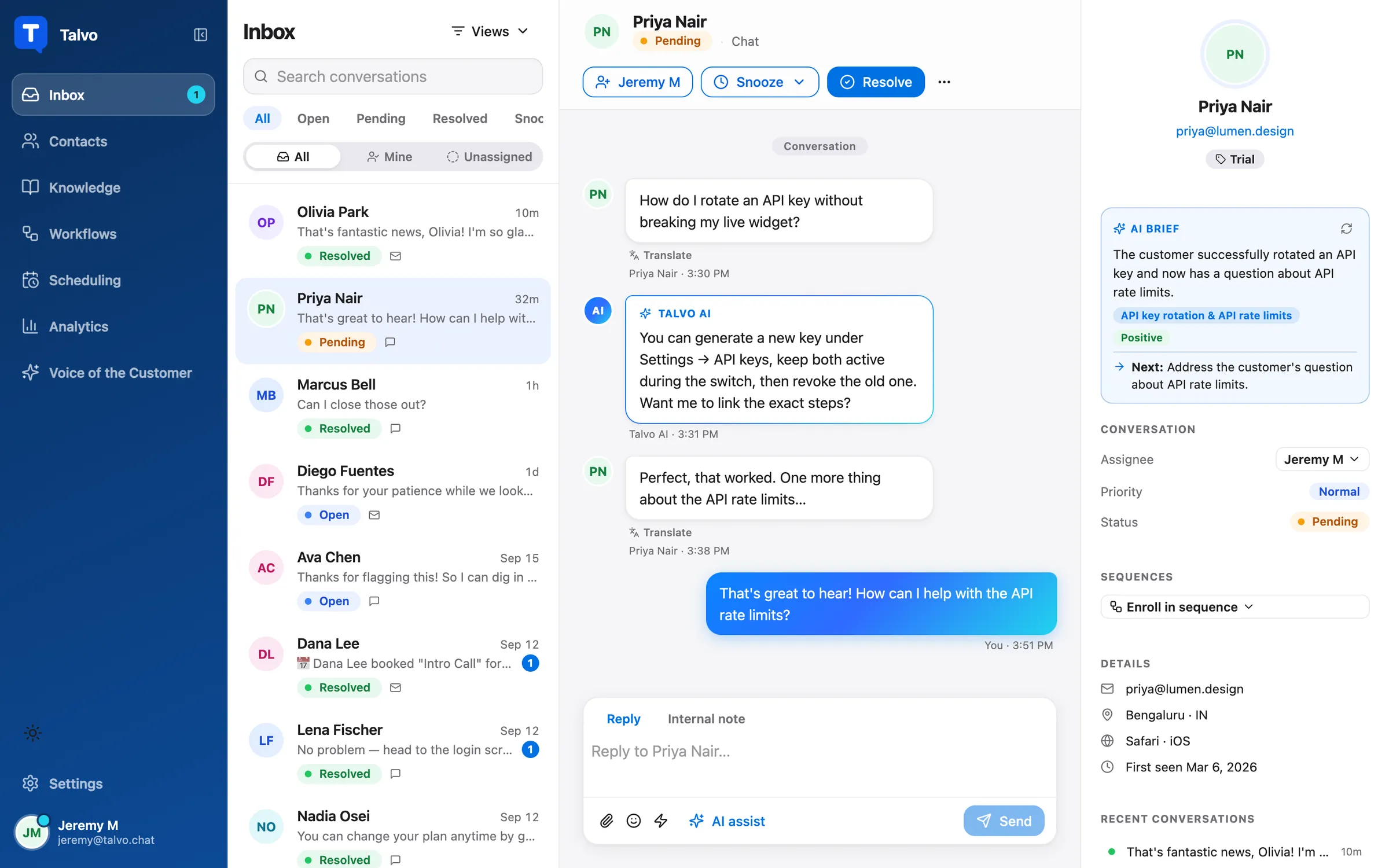
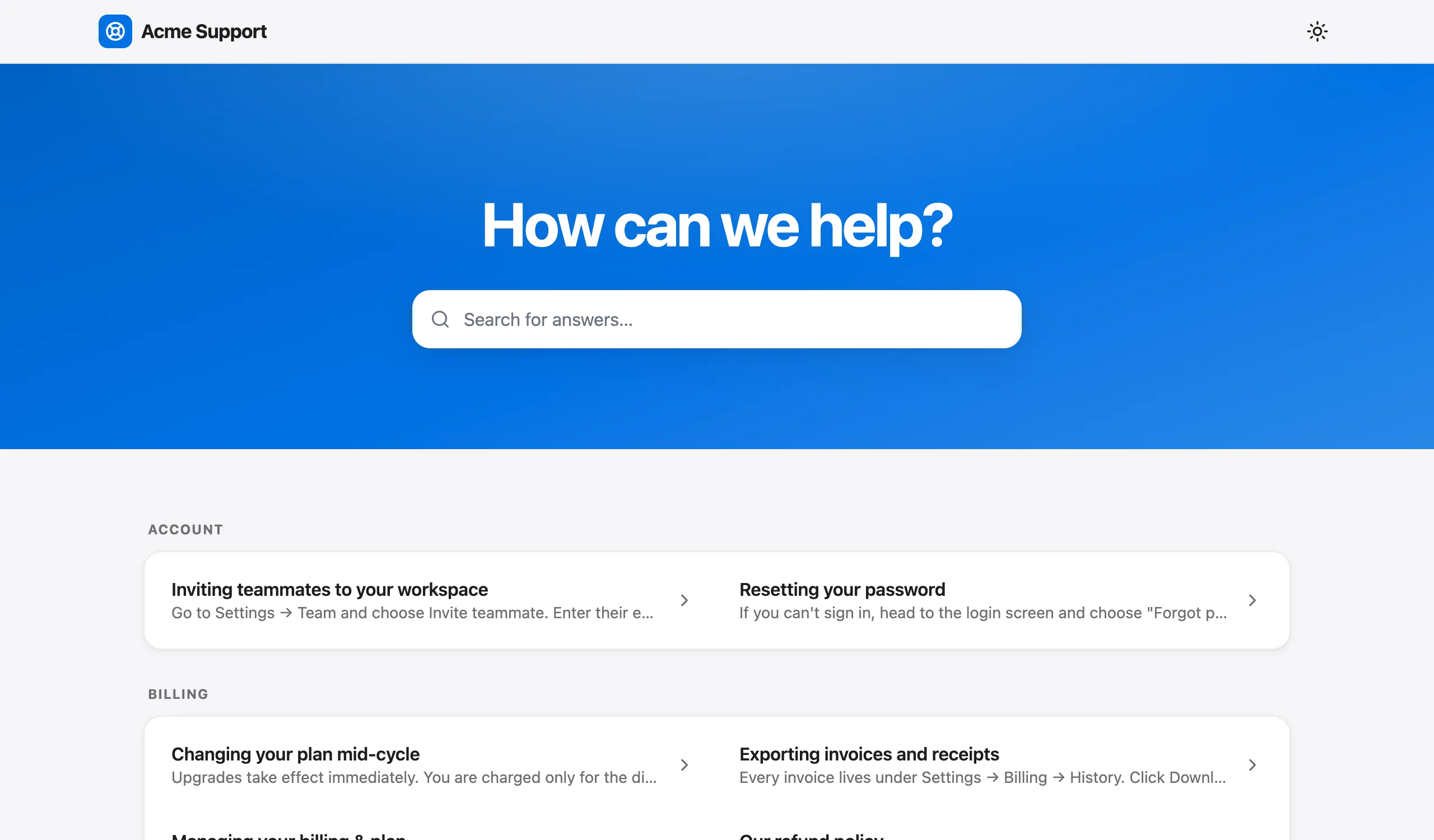
One difference that matters if you aren't starting from a help center. Talvo includes a hosted help center on the Free plan: publish an article and it appears on a public searchable page, in the widget's Help tab, and in the AI's answers. Tidio's pricing page lists no standalone help-center product; Lyro learns from FAQ uploads, scraping or imports.
Higher up Talvo's ladder, the Growth plan at $149 a month adds routing rules, SLA policies, saved views and workflows, which is where it overlaps with Tidio's Growth features. Tidio's Flows is aimed at the visitor in front of you. Talvo's workflows are a trigger, conditions and actions canvas for routing and follow-up. They're different tools, so don't assume a Flows automation maps one for one.
Switching from Tidio to Talvo, step by step
The mechanical parts take under an hour. The slower part is checking that your AI has something good to read.
- Find where your answers liveLyro learned from an FAQ upload, a scraper or an imported help center. Locate that source. If it's pages on your own site, Talvo can crawl them. If it's a file, you'll paste or write the answers into Talvo's knowledge base.
- Import or write your articlesKnowledge, then Import: paste the public address of your help pages (how the import works). Every article arrives as a draft, and the AI only answers from what you publish.
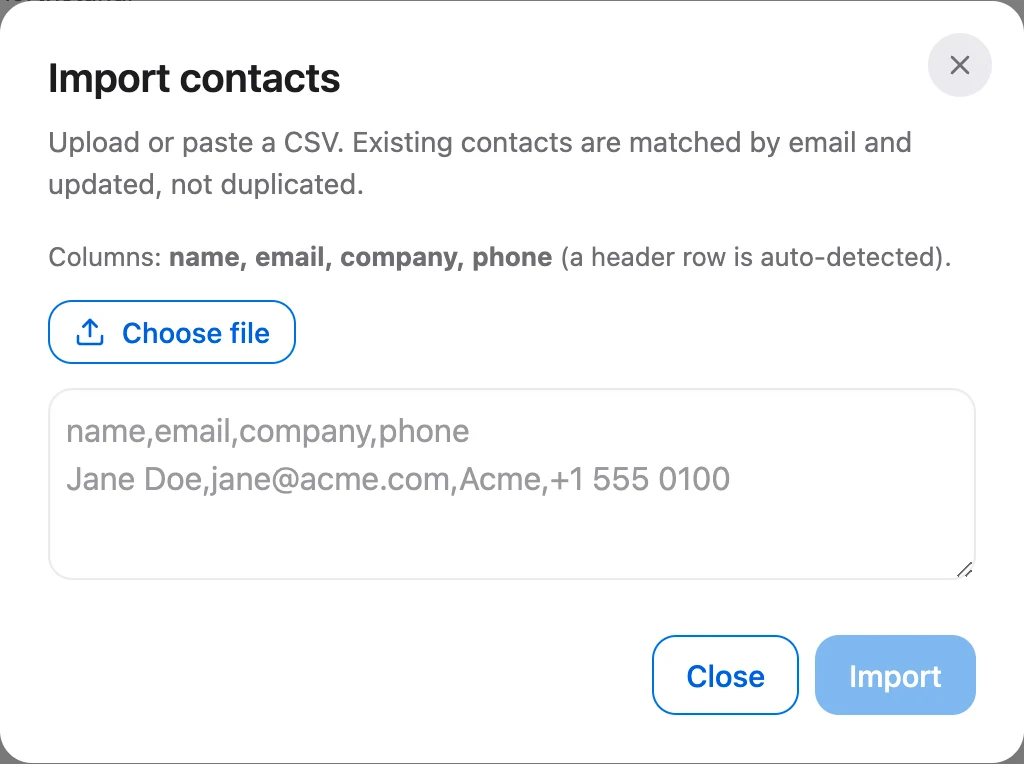
- Bring your contactsOn the Contacts page, upload a CSV with name, email, company and phone columns. People are matched by email, so nothing duplicates.
- Install the widgetPaste one script tag before the closing body tag (install guide). It works in Shopify themes, WordPress, Webflow, Squarespace, Wix and custom builds.
- Forward your support emailPoint your support address at the forwarding address in Settings, then Inbox, then Email forwarding. Replies thread back into the same conversation.
- Run both for a couple of weeksPut Talvo on a slice of pages while Tidio stays live, and watch which questions the AI hands off.
What doesn't move: your conversation history. Talvo doesn't import past conversations, so export what you need from Tidio before you cancel and treat it as an archive. Talvo also can't read private articles, because it sees only what a visitor would see. And whatever you built in Flows, Lyro Actions or Shopify integrations has to be rebuilt by hand or dropped. Our switching guide lists the limits.
- List the channels your customers use. If Instagram or WhatsApp chats are a real share, no tool without them will do, Talvo included.
- Check the Shopify features you rely on, such as order lookups from chat.
- Export contacts and any conversations you need to keep.
- Write down the Flows you use and decide what replaces each one.
- Note your billing cycle. Tidio says plan changes take effect at the start of the next cycle, and you keep features until then.
- Compare both bills at your real volume, not our sample teams.
Which one fits you
Choose Tidio when your store lives on Shopify, your customers reach you in Instagram DMs or WhatsApp, or you have a big team answering a small number of chats. Choose Talvo when your customers come through the website and email, you want an AI that cites your articles and costs less as it does more, and you can live with being early on a beta product.
If you're still comparing, Talvo vs Crisp covers the cheaper flat-price rival, and AI resolution pricing compared lines up every vendor's definition. The free plan needs no card, which is the cheapest way to see whether your own help articles produce good answers.
Which should you choose?
- you want one predictable bill instead of three meters that move separately
- you expect the AI to handle a real share of conversations and don't want to pay for hand-offs
- customers reach you through your website and email rather than Instagram or WhatsApp
- you want a hosted help center and shared inbox included on the Free plan
- you can accept being early on a beta product with no reviews
- you run a Shopify store and want native order actions in chat
- your customers message you on WhatsApp, Instagram or Messenger
- you have 6 to 10 agents with light conversation volume and little AI, where a $29 plan is hard to beat
- you want a visual Flows builder for greeting and qualifying visitors
- you want a vendor with a large review base and a SOC 2 examination behind it
Frequently asked questions
What is a good alternative to Tidio?
For small teams that want predictable pricing and an AI agent that cites help articles, Talvo is one: a 5-agent team with 400 human and 300 AI conversations is about $147 a month against about $299 on Tidio at list prices. It is new and in beta, with no Shopify actions or social channels, so stores that depend on those should stay with Tidio or look at Crisp or Gorgias.
Why is Tidio so expensive?
The base plan is cheap, but Tidio sells three separate meters: billable conversations, Lyro AI conversations and Flows visitors. Lyro costs about $0.70 to $0.78 per conversation it replies in, hand-offs included, so the AI add-on often costs more than the plan. On monthly plans, a quota that reaches 95% can also upgrade automatically unless you switch that off.
Is Talvo cheaper than Tidio?
Usually once the AI does real work: $147 against $299 for 5 agents and 300 AI conversations, and $299 against $879 for 10 agents and 1,000. Tidio is cheaper for bigger teams with light traffic. Eight agents and 80 human conversations with no AI is $29 on Tidio's Starter plan and $149 on Talvo's Growth plan.
What counts as a billable conversation in Tidio?
Any chat, ticket, email or social conversation that includes a message from a human agent. Lyro conversations are counted separately: a conversation with at least one Lyro reply. Tidio's own pages disagree on whether a returning customer is one Lyro conversation or two, so check with Tidio if that matters to your volume.
Is Lyro worth it?
It depends on volume and on how often it resolves rather than hands off. Lyro starts at $39 a month for 50 conversations and runs about $0.70 per conversation at 300 to 1,000, billed whether or not the question was solved. If your help content is strong and volume is modest, it can pay for itself; if not, a resolution-billed AI avoids paying for hand-offs.
Is Tidio better than Talvo for Shopify?
Yes. Tidio has native Shopify actions on its Growth plan and up and a long record with small stores. Talvo installs on a Shopify theme with one script tag and can answer from your policy articles, but it has no Shopify app, order lookups or store actions.
Can I keep my help articles if I switch from Tidio?
Mostly. Talvo can crawl your public help pages or website FAQ and imports contacts from a CSV, but articles arrive as drafts you publish yourself, and private content can't be read. Tidio doesn't list a standalone help-center product, so find where Lyro's source content lives first. Past conversations aren't imported.
Is Tidio good for SaaS, or only for ecommerce?
Tidio works for SaaS chat, but it is built around small online stores and its strongest ground is Shopify and WordPress. SaaS teams that rely on signed-in users, a help center and email may find Talvo a closer fit, since it supports identity verification on every plan and includes a hosted help center on Free.
Sources
Other products' prices and features change. We checked these pages on October 21, 2026; if something is out of date, tell us and we'll fix it.
- Tidio pricing page (checked Oct 21, 2026)
- Tidio security page (checked Oct 21, 2026)
- Tidio help: The Lyro AI agent limit
- Tidio help: The monthly conversations limit
- Tidio help: Automatic upgrades
- Talvo pricing (checked Oct 21, 2026)
- Talvo help: Plans, billing and AI usage
- Talvo help: What counts as an AI resolution
- Talvo help: Switching from another help desk