On this page
- The three meters, and why they don't line up
- What Tidio actually costs at three sizes
- Size your own Tidio bill before you compare anything
- Six Tidio alternatives, priced on the same teams
- Tidio vs Intercom, without the marketing
- Ecommerce: when to look at Gorgias instead
- Where Tidio is still the right call
- A short checklist for leaving Tidio
- Frequently asked questions
Tidio looks like the cheap option until you add its AI. The Starter plan is $29 a month. Lyro, its AI agent, starts at $39 more for 50 conversations. Flows, its chatbot automation, is a third line item. Three meters, three bills, and none of them moves in step with the others. If you're hunting for Tidio alternatives because the invoice stopped matching the pricing page, this is the arithmetic, plus six other places to land. Prices are from the vendors' own pages, checked October 21, 2026, in US dollars.
Talvo makes one of the alternatives here. We've put it in with its gaps, and we say where Tidio is the better pick.
The three meters, and why they don't line up
Tidio's base plan isn't priced by seat. It's priced by billable conversations: any chat, ticket, email or social conversation that includes a message from a human on your team. Starter covers 100 for $29 a month. Growth runs from $59 for 250 up to $349 for 2,000. Both allow 10 seats. Annual billing takes off two months, so Starter is $24.17.
Lyro is the second meter, and it counts differently. A Lyro conversation is any interaction where Lyro sends at least one reply, counted once even if the customer comes back later. It's billed on usage, not on whether the question got solved. The free allowance is 50 Lyro conversations, one time, for good. After that the add-on runs $39 for 50, $75 for 100, $210 for 300, $350 for 500, $525 for 750 and $700 for 1,000, on monthly billing. That's about $0.70 to $0.78 per conversation.
Flows is the third. It's free for 100 visitors reached a month, then from $29 for 2,000, scaling to 100,000.
Put the first two together and you find the catch people complain about. By the definitions on Tidio's pricing FAQ, a conversation that Lyro opens and a teammate finishes can count against both: once as a Lyro conversation, once as a billable conversation, because a human replied. That's our reading of the two definitions, not a line Tidio prints, so check it with them if it matters to your volume. Proactive greetings can also eat quota, according to reviewers.
What Tidio actually costs at three sizes
Tidio's base price depends on how many conversations your humans handle, which none of the other tools here care about. To compare, we assumed the human-handled count for each team. Teams A, B and C are 2, 5 and 10 people, with 100, 500 and 1,500 AI-answered conversations a month.
| Team A | Team B | Team C | |
|---|---|---|---|
| Human-handled conversations (our assumption) | 100 | 400 | 1,000 |
| Base plan | Starter, $29 | Growth, $89 | Growth, $179 |
| Lyro conversations | 100 for $75 | 500 for $350 | 1,500, about $1,050 (our estimate) |
| Flows (if you use more than 100 visitors) | $0 | $29 for 2,000 visitors | $29 for 2,000 visitors |
| Total, without Flows | $104 | $439 | about $1,230 |
| Total, with Flows | $104 | $468 | about $1,260 |
The Lyro price list stops at 1,000 conversations. The 1,500 figure applies the $0.70 rate at the top of the list, so it's a projection. At that volume Tidio's own Plus plan, from $300 a month plus usage, may be the better conversation to have with sales. Premium advertises pay-per-resolution billing and a guaranteed 50% Lyro resolution rate, without a published price.
So Tidio isn't expensive at the start. A two-person store with 100 AI answers pays $104, cheaper than Help Scout or Intercom. It becomes expensive the moment the AI does real work, because the Lyro meter is steep and unconditional.
Size your own Tidio bill before you compare anything
Our three teams are assumptions, and Tidio is the one product here where the assumption matters most, because the base plan follows how many conversations your humans touch. Pull last month's numbers before you trust any total in this post, ours included.
Count three things. First, conversations where a teammate sent at least one message, across chat, email, tickets and social; that picks your Starter or Growth tier. Growth's published steps are 250, 400, 600, 800, 1,000, 1,500 and 2,000 conversations, at $59, $89, $129, $159, $179, $249 and $349 a month. Second, conversations where Lyro sent any reply, including ones a person finished, which is what the Lyro ladder prices (it also has 150 for $110 and 200 for $140). Third, visitors you want Flows to reach.
Then add the three lines. If the Lyro line is more than the base plan, you're already in the territory where the alternatives below start to win. If you're testing a rival, Tidio's own trial runs 7 days with no card and then drops to the Free plan, so nothing bills while you compare.
Six Tidio alternatives, priced on the same teams
The same three teams on each alternative, monthly billing unless noted.
| Tool | Team A | Team B | Team C |
|---|---|---|---|
| Tidio | $104 | $439 | about $1,230 |
| Crisp | about $45 to $50 | about $95 to $120 | about $145 to $220 |
| Talvo | $49 | $149 | $299 |
| Freshchat (annual billing) | $87 | $340 | $925 |
| Help Scout | $135 | $525 | $1,425 |
| LiveChat | $149 | $620 | $1,735 |
| Intercom (now Fin), Essential | $177 | $690 | $1,875 |
The arithmetic behind the others is in our full Intercom alternatives comparison. Short version: Help Scout is 2, 5 or 10 users at $30 plus $0.75 per resolution; Intercom is $39 per seat plus $0.99 per outcome; LiveChat is $25 per user plus packs of 50 resolutions at $49.50; Freshchat is $19 per agent plus $49 per 100 AI sessions, after 500 free once per account.
Crisp: the closest in spirit, and cheaper
Crisp is the natural next stop for small shops. It's flat per workspace ($45 for 4 seats, $95 for 10), has a free plan, and supports WhatsApp, Instagram, Messenger and SMS. Its AI bills credits instead of conversations, at an estimated $0.05 to $0.10 each, which is a fraction of Lyro's price. The trade: Crisp says it hasn't passed a SOC 2 audit, and its credit rates beyond the included amount aren't published. Our Talvo vs Crisp post goes deeper.
Talvo: flat plans, a lower AI rate, a young product
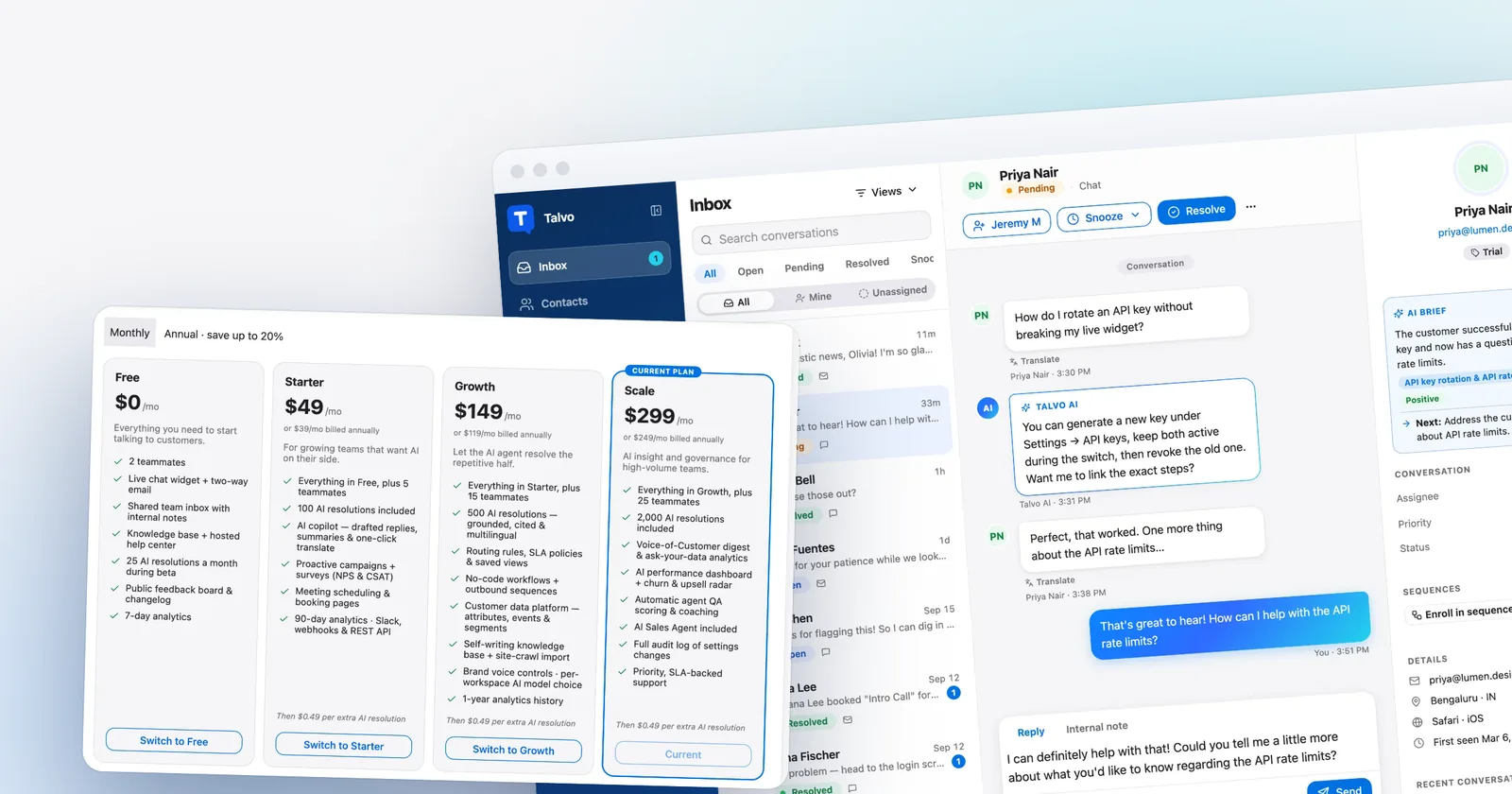
Talvo's Starter plan is $49 a month with 5 teammates and 100 AI resolutions. Growth is $149 with 15 teammates and 500 resolutions. Scale is $299 with 25 and 2,000. Extra resolutions cost $0.49 each. A resolution here is a conversation the AI answered end to end from your published knowledge base; a hand-off to a person is never billed (the definition). That one difference removes the double-count described above.
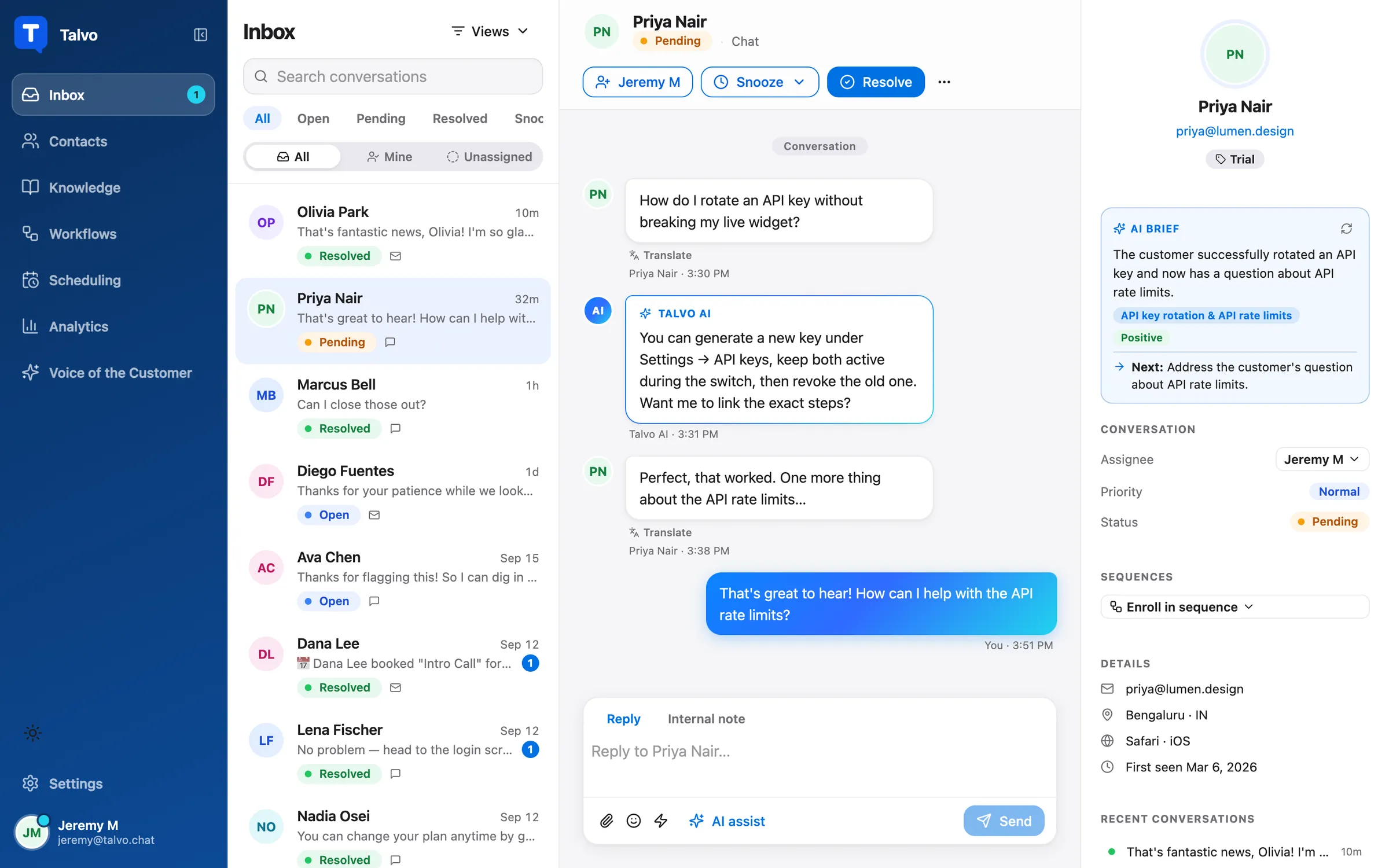
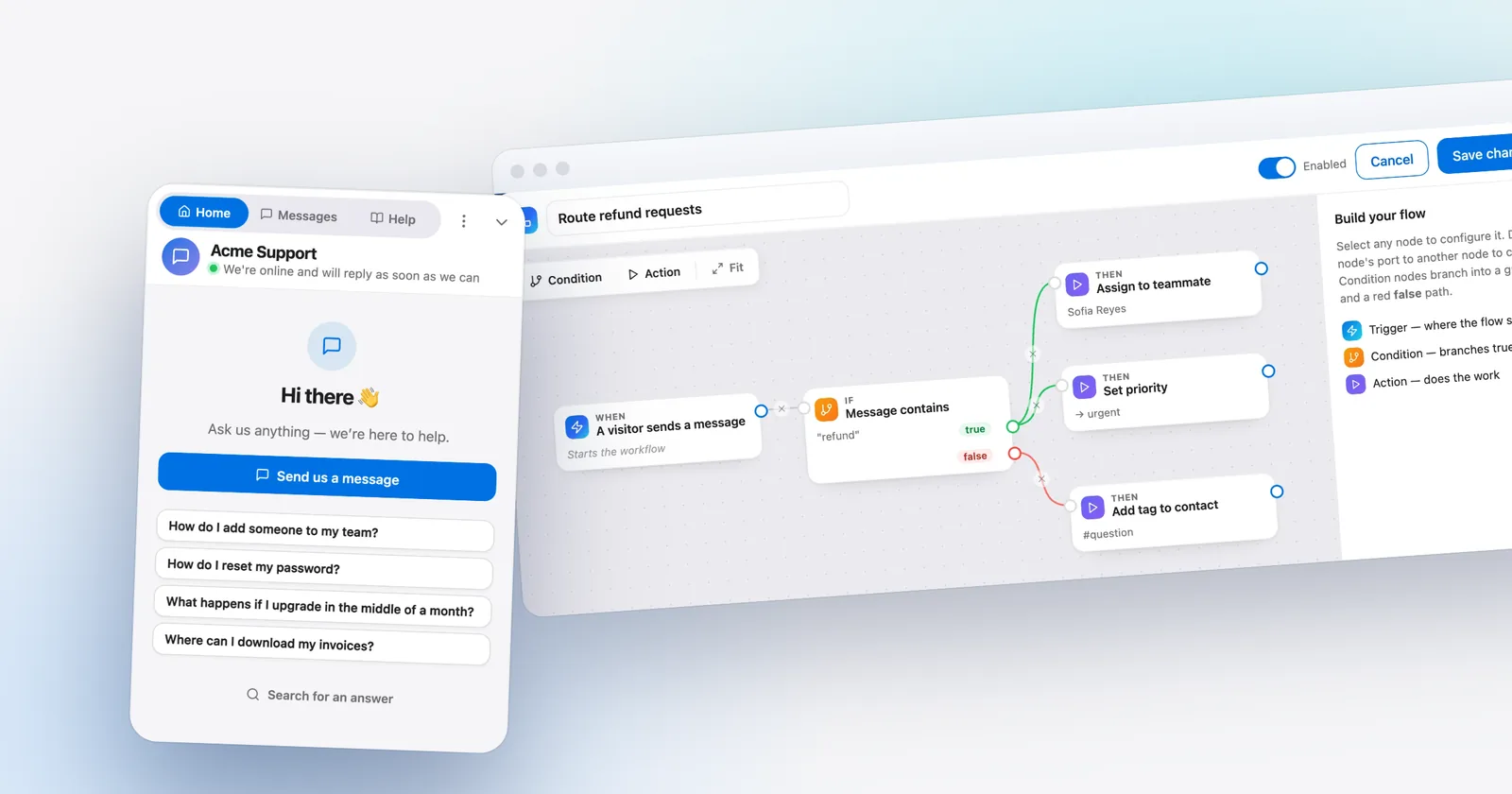
The honest part. Talvo launched in 2026 and is in beta, with no reviews on G2 or Capterra. It has no WhatsApp, SMS, Instagram or Messenger yet (all on the roadmap), no phone channel, no Zapier, and no native Shopify integration, which matters if you came to Tidio for a store. It has no SOC 2 report or SAML SSO. Tidio has the Shopify and WordPress fit, the Instagram and WhatsApp channels on every plan, and a visual Flows builder for greeting and qualifying visitors; Talvo's workflows are a no-code canvas for routing and automation, a different tool. If your store lives on chat inside Instagram DMs, Talvo isn't ready for you.
Help Scout, LiveChat, Freshchat and Intercom
Help Scout makes sense if your volume is mostly email: $0.75 per strictly counted resolution, a three-month free AI trial, and a clean inbox. LiveChat is a polished per-seat chat console with Shopify selling features, and roughly Intercom's bill. Freshchat has the lowest per-agent price of the per-seat tools here ($19 on annual billing), a free plan for up to 10 agents, and a long compliance list, though its AI bills by session rather than resolution. Intercom is the benchmark and the most expensive row.
Tidio vs Intercom, without the marketing
People search "Tidio vs Intercom" because they've outgrown one or are scared of the other. On our three teams Tidio is cheaper every time: $104 against $177, $439 against $690, $1,230 against $1,875. Intercom's seat-plus-outcome model scales with headcount and AI volume together, and Tidio's scales mainly with AI volume.
One fairness note on security before the list. Tidio says on its security page that it has completed a SOC 2 examination, though the page does not state the type, so don't read the Intercom comparison below as "Intercom has it, Tidio doesn't." SSO is where Tidio draws a line: its pricing page lists it on Premium only.
What Intercom adds for the money: SOC 2 Type II, ISO certifications, HIPAA support on its Expert plan, SSO, data hosting in the US, EU or Australia, a larger app marketplace (it claims 450+), and a stronger reputation for AI quality. What Tidio adds: a free plan, ten seats on every self-serve plan, Instagram and WhatsApp included in the plan, and a gentler setup for a small shop. Intercom's Fin counts a conversation as an outcome even when the customer simply stops replying, which is its own forecasting problem. Neither is a clean win. Our Talvo vs Intercom and Intercom pricing posts cover the other side.
Two more names come up in these searches. Zendesk is the step up when you've outgrown small-team tools and need compliance and scale; it's priced well above everything here. Chatwoot is open source, cheap per seat, and worth it only if someone on your team is happy running software. Both are priced in our cheaper Intercom alternatives comparison.
Ecommerce: when to look at Gorgias instead
If your support is mostly order questions, Gorgias deserves a look. It prices by tickets, not seats, with Basic at $60 a month for 300 tickets and Pro at $360 for 2,000 ($300 on annual billing). Its AI Agent is $0.90 per interaction on Basic and Pro, and each interaction also counts as a ticket. You get cancel, refund and discount actions from inside the inbox and revenue attribution on Pro. Gorgias's pricing page shows a second set of higher prices in its structured data, so confirm what the live plan cards say before you budget. It isn't a cheap Tidio replacement; it's a different kind of product for stores where order handling is the work.
Where Tidio is still the right call
Stay on Tidio if you run a small Shopify or WordPress store, your human-handled volume is modest, you want Instagram and WhatsApp chat on the base plan, and you'd use Flows to greet visitors and qualify leads. At low AI volume, 50 free Lyro conversations and a $29 base is hard to beat.
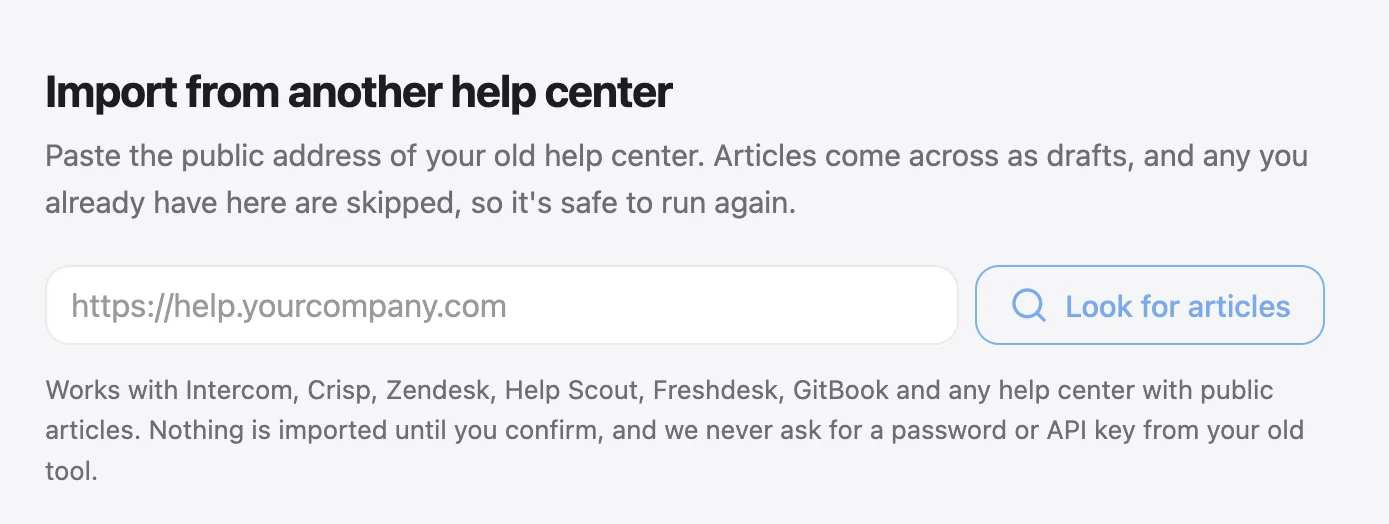
Switching costs are smaller than they look. Your help articles are the thing to move. Talvo can crawl your public help center, or import from Intercom, Zendesk, Help Scout, Crisp, Freshdesk and others (how switching works), and contacts import from CSV.
A short checklist for leaving Tidio
Most of the work is deciding what you can't lose. Go through it in this order.
- List the channels customers actually use. Tidio puts Messenger, Instagram and WhatsApp on every plan; if Instagram DMs are a big share of your chats, that rules out any tool without it, Talvo included today.
- Check your store or site integration. Shopify and WordPress are Tidio's strongest ground, so confirm the new tool has an equivalent before you remove the old widget.
- Gather the content your AI answers from. We didn't find a standalone help-center product on Tidio's pages, so find where your FAQ lives (Lyro's FAQ upload, or your own site) and make sure you have a copy.
- Note any Flows you rely on, such as greetings and lead qualification, and decide what replaces them.
- Run the new tool on one slice, a single page or a second site, for a couple of weeks while Tidio stays live.
- Compare the bills at your real volume, not the sample teams, and only then cancel.
Nothing here is urgent if Tidio's invoice still makes sense. It's the checklist for the month it stops making sense.
For the broader cost argument see per-seat vs flat pricing and AI resolution pricing compared.
Which should you choose?
- your AI volume is growing and you want it covered by a plan allowance, then $0.49 per extra resolution, rather than a separate Lyro meter
- you want one predictable monthly price per workspace with no per-seat or per-conversation tiers
- you want an AI agent that answers only from published articles, cites them and hands off with context
- you can do without WhatsApp, Instagram, Messenger and a native Shopify integration for now
- you run a small Shopify or WordPress store and want its integrations out of the box
- you want WhatsApp, Instagram and Messenger chat included in the base plan
- your human-handled and AI volume are both low, so a $29 plan and 50 free Lyro conversations cover you
- you want a free plan with 10 seats and Flows to greet and qualify visitors
Frequently asked questions
What is better than Tidio?
It depends on what you outgrew. Crisp is cheaper and adds more channels, Help Scout suits email-first teams, Gorgias suits Shopify stores that need order actions, and Talvo has flat workspace pricing with AI resolutions at $0.49 each beyond the plan allowance. Talvo is new and in beta, so check its gaps first.
Why is Tidio so expensive?
Because there are three meters. The base plan is priced by conversations a human handles, Lyro AI is a separate add-on from $39 for 50 conversations, and Flows is billed by visitors reached. A conversation Lyro opens and a teammate finishes can count against both the Lyro and base meters, which is how bills outgrow the headline price.
Is Tidio free?
There is a free plan with 50 billable conversations a month and 10 seats. It includes 50 Lyro AI conversations one time only, and Flows is free for 100 visitors a month. Paid plans start at $29 a month, or $24.17 on annual billing.
Is Lyro worth it?
Lyro costs roughly $0.70 to $0.78 per conversation on published tiers, billed whenever it sends a reply, whether or not the question was solved. For a small store with a few dozen AI conversations a month it can be worth it. At hundreds of conversations, tools that bill resolutions or include allowances usually cost less.
Is Tidio better than Intercom?
Tidio is cheaper on all three team sizes we priced, for example about $439 against $690 a month for 5 people and 500 AI answers. Intercom offers more compliance (SOC 2 Type II, HIPAA support, SSO), a bigger app ecosystem and deeper features. Choose Tidio for a small store, Intercom when compliance and scale matter.
Does Tidio charge per seat?
No. Tidio prices by billable conversations, meaning conversations that include a message from a human agent. Starter and Growth both include 10 seats, so adding a teammate doesn't change the price, but more human-handled conversations push you up a tier.
Sources
Other products' prices and features change. We checked these pages; if something is out of date, tell us and we'll fix it.
- Tidio pricing page (checked Oct 21, 2026)
- Tidio security page
- Intercom pricing page (checked Oct 21, 2026)
- Crisp pricing page (checked Oct 21, 2026)
- Help Scout pricing page (checked Oct 21, 2026)
- LiveChat pricing page (checked Oct 21, 2026)
- Freshchat pricing page (checked Oct 21, 2026)
- Gorgias pricing page (checked Oct 21, 2026)
- Talvo pricing