On this page
- Tidio pricing at a glance
- The three meters, defined
- The full price ladders
- What a five-person team really pays
- Better AI shrinks one meter and grows the other
- Three, five and ten people
- Where the bill surprises people
- Free plan, trial, annual billing and branding
- How you'd size your own Tidio bill
- How Talvo prices the same teams
- Frequently asked questions
Tidio has a $0 Free plan, and its paid plans start at $29 a month. A five-person team with 1,000 conversations a month, 300 of them resolved by Lyro (Tidio's AI agent) with no human reply, pays about $509 a month on the same page's list prices, assuming Lyro also replies in 150 conversations it hands to a person. Nothing changed between those two numbers except which meters the team turned on. Tidio sells three of them separately, and each one counts something different.
This is the full explainer: every plan, every ladder, the rules that trigger upgrades, and worked totals for 3, 5 and 10 people. It's written for the question "what will Tidio cost me", not "what should I switch to", so there's no verdict at the end. Talvo makes a competing product; it comes up in a few direct comparisons and gets one section of its own, clearly marked. Every Tidio number comes from Tidio's pricing page and help center, checked on October 21, 2026, in US dollars before tax. If you're comparing options, Tidio alternatives and Talvo vs Tidio take the next step.
Tidio pricing at a glance
Tidio's plans are priced by billable conversations, not by seat. Every self-serve plan includes up to 10 seats.
| Plan | Monthly | Annual (per month) | Billable conversations | Notes |
|---|---|---|---|---|
| Free | $0 | $0 | 50 | 50 lifetime Lyro conversations, 100 Flows visitors a month |
| Starter | $29 | $24.17 | 100 | |
| Growth | from $59 | from $49.17 | 250 to 2,000 | Adds auto-assignment, macros, auto-reply, satisfaction survey, permissions, advanced analytics and native Shopify actions |
| Plus | from $300 plus usage | not listed | custom | Custom branding, departments, OpenAPI, Lyro from 300 conversations a month |
| Premium | contact sales | not listed | custom | SSO, compliance features, mobile SDK, Lyro from 3,000 a month |
Annual billing is the monthly price times 10/12, which Tidio labels "2 months free". Messenger, Instagram and WhatsApp are included on every plan, Free too. A 7-day trial gives you every plan's features with no card, then drops you to Free.
Older third-party pages still quote Plus at $749 and Lyro's entry tier at 100 conversations. Tidio's page now shows Plus as "from $300 plus monthly usage" and Lyro starting at 50 conversations for $39. If a price you read elsewhere doesn't match, that's probably why.
The three meters, defined
Billable conversations are the base plan's meter. Tidio's FAQ defines one as any chat, ticket, email or social conversation that includes a message from a human agent. Visitor messages nobody answered don't count, and neither do replies from Flows or Lyro.
Lyro conversations are the AI meter: an interaction on any connected channel with at least one reply from Lyro. It's billed on usage, not on whether the question got solved. The exception is the Premium plan, which advertises pay-per-resolution billing and a guaranteed 50% Lyro resolution rate, with no published price.
Flows is the third. It counts visitors reached by a Flows automation, which is Tidio's visual builder for greetings and qualifying chats. The first 100 visitors a month are free.
One more wrinkle on the first meter. Tidio's pricing FAQ says a conversation counts once you reply or start a chat proactively. An older help-center article, last updated in May 2025, says it counts when an agent marks it solved. Neither page says which is current, and for most teams the monthly total comes out the same, but it matters if you have conversations that span the month boundary.
The full price ladders
These are the tiers in the pricing data on Tidio's page. The Growth steps come from that embedded data rather than visible text, so confirm yours on the page before you commit.
Growth (base plan), by billable conversations
| Conversations | Monthly | Annual (per month) |
|---|---|---|
| 250 | $59 | $49.17 |
| 400 | $89 | $74.17 |
| 600 | $129 | $107.50 |
| 800 | $159 | $132.50 |
| 1,000 | $179 | $149.17 |
| 1,500 | $249 | $207.50 |
| 2,000 | $349 | $290.83 |
Lyro, by conversations with an AI reply
| Conversations | Monthly | Annual (per month) | Cost per conversation |
|---|---|---|---|
| 50 | $39 | $32.50 | $0.78 |
| 100 | $75 | $62.50 | $0.75 |
| 150 | $110 | $91.67 | $0.73 |
| 200 | $140 | $116.67 | $0.70 |
| 300 | $210 | $175.00 | $0.70 |
| 500 | $350 | $291.67 | $0.70 |
| 750 | $525 | $437.50 | $0.70 |
| 1,000 | $700 | $583.33 | $0.70 |
Flows, by visitors reached
| Visitors | Monthly | Annual (per month) |
|---|---|---|
| 2,000 | $29 | $24.17 |
| 3,000 | $39 | $32.50 |
| 5,000 | $49 | $40.83 |
| 10,000 | $69 | $57.50 |
| 15,000 | $85 | $70.83 |
| 20,000 | $99 | $82.50 |
| 30,000 | $119 | $99.17 |
| 40,000 | $139 | $115.83 |
| 50,000 | $169 | $140.83 |
| 75,000 | $239 | $199.17 |
| 100,000 | $299 | $249.17 |
Two things jump out. Growth gets cheaper per conversation as you climb, from about 24 cents at 250 to about 17 cents at 1,500. Lyro doesn't. It flattens at 70 cents a conversation from 200 up and never falls further, so volume buys you nothing on the AI meter. And the Lyro ladder stops at 1,000. Beyond that you're talking to sales about Plus.
What a five-person team really pays
Here is the scenario this site uses in its pricing explainers: 5 agents and 1,000 conversations a month. The AI fully resolves 300 of them with no human reply. The other 700 get a person. The assumption that matters is the next one. Usage-billed AI like Lyro charges for every conversation it replies in, including the ones it hands off. We assume it touches 450, which is the 300 it resolved plus 150 it passed to a person.
| Line | Count | Tier | Monthly | Annual (per month) |
|---|---|---|---|---|
| Base plan (Growth) | 700 human-replied | 800 | $159 | $132.50 |
| Lyro | 450 touched | 500 | $350 | $291.67 |
| Flows | under 100 visitors | free | $0 | $0 |
| Total | $509 | $424.17 |
If Lyro had somehow touched only the 300 it resolved, the 300 tier at $210 would do, and the total would be $369. That's the best case, and no AI manages it, because every hand-off is a conversation where Lyro replied first. Spread over the 300 resolutions, the $350 Lyro line is about $1.17 for every conversation the AI actually finished.
Add $29 for Flows if you reach more than 100 visitors, and $20 a month ($16.67 annual) if you want Tidio's branding gone. Both are separate lines.
Better AI shrinks one meter and grows the other
This is the part nobody explains. A conversation only becomes billable on the base plan when a human replies. So the more Lyro finishes alone, the fewer billable conversations you pay for on Growth. But Lyro bills every conversation it touches, so it grows its own meter faster than it shrinks the first.
Take the same team and double what the AI resolves, keeping the same one-hand-off-per-two-resolutions ratio.
| AI resolves 300 | AI resolves 600 | |
|---|---|---|
| Human-replied conversations | 700, tier 800 for $159 | 400, tier 400 for $89 |
| Lyro conversations | 450, tier 500 for $350 | 900, tier 1,000 for $700 |
| Tidio total, monthly | $509 | $789 |
The base plan fell by $70 and the Lyro line rose by $350. Doing twice the AI work cost $280 more a month. That's an honest result of usage billing, not a trick: Lyro did more, so Tidio charged for more. But it means your invoice grows with success. On a per-resolution price like Talvo's, the same jump from 300 to 600 resolutions moves the bill from $147 to $198, because the allowance in the plan absorbs part of it.
Three, five and ten people
Tidio doesn't price by seat, so team size matters only through volume. We scaled the walk-through team at 200 conversations per person, 30% resolved by AI, and one hand-off for every two resolutions. Everything below uses the ladders above at monthly list prices unless a row says otherwise.
| 3 people | 5 people | 10 people | |
|---|---|---|---|
| Conversations a month | 600 | 1,000 | 2,000 |
| Resolved by the AI | 180 | 300 | 600 |
| Lyro replies in (resolved plus hand-offs) | 270 | 450 | 900 |
| Human-replied conversations | 420 | 700 | 1,400 |
| Growth tier | 600 for $129 | 800 for $159 | 1,500 for $249 |
| Lyro tier | 300 for $210 | 500 for $350 | 1,000 for $700 |
| Tidio total, monthly | $339 | $509 | $949 |
| Tidio total, annual (per month) | $282.50 | $424.17 | $790.83 |
| Best case, no hand-offs, monthly | $269 | $369 | $774 |
All three fit inside the 10-seat limit and the self-serve ladders. Push the 10-person team to 3,000 AI conversations and the Lyro meter leaves the price list. At the self-serve $0.70 rate that would be roughly $2,100 for Lyro alone, or about $2,449 with Growth's 2,000-conversation tier at $349. That is an illustration, not a quote, because Plus starts at $300 plus usage and advertises discounted usage rates, so the real number could land either way.
Where the bill surprises people
Reviewers call price the most common complaint about Tidio, mostly because the three meters move independently. A few rules in Tidio's help center explain the rest.
Automatic upgrades. On standard monthly plans, once any quota hits 95%, the package moves to the next tier on its own. That applies to conversations, Lyro and Flows alike, and Tidio sends an email at 80%. It doesn't apply to annual plans, Plus or Free, it only covers newer projects, and it can be switched off. The arithmetic is unforgiving. A Lyro quota of 500 that reaches 475 conversations steps to the 750 tier, which takes that line from $350 to $525. Tidio doesn't say how it prorates a mid-month upgrade, so the figure above assumes no proration. Some reviewers say they were moved to a higher tier without clear consent. We think this default is the likely cause, but that's our inference, not a finding.
A hard stop on human replies. When the monthly human-conversation quota runs out and no upgrade happens, Tidio says you can no longer respond to incoming messages or see their details until the quota resets on the first of the month. A banner shows at 80%.
A one-time Lyro allowance. The 50 free Lyro conversations are for life. When they're gone on the Free plan, Lyro stops and the quota doesn't come back.
Possible double counting. The help center says a Lyro thread closes after 15 minutes of inactivity, and a new visitor message starts a new thread that counts against your quota again. The pricing FAQ says a customer who leaves and returns is still one conversation. Tidio's pages disagree, so ask support which applies if customers drift in and out of chats.
The seat ceiling. Self-serve plans stop at 10 agents. An 11th person means Plus, from $300 a month plus usage.
Changes land next cycle. Plan changes take effect at the start of your next billing cycle, and you keep the higher plan's features until then.
- Find out whether automatic upgrades are on, and decide whether you want them.
- Note whether you're on monthly or annual billing. Auto-upgrades only apply to monthly plans.
- Count last month's Lyro conversations that ended with a hand-off. You paid for those.
- Compare your seat count with the 10-seat ceiling.
- Check whether you're paying for branding removal you don't need.
- Set a reminder for the day your quotas reset.
Free plan, trial, annual billing and branding
The Free plan is genuinely usable: 50 billable conversations, 10 seats, every social channel, and 100 Flows visitors. It stops there. Lyro is limited to 50 conversations over the life of the account.
The trial is 7 days with every feature and no card required. At the end, the account reverts to Free automatically, so a trial can't surprise you with a charge.
Annual billing is worth 16.7%, since it's 10 months for 12. It also takes you out of the auto-upgrade rule, which is a point in its favor if you'd rather hit a limit than have a plan change for you.
Removing the Tidio badge from the widget is a paid add-on, not a plan feature, on Starter and Growth: $20 a month, or $16.67 on annual billing. It's included on Plus (custom branding) and Premium, and it isn't available on Free.
How you'd size your own Tidio bill
Our teams are assumptions. Yours is real, and it takes about fifteen minutes to price.
- Count human-replied conversationsLast month's conversations where a teammate sent at least one message, across chat, email, tickets and social. Pull the number from wherever Tidio shows your usage.
- Count Lyro conversationsEvery conversation where Lyro sent any reply, including the ones a person finished.
- Count Flows visitorsOnly if you use Flows. Under 100 a month is free.
- Round each up to the next tierUse the ladders above. A count of 640 conversations is the 800 tier, not 600.
- Add the three linesThen add $20 for branding removal if you want it, and compare with the monthly and annual totals.
- Leave headroomOn monthly billing, a quota that crosses 95% upgrades itself. Either set aside the difference or switch the setting off.
If you want a second opinion on the shape of the numbers, the support cost calculator lets you compare several tools for the same team.
How Talvo prices the same teams
Talvo is a competing product, so read this section with that in mind. It's new, in beta, with no reviews yet.
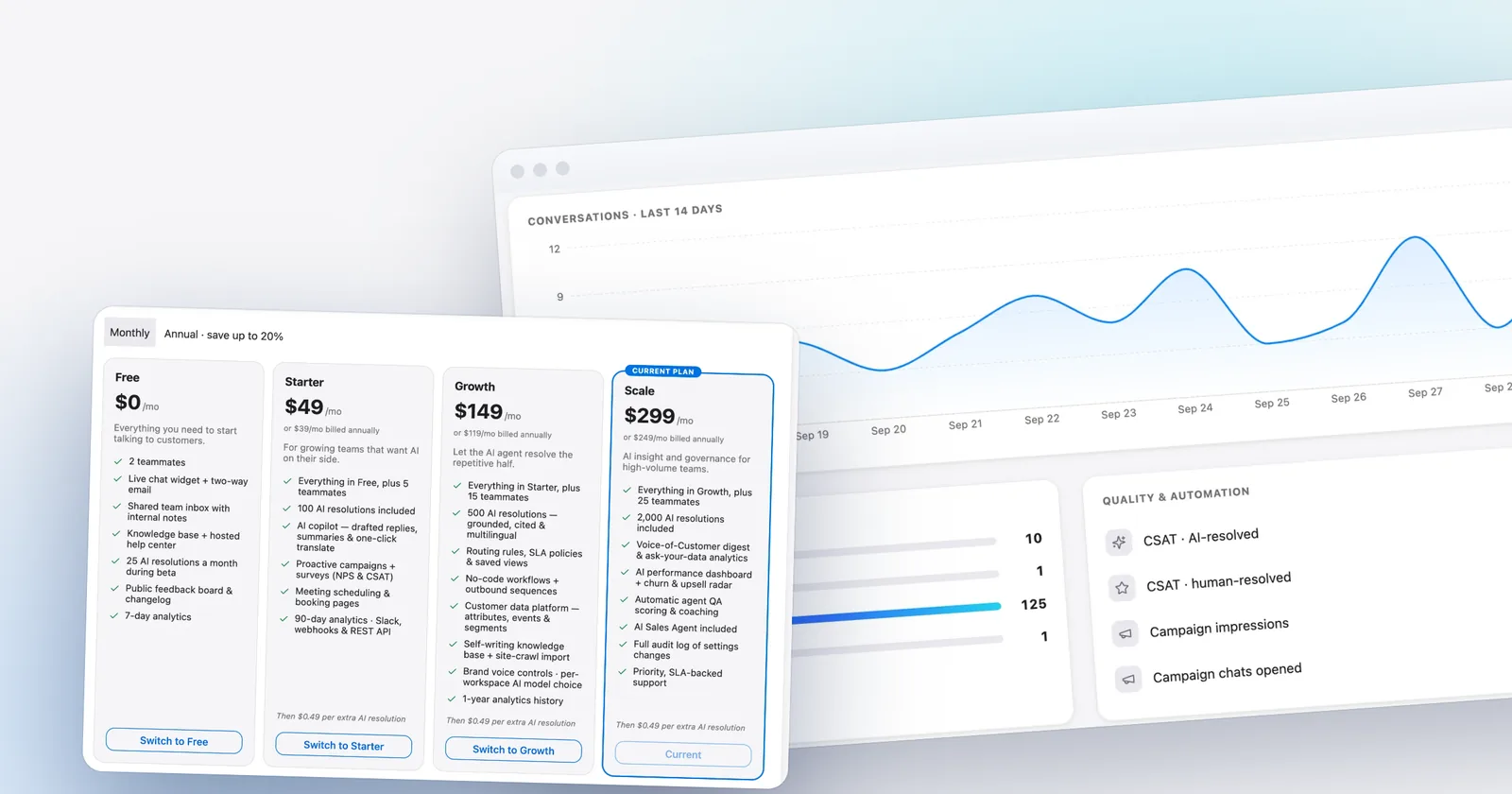
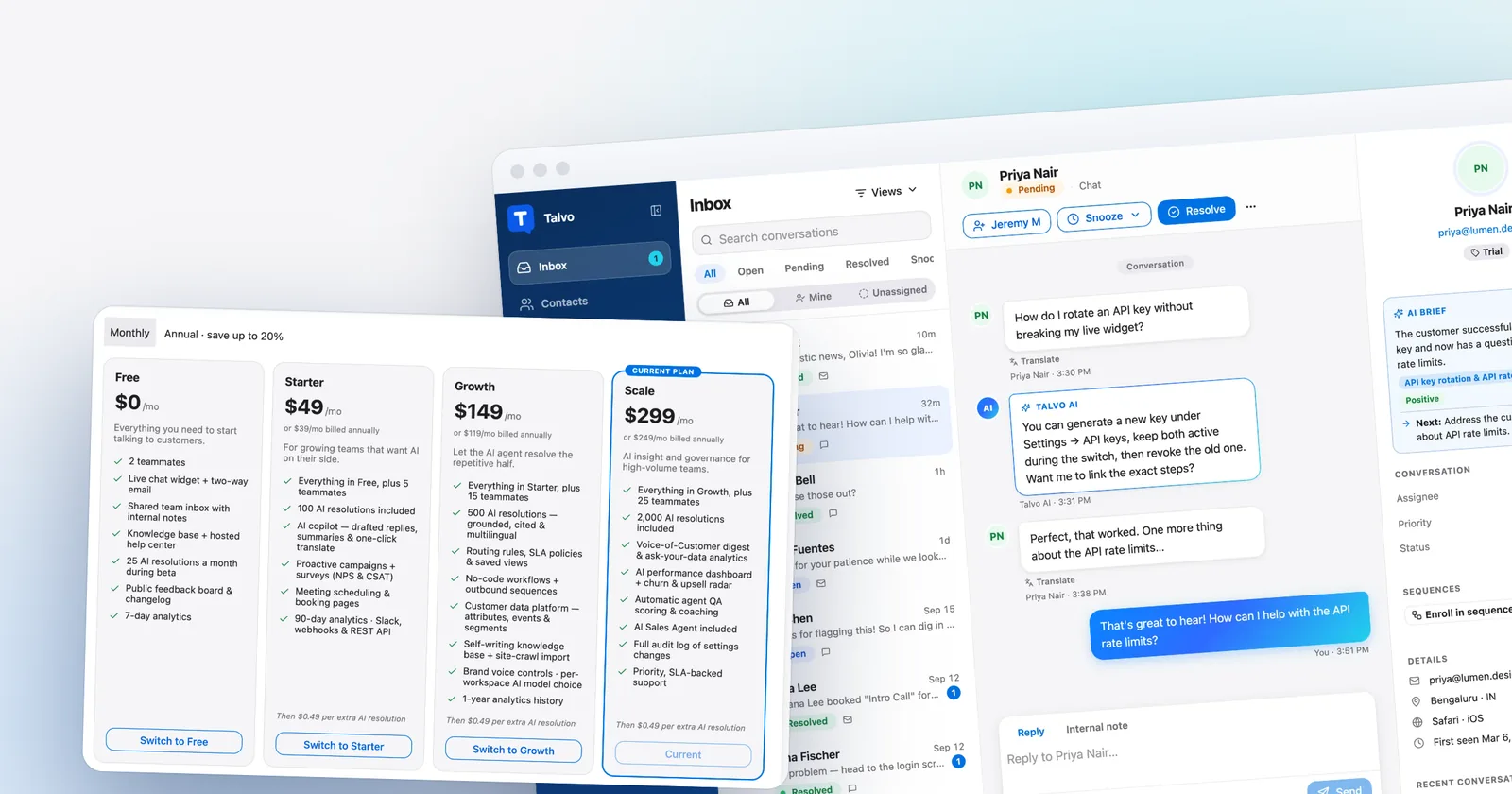
Talvo has one price per workspace and one usage meter. Starter is $49 a month for 5 teammates and includes 100 AI resolutions. The Growth plan is $149 for 15 teammates and 500 resolutions. Scale is $299 for 25 and 2,000. Past the allowance each resolution costs $0.49. Annual billing takes those to $39, $119 and $249 a month. Human conversations aren't metered, and a hand-off to a person is never a resolution (the definition). A resolution is a conversation the AI answered from a published article with no teammate message.
| Team | Resolutions | Cheapest fitting plan, monthly | Annual (per month) |
|---|---|---|---|
| 3 people | 180 | Starter $49 + 80 × $0.49 = $88.20 | Starter, $78.20 |
| 5 people | 300 | Starter $49 + 200 × $0.49 = $147 | Growth, $119 |
| 10 people | 600 | Growth $149 + 100 × $0.49 = $198 | Growth plus overage, $168 |
Against Tidio's $339, $509 and $949 for the same teams, that's the whole pitch. It isn't universal. Talvo's Starter plan stops at 5 teammates and Free at 2, so a 9-person team with light traffic and no AI pays $149 for the Growth plan where Tidio's Starter is $29. We work through that case in Talvo vs Tidio.
Talvo is also missing things Tidio has. There's no WhatsApp, SMS, Instagram or Messenger channel, no Shopify app or order actions, no SOC 2 report, SSO or HIPAA support, and its widget always shows "Powered by Talvo". If your store depends on any of those, Tidio's higher bill buys something real.
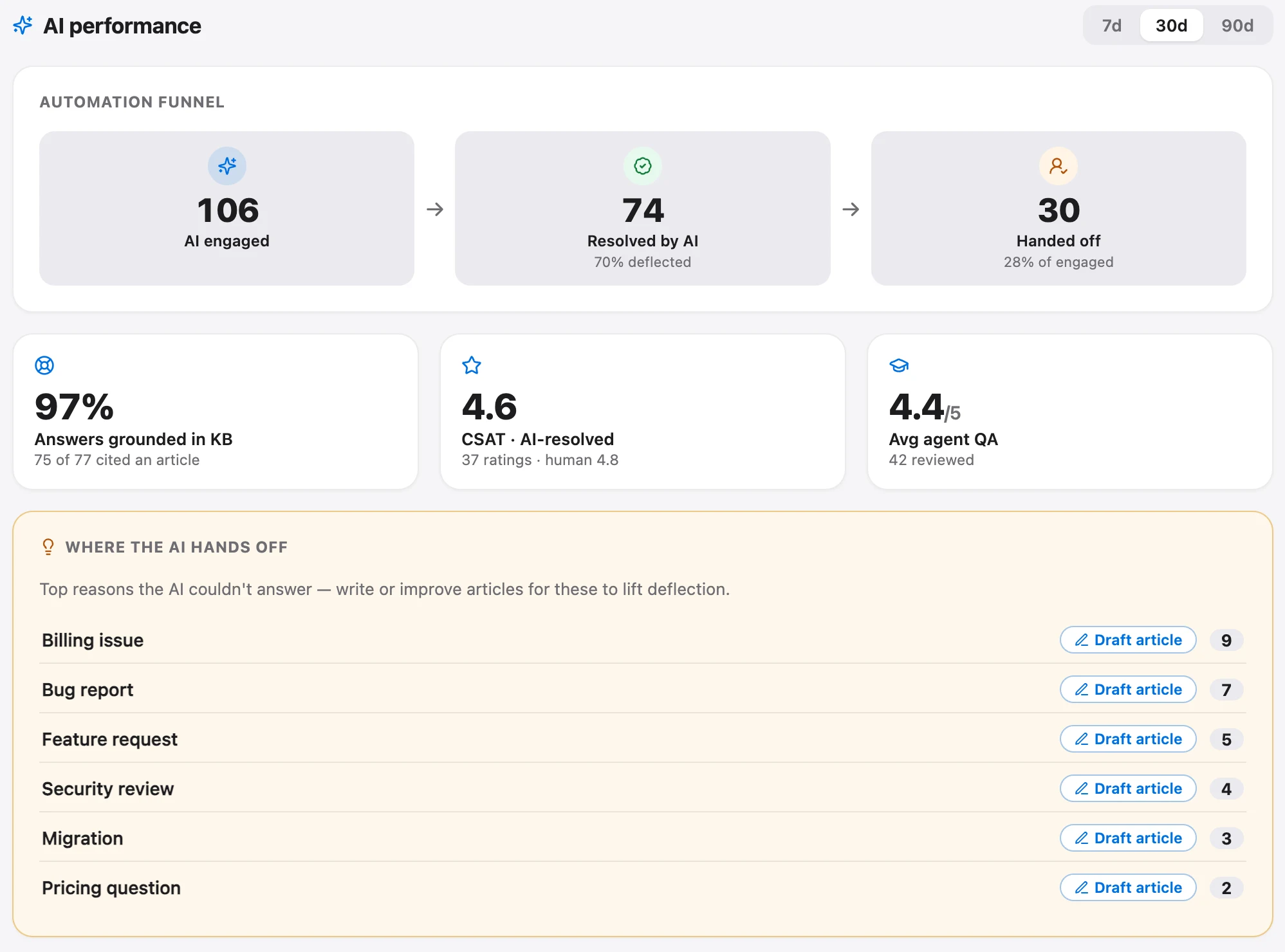
Whichever tool you choose, track the same three numbers: conversations the AI replied in, conversations it resolved, and conversations it handed off. The gap between the first two is what a usage-billed price charges you for. See AI resolution pricing compared for how every major vendor defines the unit, and per-seat vs flat pricing for the other half of the argument.
Frequently asked questions
How much does Tidio cost per month?
The Free plan is $0 and Starter is $29 a month ($24.17 on annual billing). Growth runs from $59 for 250 billable conversations up to $349 for 2,000. Plus starts at $300 plus usage and Premium is contact sales, and Lyro AI and Flows are priced separately on top.
Is Tidio free?
Yes, there is a Free plan with 50 billable conversations a month, 10 seats, every social channel and 100 Flows visitors a month. Lyro gets 50 conversations over the life of the account, and when those are used it stops and does not reset. A 7-day trial of every plan needs no card, then drops you to Free.
What is a billable conversation in Tidio?
A chat, ticket, email or social conversation that includes a message from a human agent. Conversations only Flows or Lyro replied to don't count toward the base plan. Tidio's pages disagree slightly on the moment it counts, a reply or marking it solved, so check with Tidio if you have conversations that span months.
How much does Lyro AI cost?
Lyro starts at $39 a month for 50 conversations and rises to $75 for 100, $210 for 300, $350 for 500, $525 for 750 and $700 for 1,000, which is about $0.70 per conversation from 200 up. Annual billing is the monthly price times 10/12. Above 1,000 conversations you need the Plus or Premium plan.
Does Lyro charge for conversations it hands to a human?
Yes, if Lyro replied first. A Lyro conversation is any interaction with at least one reply from the AI agent, billed on usage rather than resolution. Only a hand-off where Lyro never replied is not counted, and the top Premium plan is the one tier that advertises per-resolution billing.
Is Lyro included in Tidio plans?
Only as a small allowance. Free, Starter and Growth each include 50 Lyro conversations for the life of the account, then Lyro is a paid add-on. Plus includes Lyro from 300 conversations a month and Premium from 3,000, both on custom pricing.
How many agents can use Tidio?
Up to 10 agents on every self-serve plan, Free included. An 11th agent means the Plus plan, which starts at $300 a month plus usage and has custom seat numbers.
Why is Tidio so expensive?
The base plan is cheap, but three separate meters add up. Lyro costs about $0.70 per conversation it replies in, so a team with 450 Lyro conversations pays $350 for AI on top of its base plan. On monthly plans, a quota reaching 95% also upgrades to the next tier automatically unless you switch that off.
Sources
Other products' prices and features change. We checked these pages; if something is out of date, tell us and we'll fix it.