On this page
- Where does your customer record live?
- What each plan costs per person
- What the AI costs, defined side by side
- The same team on both bills
- Channels, calling, portal and surveys
- Running both, and what to confirm first
- What Salesforce owning Fin means for a HubSpot shop
- A third option: Talvo, without a HubSpot integration
- Deciding between HubSpot and Intercom
- Frequently asked questions
The question that decides HubSpot vs Intercom isn't which has the better AI agent. It's where your customer record lives. If your contacts, deals and marketing emails already sit in HubSpot CRM, a support ticket belongs on that same record, and HubSpot Service Hub makes that automatic. If your customers talk to you from inside a web app, through a chat Messenger, Intercom (now Fin) was built for that, and it doesn't ask you to run a CRM to use it.
The money follows the same split, and it surprised us. Price a 5-person team with the AI answering 1,000 conversations a month, and HubSpot Service Hub Professional comes to $720 a month on annual billing while Intercom Essential comes to $739. Add HubSpot's required $1,500 onboarding fee and its first year costs $10,140 against $8,868. At 10 people HubSpot is the cheaper of the two. At 3 it isn't.
This post prices the same 3-, 5- and 10-person teams on both with every sum shown, puts the two AI billing definitions side by side, and says who should pick which. Near the end there's a short section on a third option, because we make one, and it has no HubSpot integration. Every HubSpot and Intercom number comes from the vendors' own pages, checked October 21, 2026, in US dollars before tax.
Where does your customer record live?
Three kinds of buyer reach this comparison, and the answer differs for each.
You already run HubSpot CRM, Sales Hub or Marketing Hub. The case for Service Hub is that tickets, chats, deals and emails share one contact record, and the people who sell to a customer can see what the customer complained about last week. Moving support to another tool means running two systems, or losing that context. Most of the other tools in this market, Talvo included, can't replicate it. Unless the price is out of reach, start with HubSpot.
You're a SaaS company with signed-in users and an in-app chat. Intercom grew out of the Messenger. Live chat, support email and in-app chats come with every plan, and Fin, its AI agent, is the center of the product. HubSpot has live chat and bots too, but its center of gravity is the CRM, and its AI agent and knowledge base only start at the Professional tier. Start with Intercom.
You have neither. This is the buyer HubSpot's pricing is hardest on. You'd pay a CRM suite's per-seat rate and a $1,500 entry fee for the support slice of it, or Intercom's per-seat plus per-outcome meter. Either way, a free tier and a good look at the third option make sense.
What each plan costs per person
| HubSpot Service Hub | Intercom (Fin) | |
|---|---|---|
| Free | $0 for up to 2 users, with live chat (HubSpot-branded) and ticketing | None; 14-day trial with every feature |
| Entry | Starter: shown as "starts at $7 a seat", $20 struck through | Essential: $29 annual, $39 monthly list ($19 / $29 new-customer promo) |
| Middle | Professional: $90 annual, $100 struck through (read as pay-monthly), plus $1,500 required onboarding | Advanced: $85 annual, $99 monthly, with 20 free Lite seats |
| Top | Enterprise: $150, plus $3,500 required onboarding, sold through sales | Expert: $132 annual, $139 monthly, with 50 free Lite seats |
| Commitment | Professional requires an annual commitment even when billed monthly | Self-serve monthly or annual on Essential and Advanced |
A few notes on reading HubSpot's page. The Starter card is the "Starter Customer Platform," a bundle of every hub at Starter level, and $7 looks like a promotion; HubSpot's catalog lists the Starter Core Seat at $20 a month, so use $20 for planning. On Professional, the page loads on annual payment at $90 with $100 struck through. HubSpot's catalog lists the Service Seat at $100 a month, which we read as the monthly price. How Core and Service seats combine on an invoice isn't spelled out, so "starts at" is a floor. For the line-by-line, see HubSpot Service Hub pricing in 2026 and Intercom (Fin) pricing in 2026.
Starter matters less than it looks, because it has no AI agent, no knowledge base and no SLAs. The AI agent, the knowledge base, SLAs and the help desk workspace all begin at Professional. Intercom puts Fin on every plan, a public help center on Essential, workflows and round-robin on Advanced, and SLAs on Expert.
What the AI costs, defined side by side
HubSpot's agent is called Customer Agent (the news post says Breeze Customer Agent). It costs $0.50 per resolved conversation, paid in HubSpot Credits at 50 credits per resolution and $0.01 per credit. That rate took effect April 14, 2026; before then it was $1.00 per conversation, and older guides still quote that. It's available only on Professional and Enterprise. Professional includes 3,000 credits a month, enough for 60 resolutions, and credits reset monthly with no rollover. The pricing page lists chat, email, forms and calling as its channels.
Fin costs $0.99 per outcome, charged once per conversation, with nothing included, on every plan. An outcome is one of three things per Intercom's pricing FAQ: the customer confirms the issue is solved, the customer doesn't ask for more help after Fin responds, or Fin completes a workflow (a Procedure), including one that ends in a handoff to a human.
| HubSpot Customer Agent | Fin | |
|---|---|---|
| Billable unit | A resolved conversation | An outcome |
| Price | $0.50 (50 credits) | $0.99 |
| Included | 3,000 credits a month on Professional (60 resolutions); 5,000 on Enterprise; Starter has 500 credits but no Customer Agent | None |
| Available on | Professional and Enterprise only | Every plan |
| Silence after an answer | Not stated on the pricing page | Billable |
| Handoff to a human | Not stated on the pricing page | Billable if it completes a Procedure that ends in handoff |
| Trial | 14 days with a Professional or Enterprise seat on the pricing page; the news post says 28 days | 14-day trial includes Fin |
HubSpot's pricing page doesn't define "resolved", so read HubSpot's Customer Agent help article before you forecast. Fin's definition is broader, and the "customer goes quiet" clause is the one reviewers flag as making bills hard to predict. HubSpot's pricing page claims 65%+ of conversations are resolved automatically, a vendor figure rather than a benchmark. Both vendors publish resolution rates of their own. Those are claims built on different definitions, so don't read one against the other. Our AI resolution pricing comparison lines up more vendors.
The same team on both bills
The teams are 3 people with 300 AI-handled conversations a month, 5 with 1,000, and 10 with 3,000. "AI-handled" means the AI replied at least once.
One assumption drives the AI line and it is ours, not vendor data: 60% of AI-handled conversations become billable on both sides, giving 180, 600 and 1,800 a month. We price HubSpot Professional, the cheapest tier with the agent, and Intercom Essential and Advanced. Add-ons, calling minutes, WhatsApp and SMS are excluded.
HubSpot arithmetic. The 3-person team pays 3 × $90 = $270 for seats. Of its 180 resolutions, 60 are covered by the 3,000 included credits, leaving 120 × $0.50 = $60. That's $330 a month. The 5-person team: 5 × $90 = $450, plus (600 − 60) × $0.50 = $270, for $720. The 10-person team: 10 × $90 = $900, plus (1,800 − 60) × $0.50 = $870, for $1,770. Intercom arithmetic. Essential on annual billing for the 3-person team: 3 × $29 = $87, plus 180 × $0.99 = $178.20, for $265.20. For 5 people: $145 + 600 × $0.99 ($594) = $739. For 10: $290 + $1,782 = $2,072. Advanced is 3 × $85 = $255, 5 × $85 = $425 and 10 × $85 = $850 in seats, so $433.20, $1,019 and $2,632.
| Team, per month on annual billing | HubSpot Professional | Intercom Essential | Intercom Advanced |
|---|---|---|---|
| 3 people, 300 AI-handled | $330 | $265.20 | $433.20 |
| 5 people, 1,000 AI-handled | $720 | $739 | $1,019 |
| 10 people, 3,000 AI-handled | $1,770 | $2,072 | $2,632 |
Essential and Professional aren't the same product, because HubSpot Professional includes a knowledge base, SLAs, a help desk workspace, surveys and a customer portal that Intercom spreads across Essential, Advanced and Expert. If you need SLAs, Intercom's match is Expert ($132 a seat annually): $574.20, $1,254 and $3,102 for the three teams. Then HubSpot is cheaper in every row.
Now the part HubSpot's per-seat number hides, year one:
| Year one (12 months, plus onboarding for HubSpot) | HubSpot Professional | Intercom Essential | Intercom Advanced |
|---|---|---|---|
| 3 people | 12 × $330 + $1,500 = $5,460 | 12 × $265.20 = $3,182.40 | 12 × $433.20 = $5,198.40 |
| 5 people | 12 × $720 + $1,500 = $10,140 | 12 × $739 = $8,868 | 12 × $1,019 = $12,228 |
| 10 people | 12 × $1,770 + $1,500 = $22,740 | 12 × $2,072 = $24,864 | 12 × $2,632 = $31,584 |
In year two the onboarding fee falls away, and HubSpot drops to $3,960, $8,640 and $21,240. On monthly billing, HubSpot Professional at $100 a seat raises the monthly totals to $360, $770 and $1,870; Intercom Essential at $39 raises them to $295.20, $789 and $2,172.
Sensitivity matters here because the definitions differ. If both vendors billed every AI-handled conversation, HubSpot would come to $390, $920 and $2,370 a month, and Intercom Essential to $384, $1,135 and $3,260 on annual billing. HubSpot's lead at 5 and 10 people widens. At 60%, Fin's broader unit makes it look cheaper than it will be on your traffic, which is the main reason to run both trials before you decide.
Channels, calling, portal and surveys
This is where HubSpot's bundle shows. Calling minutes are included from Starter: 500 on Starter, 3,000 on Professional and 12,000 on Enterprise, with up to 1, 3 or 5 HubSpot-provided numbers. WhatsApp is on Professional, up to 1,000 messages a month. CSAT, NPS and CES surveys, SLAs, a customer portal and a help desk workspace are all in the Professional feature table. Skill-based routing waits for Enterprise.
Intercom's equivalents are metered rather than bundled. Chat, support email and in-app chats are in every plan; WhatsApp (per conversation), SMS (per message) and phone are pay-as-you-go, and the rates are not all published. Instagram and Facebook Messenger are supported. Product tours, surveys, checklists and mobile push come with the Proactive Support Plus add-on, $99 a month including 500 messages, which is also the reason product-led teams choose Intercom. Some comparison pages say Intercom has no inbound calling; its own pricing page lists phone as a usage-based channel, with no published rate.
Compliance differs too. Intercom publishes SOC 2 Type II, ISO 27001, 27018, 27701 and 42001, HIPAA support and SSO on Expert, and hosting in the US, EU or Australia. HubSpot has a confidential SOC 2 Type 2 report, offers SAML SSO only at the Enterprise tier (Google sign-in is available to everyone). Ask HubSpot directly about HIPAA terms and hosting regions if you need them. On integrations, HubSpot's page says over 2,000 apps, and Intercom's platform page says 450+.
- Tickets, chats, deals and marketing emails on one contact record
- Calling minutes, WhatsApp, surveys, SLAs and a customer portal under one vendor on Professional
- The AI agent bills only when it resolves, at $0.50
- A real free tier for 2 users
- The AI agent, knowledge base and SLAs all require Professional
- $1,500 onboarding fee and an annual commitment
- Seat price scales with headcount, and credits expire monthly
- Core vs Service seats and credit rules take effort to price
- A polished Messenger with in-app chats on every plan
- Fin on every plan, and self-serve monthly or annual billing on Essential and Advanced
- Free Lite seats on Advanced (20) and Expert (50)
- HIPAA support and SSO on Expert, and hosting in the US, EU or Australia
- $0.99 per outcome, nothing included, and the definition is broad
- Tours, surveys and outbound messages sit in a $99-a-month add-on
- WhatsApp, SMS and phone are usage-billed, so the bill varies
- No free plan
Running both, and what to confirm first
Plenty of teams keep a CRM in one tool and support in another. The question is how much the two share. How Intercom connects to HubSpot, what it syncs and in which direction is something to confirm before you plan around it. Intercom's help center is the place to check; read its HubSpot app article before assuming the support history will appear on a HubSpot contact, and ask what, if anything, flows back. Do the same on HubSpot's side. An integration that moves contacts one way and conversation transcripts the other is a very different thing from a shared record.
The honest summary: HubSpot Service Hub is the one tool of the two where support and CRM are the same data. Everything else is a bridge.
What Salesforce owning Fin means for a HubSpot shop
Salesforce completed its acquisition of Fin (formerly Intercom) on September 10, 2026. The release says Fin now sits inside Salesforce AI Labs and "will continue to serve its customers." It says nothing about pricing, plans or integrations. Salesforce sells its own CRM, so if HubSpot is your system of record, it's reasonable to ask Intercom, in writing, what the ownership change means for its HubSpot connection and for your renewal. As of October 21, 2026, Intercom's pricing page still shows the same per-seat plans and $0.99 Fin outcome. Our explainer on Fin and Salesforce covers the timeline and what to check before a renewal.
A third option: Talvo, without a HubSpot integration
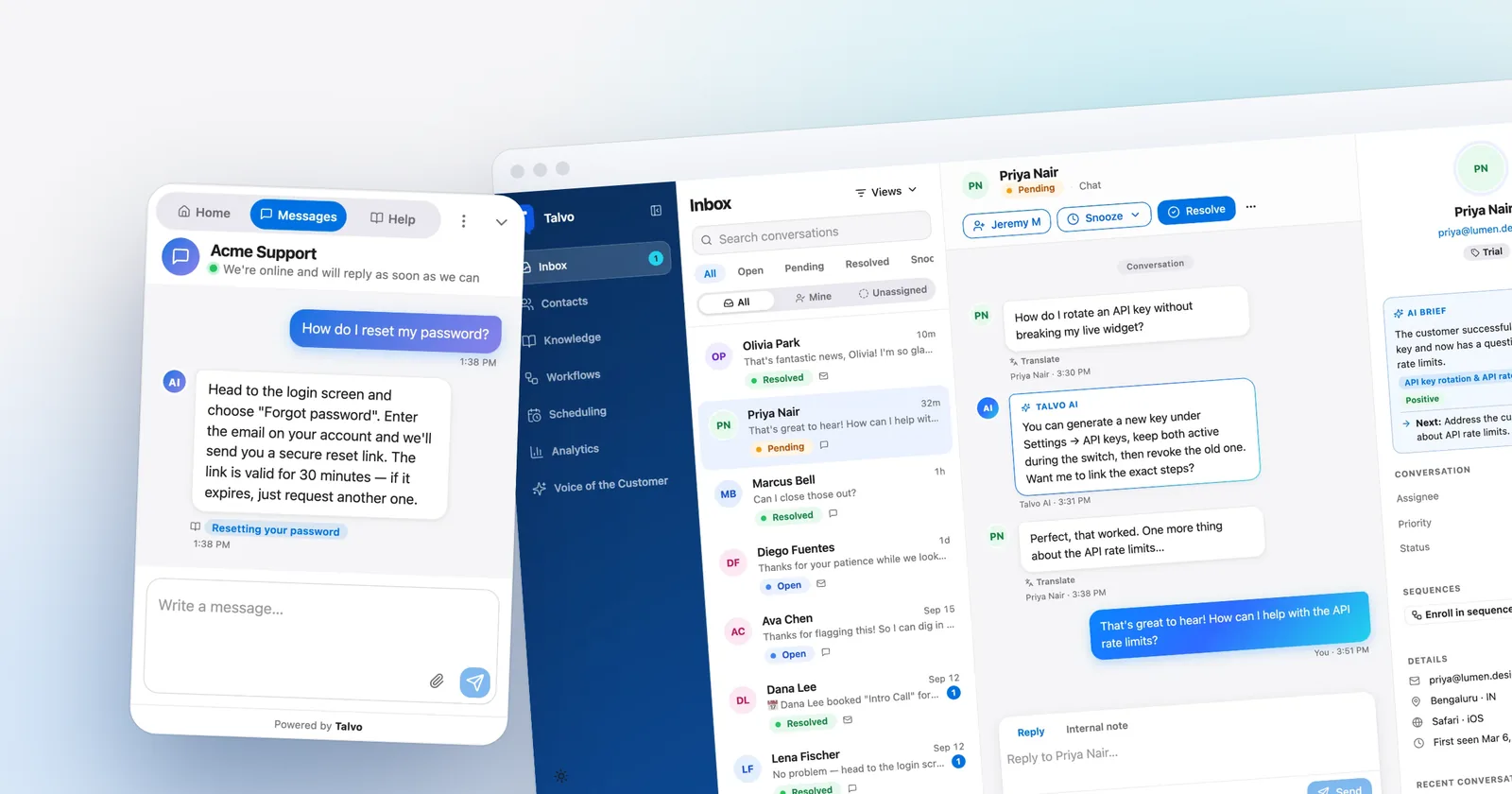
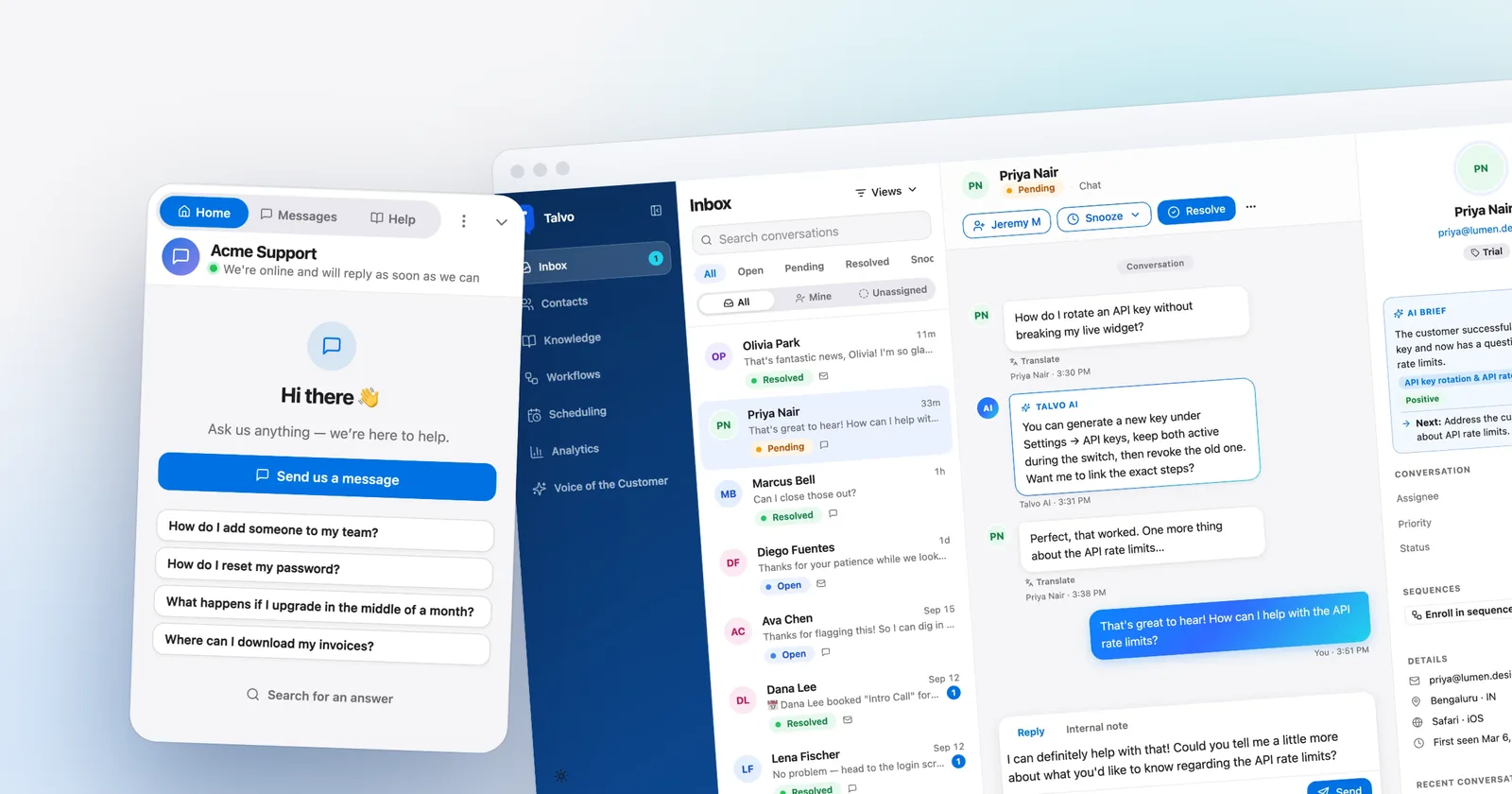
Talvo, which we make, prices the workspace rather than the seat. Starter is $49 a month ($39 billed annually) for 5 teammates and 100 AI resolutions, Growth is $149 ($119) for 15 and 500, and Scale is $299 ($249) for 25 and 2,000. Extra resolutions are $0.49 each, and a hand-off to a human is never billed. There's no AI spending cap; the control is turning the AI off for the workspace. A resolution is a conversation the AI agent answered end to end from your published help articles with no teammate stepping in, counted once.
Using the same 60% assumption (180, 600 and 1,800 resolutions), we take the cheapest plan with enough teammate seats, overage included, separately for monthly and annual billing. The 3-person team is cheapest on Starter: $49 + (180 − 100) × $0.49 = $88.20 monthly, or $39 + $39.20 = $78.20 annual. The 5-person team is cheapest on Growth: $149 + (600 − 500) × $0.49 = $198 monthly, or $119 + $49 = $168 annual. The 10-person team is cheapest on Scale at $299 monthly or $249 annual, against $786 monthly on Growth ($149 + 1,300 × $0.49).
| Team | Talvo monthly billing | Talvo annual billing | Year one, annual billing |
|---|---|---|---|
| 3 teammates, 180 resolutions | $88.20 (Starter) | $78.20 (Starter) | $938.40 |
| 5 teammates, 600 resolutions | $198 (Growth) | $168 (Growth) | $2,016 |
| 10 teammates, 1,800 resolutions | $299 (Scale) | $249 (Scale) | $2,988 |
There is no onboarding fee and no annual contract on a self-serve plan.
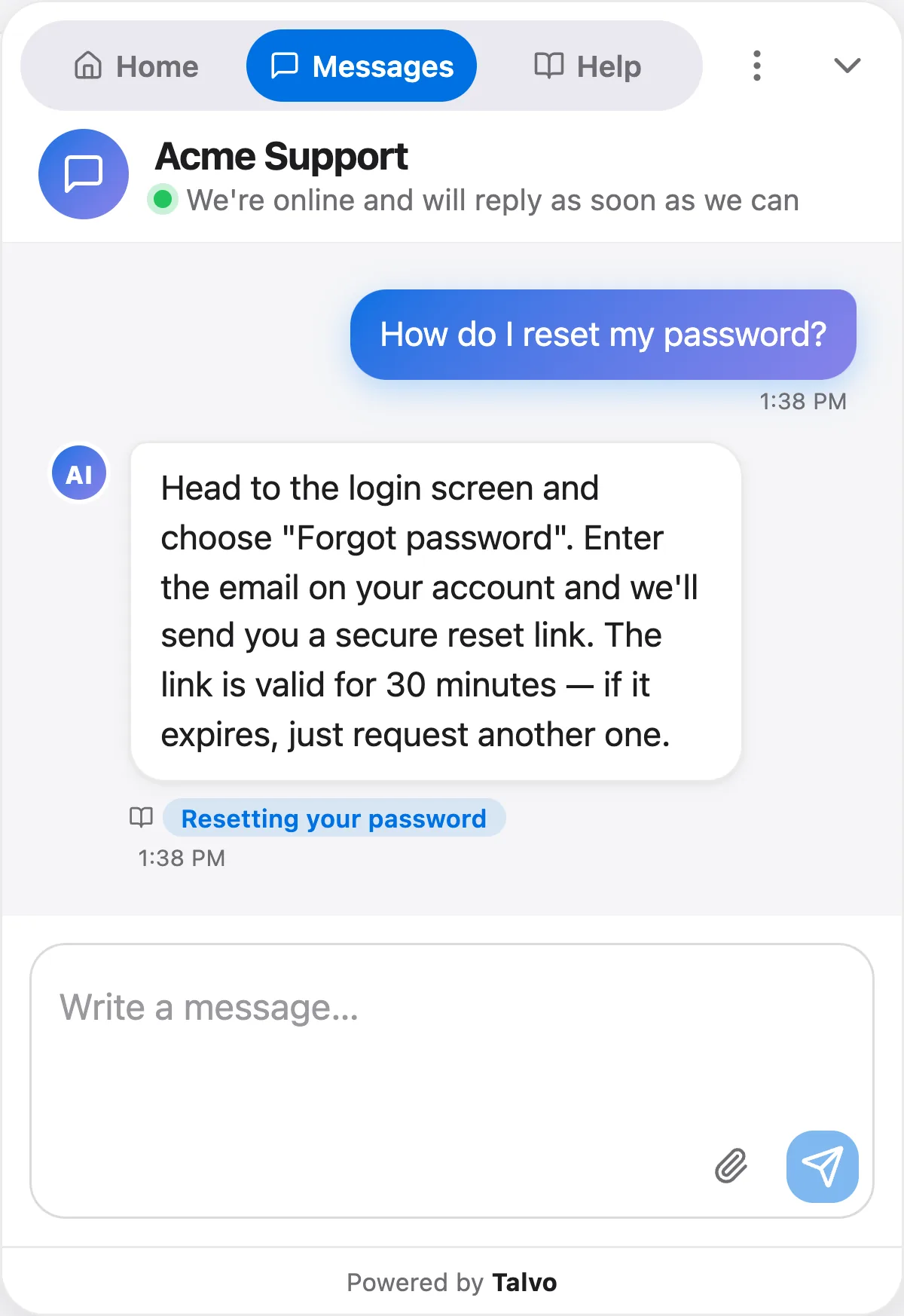
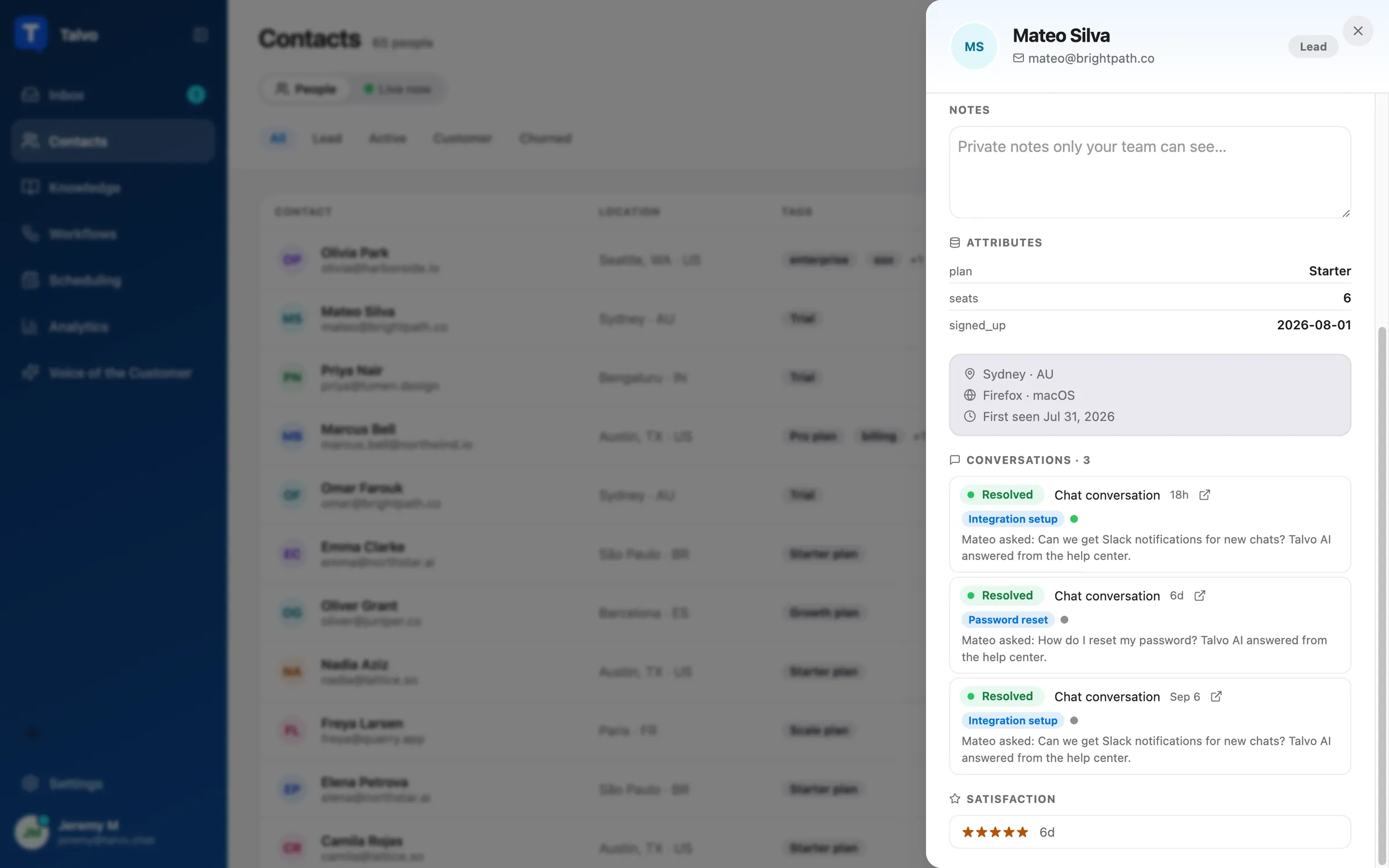
Now the gaps, which for a HubSpot shop are large. Talvo has no HubSpot integration, and none for Salesforce or Zapier either (Zapier is planned). The only bridges are the REST API and signed webhooks, which start on the Starter plan, and building a sync means writing code. Talvo keeps its own contact records, with a profile, lifecycle, tags and conversation history, and on Growth it takes custom attributes and events through the API. It is not a CRM, and it won't put a ticket on a HubSpot timeline for you.
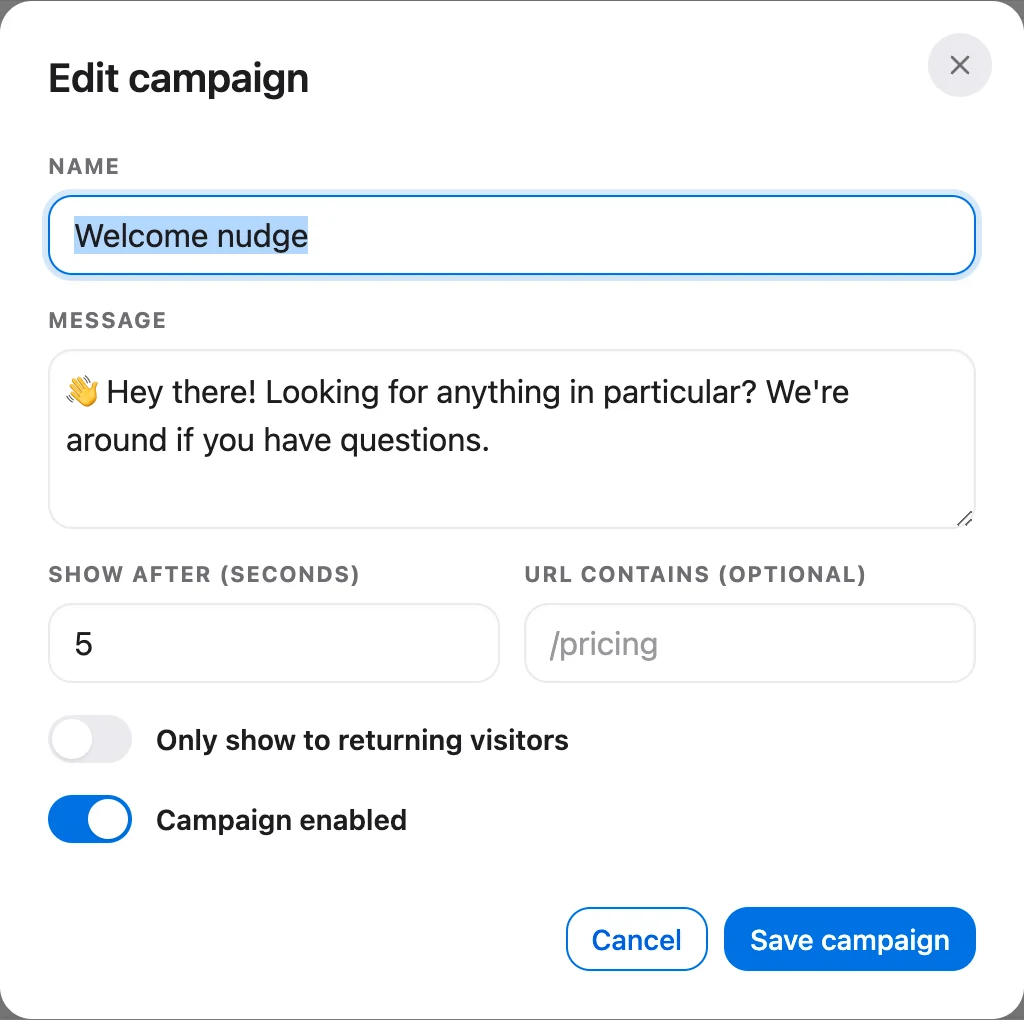
The channel gaps are the usual ones. There's no calling or phone, WhatsApp, SMS, Instagram or Messenger. There are no product tours or checklists, though Starter and up include proactive chat messages that you target by page URL, delay and returning visitors, and surveys that are shared by link. There's no SOC 2 report, SAML single sign-on, HIPAA support or data-region choice (data is processed in the United States), and no marketplace. Talvo launched in 2026, is in beta, and has no review-site ratings.
If you want to see the numbers for your own team, the calculator below takes teammates and billable AI resolutions a month; for the middle team enter 600. It uses monthly list prices, so its Intercom Essential and Talvo totals match the monthly figures above ($789 and $198). It doesn't include HubSpot, so use the sums in this post for that column.
- Crisp Essentials~$100–$130/mo$95 per workspace + AI at Crisp's estimate of $0.05–$0.10 per conversation, less $25 of included credits · Estimate: top-up rate and annual prices aren't published
- Talvo Growth$198/mo$149 per workspace, 500 AI resolutions included + 100 × $0.49
- Help Scout Standard$600/mo5 users × $30 + 600 AI resolutions × $0.75
- Intercom (Fin) Essential$789/mo5 seats × $39 + 600 Fin outcomes × $0.99 · Workflow automation needs Advanced ($85–$99 per seat)
- Zendesk Suite Team$1,495/mo5 agents × $69 + 575 AI resolutions × $2.00 (25 included) · $1.50 each with a committed 100+ purchase
Estimates from each vendor's published list prices, checked October 21, 2026. Assumes the cheapest plan that includes live chat and an AI agent, and that every AI-resolved conversation is billable. Excludes taxes, promotions, add-ons (such as agent copilots) and per-use channels like SMS or WhatsApp. Talvo's annual price includes extra resolutions at the same $0.49, billed once a year.
Talvo imports an Intercom or HubSpot help center from its public address, which is the slowest part of a move. Past conversations don't come across; contacts import from CSV. Our head-to-head posts cover the details: Talvo vs Intercom and Talvo vs HubSpot. For a wider field, HubSpot Service Hub alternatives and cheaper Intercom alternatives price the same teams across more tools.
Deciding between HubSpot and Intercom
Both vendors will let you try the AI before you commit, so use the trials. HubSpot's pricing page offers 14 days of Customer Agent when you buy a Professional or Enterprise seat, and Intercom's 14-day trial includes Fin.
- Find your system of recordIf deals and contacts live in HubSpot CRM and you intend to keep them there, price Service Hub Professional first. If not, start with Intercom.
- Add the onboarding fee to year oneHubSpot Professional costs $1,500 up front and requires an annual commitment. Compare vendors on year two as well as year one.
- Run both AIs on the same 50 conversationsLoad the same help articles into each trial, then apply each vendor's billing rule to the transcripts. HubSpot's unit is cheaper, but Fin's definition is broader.
- Check the bridge in writingIf you plan to run Intercom beside HubSpot CRM, ask Intercom what its HubSpot connection syncs and in which direction before you rely on it.
- Ask about the Salesforce dealIf you're an Intercom customer, read your renewal terms and ask your account contact what the ownership change means for you.
Which should you choose?
- you have no HubSpot CRM to connect and want a flat workspace price for a team of 2 to 10
- you want AI resolutions at $0.49 beyond an included amount, with no onboarding fee and hand-offs never billed
- you can live without a HubSpot integration, calling, WhatsApp, SOC 2 and HIPAA, and accept a beta product with no reviews
- Choose HubSpot Service Hub if your contacts, deals and marketing already live in HubSpot, or you want calling, WhatsApp, SLAs and a portal from one vendor
- Choose Intercom (Fin) if your customers chat from inside a web app, you want the Messenger and in-app messaging, or HIPAA and hosting region matter
- Run the AI trials on both before you commit; the cheaper bill depends on how each defines a resolution on your traffic
Frequently asked questions
Is HubSpot or Intercom better for customer support?
It depends on where your customer record lives. HubSpot Service Hub suits teams already on HubSpot CRM, because tickets, chats, deals and emails share one contact record. Intercom (now Fin) suits teams whose customers chat from inside a web app, with the Messenger and Fin AI on every plan.
Does Intercom integrate with HubSpot?
Check the details before you plan around it. Read Intercom's help-center article on its HubSpot app and HubSpot's own listing to see what syncs and in which direction, and ask both vendors what flows each way. A connection that copies contacts or transcripts is not the same as one shared record.
How much does HubSpot's AI customer agent cost?
HubSpot's Customer Agent costs $0.50 per resolved conversation, paid with HubSpot Credits at 50 credits per resolution and $0.01 per credit. It is available only on Professional and Enterprise, which include 3,000 and 5,000 credits a month (60 and 100 resolutions). Professional also requires a $1,500 onboarding fee and an annual commitment.
How much does Fin cost per resolution?
Fin costs $0.99 per outcome, charged once per conversation, with none included in the seat price. An outcome is the customer confirming the issue is solved, the customer not asking for more help after Fin responds, or Fin completing a workflow (a Procedure), including one that ends in a handoff to a human.
Is HubSpot Service Hub free?
There is a free tier for up to 2 users, with live chat (carrying HubSpot branding) and ticketing, and no credit card required. The AI Customer Agent, knowledge base, SLAs and help desk workspace are not on it; they start at Professional, which HubSpot lists from $90 a seat on annual payment.
Why does HubSpot charge an onboarding fee?
HubSpot requires a one-time onboarding fee on its higher tiers: $1,500 for Service Hub Professional and $3,500 for Enterprise. It is charged once, on top of the seats and the annual commitment. For budgeting, add it to year one and compare vendors on year two as well.
Can I use Intercom and HubSpot together?
Plenty of teams run a CRM and a separate support tool. What Intercom's HubSpot connection moves, and in which direction, is the thing to confirm: ask Intercom, read its HubSpot app article, and test it in your trial before you rely on it.
Is Intercom owned by Salesforce now?
Yes. Intercom renamed itself Fin in May 2026, keeping Intercom as the name of the helpdesk product, and Salesforce said on September 10, 2026 that it had completed its acquisition of Fin. Fin sits inside Salesforce AI Labs, and the release says it will continue to serve its customers.
Sources
Other products' prices and features change. We checked these pages; if something is out of date, tell us and we'll fix it.
- HubSpot Service Hub pricing (checked Oct 21, 2026)
- HubSpot Credits (checked Oct 21, 2026)
- HubSpot: Customer Agent pricing announcement (updated April 13, 2026)
- HubSpot product and services catalog (checked Oct 21, 2026)
- HubSpot security (checked Oct 21, 2026)
- Intercom pricing (checked Oct 21, 2026)
- Intercom security (checked Oct 21, 2026)
- Salesforce: completes acquisition of Fin (Sept 10, 2026)
- Talvo pricing (checked Oct 21, 2026)