On this page
Help Scout is built for the person answering the email. Zendesk is built for the person running the queue. Everything else in this comparison, including the price, follows from that.
The price gap is large. Put five people on each, with the AI answering 1,000 conversations a month, and Help Scout Standard comes to $575 on annual billing while Zendesk Suite Team comes to $1,137.50. Most of that gap sits in the AI line, which is why this post spends as much time on what each vendor counts as a billable AI answer as on seat prices.
Below you'll find a Tuesday morning in each product, the same 3-, 5- and 10-person teams priced on both with every sum shown, the two AI definitions side by side, and an honest verdict. Near the end, one short section covers a third option, because we make one. Every Help Scout and Zendesk number comes from the vendors' own pricing and help pages, checked October 21, 2026, in US dollars before tax.
A Tuesday morning in each inbox
These two scenes are illustrations of how each tool is designed to be used, not notes from a trial. They're here because the feature tables don't capture the difference.
At a five-person company on Help Scout, nobody has the title "support." Whoever opens the shared inbox first at 9:10 sees conversations that look like email threads, with the customer's name, a reply box and a note pane. Someone grabs a saved reply, edits it, and sends. A visitor on the pricing page opens the Beacon widget, gets article suggestions, and starts a chat that lands in the same inbox. The team's docs site answers the repeated questions. The tool does what an email program would do, with assignment, notes and a customer history attached.
At a 25-person company on Zendesk, the same morning looks like a queue. Tickets arrive from email, chat and social messaging into views organized by team and priority. Macros fill in the standard answers; triggers and automations route, tag and escalate without anyone touching them. If the plan is Suite Professional, SLA timers count down and skills-based routing sends the billing question to the people who handle billing. A manager checks a dashboard. Voice calls come into the same system.
Neither scene is better. One is a mailbox with chat added, the other is a ticketing system with everything bolted on, and the question is how much machinery your team needs before it starts to feel like overhead.
Seats, on the plans that have chat
Both vendors price per person per month, and both have a cheaper plan that leaves out chat or most of what you need.
| Help Scout | Zendesk | |
|---|---|---|
| Free | $0: up to 5 users, 1 inbox, Docs with 10 articles, Beacon contact form only, 100 contacts a month | None; 14-day trial of Suite Professional |
| Email only | Free plan above | Support Team: $19 annual, $25 monthly |
| Cheapest with live chat | Standard: $25 annual, $30 monthly (up to 25 users) | Suite Team: $55 annual, $69 monthly |
| Middle | Plus: $45 annual, $54 monthly (up to 50 users) | Suite Professional: $115 annual, $149 monthly |
| Top | Pro: $75 annual, $90 monthly (minimum 10 users) | Suite Enterprise, quoted by sales |
Two limits matter on Help Scout. User caps force an upgrade: Standard stops at 25 users and Plus at 50, so the 26th person means moving up a tier. Pro has a 10-user minimum. Zendesk lists no seat caps or minimums on its core plans.
The free plan is a real difference. Help Scout's Free tier gives five users one shared inbox, a small Docs site and a contact form in Beacon, with a catch: at 100 contacts a month you can't reply to customers until the next cycle or you upgrade. Zendesk has nothing equivalent. If you're starting out, that alone can decide it.
- A free plan for up to 5 users, and the lowest seat price with chat of the two
- An email-like inbox that non-support people pick up quickly
- AI Assist, AI Drafts and AI Summarize are included, not sold as a separate add-on
- A monthly cap you set on AI resolutions
- User caps (25 on Standard, 50 on Plus) and a 10-user minimum on Pro
- Phone only through an integration such as Aircall
- Fewer apps: 100+ listed, and Salesforce, HubSpot and Jira only from Plus
- The region where data is hosted isn't stated
- Ticketing, routing and reporting with room to grow
- Native voice, plus social and business messaging on Suite plans
- HIPAA enablement and a choice of data center on Suite Professional
- 1,000+ listed apps
- The $19 entry plan has no chat; chat starts at $55 to $69 per agent
- Only 5 included AI resolutions per agent a month, then $1.50 to $2.00 each
- Copilot ($50 per agent, yearly) and QA and workforce tools are paid add-ons
- No free plan
How each one bills its AI
Help Scout's AI agent is sold as Envoy on the pricing page; its FAQ calls it AI Answers and its docs call the agent Scout. The price is $0.75 per resolution, billed monthly in arrears. Its docs define a resolution as "a single AI chat session that is resolved without help from a human." You pay when the AI responds and the customer doesn't ask for additional help after the last AI response. You don't pay if the AI only greets or asks a follow-up, or if the customer escalates, searches the knowledge base further, or presses the "I still need help" button.
Zendesk bills the automated resolution. Its pricing FAQ says you "pay only for customer requests that were successfully resolved by the AI agent, without any escalation to a human agent." Since May 18, 2026 an LLM reviews each transcript to verify the resolution. A "contained" resolution that fails verification doesn't count, and neither does an "assisted escalation" where a human finished. Zendesk's resolution tiers article implies that only verified resolutions count against the allowance without saying so in one sentence, so that part is our reading.
| Help Scout (Envoy) | Zendesk | |
|---|---|---|
| Billable unit | A single AI chat session resolved without human help | An LLM-verified automated resolution |
| Included | Nothing; new accounts get 3 months of free, unlimited AI resolutions (existing customers don't) | 5 per agent a month on Support and Suite Team, 10 on Professional; pooled yearly, capped at 10,000 a year per account |
| Price after that | $0.75 each | $1.50 committed (100 or more bought ahead), $2.00 pay-as-you-go |
| Quiet customer after an answer | Billable | Billable only if the LLM check confirms resolution |
| Escalation to a human | Not billable | Not billable |
| Spending control | A monthly cap you set by number of resolutions; AI turns off in your Beacon at the cap | At the allowance you choose to allow overage or pause the AI agent |
| Billing timing | In arrears; on annual plans deducted from prepaid credit | Overage billed monthly |
The two definitions agree more than the prices suggest. Both leave out escalations. Both bill a conversation where the AI answered and nothing happened next, although Zendesk adds a verification step that can reject it. The real differences are the unit price ($0.75 against $1.50 to $2.00), the small Zendesk allowance, and the control. Help Scout lets you pick a number and stop at it. Zendesk's documented choice is allow overage or pause at the allowance, which for a five-agent team is 25 a month.
Agent-side AI diverges too. Help Scout includes AI Assist on Standard and up, and AI Drafts and AI Summarize on Plus and up, with no extra charge. Zendesk's Copilot is $50 per agent a month, billed yearly, and sits on Suite Professional and above. For the same-team math in other vendor pairs, Help Scout vs Intercom uses the same method, and AI resolution pricing compared lines up the definitions for more vendors.
The same team at 3, 5 and 10 people
The teams are 3 people with 300 AI-handled conversations a month, 5 with 1,000, and 10 with 3,000. "AI-handled" means the AI replied at least once.
The assumption we have to make is the one that drives everything: 60% of AI-handled conversations become billable resolutions on both sides. That is our assumption, not vendor data. Help Scout's own calculator cites a 73% average resolution rate, and Zendesk publishes no rate. We priced the cheapest plan with live chat on each side, Help Scout Standard and Zendesk Suite Team, and left out add-ons.
Middle team arithmetic. Help Scout: 600 resolutions × $0.75 = $450, plus 5 users × $25 = $125 for $575 annual, or 5 × $30 = $150 for $600 monthly. Zendesk: 600 resolutions, less 25 included (5 agents × 5), leaves 575. At $1.50 that's $862.50, plus 5 × $55 = $275, for $1,137.50 annual; monthly is 575 × $2.00 = $1,150 plus 5 × $69 = $345, for $1,495.
| Team | Help Scout Standard, annual / monthly | Zendesk Suite Team, annual / monthly |
|---|---|---|
| 3 people, 300 AI-handled | 180 × $0.75 = $135, plus $75 = $210 / plus $90 = $225 | (180 − 15) × $1.50 = $247.50, plus $165 = $412.50 / 165 × $2.00 = $330, plus $207 = $537 |
| 5 people, 1,000 AI-handled | $575 / $600 | $1,137.50 / $1,495 |
| 10 people, 3,000 AI-handled | 1,800 × $0.75 = $1,350, plus $250 = $1,600 / plus $300 = $1,650 | (1,800 − 50) × $1.50 = $2,625, plus $550 = $3,175 / 1,750 × $2.00 = $3,500, plus $690 = $4,190 |
Help Scout is cheaper in every row: roughly half Zendesk's price on annual billing, and about 60% less on monthly billing. Now the sensitivity. At a 100% resolution rate, Help Scout's AI line becomes $225, $750 and $2,250, and the annual totals become $300, $875 and $2,500. Zendesk at 100% becomes $592.50, $1,737.50 and $4,975. The order doesn't change.
New Help Scout accounts get three months of free AI resolutions, so the first quarter's bill for the 5-person team is just the seats, $125 a month on annual billing. Existing Help Scout customers don't get this.
For teams that need workflows, round-robin and SLAs, the fair match is Help Scout Plus against Zendesk Suite Professional. For the 5-person team with 1,000 AI conversations:
| 5 people, 1,000 AI-handled | Annual | Monthly |
|---|---|---|
| Help Scout Plus | 5 × $45 = $225, plus $450 = $675 | 5 × $54 = $270, plus $450 = $720 |
| Zendesk Suite Professional | 5 × $115 = $575, plus (600 − 50) × $1.50 = $825 = $1,400 | 5 × $149 = $745, plus 550 × $2.00 = $1,100 = $1,845 |
Both also have extras that sit outside these tables. Help Scout charges $10 a month ($12 monthly billing) for an extra inbox, $20 ($24) for an extra Docs site and $10 ($12) for an extra light user. Zendesk's list includes Copilot, QA and workforce tools, SMS and voice minutes. For the full grids, see Help Scout pricing in 2026 and Zendesk pricing in 2026.
Where Zendesk is the better choice
Phone is the clearest case. Zendesk has native voice: embedded voice, recording and voicemail from Suite Team, and IVR, callbacks and monitoring on Professional, with numbers and minutes as add-ons. Help Scout reaches phone through an integration such as Aircall.
Scale is the second. Help Scout stops at 25 users on Standard and 50 on Plus; Zendesk lists no caps. Zendesk also sells a Workforce Engagement bundle (workforce management plus QA) at $50 per agent a month annually, has custom objects (up to 3 on Suite Team, 30 on Professional), and offers an app catalog of 1,000+ prebuilt apps against Help Scout's 100+.
Compliance paths are published at both, but Zendesk's is broader. On Zendesk, HIPAA enablement and data center location (US, EEA, UK or APAC) sit on Suite Professional, and signing a BAA also requires the Advanced Compliance add-on, which isn't priced publicly. Help Scout holds SOC 2 Type 2 and offers HIPAA as an add-on on Plus, included on Pro, with SSO as an add-on on Standard and Plus and included on Pro. Its data-hosting region isn't stated, which matters if a security questionnaire asks.
Routing and SLAs are deeper on Zendesk too. Suite Professional adds SLAs and skills-based routing; Help Scout Standard has one basic SLA, Plus has two advanced SLAs and round-robin, and Pro has unlimited SLAs and load balancing.
Where Help Scout is the better choice
If your support is email and a bit of chat, Help Scout does that job at a lower cost and with less setup. Its clean, email-like interface and ease of use are what reviews tend to praise, and the usual complaint is thinner reporting and multichannel automation than the enterprise suites offer.
The AI controls are friendlier. A cap, a lower unit price, and a definition that voids the charge on escalation all lean toward predictable bills. The agent-side AI tools are bundled. And the free plan is the right place to test the workflow before you pay anyone.
One caution on contracts. Zendesk says downgrades and seat reductions take effect at the next billing cycle with no prorated refund. Help Scout's docs describe annual payments as a credit that lasts longer if you remove users, but its Terms of Service say a customer may not decrease the scope of a plan, including the number of users, during the current term. The docs and Terms conflict, and the Terms are binding. Ask for the downgrade rules in writing from either.
A third option for chat-first teams: Talvo
If you're weighing these because the team answers customers through a website chat widget and email, and both seat-based bills feel heavy, there is a different shape. Talvo, which we make, prices the workspace, not the seat. Starter is $49 a month ($39 billed annually) for 5 teammates and 100 AI resolutions, Growth is $149 ($119) for 15 teammates and 500, and Scale is $299 ($249) for 25 and 2,000. Extra resolutions are $0.49 each. A hand-off to a human is never billed.
A Talvo resolution is a conversation the AI agent answered end to end from your published help articles, with no teammate stepping in, counted once. That's close to Help Scout's definition, and unlike Help Scout there's no way to cap it: Talvo has no AI spending cap, only an on/off switch for the AI.
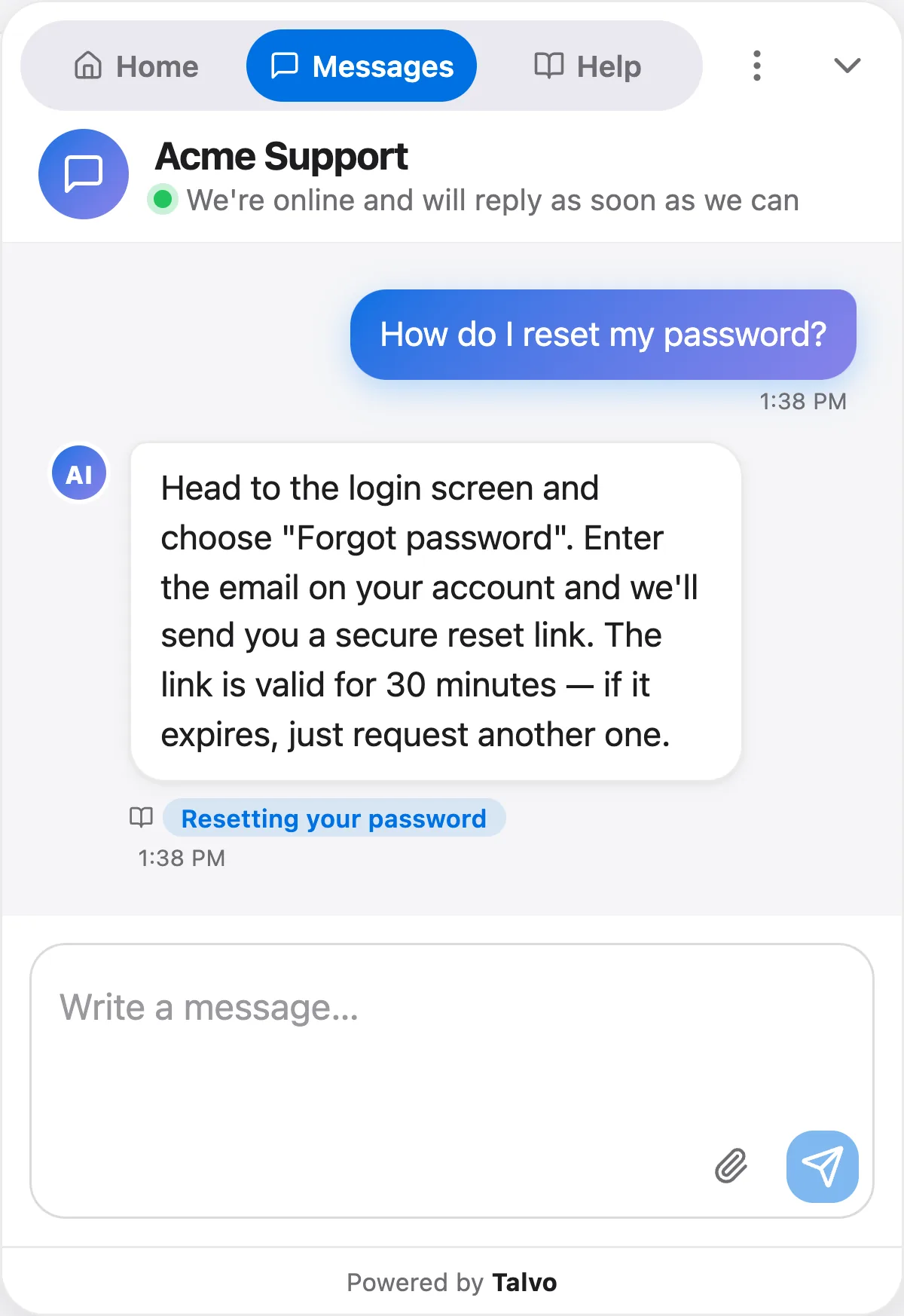
For the same teams at the same 60% assumption (180, 600 and 1,800 resolutions), we take the cheapest plan with enough teammate seats, overage included, separately for monthly and annual billing. The 3-person team is cheapest on Starter: $49 + (180 − 100) × $0.49 = $88.20 monthly, or $39 + $39.20 = $78.20 annual. The 5-person team is cheapest on Growth: $149 + (600 − 500) × $0.49 = $198 monthly, or $119 + $49 = $168 annual. The 10-person team is cheapest on Scale, which includes 2,000 resolutions: $299 monthly or $249 annual, against $786 monthly on Growth ($149 + 1,300 × $0.49).
| Team | Talvo monthly billing | Talvo annual billing |
|---|---|---|
| 3 teammates, 180 resolutions | $88.20 (Starter) | $78.20 (Starter) |
| 5 teammates, 600 resolutions | $198 (Growth) | $168 (Growth) |
| 10 teammates, 1,800 resolutions | $299 (Scale) | $249 (Scale) |
Those figures sit under Help Scout's $225, $600 and $1,650 monthly totals above, and the gap widens as AI volume grows. To try your own numbers, the calculator takes teammates and billable AI resolutions a month, so for the middle team enter 600. It prices Zendesk at the $2.00 pay-as-you-go rate and everything at monthly list prices, so its Zendesk, Help Scout Standard and Talvo totals match the monthly figures above ($1,495, $600 and $198).
- Crisp Essentials~$100–$130/mo$95 per workspace + AI at Crisp's estimate of $0.05–$0.10 per conversation, less $25 of included credits · Estimate: top-up rate and annual prices aren't published
- Talvo Growth$198/mo$149 per workspace, 500 AI resolutions included + 100 × $0.49
- Help Scout Standard$600/mo5 users × $30 + 600 AI resolutions × $0.75
- Intercom (Fin) Essential$789/mo5 seats × $39 + 600 Fin outcomes × $0.99 · Workflow automation needs Advanced ($85–$99 per seat)
- Zendesk Suite Team$1,495/mo5 agents × $69 + 575 AI resolutions × $2.00 (25 included) · $1.50 each with a committed 100+ purchase
Estimates from each vendor's published list prices, checked October 21, 2026. Assumes the cheapest plan that includes live chat and an AI agent, and that every AI-resolved conversation is billable. Excludes taxes, promotions, add-ons (such as agent copilots) and per-use channels like SMS or WhatsApp. Talvo's annual price includes extra resolutions at the same $0.49, billed once a year.
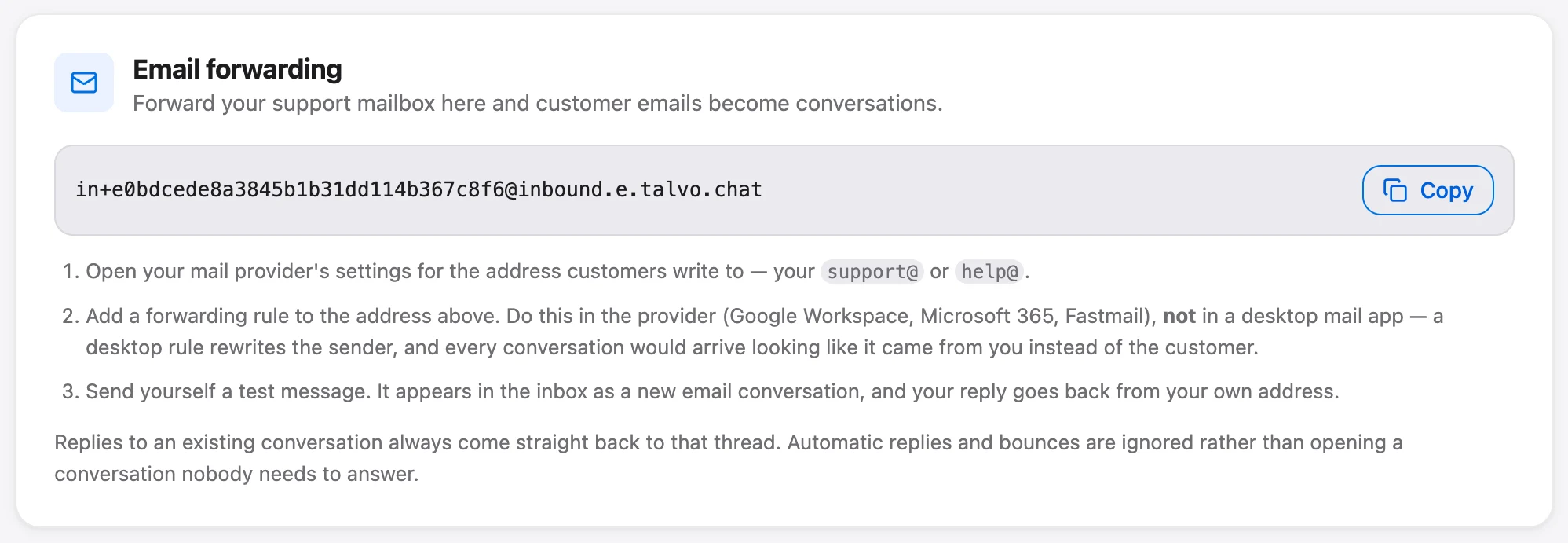
Where Help Scout beats Talvo is email. Help Scout is built around the shared inbox, with years of polish on it. Talvo does two-way email: you forward your support address in, and replies thread back into the same conversation. Replies go out from Talvo's sending address under your workspace name, there's no custom sending domain, and replies don't appear in your Gmail Sent folder. Attachments work in both directions. If your customers write long emails and your team lives in that inbox, Help Scout is the better tool.
The other gaps are the usual ones, and some may disqualify. There's no phone or voice, WhatsApp, SMS, Instagram or Messenger. There's no SOC 2 report, SAML single sign-on, HIPAA support or data-region choice. There's no marketplace, no skills-based routing, and no customer ticket portal; integrations today are a REST API, webhooks and Slack. Talvo launched in 2026, is in beta, and has no reviews yet. On the upside, a hosted help center, shared inbox with @mentions and canned responses, and, on Growth, routing rules with round-robin and SLA policies come in the workspace price.
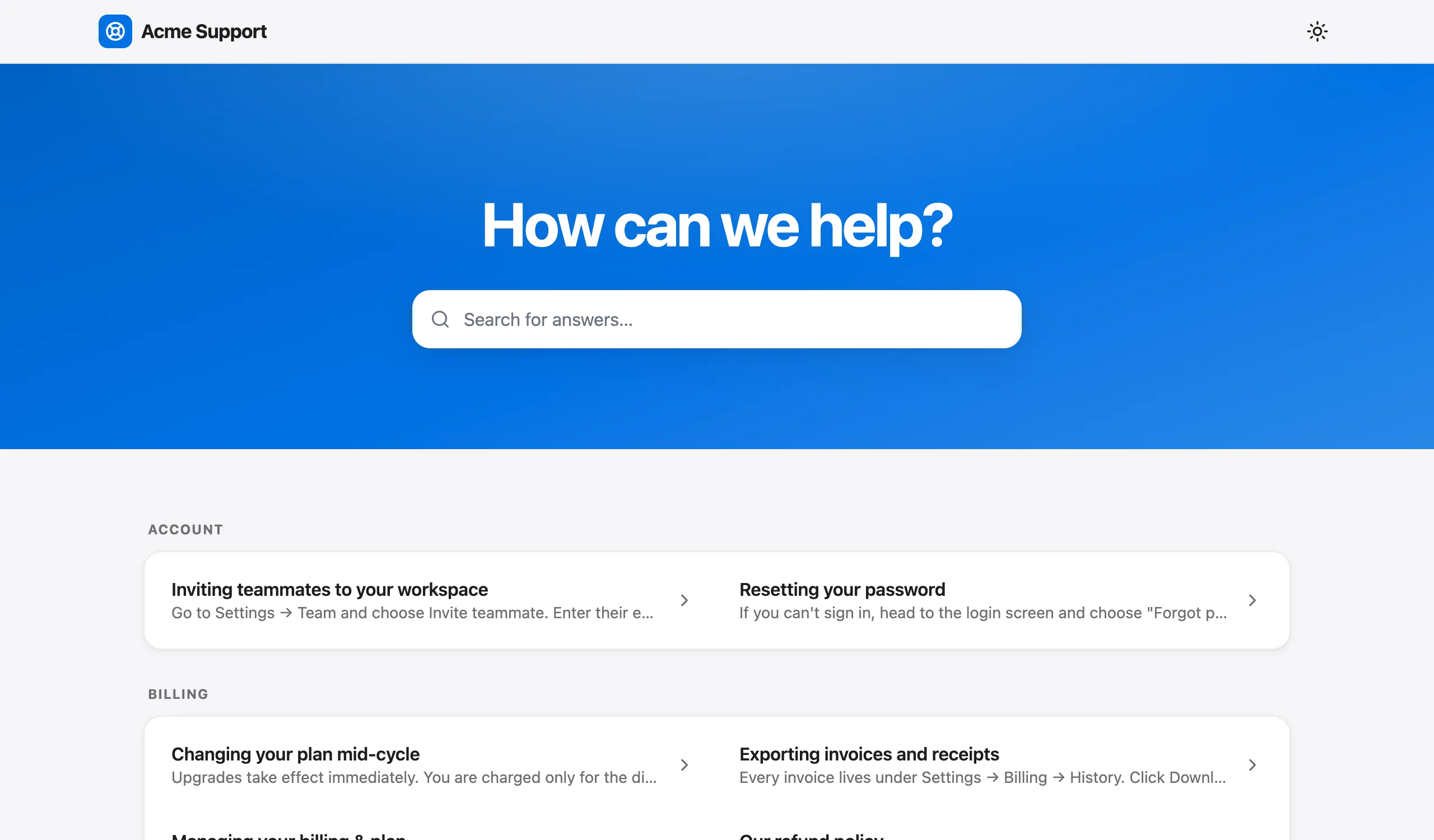
Talvo imports a Help Scout or Zendesk help center from its public address, which is usually the slowest part of a move. Past conversations don't come across, and contacts import from CSV. Our head-to-heads cover the details: Talvo vs Help Scout and Talvo vs Zendesk, and per-seat vs flat pricing explains when each model wins.
Before you pick
The decision is mostly about three questions, and a week-long trial settles the rest.
- Count your channelsIf customers phone you, price Zendesk's voice first. If it's email plus a website chat widget, both work and Help Scout costs less.
- Count the people in a yearHelp Scout Standard stops at 25 users and Pro needs 10. Zendesk has no cap, so the choice flips if you expect to grow past that.
- Test the AI on real conversationsLoad the same help articles into both trials, run a week of genuine questions, and apply each vendor's billing rule to the transcripts.
- Ask the small-print questionsDowngrade rules, HIPAA terms, hosting region and the Zendesk BAA add-on price are not on the pricing pages. Get them in writing.
For a wider field than two, Help Scout alternatives and Zendesk alternatives for small teams price the same teams across more tools.
Which should you choose?
- your customers mostly use a website chat widget, and a team of 2 to 10 wants a flat workspace price
- you want AI resolutions at $0.49 beyond an included amount, with hand-offs never billed
- you can live without a spending cap, voice, WhatsApp, SMS, SOC 2 and HIPAA, and accept a beta product with no reviews
- Choose Help Scout if support is mostly email with some chat, you want a free plan to start, and a capped, predictable AI bill matters
- Choose Zendesk if customers phone you, you expect to grow past 50 people, or you need HIPAA enablement, data center choice or skills-based routing
- Choose neither on price alone: the AI definitions decide most of the bill
Frequently asked questions
Is Help Scout cheaper than Zendesk?
At every team size we priced, yes. With 60% of AI conversations billable, Help Scout Standard comes to $210, $575 and $1,600 a month on annual billing for 3, 5 and 10 people, against $412.50, $1,137.50 and $3,175 on Zendesk Suite Team. That is roughly half the cost on annual billing.
Is Help Scout good for small business?
It suits small teams whose support is mostly email, with live chat through its Beacon widget from the Standard plan. It has a free plan for up to 5 users, a clean inbox that non-specialists learn quickly, and AI writing tools included. Its limits are user caps (25 on Standard, 50 on Plus) and phone support only through an integration.
Does Help Scout have live chat?
Yes. Live chat runs through Beacon, Help Scout's widget, from the Standard plan up. The Free plan has only a contact form in Beacon. Zendesk's chat starts one tier above its email-only plan, on Suite Team at $55 a month per agent on annual billing.
How much does Help Scout AI cost per resolution?
Help Scout's AI agent, sold as Envoy, costs $0.75 per resolution, billed in arrears. A resolution is a single AI chat session resolved without help from a human. The charge is voided if the customer escalates, asks for more help or presses the 'I still need help' button. New accounts get three months of free AI resolutions.
Does Zendesk have a free plan?
No. Zendesk offers a 14-day trial of Suite Professional and a startup program, with a baseline length of six months for eligible startups, but no permanent free tier. Help Scout has a Free plan for up to 5 users with one inbox, limited to 100 contacts a month.
Can I cap AI spending in Help Scout or Zendesk?
Help Scout lets you set a monthly cap by number of resolutions, and the AI turns off in your Beacon when it is reached. Zendesk lets you choose, at the limit of your included allowance, whether to allow overage or pause the AI agent. Zendesk's included allowance is small, 5 resolutions per agent a month on Team plans.
Which supports phone calls, Help Scout or Zendesk?
Zendesk has native voice: embedded voice, recording and voicemail from Suite Team, and IVR, callbacks and monitoring on Professional, with numbers and minutes as add-ons. Help Scout reaches phone only through an integration such as Aircall.
Which is easier to use, Help Scout or Zendesk?
Help Scout is usually praised for a clean, email-like interface that non-specialists pick up quickly, while Zendesk is described as powerful but with a complex price structure and add-ons. Impressions vary by team, so run a trial with your own people and real conversations before deciding.
Sources
Other products' prices and features change. We checked these pages; if something is out of date, tell us and we'll fix it.
- Help Scout pricing (checked Oct 21, 2026)
- Help Scout docs: AI resolutions pricing
- Help Scout docs: Free plan
- Help Scout security (checked Oct 21, 2026)
- Help Scout terms of service
- Zendesk pricing (checked Oct 21, 2026)
- Zendesk: About automated resolution tiers
- Zendesk: About automated resolutions for AI agents
- Zendesk trust center (checked Oct 21, 2026)
- Talvo pricing (checked Oct 21, 2026)