On this page
A voice of customer program sounds like something with a budget, a survey platform and a research team. If you have five people, none of those. What you have is an inbox full of customers telling you, in their own words, what's confusing, what's missing and what annoyed them last Tuesday.
That's most of a program already. What's missing is a routine: someone reads on purpose, counts honestly, picks three things to act on, and tells people what happened. This guide lays that out as a monthly cycle that takes about two hours of reading and an hour of writing, for a team with no research budget. The time figures are our estimate. Your volume will move them.
What a voice of customer program is when you're five people
Strip the enterprise version down and three parts remain: sources, an owner and an output.
Sources: three is plenty. Support conversations, the comments that come with satisfaction ratings, and what customers ask for on a public board. Add an NPS comment pass once a quarter if you run one.
Owner: one named person, not a committee. In a five-person team that's often the support lead or a founder. Their job is not to analyze everything. It's to make sure the monthly page gets written.
Output: one page, once a month, read by whoever decides what gets built or fixed. If it takes more than a page, nobody reads it.
Voice of customer, VoC for short, is different from NPS. NPS is one number from one question. VoC is everything customers say, measured or not, and an NPS score can be one input to it. If you're choosing between survey types, CSAT vs NPS covers that decision.
The monthly cycle, week by week
- Week 1, collectMake sure every conversation is tagged and every rating comment is in one place. List the board's top requests.
- Week 2, readRead a sample of about 30 conversations plus every low rating. Tally themes.
- Week 3, decidePick the top three themes. Give each one an owner and one action with a date.
- Week 4, report and close the loopWrite the one-page report, update the changelog, and reply to the people who asked.
Week 1: collect, and agree on tags
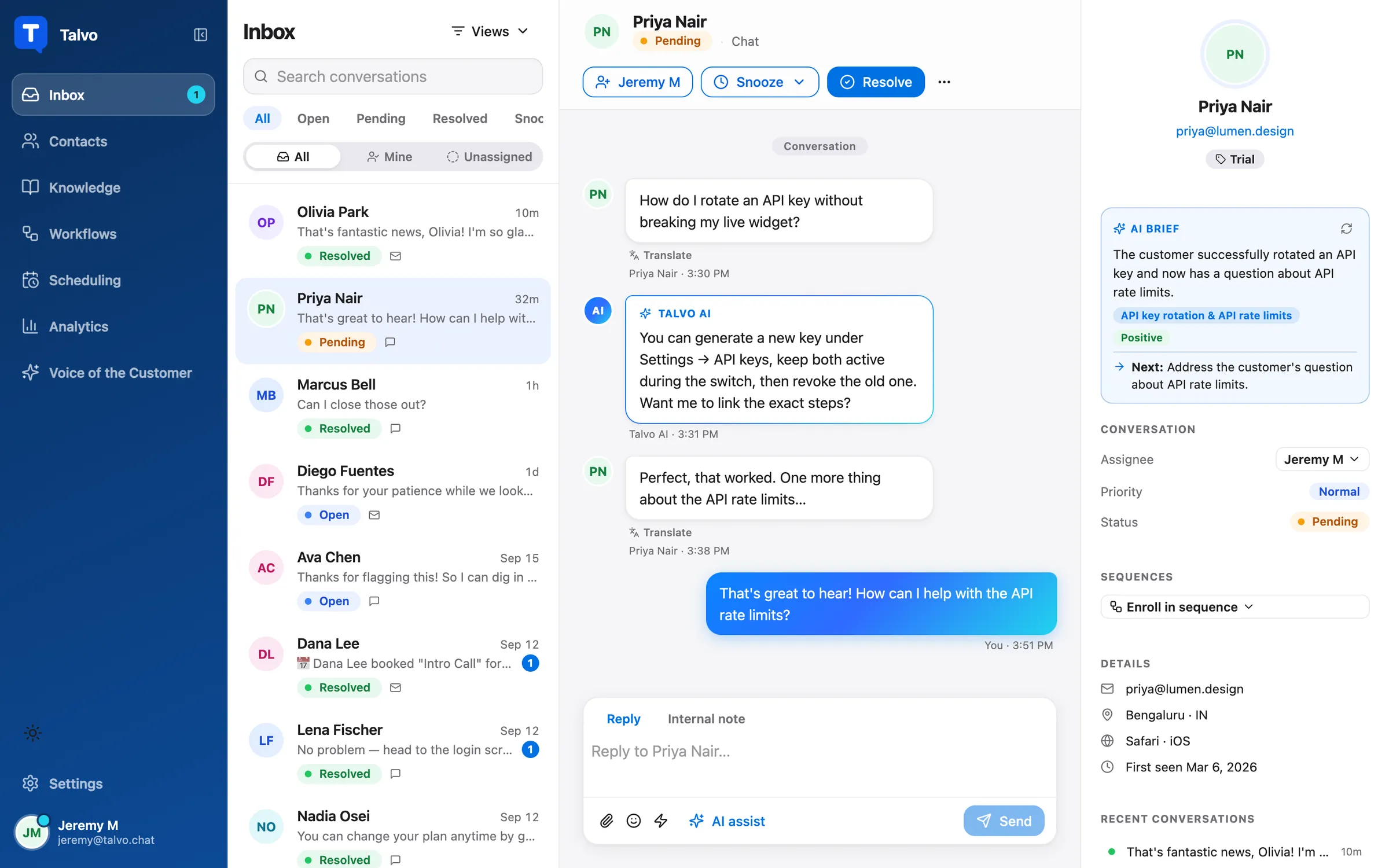
The collecting is mostly tagging while you reply. Agree on 8 to 12 tags and stop adding new ones for a quarter. More than 12 and people stop applying them consistently, which ruins the counts. A starting set might be: bug, how-do-I, billing, missing-feature, onboarding, integration, speed, pricing-question, praise, cancel. Adjust to your product, but write the definitions down in one line each so two people tag the same message the same way.
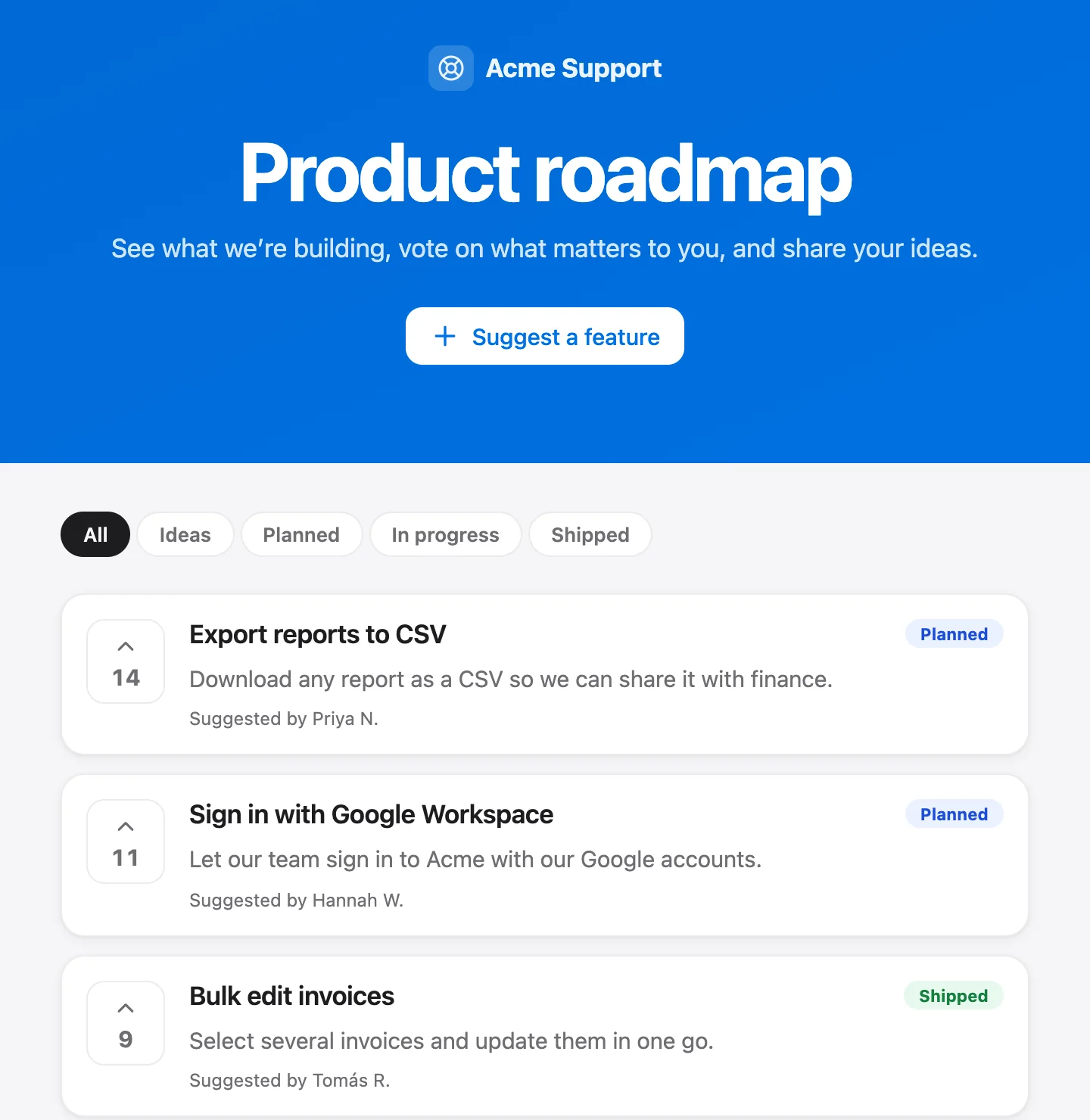
Where do the other sources live? CSAT comments arrive on the conversation they rate, so they come with context for free. A public feedback board collects feature requests with votes. If you haven't set one up, public feedback board and roadmap walks through it.
Week 2: read a sample, and read every low score
Reading everything doesn't scale past a few hundred conversations a month, and you don't need to. Take about 30 at random, plus every conversation that got a low rating. The random 30 tells you what's common. The low scores tell you what hurts. They're different lists and you want both.
Here's what 30 can and can't tell you. Say you tag six of your 30 as "billing." That's 20%. But with a sample of 30, the real share in all your conversations could plausibly be anywhere from about 10% to about 37% (the Wilson interval for 6 of 30; NIST describes the method). And four of 30, which is 13%, gives a range of roughly 5% to 30%. Those two ranges overlap heavily, so a theme at four and a theme at six are not meaningfully different. Rank themes only when the gap is large, and when two sit close together, call them tied.
That doesn't make a sample worthless. It tells you to look for big differences and be suspicious of small ones. If one theme is half of what you read and the next is a tenth, you can trust the order. For more on sample sizes, the CSAT vs NPS guide has a section on how many responses before a number means anything, and the NPS and CSAT calculator will show you the uncertainty for any count.
Week 3: decide on three things
Count by volume, but choose by importance. A theme that's 5% of conversations but comes from your biggest accounts, or from people in their first week, can matter more than one at 15%. Write down, for each of your top three themes, what you'll do, who owns it and by when. "Improve onboarding" is not an action. "Rewrite the three help articles people open before they write in about setup, by the 15th" is.
Three is deliberate. A list of ten gets none done. If something truly urgent shows up, it jumps the queue, but it still counts as one of the three.
Week 4: the one-page report and closing the loop
Here is a layout that fits on a page:
| Section | What goes in it |
|---|---|
| Volume | Conversations this month, and last month for comparison |
| Top themes | The top five with counts from your sample, flagged where they're too close to rank |
| Quotes | Three or four short verbatims, with names removed, that make a theme real |
| Ratings | Average CSAT, and the number of low ratings you read |
| Decisions | The three actions, each with an owner and a date |
| Last month | What you said you'd do, and whether you did |
The "last month" row keeps the program honest. A report that never reviews its own promises turns into a ritual.
Then tell the people who asked. A short note under the original request, an entry in your changelog, or a reply to the customer who wrote in, all do the job. How to write release notes covers what a good entry looks like, and when the answer is no, how to say no to feature requests covers that.
Counting without fooling yourself
Three habits keep the monthly page from becoming a collection of anecdotes.
First, separate volume from importance in the report. Say "billing was 6 of 30 conversations" and "two of those came from accounts in their first week." Both facts matter, and they're different facts.
Second, keep your tags stable. If you rename "billing" to "payments" in month three, last quarter's counts stop being comparable. When you must change a tag, recount the old months or note the break.
Third, be careful with board votes. They tell you what people who visit a board care about, not what your customers care about. On Talvo's board, merging duplicates adds the votes together, so a person who voted on two requests that you later merge counts twice. Treat votes as a signal about what to read more closely, not a ranking you can sort by.
A single customer who writes five times about the same thing is one customer. Count people as well as messages.
When to add interviews
Conversations tell you what people ran into. They don't tell you why they chose you, what they tried before, or what they'd never ask for in a support message. When your monthly pages keep circling the same unexplained question, such as why do trial users drop off at step three, book a handful of 20-minute calls.
You'll sometimes see a precise figure for how many interviews are enough to cover most customer needs. Your product and customers aren't the ones it was measured on, so a practical rule that needs no statistic works better: keep interviewing until the last two or three calls teach you nothing new, and stop there.
Talk to people who recently canceled, as well. The sampling and testing approach in customer churn signals shows how to compare them with customers who stayed.
Doing it in Talvo
On every plan, the manual version works. Conversation tags can be applied in the inbox, tag chips show on each row, and you can filter or search by tag. CSAT comments land on the conversation they rate. The public feedback board, roadmap and changelog are on every plan, including Free, and a teammate can turn a conversation into a feature request. Talvo's analytics can't report by tag, so the counts in your report come from filtering and tallying yourself.
On Starter and up, you can build NPS and custom surveys. They're delivered as a shareable link, not inside the chat widget or by email, so you send the link yourself. Responses are anonymous. Each survey's "View results" page breaks answers down question by question, including the latest 50 free-text answers with their dates, so the comments can feed your Week 2 reading. Because responses are anonymous and can't be exported or tied to a contact, use conversations when you need to know who said what.
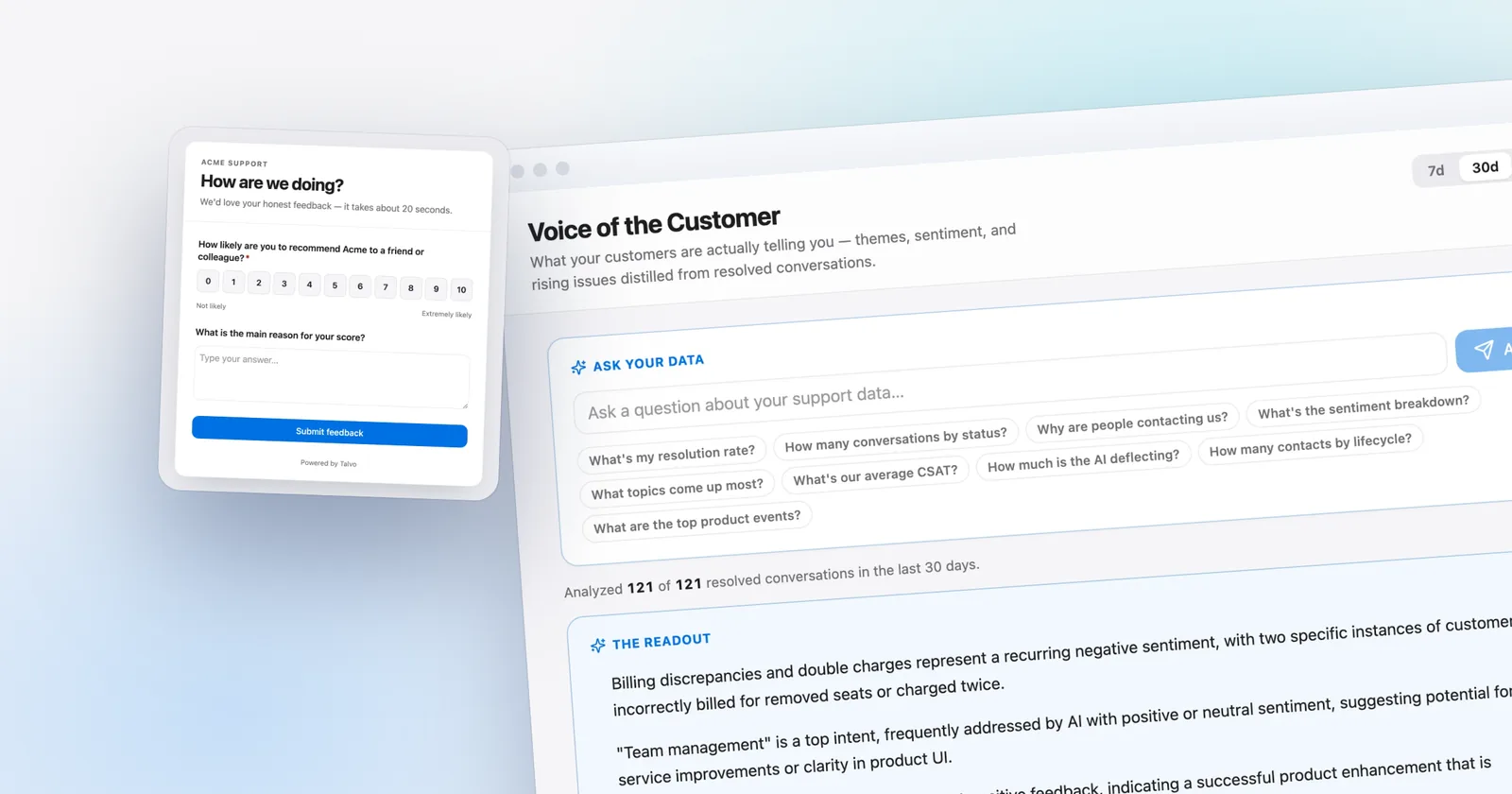
On Scale ($299 a month, or $249 billed annually), the Voice of Customer page does part of the reading for you. It is computed when you open the page, over 7, 30 or 90 days, and shows:
- an AI-written readout of three to five short bullets (it needs a minimum of three analyzed conversations);
- a sentiment bar with a trend against the previous period;
- the top reasons customers reach out;
- a cloud of topics customers mention.
The page reports how many of your resolved conversations it analyzed, so check that count against your total before you trust a theme.
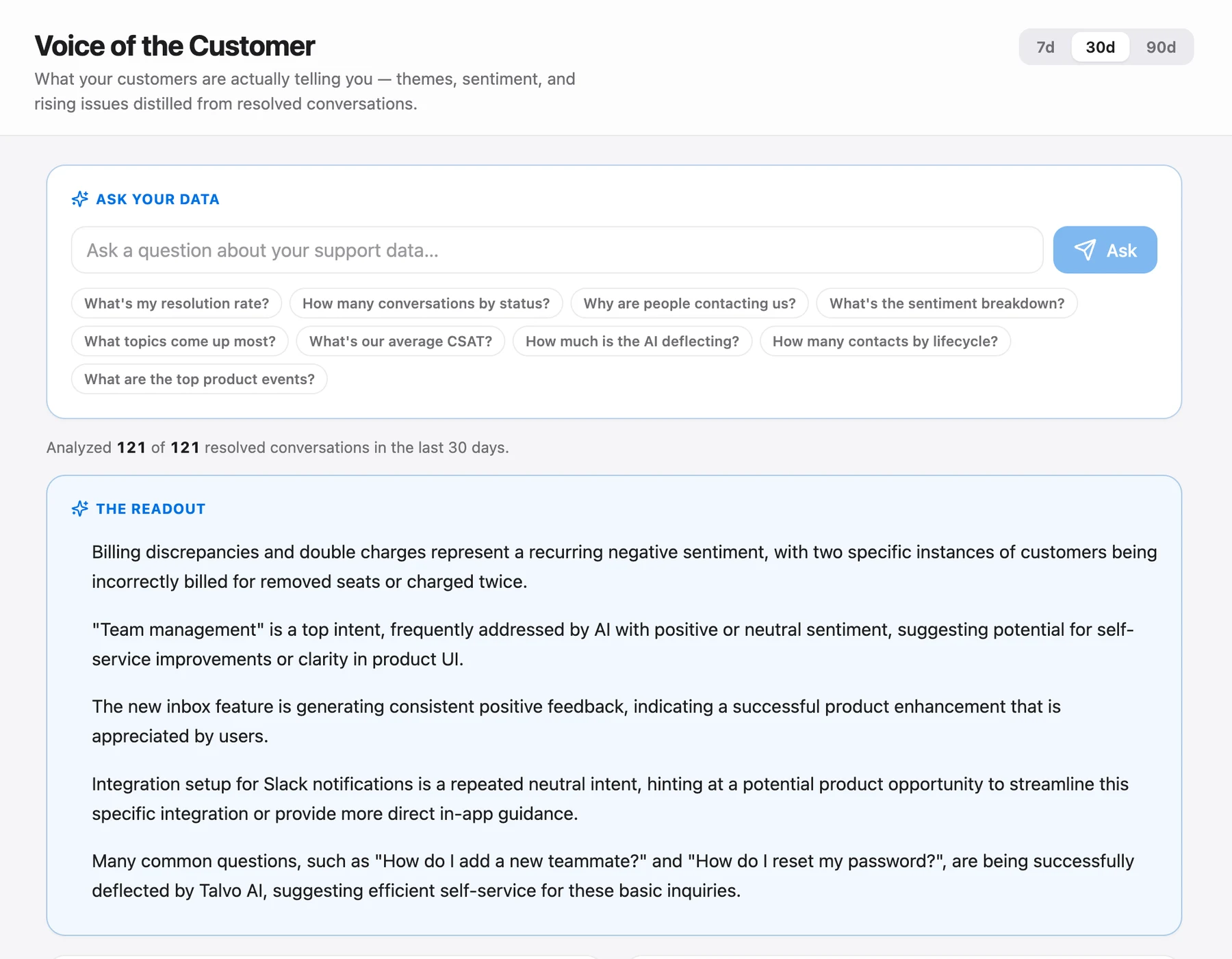
Know what it is not. It's not emailed or scheduled. Nothing arrives in anyone's inbox on the first of the month, so a person still has to open the page and write the report. It reads resolved conversations only, so open or snoozed ones won't count. And "Ask your data" isn't free-form analytics: it runs a fixed set of queries, such as resolution rate, sentiment breakdown, top topics and average CSAT, and mostly looks at all-time data rather than the window you picked. Typing a question outside that set gets a polite refusal.
That makes the Scale page a strong first pass for Week 2 rather than a replacement for it. Read the readout, then read the conversations behind the themes it names. See the help article on the Voice-of-Customer digest, which also covers Ask your data, or the feature overview.
Frequently asked questions
What is a voice of customer program?
It is a repeatable routine for collecting what customers say, finding the themes, deciding what to do and telling customers what changed. For a small team it can be one owner, three sources and a one-page monthly report. The point is the routine, not the software.
How do you start a voice of customer program?
Name one owner, agree on 8 to 12 conversation tags with a one-line definition each, and start tagging while you reply. In the first month, read about 30 random conversations plus every low rating, pick three themes to act on, and write them on one page. Review that page at the start of the next month.
What are examples of voice of customer data?
Support conversations, comments attached to CSAT ratings, NPS comments, feature requests and votes on a public board, cancellation reasons, and interview notes. A small team can get most of the value from the first three without buying anything new.
Can support tickets be used for voice of customer?
Yes, and for a small team they are usually the best source because customers write in their own words about a real problem. The limits are that you only hear from people who contact you, and counts from a small sample are rough. Pair them with ratings, board requests and the occasional interview.
How often should you report voice of customer insights?
Monthly works for most small teams: frequent enough to catch trends, infrequent enough that the report gets read. Keep it to one page and include a line reviewing what you promised last month. Talvo's Voice of Customer page is computed when you open it and is not emailed or scheduled, so someone has to write the report.
Who should own voice of the customer?
One named person, typically the support lead or a founder in a team of five. They don't have to do all the reading, but they are responsible for the monthly page happening and for assigning each action an owner and a date.
What is the difference between VoC and NPS?
NPS is a single score from a single question, how likely you are to recommend. Voice of customer is everything customers tell you, measured or not, and an NPS comment can be one input. A program that only reports the score loses the reasons behind it.
How many customer interviews do you need?
There is no number that fits every team, and figures measured on other products may not transfer to yours. A practical rule is to keep interviewing until the last two or three calls teach you nothing new.
Sources
Other products' prices and features change. We checked these pages; if something is out of date, tell us and we'll fix it.