On this page
A four-person shop answering 1,500 chats a month, with the AI handling 900 of them, pays roughly $85 to $160 a month on Crisp. On Tidio the same month costs about $829. Same team, same traffic, and a bill roughly five to ten times bigger on one side. That spread is why "Tidio vs Crisp" is a pricing question first, and the reason is in what each company chooses to count.
Tidio counts three separate things and bills each one. Crisp counts almost nothing: it charges a flat price per workspace, and the only variable meter is AI. This post explains both models using the vendors' own definitions, prices three small teams on each, compares the AI agents (Lyro and Hugo), channels, ecommerce fit and privacy, and adds a short section on a third option, because we make one. Everything about Tidio and Crisp comes from their pricing and help pages as listed on October 21, 2026. For the full plan grids, we link to our Tidio pricing and Crisp pricing breakdowns instead of repeating them.
Which one for which shop
| Your situation | Lean toward |
|---|---|
| Lots of human-answered chats, a team of 2 to 4 | Crisp. Conversations are unlimited, and Mini is $45 for four seats |
| A Shopify store that wants the assistant to act on orders | Tidio. Native Shopify actions start on its Growth plan |
| WhatsApp, Instagram or SMS in the inbox | Check Crisp's Essentials ($95) against Tidio carefully; the plans split these differently |
| More than 4 people on a small budget | Tidio gives 10 seats on every self-serve plan; on Crisp the fifth person moves you to $95 |
| Your AI volume is high and you want it predictable | Neither; see the third option near the end |
| EU data hosting matters | Crisp |
Three meters against one flat price
Tidio sells three products, each metered on its own. Customer service is priced by billable conversations, which means any chat, ticket, email or social conversation that includes a message from a human agent. Unanswered visitor messages don't count, and neither do replies from Lyro or its Flows automations. Lyro, the AI agent, is an add-on priced by AI conversations. Flows, the visual automation builder, is an add-on priced by visitors reached. All plans include 10 seats on self-serve, and the plan ladder runs from Free (50 billable conversations) to Starter ($29 monthly, $24.17 annual, 100 conversations) to Growth (from $59, or $49.17 annual, for 250 conversations up to $349 for 2,000) to Plus and Premium through sales.
Crisp prices the workspace. Free has 2 seats; Mini is $45 for 4; Essentials is $95 for 10; Plus is $295 for 20, with $10 per extra agent beyond 20. Mini can't add seats at all, so the fifth person means Essentials, and the eleventh means Plus. Conversations are unlimited on every plan. The one thing that varies is AI, which runs on dollar-denominated credits, $5 a month on Mini, $25 on Essentials and $75 on Plus, that are consumed by token use.
- 10 seats on Free, Starter and Growth
- A Free plan with all the social channels and 50 human conversations
- Native Shopify actions (order lookup and edits) from Growth
- Three meters, and a fourth if you remove Tidio branding ($20 monthly)
- Human replies hard-stop when the conversation quota runs out
- Monthly plans auto-upgrade a quota at 95% by default
- Flat per workspace, unlimited conversations, no per-chat fee
- Mini at $45 covers four people answering email and chat
- EU-hosted, with a DPA, from a French company
- Seat steps are hard: 4, then 10, then 20
- AI credits can run out mid-month and Hugo simply stops, unless pay-as-you-go is on
- No SOC 2 audit, no published SSO or HIPAA
The same shops priced on both
Three shops. Shop one has 2 agents and 300 conversations a month, with the AI handling 30% on its own. Shop two has 4 agents and 1,500 conversations, with the AI handling 60%. Shop three has 8 agents and 3,000 conversations, also 60%. Everything the AI doesn't handle gets a human reply. Those splits are our assumptions, not vendor data, and we left out add-ons, branding removal and tax.
| Shop | AI conversations | Human conversations |
|---|---|---|
| 1: 2 agents, 300 total, 30% AI | 90 | 210 |
| 2: 4 agents, 1,500 total, 60% AI | 900 | 600 |
| 3: 8 agents, 3,000 total, 60% AI | 1,800 | 1,200 |
On Tidio you need a Growth tier that covers the human conversations and a Lyro tier that covers the AI ones. Shop two: 600 human conversations is the 600 Growth tier, $129 a month ($107.50 annual). 900 Lyro conversations rounds up to the 1,000 tier, $700 ($583.33 annual). Total $829 monthly, or $690.83 annual. Shop one: the 250 Growth tier ($59, or $49.17) plus the 100 Lyro tier ($75, or $62.50) is $134 monthly or $111.67 annual. Tidio's free 50 Lyro conversations are a one-time lifetime allowance, so we didn't deduct them.
On Crisp the seat count picks the plan, and AI usage fills in the rest. Crisp's own help article estimates a full Hugo-handled conversation at $0.05 to $0.10 in credits, and calls that only an estimate. It doesn't publish the pay-as-you-go rate after your credits run out, so we assume the same per-conversation cost. Shop two on Mini: 900 × $0.05 to $0.10 is $45 to $90, less $5 included, so $40 to $85 on top of $45, or $85 to $130. On Essentials: $45 to $90, less $25 included, is $20 to $65 on top of $95, or $115 to $160.
| Shop | Tidio (Growth + Lyro), monthly | Tidio, annual per month | Crisp Mini | Crisp Essentials |
|---|---|---|---|---|
| 1: 2 agents, 90 AI | $134 | $111.67 | $45 to $49 | $95 |
| 2: 4 agents, 900 AI | $829 | $690.83 | $85 to $130 | $115 to $160 |
| 3: 8 agents, 1,200 human, 1,800 AI | About $1,509 (illustrative) | not sold self-serve | not available (4 seats) | $160 to $250 |
Shop three needs two caveats. Eight agents rules out Mini, so it's Essentials: $95 plus $90 to $180 of AI, less $25 included. On Tidio, 1,200 human conversations is the 1,500 tier at $249, but 1,800 Lyro conversations is beyond the largest self-serve Lyro tier (1,000), so the price becomes a conversation with Plus or Premium sales. The $1,509 figure assumes Lyro stayed at its self-serve rate of about $0.70 a conversation, so 1,800 × $0.70 = $1,260 plus $249. That's an illustration, not a quote.
Crisp Mini deserves a warning even in shop one. According to Crisp's comparison table, Mini has Hugo but not AI knowledge training, a help center or the no-code workflow builder; those start on Essentials. If the AI needs to learn from your articles, price Essentials, not Mini.
Lyro and Hugo bill different things
Lyro counts a conversation once it contains at least one reply from the AI. The pricing page says a customer who leaves the chat window and returns still counts as a single conversation. Tidio's own help center says something different: a thread closes after 15 minutes of inactivity, and a new message from the same visitor starts a new thread that counts against your quota again. The two pages disagree, so watch your first month's count. A free plan gives 50 Lyro conversations, once, and when they're gone Lyro stops. Paid Lyro quotas run from $39 for 50 conversations to $700 for 1,000, about $0.70 each at the top. Handing off immediately doesn't count.
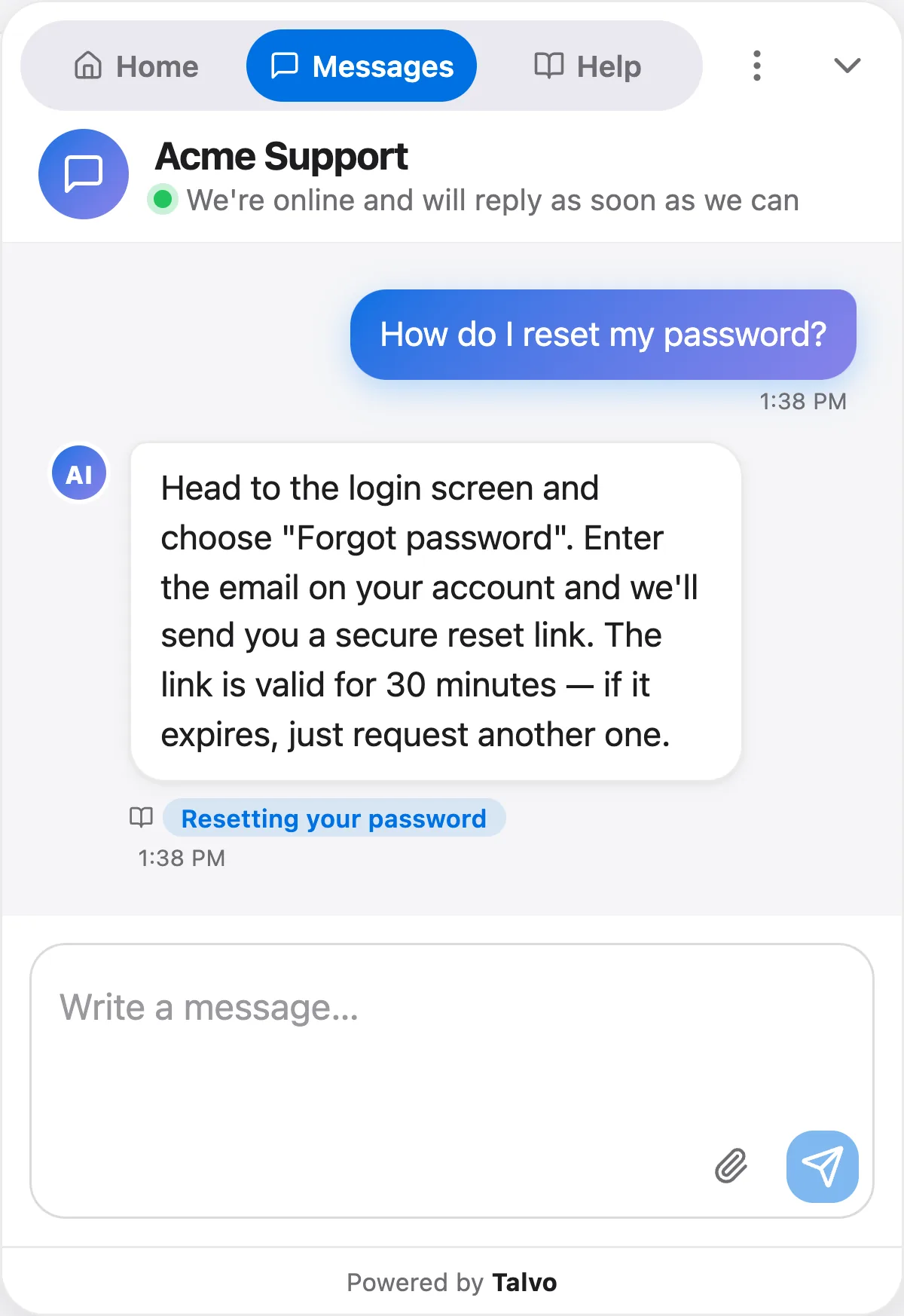
Hugo is included from Mini upward, paid out of the monthly credits, and billed on usage rather than on whether the customer was helped. A conversation runs from the first AI-handled message until it is resolved, routed or escalated, so a chat that ends in a handoff still consumes credits. When the credits are gone and pay-as-you-go is off, Hugo stops answering and new conversations go to humans. Testing and Playground use consume credits too, which matters during a 14-day trial.
Neither company's resolution-rate marketing comes with a method we can check, so we don't quote any. Test both on your own questions. The honest summary: Lyro gets a simpler mental model (a quota you buy), but the quota tiers escalate quickly. Hugo's credits are cheaper per conversation by Crisp's estimate, with a rate you can't fully see once you exceed them.
Channels by plan
Tidio includes live chat, email, Messenger, Instagram and WhatsApp on every plan, with live video calls on Free, and custom channels from Plus. Its pricing page doesn't list SMS or voice.
Crisp splits channels across its ladder. The chat widget and contact form are on every plan. Email, Telegram, Messenger and X (Twitter) start at Mini. Instagram, SMS, Viber, Line, WhatsApp Business and phone start at Essentials. Crisp also caps each workspace at one connected account of each of Instagram, Messenger, WhatsApp, Viber, Line and Telegram, with more available through higher limits whose price isn't published.
So the shop that wants WhatsApp has an odd choice. Tidio includes it from the Free plan, but you pay for human conversations by the tier. Crisp needs Essentials at $95 but charges nothing per conversation. Where human chat volume is high, Crisp usually wins even with the jump. Where it's low and WhatsApp is the main channel, Tidio can be cheaper.
Shopify, WooCommerce and WordPress
Tidio's Shopify app is on every plan, and native Shopify actions, such as looking up and editing orders, arrive on Growth. WordPress and other ecommerce integrations are prominent on its integrations page. Crisp lists WordPress, Shopify, WooCommerce, Adobe Commerce and PrestaShop on all plans, including Free, but its pricing page doesn't spell out which order actions its AI can take, or on which plan. If you want the assistant to change an order, test that on each before paying.
Privacy and data location
Crisp is a French company, hosts data on European servers on every plan, offers a DPA and two-factor authentication, and says it hasn't been through a SOC 2 audit. It lists no SSO or HIPAA on any plan.
Tidio says it has completed a SOC 2 examination (it doesn't state the type), and lists GDPR and CCPA compliance, encryption in transit and at rest, and two-factor authentication. It hosts on AWS, and its security page doesn't name a region. SSO is Premium only, and HIPAA isn't mentioned. For an EU-only data requirement, Crisp's position is clearer. For a procurement team asking about SOC 2, Tidio's statement is the only one of the two, but ask for the report.
A third option for AI-heavy small teams: Talvo
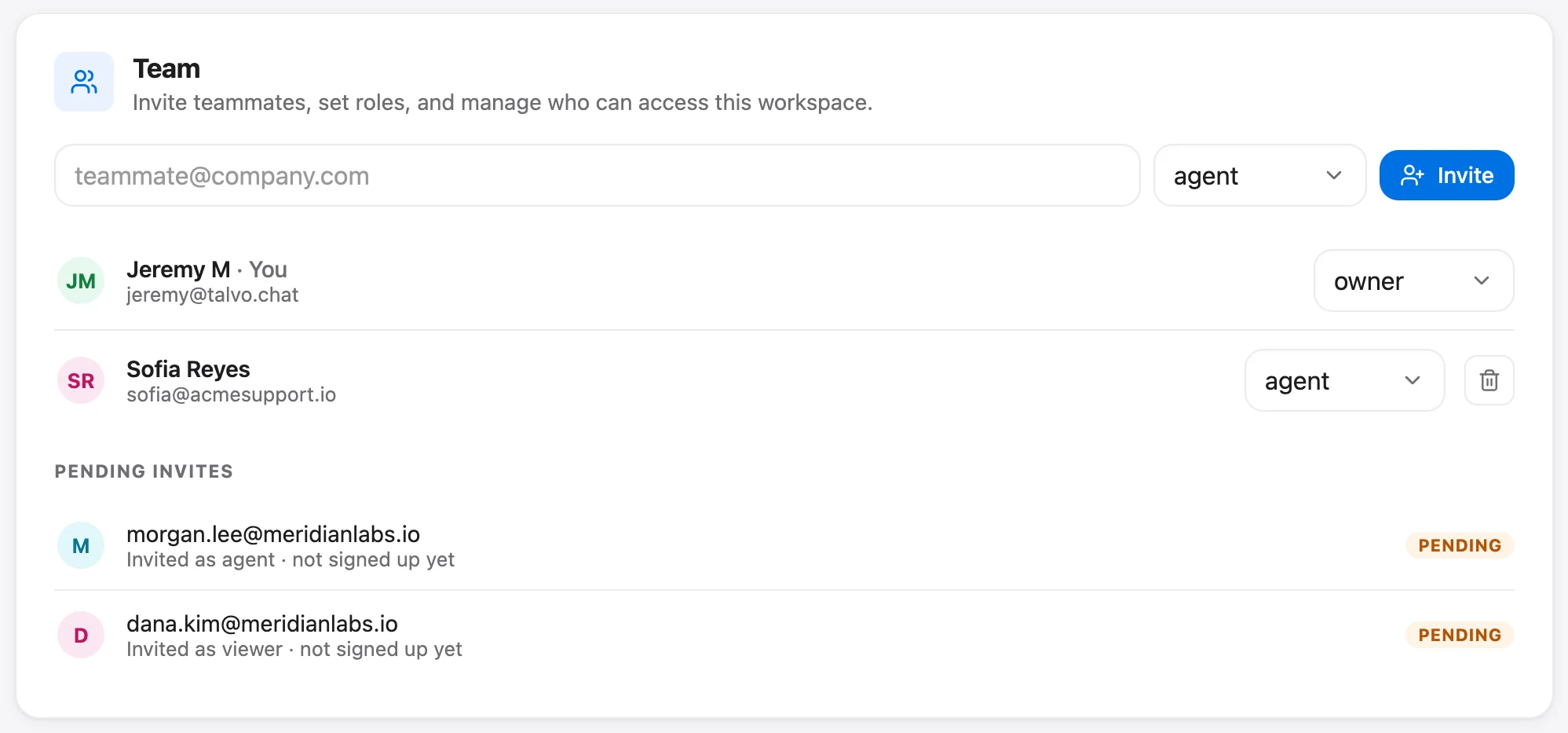
Both of these companies make AI the variable cost, one with tiered quotas and the other with token credits. Talvo, which we make, prices the workspace like Crisp but sells AI as a fixed count of resolutions: Starter is $49 a month ($39 annual) for 5 teammates and 100 resolutions, Growth is $149 ($119) for 15 and 500, Scale is $299 ($249) for 25 and 2,000, and extras are $0.49 each. A resolution is a conversation the AI answered from your published help articles with no teammate stepping in. A hand-off to a human isn't billed.
For the three shops, with AI conversations treated as resolutions (90, 900 and 1,800), we take the plan with the lowest total among those with enough teammate seats, overage included, for each billing mode. Shop one, 2 teammates: Starter is $49 monthly or $39 annual, with 90 under the 100 included. Shop two, 4 teammates: Starter would be $49 + 800 × $0.49 = $441, Growth $149 + 400 × $0.49 = $345, and Scale $299, so Scale wins at $299 monthly; annually it's $249. Shop three, 8 teammates: Growth is $149 + 1,300 × $0.49 = $786, so Scale wins again at $299 monthly or $249 annual.
| Shop | Talvo monthly | Talvo annual per month |
|---|---|---|
| 1: 2 teammates, 90 resolutions | $49 (Starter) | $39 |
| 2: 4 teammates, 900 resolutions | $299 (Scale) | $249 |
| 3: 8 teammates, 1,800 resolutions | $299 (Scale) | $249 |
That makes Talvo about the same as Crisp Mini in shop one, more expensive than Crisp's estimate in shops two and three, and far below Tidio in both. It's not a bargain for a small shop with modest AI use, and the shop-two comparison with Crisp is the honest warning: Crisp's per-conversation estimate is lower than $0.49. Where Talvo gets interesting is predictability, because the bill can only move in $0.49 steps past a count you can see.
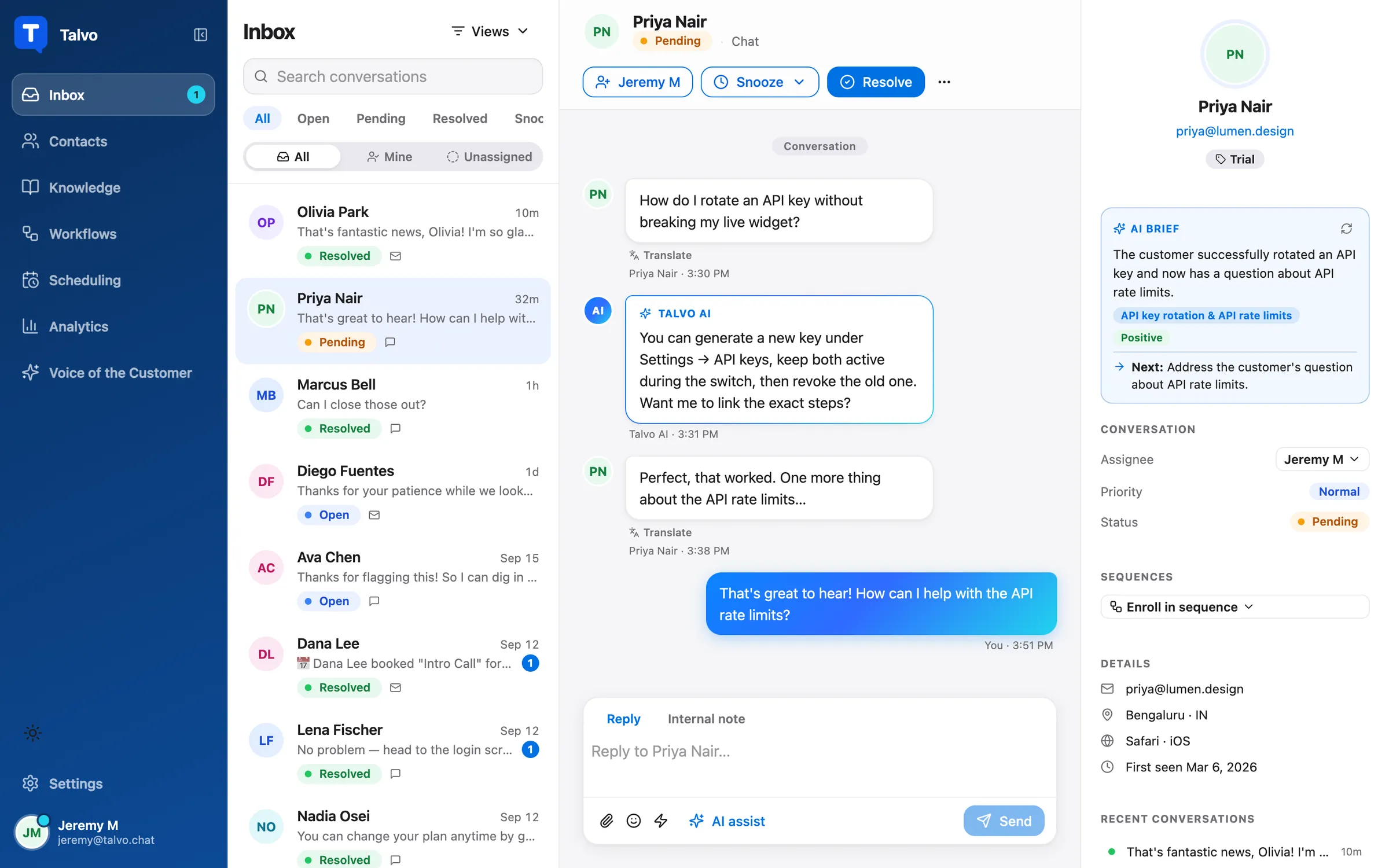
What it lacks is the point of this comparison. There's no WhatsApp, SMS, Instagram or Messenger, all of which Tidio and Crisp offer, and no Shopify or WooCommerce integration. Data is processed in the United States with no region choice, there's no SOC 2 report, and Free has 2 teammates against Tidio's 10. It's in beta, with no reviews yet. Integrations today are a REST API, webhooks and Slack. Our one-to-one comparisons are Talvo vs Tidio and Talvo vs Crisp, and the idea behind flat plans is in per-seat vs flat pricing.
Before you choose
- Count how many people answer customers each week, and compare to 4, 10 and 20 on Crisp, and 10 on Tidio
- Estimate human-answered chats separately from AI-answered chats; Tidio bills both, Crisp bills only the AI
- List the channels you need and match them to Crisp's Mini or Essentials split
- Check whether Tidio's monthly auto-upgrade at 95% is on, and decide if you want it
- On Crisp, decide whether to turn on pay-as-you-go for Hugo and set a billing limit
- Confirm where your customer data must be hosted
For other shortlists, Tidio alternatives, Crisp alternatives and best live chat software for small business price more tools, and Crisp vs Intercom follows the same format against a different rival.
Frequently asked questions
Is Crisp cheaper than Tidio?
For most small teams with a lot of human-answered chat, yes. Crisp charges a flat $45 for 4 seats on Mini with unlimited conversations, while Tidio's Starter caps at 100 human-replied conversations. Crisp loses ground when you need more than 4 people, channels like WhatsApp and Instagram (Essentials, $95), or heavy AI use.
Do Tidio and Crisp have free plans, and what are the limits?
Yes, both. Tidio Free includes 50 billable conversations a month, 10 seats, 50 lifetime Lyro AI conversations and 100 Flows visitors. Crisp Free includes 2 seats and 100 customer profiles, with no email channel, no AI agent and no AI credits.
What counts as a billable conversation in Tidio?
A chat, ticket, email or social conversation that includes at least one message from a human agent. Unanswered visitor messages and replies from Lyro or Flows don't count. Lyro conversations and Flows visitors are billed separately.
How do Crisp AI credits work, and what happens when they run out?
Hugo runs on dollar-denominated credits included monthly: $5 on Mini, $25 on Essentials and $75 on Plus. Crisp estimates a full Hugo conversation at $0.05 to $0.10. If credits run out and pay-as-you-go is off, Hugo stops answering and conversations go to your team.
Lyro vs Hugo: which AI agent is better?
We can't rank them, because neither vendor publishes a resolution rate with a method we can check. They bill differently: Lyro by AI conversation, in quotas from 50 to 1,000, and Hugo by token usage against monthly credits. Test each on your own questions before choosing.
Which is better for Shopify?
Tidio, if you want the assistant to act on orders: it has a Shopify app on every plan and native Shopify actions such as order lookup and edits from Growth. Crisp lists Shopify, WooCommerce, Adobe Commerce and PrestaShop integrations on every plan, but its pricing page doesn't spell out which order actions its AI can take.
Does Crisp's Mini plan include WhatsApp or Instagram?
No. Per Crisp's comparison table, Instagram, SMS, Viber, Line, WhatsApp Business and phone start on Essentials at $95. Mini includes the chat widget, email, Telegram, Messenger and X.
How many agents can I add on each?
Tidio allows up to 10 agents on self-serve plans; more requires Plus. Crisp includes 2 on Free, 4 on Mini with no add-ons, 10 on Essentials and 20 on Plus, with $10 per extra agent beyond 20.
Sources
Other products' prices and features change. We checked these pages; if something is out of date, tell us and we'll fix it.