On this page
In February 2024 a British Columbia tribunal ordered Air Canada to pay a customer $812.02 because of something its website chatbot told a customer about bereavement fares. The amount is small. The reason the case spread is the argument the airline made, and how the tribunal answered it.
This guide summarizes Moffatt v. Air Canada, 2024 BCCRT 149, using the decision's own paragraphs, then turns it into a checklist a small support team can run. We make a support product, so we say at the end what ours does and doesn't cover. One thing first: this is not legal advice. It's a reading of one decision by someone who isn't your lawyer.
What happened, in five dated lines
The facts below come from the Civil Resolution Tribunal's decision, published on the tribunal's own decision database. Paragraph numbers are in brackets so you can check each one.
| Date | What happened |
|---|---|
| November 11, 2022 | Mr. Moffatt's grandmother died in Ontario. That day Mr. Moffatt used Air Canada's website to book Vancouver to Toronto travel (para 13). |
| Around the booking | Air Canada's chatbot said, in part, that a ticket could be submitted for a reduced bereavement rate "within 90 days of the date your ticket was issued" (para 15). The chatbot's reply linked to a "Bereavement travel" page that said the policy doesn't apply after travel is completed (paras 16 and 17). |
| November 11 and 16, 2022 | Mr. Moffatt booked the outbound flight for $794.98 and the return for $845.38, relying on the chatbot (para 18). |
| November 17, 2022 | Mr. Moffatt first applied for the reduced fare, inside the 90 days the chatbot had given (para 20). |
| February 8, 2023 | An Air Canada representative admitted the chatbot had provided "misleading words" and said Air Canada had noted the issue so it could update the chatbot (para 22). |
| February 14, 2024 | The tribunal, in Small Claims, decided the case. Tribunal Member Christopher C. Rivers wrote the decision. |
So there were two statements from the same website, and they disagreed. The airline's refusal to honor the chatbot's version is what Mr. Moffatt took to the tribunal.
"The chatbot did it" did not work
Air Canada's defense, as the tribunal read it, amounted to saying the chatbot was a separate legal entity responsible for its own actions. The tribunal's answer in paragraph 27 is the line everyone quotes. It called the argument "a remarkable submission", said a chatbot "is still just a part of Air Canada's website", and said Air Canada is responsible for all the information on that website. It made no difference, the tribunal said, whether the information comes from a static page or a chatbot.
The reasoning around that line is ordinary. The tribunal treated the claim as negligent misrepresentation (paras 24 and 25): a duty of care, a misleading statement, a failure to take reasonable care, reasonable reliance and damages. A duty of care arose from the commercial relationship between a service provider and a consumer (para 26). Air Canada "did not take reasonable care to ensure its chatbot was accurate" (para 28), and it did not explain why a customer should have to double-check one part of its website against another. The customer's reliance was reasonable, because the customer had no reason to know that one section of the webpage was accurate and another wasn't (para 29).
Air Canada also pointed to its tariff terms but didn't file them, so it hadn't proved a contractual defense, and the tribunal called it a sophisticated litigant (para 31). The tribunal drew an adverse inference and accepted $380 a direction as the bereavement fare (paras 34 to 40). The order was $812.02 in Canadian dollars, made up of $650.88 in damages, $36.14 in pre-judgment interest and $125 in tribunal fees (paras 40 to 44), payable within 14 days. Mr. Moffatt's other claims were dismissed (para 46).
What the ruling does not say
Most coverage runs past the decision here, so it's worth being exact.
It does not say what kind of chatbot this was. Paragraph 14 records that the parties implicitly agree Mr. Moffatt was not chatting with an employee and that Air Canada "did not provide any information about the nature of its chatbot". Many articles call it a generative AI system that invented a policy. The decision doesn't support that, and we won't repeat it.
It is not a court judgment on the law of the whole country. It's a small-claims tribunal decision in one Canadian province. It isn't binding precedent, and nothing in it tells you how a US or EU court would treat the same facts. Lawyers use it as an illustration, and so can you, as long as you remember what it is.
And it doesn't tell you whether a disclaimer would have changed the outcome. Air Canada relied on tariff terms it never filed (para 31). Whether a clear disclaimer on your own chat would protect you is a question for a lawyer where you operate.
The real lesson: two pages disagreed
Look again at the table. The bot said one thing. The policy page it linked to said another. That's a content problem as much as a technology problem: a company published contradictory statements and then argued that one of them didn't count.
The tribunal's reasoning in paragraphs 28 and 29 is aimed at that. The customer shouldn't have to guess which part of your site is right. A small team can fail the same way with no chatbot at all: the pricing page says 30 days, the old help article says 14, and the support agent quotes whichever one they remember. A bot just says the wrong one faster and to more people.
A checklist for small teams
Nothing here is legal protection. It's the operating discipline the case argues for.
- Answer only from published articles, so a person has read every sentence the bot can say
- Show the source with each answer, so customers and your team can see where it came from
- Keep one source of truth per policy, and delete or redirect the old versions
- Send money and policy topics (refunds, cancellations, fees, deadlines) to a person
- Offer a way to reach a person, and make the hand-off carry the whole conversation
- Review what the bot said, weekly at first, and fix the article behind each bad answer
- Keep the transcripts, so you can show what was said and when
- Fix contradictions between pages the day you find them
A few of these deserve more than a line.
Answer only from published articles. The point is to shrink what the bot can say to what you have actually approved. A bot allowed to improvise from general knowledge can say anything. A bot limited to your articles can say only what they say. That's not a guarantee of correct answers, because an article can be wrong, but it moves the error to somewhere you can find and fix it. Writing help articles for AI covers how to word policies so they can't be misread, and our guide to a knowledge base chatbot explains the mechanics.
Show sources. A cited article is an answer a customer can check, and an answer your team can trace. It also shows you quickly when a bot leans on the wrong page.
Hand off the high-stakes topics. A refund question, a deadline, or a bereavement-type exception is where a wrong answer costs real money. Don't make the bot good at these. Make it stop. Our chatbot hand-off guide has the rules and a ten-message test, including the money questions.
Review. Open a sample of AI-handled conversations once a week. You are looking for confident answers that are slightly off. AI resolution rate explains why a high number isn't proof of a correct one.
Keep policy pages current. The case turned on information that existed but was wrong or inconsistent. Put an owner and a review date on every policy article.
How Talvo's agent is built around this
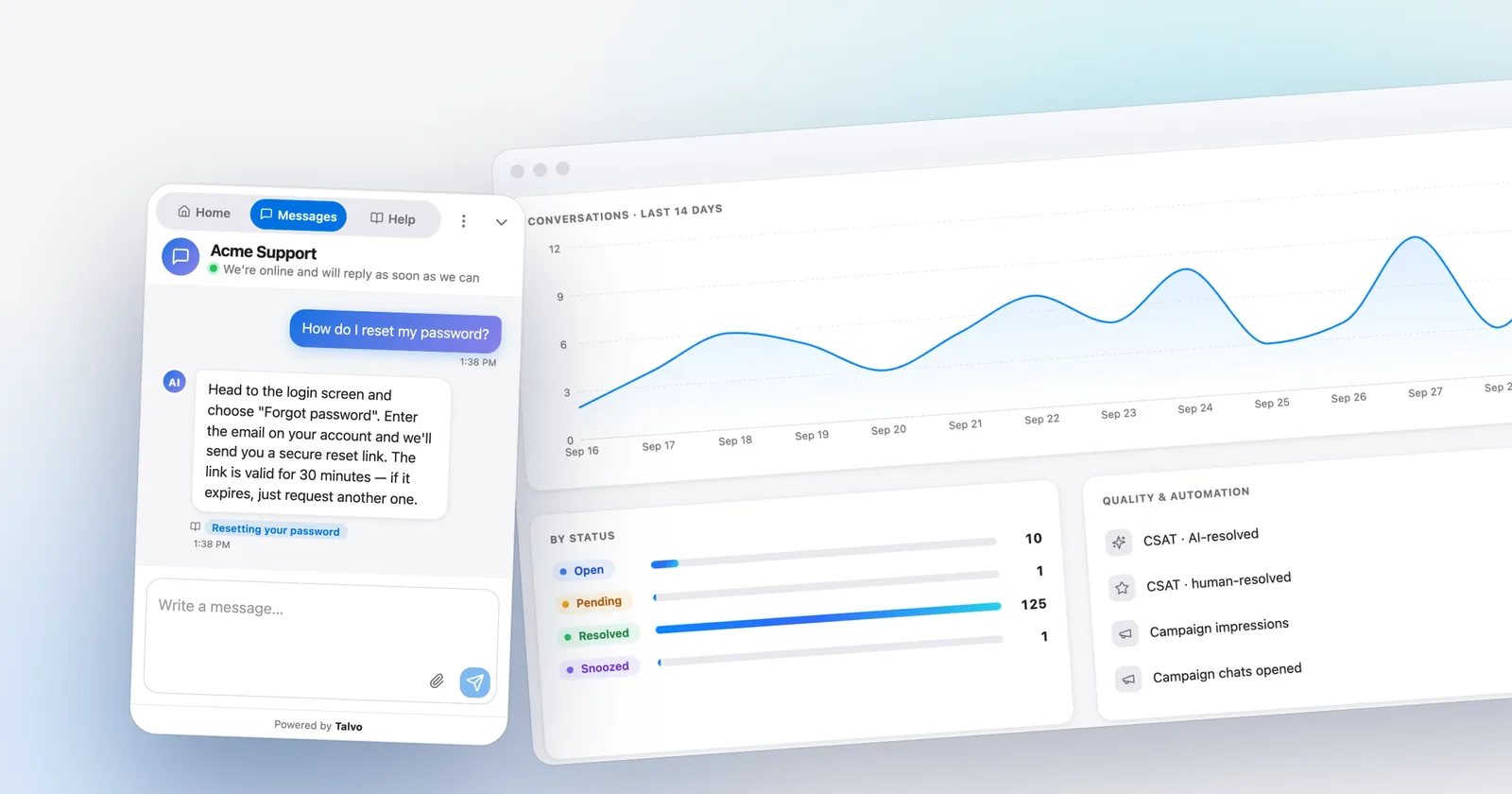
Talvo's AI agent answers only from your published knowledge base articles and shows the one it used. If the articles don't contain enough to answer, if none are published, or if the AI call fails, it hands the conversation to your team. The check is enforced in code: a reply to a real question that cites no article becomes a hand-off, and only greetings and thank-yous can go out without a citation.
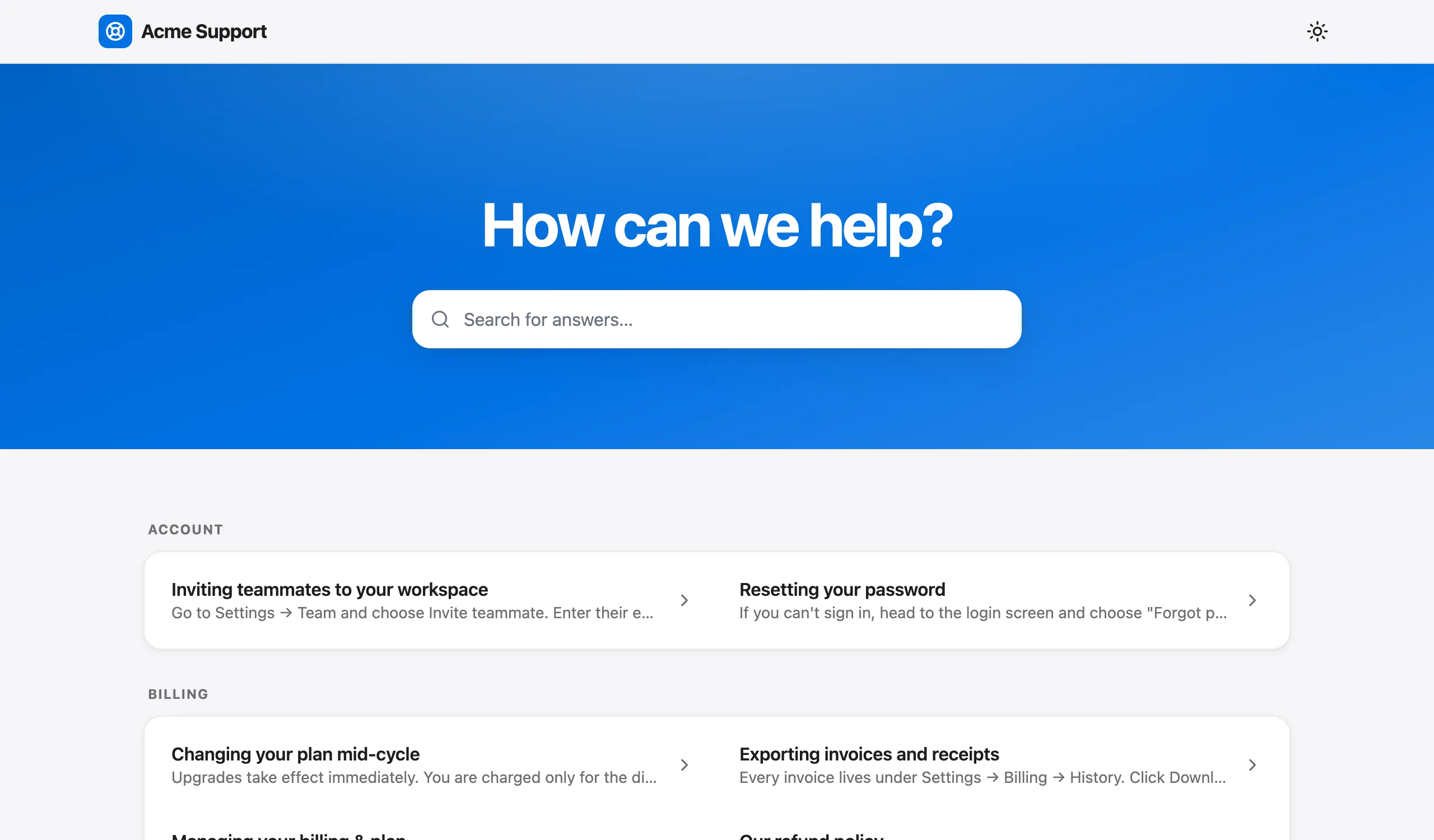
For the money topics, Settings > General > AI controls has a list called "Always hand these topics to a person". Add refund, cancel, fee or whatever your risky words are. If the customer's latest message contains one, the AI doesn't answer at all, and the team gets a note naming the topic.
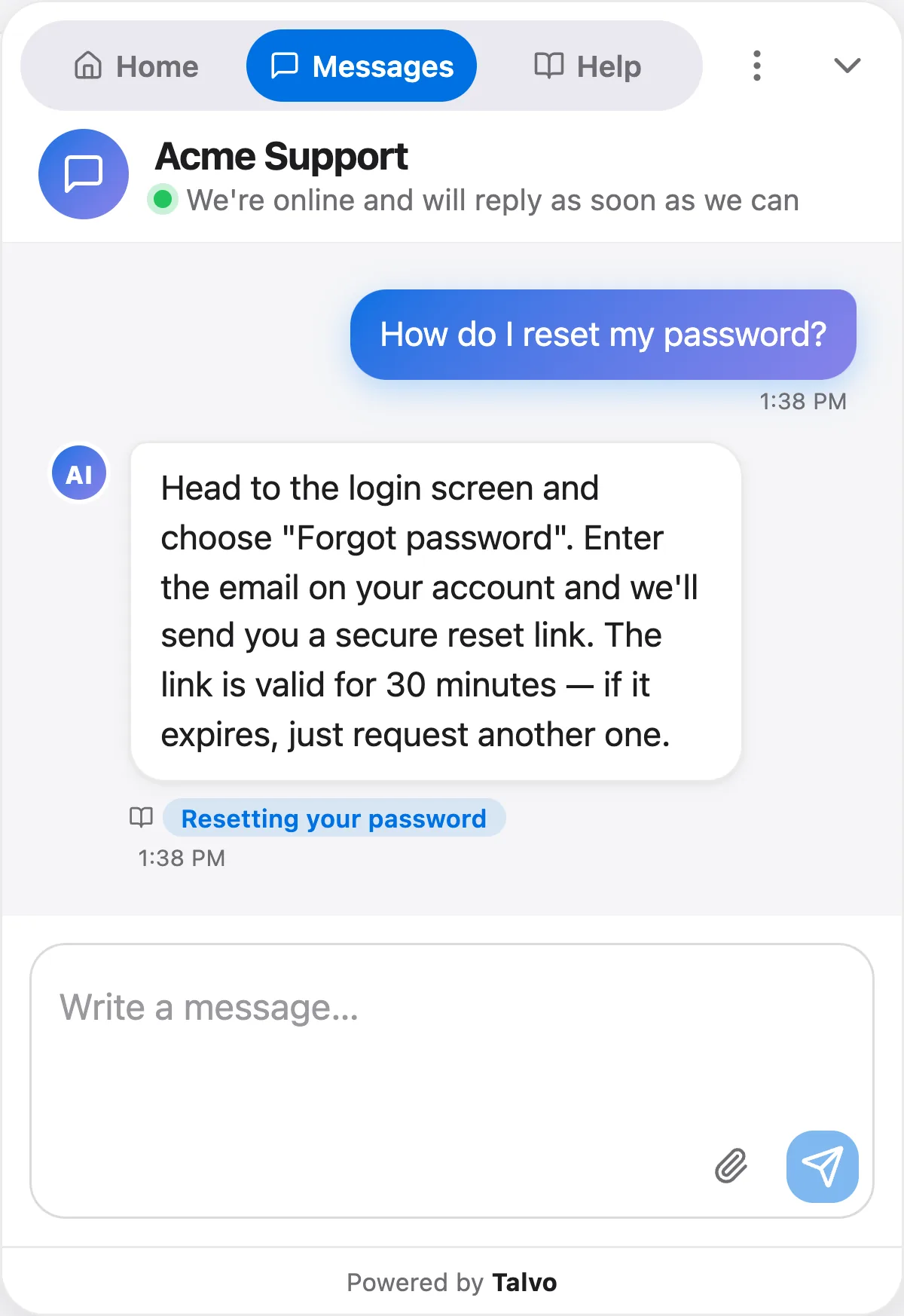
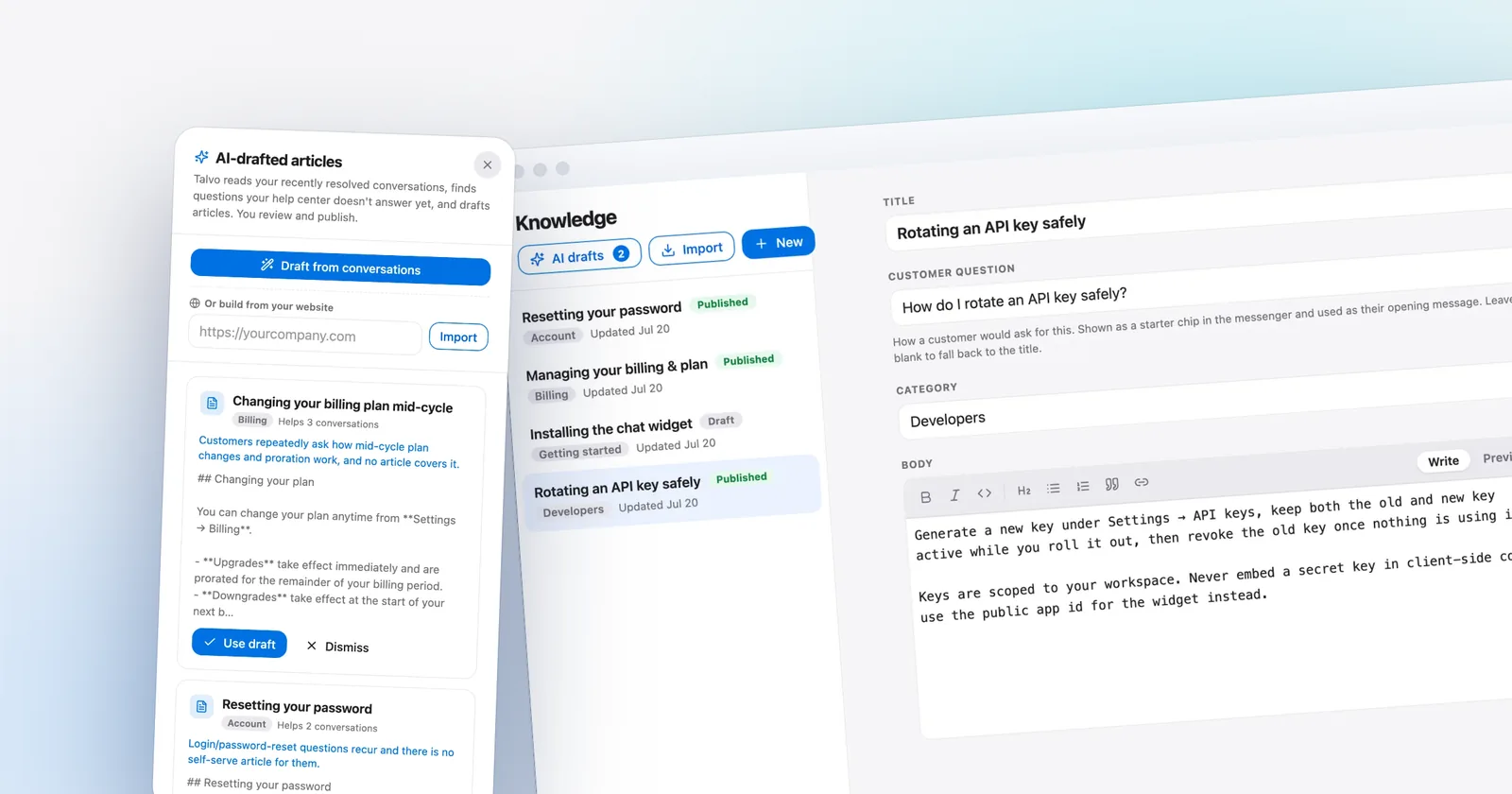
The thread stays in the shared inbox, so there's a record, with the conversation intact for whoever takes over. Under each help article, visitors can vote "Was this article helpful?", and you see views and the helpful percentage next to each article on the Knowledge page.
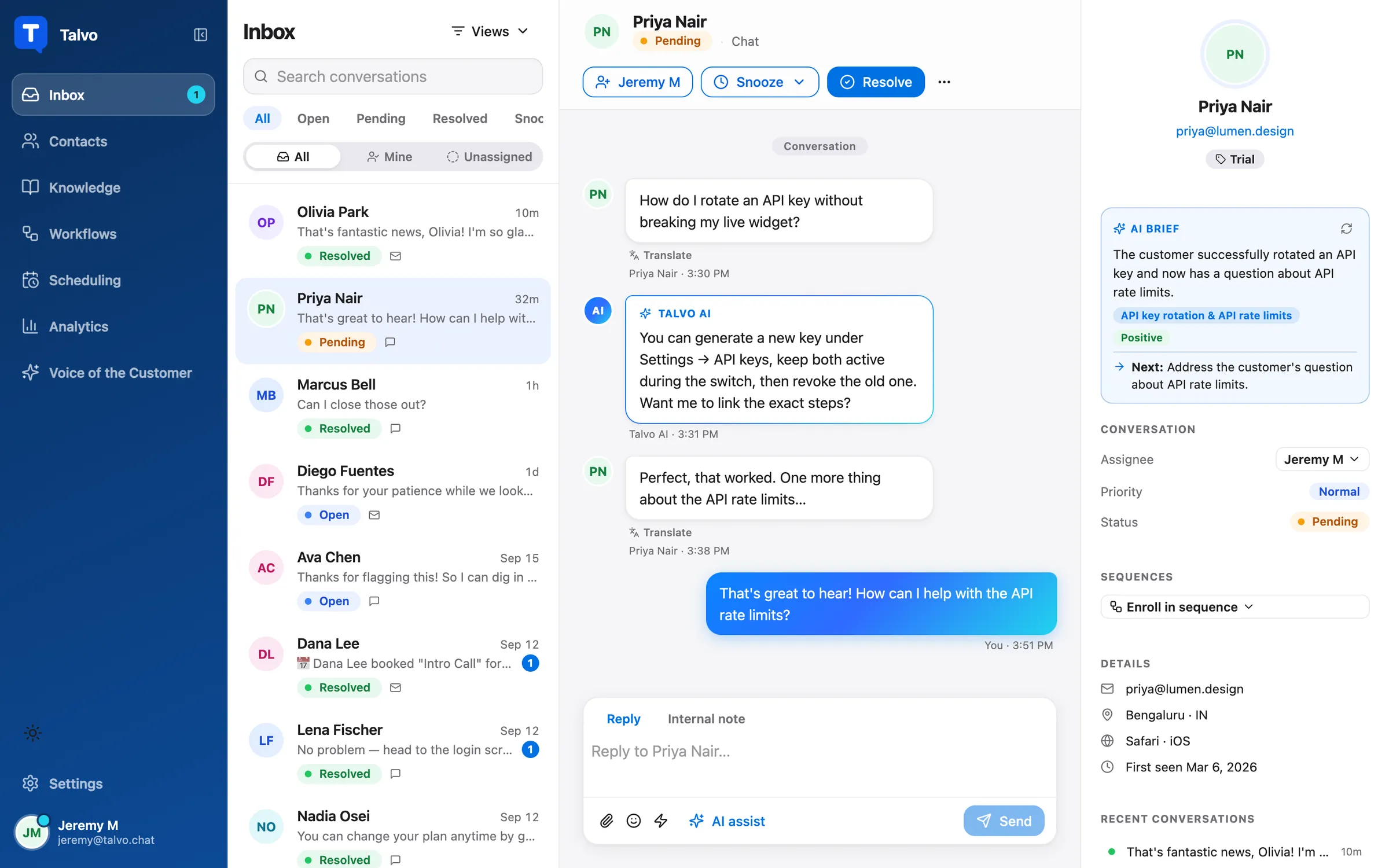
Be clear about the limits. Grounding reduces the risk of a wrong answer; it does not remove it, because an article can be wrong or out of date. The topics list is a word match on the customer's latest message, not intent detection. There is no "talk to a person" button in the widget. The AI stops after 10 replies in one chat. Talvo is new and in beta. And none of this makes you legally safe; it makes your support easier to control and to audit.
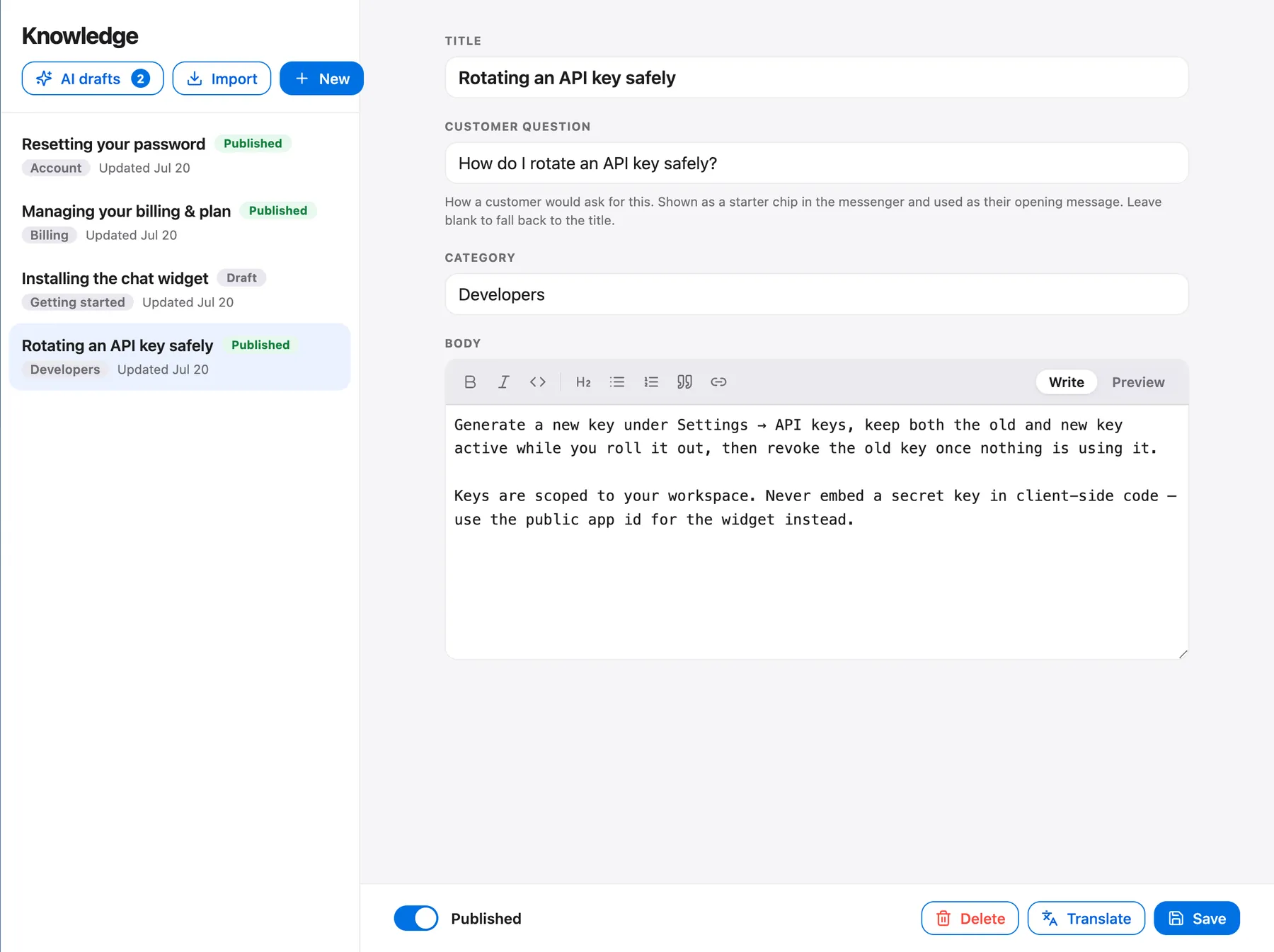
The Knowledge page is where the weekly review turns into fixes.
If you take one thing from the case, take this: your chatbot is part of your website, and customers will treat what it says as something you said. Build the support around that, and ask a lawyer about the rest.
Frequently asked questions
What happened with Air Canada's chatbot?
In November 2022 Mr. Moffatt booked flights after Air Canada's website chatbot said a reduced bereavement fare could be requested within 90 days of the ticket being issued. A linked policy page said the opposite. When Air Canada refused the reduced fare, Mr. Moffatt went to British Columbia's Civil Resolution Tribunal, which mostly allowed the claim on February 14, 2024.
Is a company liable for what its chatbot says?
In this one small-claims decision, yes: the tribunal said the chatbot was part of Air Canada's website and that Air Canada was responsible for all the information on it, whether from a static page or a chatbot. It is a decision of one Canadian tribunal, not a general rule, and it is not legal advice. Ask a lawyer where you operate.
How much did Air Canada have to pay?
The tribunal ordered $812.02 in Canadian dollars: $650.88 in damages, $36.14 in pre-judgment interest and $125 in tribunal fees, payable within 14 days. Mr. Moffatt had claimed $880.
Was the Air Canada chatbot AI?
The decision doesn't say. Paragraph 14 records that Air Canada did not provide any information about the nature of its chatbot, so claims that it was generative AI go beyond what the ruling establishes.
Can a disclaimer protect a business from chatbot errors?
The decision doesn't answer that. Air Canada relied on tariff terms it never filed, so it did not prove a contractual defense. Whether a disclaimer would help you depends on your jurisdiction and wording, which is a question for a lawyer.
Does the Air Canada ruling apply in the US?
It is a small-claims tribunal decision in British Columbia and isn't binding precedent anywhere else. It shows how one tribunal reasoned, and a US court could treat similar facts differently. Don't treat it as US law.
What is negligent misrepresentation?
The tribunal described the elements as a duty of care, an untrue or misleading representation, negligence in making it, reasonable reliance and resulting damages. It found Air Canada liable on that basis. It is a legal term, so check how it works in your own jurisdiction.
How do I stop my support bot giving wrong policy answers?
Limit it to articles you have published, show the source with each answer, keep one source of truth per policy and send money and deadline topics to a person. Then review a sample of its answers weekly and fix the article behind each bad one. This reduces the risk but cannot remove it.
Sources
Other products' prices and features change. We checked these pages; if something is out of date, tell us and we'll fix it.