On this page
- How much does an AI chatbot cost a month? The short answer
- Five meters, one question: what did the customer ask?
- Pricing your own volume in four steps
- What a standalone bot doesn't include
- The same job on a help desk with the AI built in
- Talvo at the same volumes
- Is there a free AI chatbot?
- Building your own
- Keeping the bill predictable
- Which one fits
- Frequently asked questions
How much does an AI chatbot cost? Put 1,000 customer conversations a month through six products and the monthly bill runs from $59 to $700. That is a twelvefold spread for what looks like the same job.
The gap is mostly not about quality. It comes from what each vendor counts and bills: message credits, messages, queries, conversations or resolutions. A $59 plan that includes no way to reach a human is not the same purchase as a $150 plan that does.
This guide is for people who haven't bought a help desk yet and are pricing an AI chatbot for a website. It converts every vendor's billing unit into a monthly bill at two volumes, prices what each cheap plan leaves out, and shows where a help desk with built-in AI lands. We make Talvo, which is one of the options, so we say where it costs more. Competitor figures come from each vendor's own pricing or docs pages, checked October 21, 2026, and details the vendors don't confirm are marked as unverified.
How much does an AI chatbot cost a month? The short answer
Here is the whole comparison in one table, then the rules behind it. Every figure is the cheapest published path that covers the volume. The assumption is ours, not any vendor's: each conversation has 4 bot replies, so 1,000 conversations means 4,000 replies and 3,000 means 12,000.
| Product | 1,000 conversations a month | 3,000 conversations a month | Human hand-off in that price? |
|---|---|---|---|
| SiteGPT (mini model) | $59 monthly, $39 annual | $177 monthly, $117 annual | No. Needs the Growth plan |
| Botsonic (assuming 1 reply = 1 message) | $74 monthly, $65.83 annual | $249 monthly, $240.83 annual | No. Zendesk hand-off is +$199 |
| Chatbase (1-credit model) | $150 monthly, $120 annual | $470 monthly, $400 annual | Yes, from the Standard plan |
| Chatbase (2-credit model) | $310 monthly, $280 annual | $860 monthly, $760 annual | Yes |
| CustomGPT.ai | $499 monthly, $449 annual | $1,624 monthly, $1,463 annual | No native hand-off listed |
| Tidio Lyro, standalone | $700 monthly, $583.33 annual | Not priceable from public pages | Into your existing help desk |
| Fin on an existing help desk (60% assumption) | $594 | $1,782 | Into your existing help desk |
A few notes on reading it. Annual figures are the per-month equivalent. Botsonic's figures rest on two unverified points: that one bot reply uses one "message", a unit Botsonic doesn't define, and that you buy a single add-on size, since its pages don't say whether two sizes can be combined. CustomGPT's annual figure at 3,000 uses a $338 annual add-on rate from its 2025 docs (the pricing page shows only the $375 monthly rate), so treat it as less certain. Tidio's annual figure is derived from its "2 months free" offer ($700 × 10 ÷ 12), not displayed on the page. And the Fin line excludes the cost of the help desk it runs on.
That is the standalone-bot half of the market. The other half, a help desk with the AI built in, is priced per resolution and shown further down, with Talvo as the worked example.
Five meters, one question: what did the customer ask?
A chatbot bill is a count of something multiplied by a price. Which something varies, and so does how fast it grows.
| Meter | Used by | What increments it | Bill grows with |
|---|---|---|---|
| Message credit | Chatbase | Each AI response, weighted by the model | Replies, times model weight |
| Message | SiteGPT, Botsonic | SiteGPT counts the question and the reply as one message. Botsonic doesn't define it | Replies |
| Query | CustomGPT.ai | Every message the agent processes | Replies, times model weight |
| Conversation | Tidio Lyro | The first Lyro reply in a conversation, however many follow | Conversations |
| Outcome or resolution | Fin, Zendesk, Talvo | A conversation the AI resolved, by each vendor's definition | Resolved conversations |
The first three meters punish chatty bots. If your visitors ask follow-ups, or your bot answers in long exchanges, every extra reply costs credit. The last two don't care how many replies it took. That is why the table above carries an assumption about replies for the credit, message and query tools and none for Lyro or Fin.
Why the model you pick changes the bill
Credit-based tools weight the model. Chatbase charges 1 credit per response on its default models, 2 on most frontier ones (it lists GPT-6.1 Sol, Claude 5.5 Sonnet, Gemini 3.1 Pro and others in that tier), 4 on GPT-5.5 and 5 on Claude 5.5 Opus. Moving from the 1-credit model to a 2-credit one takes the 1,000-conversation bill from $150 to $310, because 8,000 credits no longer fit in the 4,000 the plan includes. Chatbase also says actions multiply usage: an agent that makes two requests per reply uses double the credits.
SiteGPT works the same way with a harsher ratio: "GPT-4.1 messages are 10 times costlier than GPT-4.1-mini messages." Its 4,000-message Starter plan holds 400 GPT-4.1 messages. CustomGPT uses 2 to 3 queries per message on high-performance models, but its model selector is Enterprise only, so on Standard and Premium you don't get to make that trade.
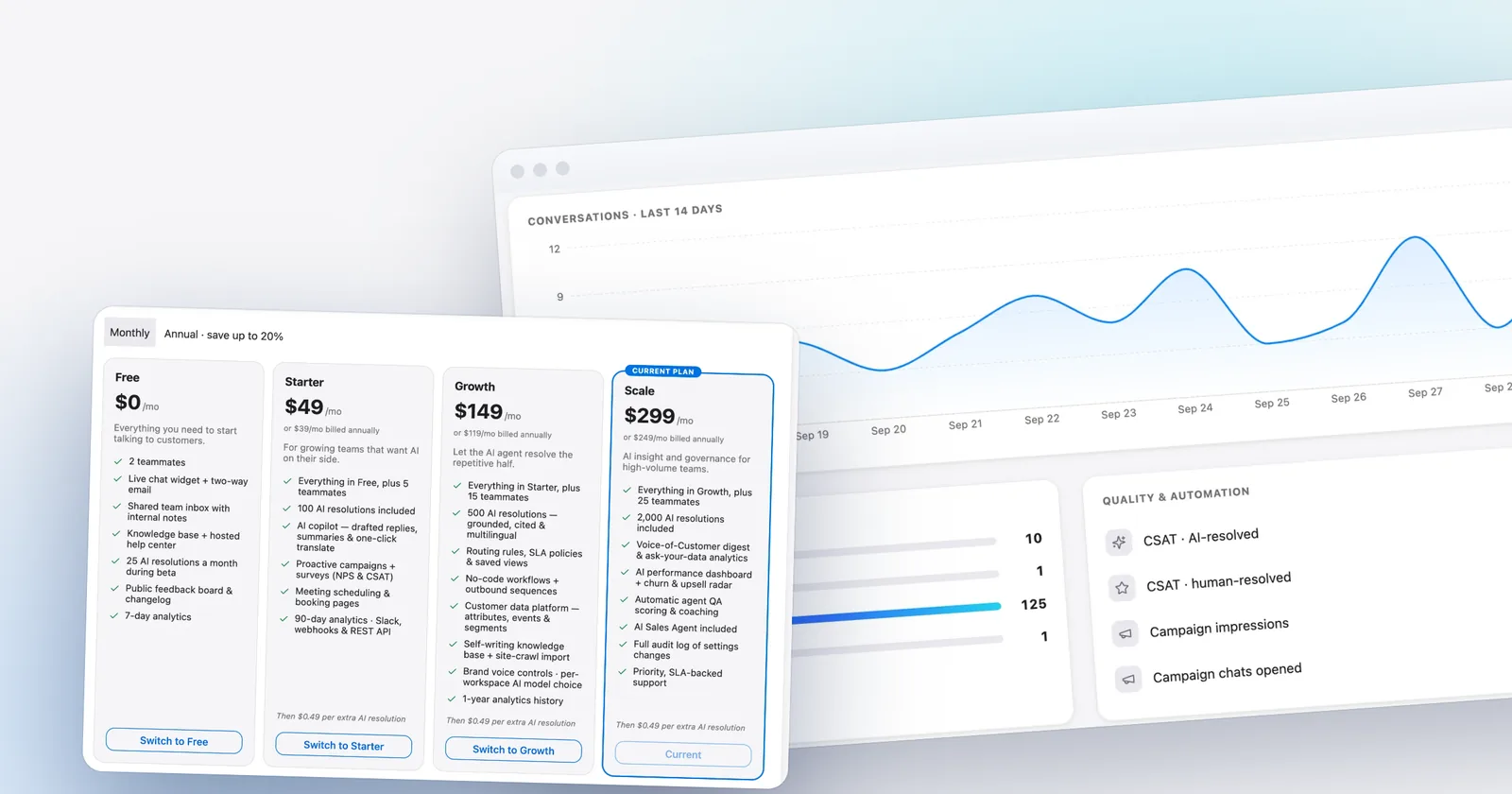
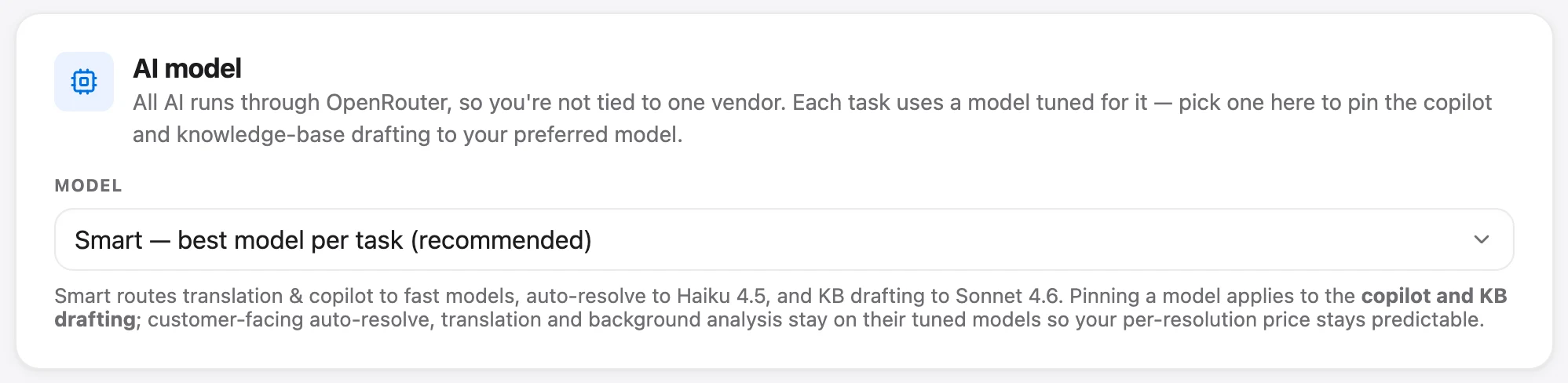
Talvo doesn't weight by model. Model usage is included in the plan. On Talvo's Growth plan ($149 a month) and up you can pin a model in Settings (see choosing your AI models), and on every paid plan the bill is $0.49 per resolution past the plan's allowance whichever one you pick.
What happens when the credits run out
Credit meters stop. When Chatbase credits run out, the agent shows "This AI Agent is currently unavailable." CustomGPT agents "stop responding to queries." Unused subscription credits don't roll over on Chatbase either: they renew on the 1st of each month.
You can top up. Chatbase auto-recharge is $40 per 1,000 credits, SiteGPT sells 5,000-message packs at $59 ($39 on yearly billing), and CustomGPT sells 2,500 extra queries at $375. Chatbase's pages don't say whether recharge is available on its cheapest plan, Hobby.
Pricing your own volume in four steps
The table at the top uses our assumptions. Yours will differ, and it takes ten minutes to redo.
- Count conversationsTake last month's chats and emails that a bot could plausibly answer, not total traffic. Some meters, like Tidio's Lyro, count any conversation the bot replied to, even a one-line question.
- Estimate replies per conversationRead twenty real transcripts and average the bot's turns. We used 4. If yours is 8, the credit, message and query tools cost roughly double what we show.
- Pick the model, then the unitCredit and query tools bill by model weight. Resolution and conversation tools don't. Note the weight before you compare prices.
- Decide the human side firstAdd whatever it costs to get a person into the conversation, whether that is a plan upgrade, an add-on or a help desk. Then compare totals.
What a standalone bot doesn't include
A chatbot answers. A support operation also needs somewhere for the unanswered ones to go. The cheapest plans in the table above are cheap partly because they stop at the answer.
The pattern across vendors is that the human side is either a higher plan, a paid add-on or somebody else's product.
| Product | Inbox and hand-off | Analytics | Branding removal |
|---|---|---|---|
| Chatbase | Native helpdesk inbox on Standard ($150 a month) and up, none on Hobby. Integrations with Zendesk, Salesforce, Intercom, HubSpot, Freshdesk, Help Scout and others on Standard and up | Basic on all plans, advanced on Pro | $1,188 a year |
| SiteGPT | From Growth ($129 a month): an iOS-app live inbox with push notifications and one-tap takeover. Zendesk AI Agent on Scale. Starter lists none | Basic on Starter, advanced (trends, knowledge gaps, CSV) on Growth | $59 a month, or $39 on yearly billing |
| Botsonic | No native live inbox on the pricing page. Zendesk ticket and live-agent hand-off is a $199 a month add-on | "Advanced AI analytics" on Enterprise only. What lower plans get is unverified | $49 a month on the pricing page, $99 in the docs. Unverified which is right |
| CustomGPT.ai | None listed. Docs show Intercom and Zendesk connections through Zapier and a connector. Any native hand-off is unverified | Basic on all plans. Standard keeps 7 days of history | Premium and up. Not sold as an add-on |
| Tidio Lyro (standalone) | Hands off into your existing help desk, such as Zendesk or Salesforce | Basic on Core | "No Tidio branding" add-on exists. Price not on the page |
Chatbase is worth singling out, because it's easy to assume a chatbot has no inbox. It has one, with live hand-off to a person, from the $150 Standard plan up. What it doesn't have is a plan below that with one.
Email is the other thing to check. SiteGPT sells AI Email Support as a separate add-on at $59 a month per inbox. Tidio's standalone Core plan lists Lyro for emails. The other vendors' pricing pages don't spell out email handling in enough detail to compare, so ask before assuming.
- Cheapest way to put an AI answer on a page, from $39 a month at 1,000 conversations
- Fine if a person already answers messages in a tool you pay for
- Some, like Chatbase, can feed into an existing help desk rather than replace it
- Hand-off, inbox, email and analytics each vary by vendor, and often cost extra
- Credit and message meters grow with replies and model choice
- On Chatbase and CustomGPT, the bot goes dark when credits run out rather than handing off
The same job on a help desk with the AI built in
If you're going to need an inbox anyway, the question changes. You're no longer asking what the bot costs. You're asking what a help desk plus a bot costs, and whether the bot meter is per message or per answer.
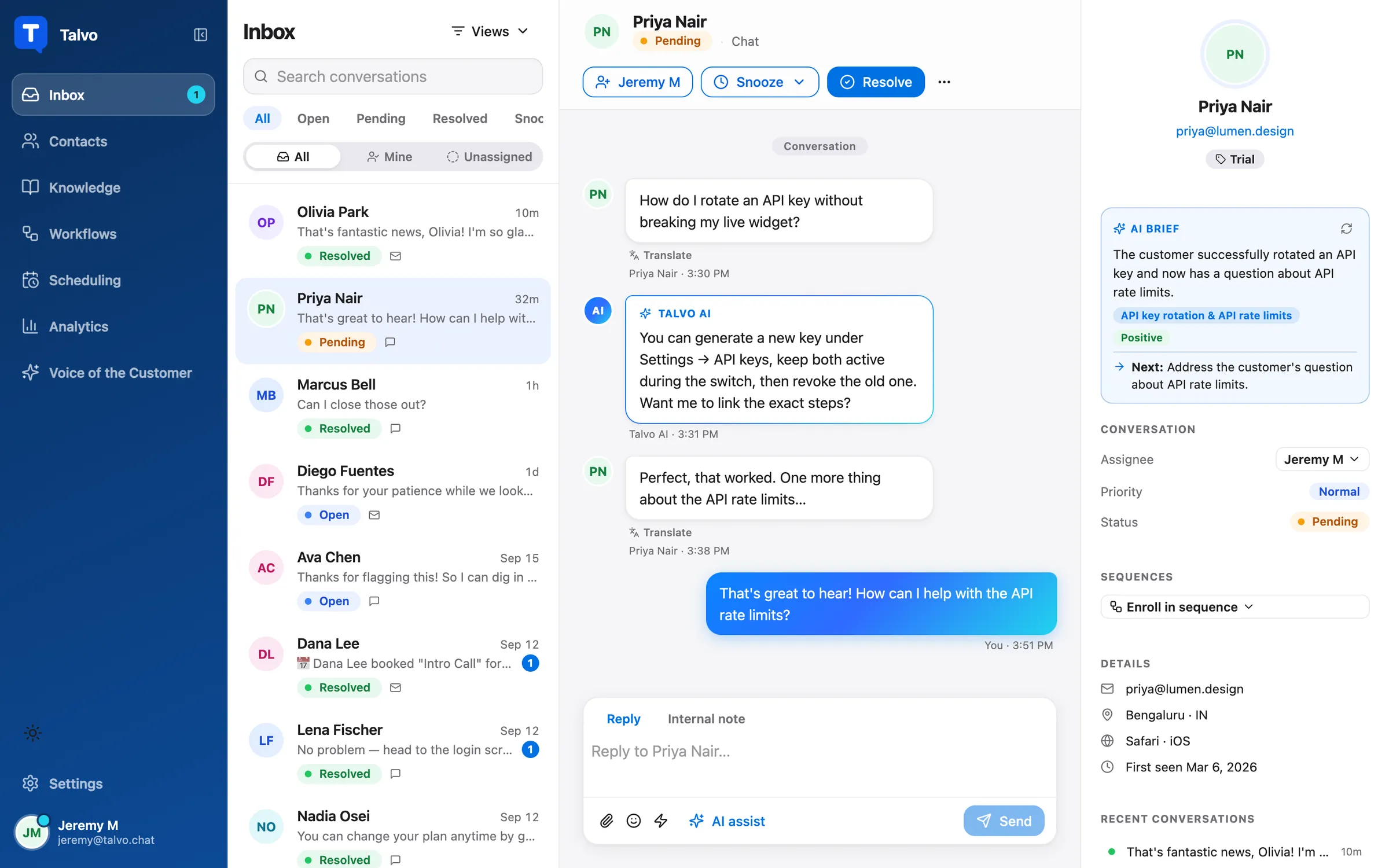
Help desks with AI mostly bill per resolution: Fin charges $0.99, Zendesk $1.50 or $2.00, and Talvo $0.49, with the inbox included in the seat or workspace price. Our AI resolution pricing guide is the rate card for those, covering ten vendors, what each counts as a resolution and the cost at four volumes. We won't rebuild it here. What matters for this comparison is that a resolution meter does not care how many replies it took, and a hand-off to your team is not billed as a resolution on Talvo.
Fin can also run on top of a help desk you already own: Salesforce, Freshdesk, HubSpot, Zendesk and others. Its page lists $0.99 per outcome with a $49 minimum that includes 50, and no seat or setup fees. At 1,000 conversations the upper bound, if every one counted, is $990. At 60% counting as outcomes, which is our assumption and the one used in our other posts, it is 600 × $0.99 = $594. At 3,000 conversations those become $2,970 and 1,800 × $0.99 = $1,782. The help desk subscription is extra, and this option is bought through Fin's sales team ("Contact sales") rather than a sign-up form. For the options around it, see Fin AI alternatives.
Zendesk's AI agents aren't sold standalone at a list price. They are included in Suite and Support plans, with additional resolutions at $1.50 committed or $2.00 pay as you go. The standalone option is Zendesk + Forethought, which is Contact Sales only, so there is no figure to put in the table.
Talvo at the same volumes
Talvo bills per resolution, not per message, so the replies assumption drops out. What matters is how many of the conversations the AI resolves end to end. We assume 60% (the same assumption used for Fin above), and show the all-resolved case alongside it so you can see the bound. A conversation the AI hands to a person is not a resolution and isn't charged.
The team is 3 teammates, which every paid plan covers (Starter allows 5, Growth 15, Scale 25). We pick the plan with the lowest total, overage included: plan price plus AI resolutions beyond the allowance at $0.49 each. The plans include 100, 500 and 2,000 resolutions.
| Conversations | AI resolutions | Lowest-total plan, monthly billing | Lowest-total plan, annual billing |
|---|---|---|---|
| 1,000 | 600 (60%) | Growth: $149 + (600 − 500) × $0.49 = $149 + $49 = $198 | Growth: $119 + $49 = $168 |
| 1,000 | 1,000 (all) | Scale: $299. Growth would be $149 + 500 × $0.49 = $394 | Scale: $249. Growth would be $119 + $245 = $364 |
| 3,000 | 1,800 (60%) | Scale: $299. Growth would be $149 + 1,300 × $0.49 = $786 | Scale: $249. Growth would be $119 + $637 = $756 |
| 3,000 | 3,000 (all) | Scale: $299 + (3,000 − 2,000) × $0.49 = $299 + $490 = $789 | Scale: $249 + $490 = $739 |
Starter is never the cheapest here: at 600 resolutions it comes to $49 + 500 × $0.49 = $294 monthly.
Compare that with the bots. At 1,000 conversations, Chatbase on its 1-credit model is $150 and cheaper than Talvo's $198, and SiteGPT or Botsonic are cheaper still, without a hand-off. At 3,000 conversations the order flips: Talvo's Scale plan at $299 undercuts Chatbase's $470, CustomGPT's $1,624 and Fin's $1,782, because Scale's 2,000 included resolutions cover all 1,800. The cheapest bots, SiteGPT at $177 and Botsonic at $249, are still cheaper than Talvo at that volume, but neither includes a way to take over a conversation. The next rung up that does, SiteGPT's Growth at $188, adds a live inbox through an iOS app.
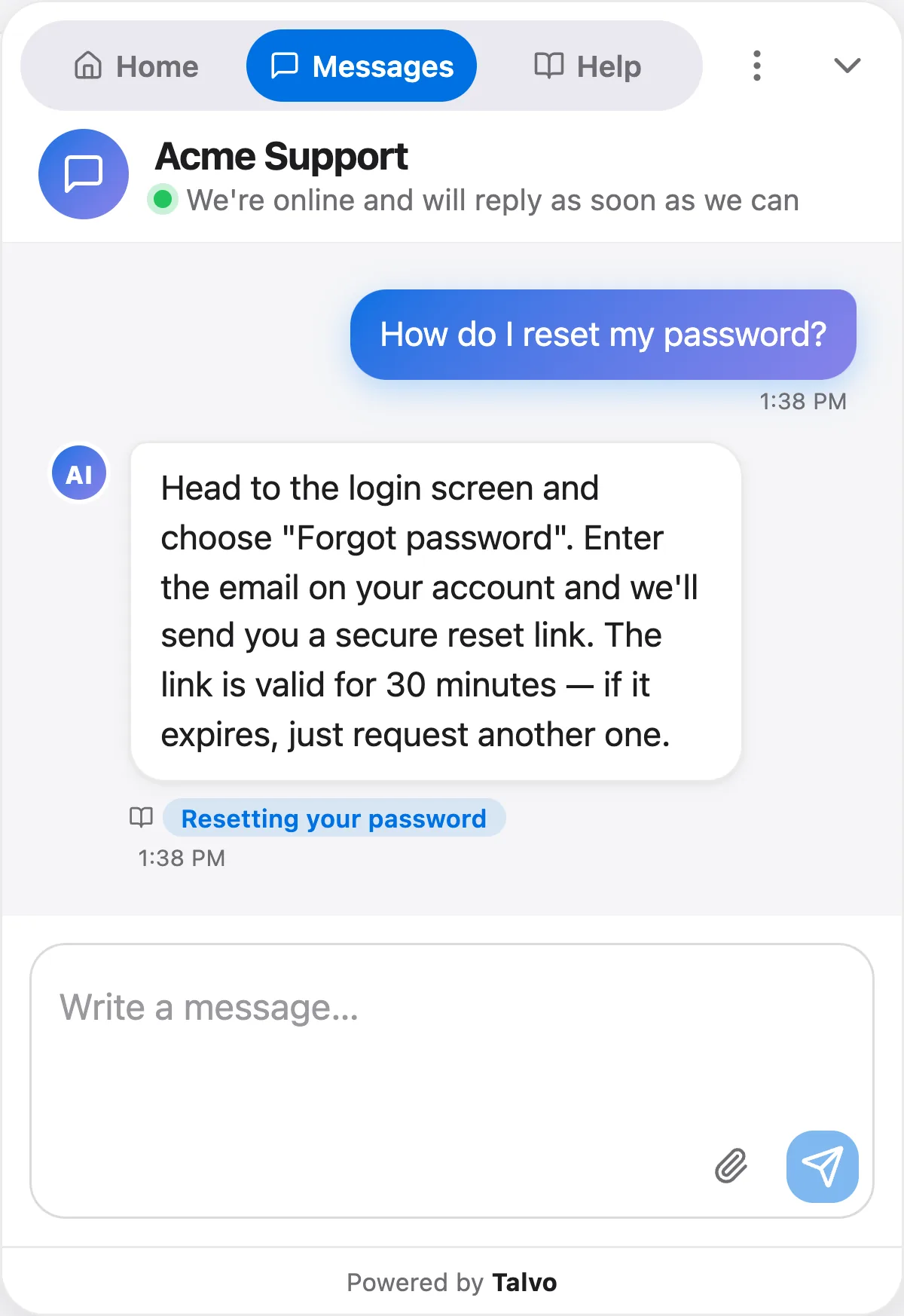
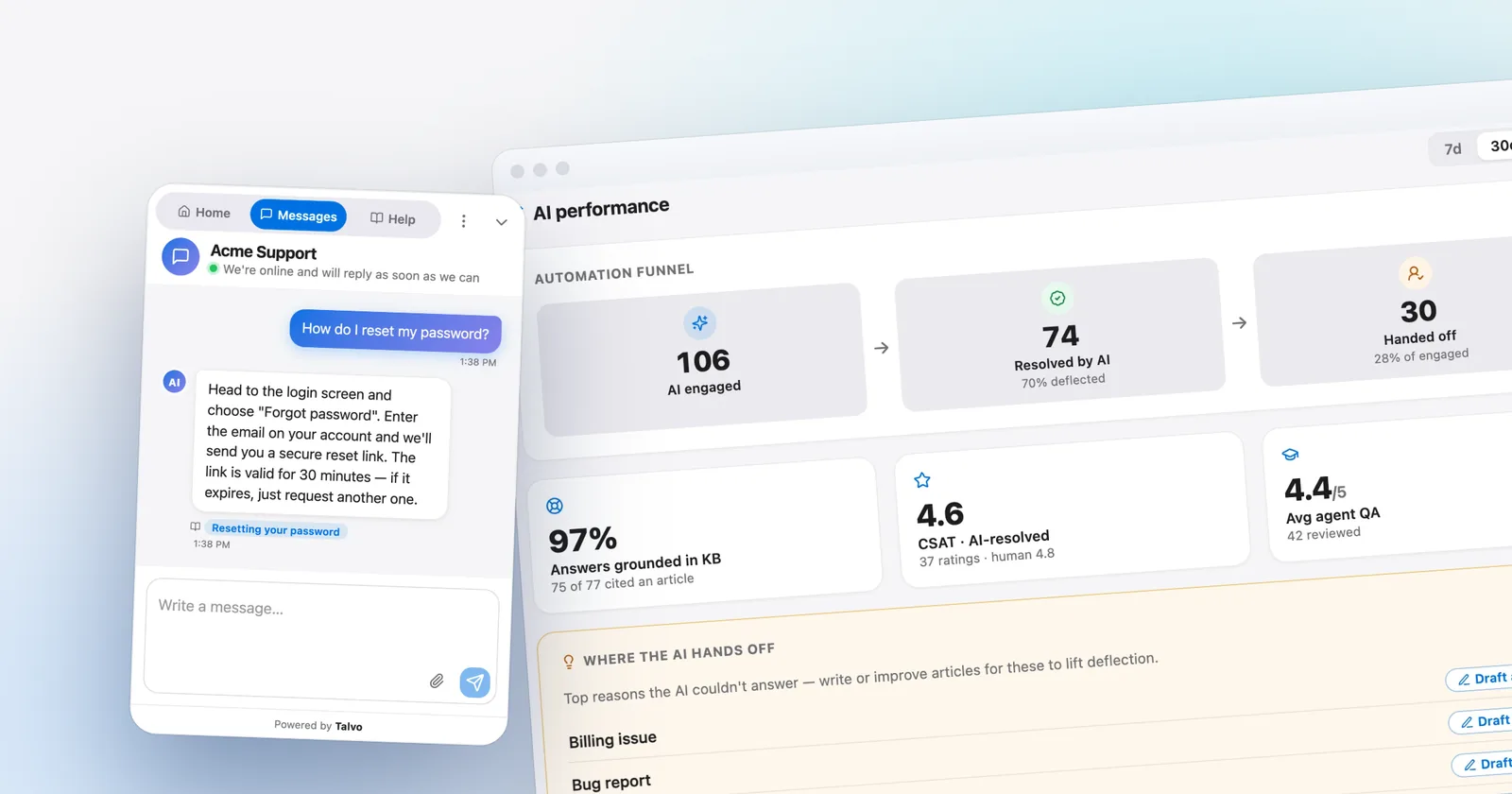
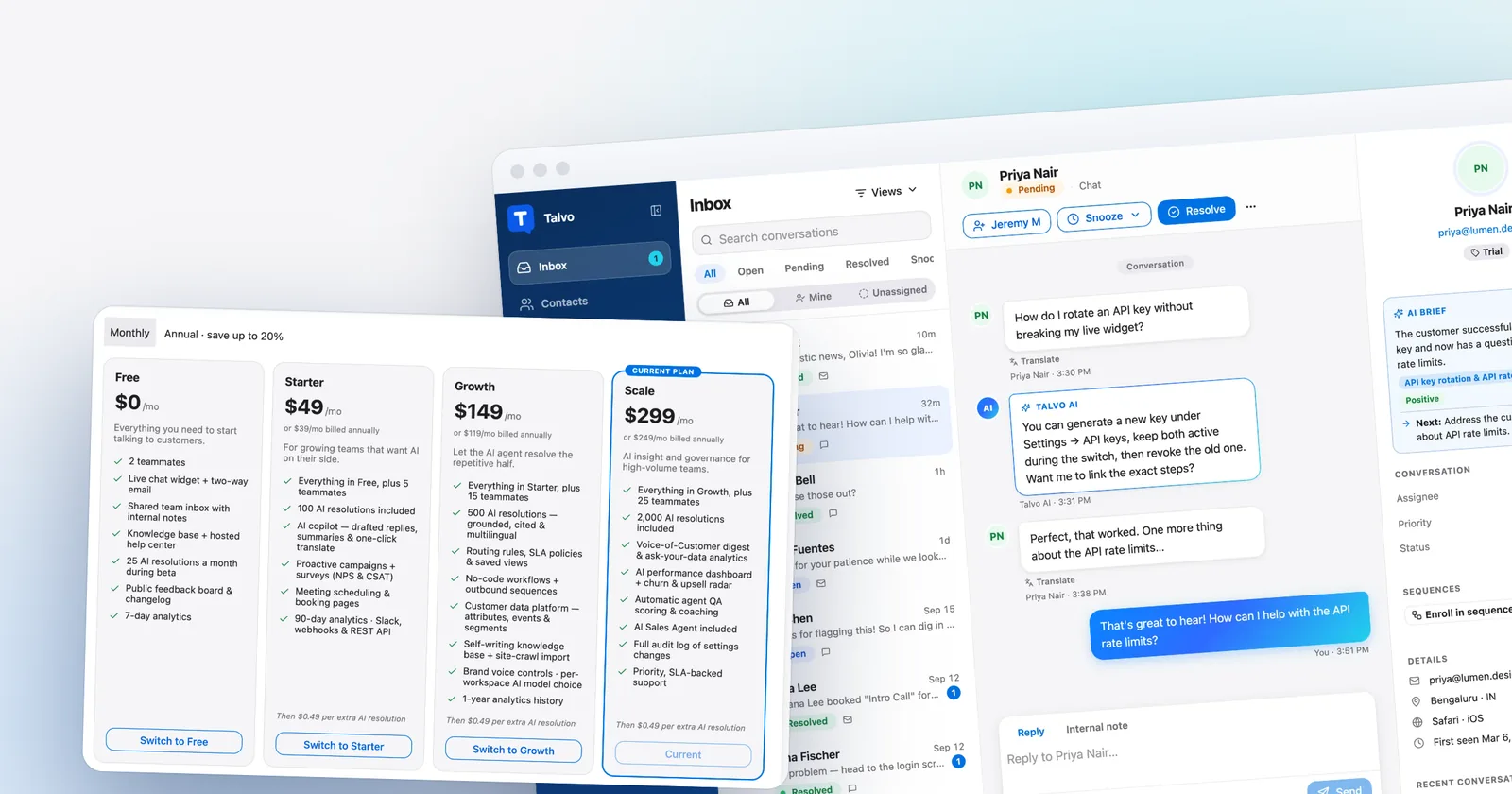
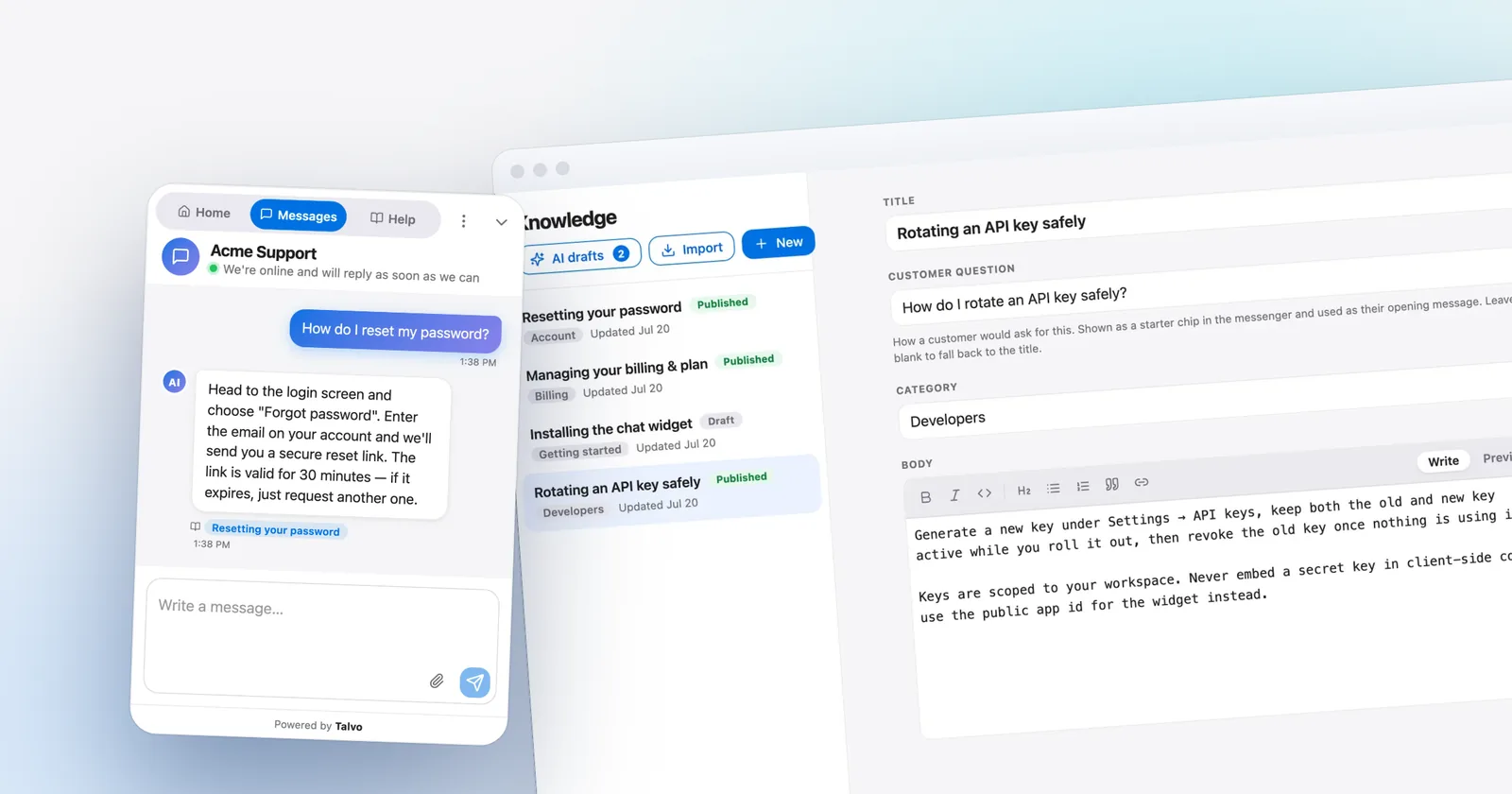
What the Talvo price buys: the chat widget, the AI agent, a shared inbox with internal notes and two-way email, a knowledge base with a hosted help center, and analytics, all in one workspace price. The AI answers only from your published articles and shows which one it used. When it isn't confident, or has no published article to answer from, it hands off with the thread intact and your team gets a push and an email.
What it doesn't buy, so you can rule it out quickly. There's no WhatsApp, SMS, Instagram or Messenger channel (Chatbase's Hobby plan lists WhatsApp, Messenger and Instagram). There's no SOC 2 report (Chatbase claims SOC 2 Type II). "Powered by Talvo" can't be removed, where Chatbase and SiteGPT will remove their branding for a fee. Integrations today are a REST API, webhooks and Slack. And Talvo is new and in beta, with no customer reviews on G2 or Capterra yet.
That is the opposite failure mode from a credit meter. A credit bot goes dark when it runs out. A resolution meter keeps working and keeps billing. Neither is wrong, but you should know which one you bought. Our support cost calculator covers the help-desk side of this math, with teammates and AI volume, though it doesn't include the standalone bots above.
Is there a free AI chatbot?
Sort of. Tidio gives every account 50 Lyro conversations once, then asks you to pay. Chatbase, SiteGPT and CustomGPT have no free plan, only a 7-day trial, and SiteGPT and CustomGPT require a credit card for it. Botsonic's 7-day trial lists no card requirement in its docs. Talvo's Free plan includes the AI agent for 25 resolutions a month during the beta, plus two teammates, the inbox, and the help center. That's a testing allowance, not a free tier for a busy site.
Building your own
A custom build is the other end of the market. Development agencies sell custom chatbot builds as projects, which is a different purchase from the subscriptions priced here. Building makes sense when your product is the chatbot, or when retrieval needs to touch data that no vendor can reach. For the usual case, a business answering questions from its own help articles, the build-versus-buy section of our knowledge base chatbot guide lays out the trade-offs, and it comes down on buying.
Keeping the bill predictable
Whichever meter you're on, the bill follows how many questions arrive and how many the AI answers. You can't control the first. You can control how often the answers are wrong.
- Ask what happens when credits or the allowance run out: goes dark, keeps billing or hands off
- Ask whether the plan includes a way for a person to take over, and where that person works
- Check whether email, analytics history and branding removal are in the plan or are add-ons
- Confirm which model the price assumes, and what a pricier model multiplies it by
- Set a calendar reminder to read the first full month's usage against your estimate
- Write help articles for your top twenty questions first, so the AI has something to cite
The last item matters more than the others. A bot that answers from your published articles, and hands off when it finds none, spends less on wrong answers. Our guides on writing help articles for AI and on the AI resolution rate go through how to write and measure that. For how Talvo decides what counts, see what counts as an AI resolution.
Which one fits
Pick a standalone bot when a person already answers customers in a tool you pay for and you want an AI answer in front of them. SiteGPT and Botsonic are the cheapest ways to do that, as long as you don't need hand-off from that same plan. Chatbase is the pick when you want a native inbox and hand-off, and can live with the plan jump to $150.
Pick a help desk with AI built in when you don't have an inbox yet. A shared inbox, email and a help center cost real money on top of a standalone bot, and at 3,000 conversations a month Talvo's Scale plan comes in below several of the bot-only totals. At 1,000, the cheaper standalone bots win: Chatbase, the cheapest one with a native inbox, is $150 against Talvo's $198. Against Chatbase, the crossover falls somewhere between 1,000 and 3,000 conversations, on our assumptions.
Pick Fin on your existing help desk when you already have one you like and don't want to move. Test its resolution rate on your own content first, because at $0.99 each, a low rate shows up on the invoice.
Frequently asked questions
How much does an AI chatbot cost per month for a small business?
On the published prices we checked on October 21, 2026, 1,000 conversations a month cost $59 on SiteGPT, about $74 on Botsonic, $150 on Chatbase, $499 on CustomGPT.ai and $700 on Tidio Lyro, assuming 4 bot replies per conversation. The cheapest plans don't include a way to hand a conversation to a person. A help desk with built-in AI such as Talvo comes to $198 a month at the same volume if 60% of conversations are resolved by the AI.
Is there a free AI chatbot for websites?
Mostly there are trials and small allowances. Tidio gives every account 50 Lyro conversations once. Chatbase, SiteGPT and CustomGPT offer 7-day trials with no free plan, and Botsonic offers a 7-day trial. Talvo's Free plan includes 25 AI resolutions a month during its beta, along with two teammates and an inbox. These are enough to test a bot, not to run a busy site.
What is a message credit?
A message credit is the unit Chatbase uses to meter AI replies. Each response consumes credits according to the model: 1 credit on its default models, 2 on many frontier models, 4 on GPT-5.5 and 5 on Claude 5.5 Opus. Credits renew monthly and unused ones don't carry over.
Why do some AI models use more credits?
Credit-based tools charge more for larger models by counting each of their replies as several credits or messages. Chatbase weights models from 1 to 5 credits per response, and SiteGPT says a GPT-4.1 message is 10 times costlier than a GPT-4.1-mini one. Switching to a pricier model can double the bill or more for the same traffic.
Do AI chatbots charge per conversation or per resolution?
Both exist, plus per message and per query. Chatbase, SiteGPT, Botsonic and CustomGPT bill per credit, message or query, which grows with replies. Tidio Lyro bills per conversation it replies to, and Fin, Zendesk and Talvo bill per resolution, at $0.99, $1.50 to $2.00, and $0.49 beyond the plan's allowance respectively.
What happens when chatbot credits run out?
On credit-based bots the agent stops. Chatbase shows "This AI Agent is currently unavailable" and CustomGPT agents stop responding to queries, until you buy more or the month renews. Per-resolution tools like Talvo keep working and keep billing past the plan's allowance, and Talvo has no AI spending cap on paid plans.
Can an AI chatbot hand off to a human?
Some can, but often only on a higher plan or through another product. Chatbase has a native helpdesk inbox with live hand-off from its $150 Standard plan up. SiteGPT adds an iOS-app live inbox from Growth, Botsonic hands off through a $199 a month Zendesk add-on, and Tidio Lyro hands off into your existing help desk. A help desk with built-in AI hands off inside its own inbox.
Is it cheaper to build or buy a chatbot?
For a team that mostly wants fewer repetitive questions, buying is almost always cheaper once you count engineering hours, and the hand-off, inbox and analytics are most of the build. Building makes sense when the chatbot is a feature of your own product or needs data no vendor can reach.
Sources
Other products' prices and features change. We checked these pages; if something is out of date, tell us and we'll fix it.
- Chatbase pricing (checked Oct 21, 2026)
- Chatbase FAQ: credits per model (checked Oct 21, 2026)
- SiteGPT pricing (checked Oct 21, 2026)
- Botsonic pricing (checked Oct 21, 2026)
- Botsonic docs: subscription plans
- CustomGPT.ai pricing (checked Oct 21, 2026)
- CustomGPT.ai docs: how usage limits work
- Tidio pricing, Lyro AI Agent only (checked Oct 21, 2026)
- Fin pricing (checked Oct 21, 2026)
- Zendesk pricing (checked Oct 21, 2026)
- Talvo pricing
- Talvo help: What counts as an AI resolution